Turkey Fans and Blowers Market Growth Rate
According to 6Wresearch internal databases and industry insights, the Turkey Fans and Blowers Market is anticipated to grow at a CAGR of 5.92% during the forecast period 2026–2032.
Turkey Fans and Blowers Market Year-wise Growth Rate and Key Drivers (2022–2032)
This graph illustrates the annual growth rates of the Turkey Fans and Blowers Market from 2022 to 2032, highlighting a steady upward trajectory and projected market expansion over the forecast period.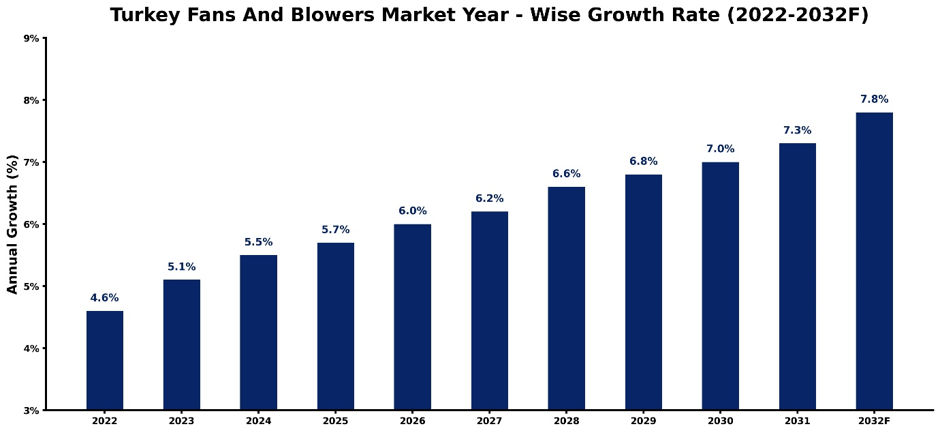
The following table summarizes the historical and forecasted growth rates of the Turkey Fans and Blowers Market, along with the rationale behind each year’s performance.
| Year | Estimated Growth (%) | Market Rationale |
| 2022 | 4.6% | Retrieval in industrial production and manufacturing output following economic stabilization. |
| 2023 | 5.1% | Rising investments in industrial facilities and warehouse construction increased ventilation equipment demand. |
| 2024 | 5.5% | Expansion of HVAC installations in commercial buildings and public infrastructure projects supported market growth. |
| 2025 | 5.7% | Higher investments in manufacturing modernization and energy-efficient ventilation systems accelerated adoption. |
| 2026 | 6% | Demand from cement, mining, food processing, and automotive industries strengthened equipment sales. |
| 2027 | 6.2% | Industrial automation and replacement of aging ventilation equipment supported market expansion. |
| 2028 | 6.6% | Growing adoption of EC motors and energy-efficient centrifugal fans boosted installations. |
| 2029 | 6.8% | Increasing investments in logistics hubs and industrial parks expanded commercial ventilation demand. |
| 2030 | 7% | Government-backed industrial development projects continued supporting equipment upgrades. |
| 2031 | 7.3% | Smart building technologies and digital HVAC monitoring increased demand for advanced blower systems. |
| 2032 | 7.8% | Sustainability initiatives and industrial efficiency programs further accelerated market growth. |
Topics Covered in the Turkey Fans and Blowers Market Report
The Turkey Fans and Blowers Market Report provide a comprehensive analysis based on Type, Application, and Distribution Channel. It offers detailed insights into market dynamics, technological developments, growth drivers, investment opportunities, competitive landscape, and high-growth segments, enabling industry participants to formulate long-term business strategies.
Turkey Fans and Blowers Market Highlights
| Report Name | Turkey Fans and Blowers Market |
| Forecast period | 2026–2032 |
| CAGR | 5.92% |
| Growing Sector | Industrial |
Turkey Fans and Blowers Market Synopsis
Turkey Fans and Blowers Market is witnessing stable growth owing to increasing industrialization, commercial construction activities, and rising investments in energy-efficient ventilation systems. Fans and blowers are mechanical devices designed to move air or gases for ventilation, cooling, combustion, dust collection, exhaust, and industrial process applications.
Moreover, rising concerns regarding workplace safety, indoor air quality, and energy-efficient industrial equipment are also supporting the Turkey fans and blowers market growth. Technological advancements, such as electronically commutated (EC) motors and variable frequency drives (VFDs), are enhancing system performance and minimizing operational costs.
Evaluation of Growth Drivers in Turkey Fans and Blowers Market (2026–2032)
Below are some major drivers and their influence on the market dynamics:
| Drivers | Primary Segment Affected | Why It Matters (Evidence) |
| Industrial manufacturing expansion | Industrial | Growing factories require efficient air handling and process ventilation systems. |
| Rising HVAC installations | Commercial | Commercial buildings increasingly adopt energy-efficient ventilation equipment. |
| Energy efficiency regulations | Centrifugal Fans & Blowers | High-efficiency fans reduce electricity consumption and operating costs. |
| Infrastructure modernization | Offline Distribution | New industrial and commercial projects increase equipment procurement. |
| Growth of food & pharmaceutical industries | Industrial | Hygienic ventilation systems are essential for production compliance. |
Turkey Fans and Blowers Market is anticipated to grow at a compound annual growth rate (CAGR) of 5.92% over the forecast period (2026–2032), owing to ongoing industrial development, infrastructure spending, and energy efficiency measures. The manufacturing sector accounts for around 24% of the Turkish economy, while the country’s industrial output has been growing moderately each year despite any economic instability. Moreover, the inflation levels in the country have been high, prompting industries to invest in energy-efficient equipment.
Additionally, the growth of country’s automotive, cement, steel, food processing, and textile industries has been creating a strong demand for industrial ventilation systems. Growing commercial construction activities, airport development, and logistics infrastructures will drive the growth of HVAC equipment and commercial ventilation systems.
Evaluation of Restraints in Turkey Fans and Blowers Market
Below are some major restraints and their influence on the market dynamics:
| Restraints | Primary Segment Affected | What This Means (Evidence) |
| Volatile steel and aluminum prices | Manufacturers | Higher raw material costs increase equipment prices. |
| High electricity prices | Industrial | Customers delay equipment replacement due to operating cost concerns. |
| Import dependence for advanced components | Commercial | Currency fluctuations increase procurement expenses. |
| Intense price competition | Offline Distribution | Lower margins affect profitability among suppliers. |
| Skilled maintenance shortage | Industrial | Limited technical expertise delays maintenance and system optimization. |
Turkey Fans and Blowers Market Challenges
Although demand remains positive, manufacturers continue facing challenges associated with volatile raw material costs, currency depreciation, and increasing energy prices. Imported motors, electronic controls, bearings, and specialty components remain exposed to exchange rate fluctuations, raising production expenses. Turkey has experienced relatively high inflation in recent years, placing additional pressure on industrial capital expenditure. While unemployment has gradually improved to around 8%, industries remain cautious regarding large-scale equipment investments. Moreover, stricter environmental regulations require manufacturers to improve energy efficiency and reduce industrial emissions, increasing research and development costs for advanced fan technologies.
Turkey Fans and Blowers Market Trends
Key trends shaping the Turkey Fans and Blowers Market are outlined below:
- Use of energy efficient centrifugal fans – Many of the industries in Turkey are replacing traditional ventilation systems with highly efficient centrifugal fans in order to save on electricity and cope with increased energy saving norms.
- Use of variable frequency drives (VFD) based fan control system – There is an increased use of the above fan control system as it helps in airflow management and saving on energy.
- Growth in automated industry – The growth in automated industries is leading to the increased demand for intelligent fans and blowers that can integrate with modern industrial control networks.
- Rising focus on workplace air quality – Increasing awareness of occupational health and safety standards is encouraging industries to invest in advanced ventilation equipment.
Investment Opportunities in the Turkey Fans and Blowers Market
Key investment prospects in the Turkey Fans and Blowers Market are presented below:
- Development of smart fan technologies – Investment in IoT-enabled fans with real-time monitoring, remote diagnostics, and predictive maintenance capabilities presents significant growth opportunities.
- Energy-efficient retrofit projects – Upgrading outdated industrial ventilation systems with modern, energy-saving fans and blowers offers strong aftermarket potential.
- Commercial HVAC expansion – The growing construction of hotels, hospitals, shopping centers, and office buildings is creating demand for advanced HVAC ventilation solutions.
- Localized component manufacturing – Developing domestic manufacturing capabilities for key components such as motors, impellers, and control systems can reduce reliance on imports.
Top Players in Turkey Fans and Blowers Market
A comprehensive list of major players operating in the Turkey Fans and Blowers Market is provided below:
1. Sodeca S.L.U.
| Company Name | Sodeca S.L.U. |
|---|---|
| Established Year | 1983 |
| Headquarters | Sant Quirze de Besora, Spain |
| Official Website | Click Here |
Sodeca specializes in industrial fans, smoke extraction systems, pressurization fans, and ventilation solutions used in industrial facilities, tunnels, parking areas, and commercial buildings.
2. Soler & Palau (S&P)
| Company Name | Soler & Palau (S&P) |
|---|---|
| Established Year | 1951 (Global) |
| Headquarters | Barcelona, Spain |
| Official Website | Click Here |
Soler & Palau (S&P) supplies a wide range of ventilation solutions, including axial fans, smoke extraction fans, jet fans, and energy-efficient ventilation equipment for residential, commercial, and industrial applications.
3. FläktGroup
| Company Name | FläktGroup |
|---|---|
| Established Year | 2016 |
| Headquarters | Herne, Germany |
| Official Website | Click Here |
FläktGroup provides advanced air movement and ventilation solutions, including fans, air handling units, HVAC systems, and indoor air quality solutions for commercial buildings, cleanrooms, and data centers.
4. Ziehl-Abegg SE
| Company Name | Ziehl-Abegg SE |
|---|---|
| Established Year | 1910 |
| Headquarters | Künzelsau, Germany |
| Official Website | Click Here |
Ziehl-Abegg supplies axial fans, centrifugal fans, and intelligent air movement solutions used in industrial ventilation, refrigeration, HVAC systems, and process applications in Turkey.
5. ebm-papst Group
| Company Name | ebm-papst Group |
|---|---|
| Established Year | 1963 |
| Headquarters | Mulfingen, Germany |
| Official Website | Click Here |
ebm-papst is a global leader in fan and motor technology, offering energy-efficient fans, blowers, EC motors, and air movement solutions for HVAC systems, industrial automation, refrigeration, and transportation applications in Turkey and worldwide.
Government Initiatives being implemented in the Turkey Fans and Blowers Market
The government of Turkey is continuing its efforts in support of modernization of industrial equipment through several programs related to energy efficiency and manufacturing development. The National Energy Efficiency Action Plan (NEEAP) promotes the substitution of ineffective industrial equipment with energy efficient technologies, including the installation of ventilation systems that provide higher energy-efficiency.
Turkey's Industry and Technology Strategy 2023 stimulate manufacturing of domestic industrial machinery through incentives and programs. Furthermore, KOSGEB provides funding for small business investments in modern manufacturing equipment, while TÜBİTAK finances research projects in such areas as industrial innovations, smart manufacturing, and energy-efficient mechanical systems. These government initiatives arouse the widespread application of the latest models of fans and blowers in manufacturing.
Future Insights of the Turkey Fans and Blowers Market
The Turkey Fans and Blowers Industry is expected to experience healthy expansion as industrial modernization, smart manufacturing, and green building development continue progressing. The country’s industrial exports continue to be a major driver of economic growth and investments in logistics infrastructure, manufacturing automation and commercial construction are anticipated to further boost equipment demand. The adoption of Industry 4.0 technologies, predictive maintenance systems and digitally connected HVAC equipment will further transform future ventilation solutions. Also, energy-efficient EC motors, intelligent airflow controls, and low-noise industrial fans are expected to become more important as industries seek to improve productivity and reduce energy consumption.
Market Segmentation Analysis
This report presents a detailed analysis of the market segments along with their leading categories.
By Type – Centrifugal Fans and Blowers Dominate the Market
According to Bhawna Singh, Assistant Manager, 6Wresearch, Centrifugal Fans and Blowers captured 58.42% of the Turkey fans and blowers market share in 2025, owing to their superior pressure generation, high airflow efficiency, and extensive deployment across cement plants, steel mills, chemical facilities, mining operations, and HVAC systems. Their ability to operate reliably under demanding industrial conditions continues to make them the preferred choice for heavy-duty ventilation and dust collection applications. The segment is projected to register a CAGR of 6.35% during 2026–2032, supported by increasing industrial automation and replacement of aging ventilation infrastructure.
By Application – Industrial Segment Maintains Market Leadership
The industrial application segment held a share of 67.22% in the Turkey Fans and Blowers Market in 2025, owing to rising manufacturing output, mining activities, petrochemical production, food processing, and extensive industrial ventilation requirements. In addition, ongoing investments in industrial modernization, workplace safety, and energy-efficient manufacturing equipment will drive the segment’s compound annual growth rate (CAGR) of 6.56% over the forecast period (2026-2032).
By Distribution Channel – Offline Distribution Continues to Lead the Market
The offline distribution channel held a dominant position in the market with a share of 81.63% in 2025, due to the project-based procurement, technical consultation, installation services, after-sales support, and customized industrial solutions provided by authorized distributors and engineering contractors. The segment is projected to grow at a CAGR of 5.89% during the forecast period, driven by the ongoing demand from industrial and commercial infrastructure projects.
Note- Market size estimations and growth projections presented in this report are based on 6Wresearch's proprietary forecasting methodology, utilizing the latest available industry data, government publications, and primary research inputs.
Key Attractiveness of the Report
- 10 Years of Market Numbers
- Historical Data Starting from 2022 to 2025
- Base Year: 2025
- Forecast Data until 2032
- Key Performance Indicators Impacting the Market
Key Highlights of the Report:
- Turkey Fans And Blowers Market Outlook
- Market Size of Turkey Fans And Blowers Market, 2025
- Forecast of Turkey Fans And Blowers Market, 2032
- Historical Data and Forecast of Turkey Fans And Blowers Revenues & Volume for the Period 2022-2032
- Turkey Fans And Blowers Market Trend Evolution
- Turkey Fans And Blowers Market Drivers and Challenges
- Turkey Fans And Blowers Price Trends
- Turkey Fans And Blowers Porter's Five Forces
- Turkey Fans And Blowers Industry Life Cycle
- Historical Data and Forecast of Turkey Fans And Blowers Market Revenues & Volume By Type for the Period 2022-2032
- Historical Data and Forecast of Turkey Fans And Blowers Market Revenues & Volume By Centrifugal Fans and Blowers for the Period 2022-2032
- Historical Data and Forecast of Turkey Fans And Blowers Market Revenues & Volume By Axial Fans and Blowers for the Period 2022-2032
- Historical Data and Forecast of Turkey Fans And Blowers Market Revenues & Volume By Others for the Period 2022-2032
- Historical Data and Forecast of Turkey Fans And Blowers Market Revenues & Volume By Application for the Period 2022-2032
- Historical Data and Forecast of Turkey Fans And Blowers Market Revenues & Volume By Industrial for the Period 2022-2032
- Historical Data and Forecast of Turkey Fans And Blowers Market Revenues & Volume By Commercial for the Period 2022-2032
- Historical Data and Forecast of Turkey Fans And Blowers Market Revenues & Volume By Others for the Period 2022-2032
- Historical Data and Forecast of Turkey Fans And Blowers Market Revenues & Volume By Distribution Channel for the Period 2022-2032
- Historical Data and Forecast of Turkey Fans And Blowers Market Revenues & Volume By Online for the Period 2022-2032
- Historical Data and Forecast of Turkey Fans And Blowers Market Revenues & Volume By Offline for the Period 2022-2032
- Turkey Fans And Blowers Import Export Trade Statistics
- Market Opportunity Assessment By Type
- Market Opportunity Assessment By Application
- Market Opportunity Assessment By Distribution Channel
- Turkey Fans And Blowers Top Companies Market Share
- Turkey Fans And Blowers Competitive Benchmarking By Technical and Operational Parameters
- Turkey Fans And Blowers Company Profiles
- Turkey Fans And Blowers Key Strategic Recommendations
Market Covered
The report offers an extensive study of the following market segments:
By Type
- Centrifugal Fans and Blowers
- Axial Fans and Blowers
- Others
By Application
- Industrial
- Commercial
- Others
By Distribution Channel
- Online
- Offline






































