Turkey Fish Farming Market Size, Share & Growth Rate
The Turkey Fish Farming Market was estimated at USD 808 Million in 2025 and is projected to reach USD 1176 Million by 2032, growing at a CAGR of 5.5% from 2026 to 2032. This growth trajectory is primarily driven by the rising demand for seafood, coupled with an increasing preference for sustainable farming practices. The modernization of aquaculture methods and government initiatives supporting the industry further bolster this expansion.
Turkey Fish Farming Market Year-wise Growth Rate and Key Drivers
This graph highlights how the Turkey Fish Farming Market has steadily grown over the years, supported by major growth factors.
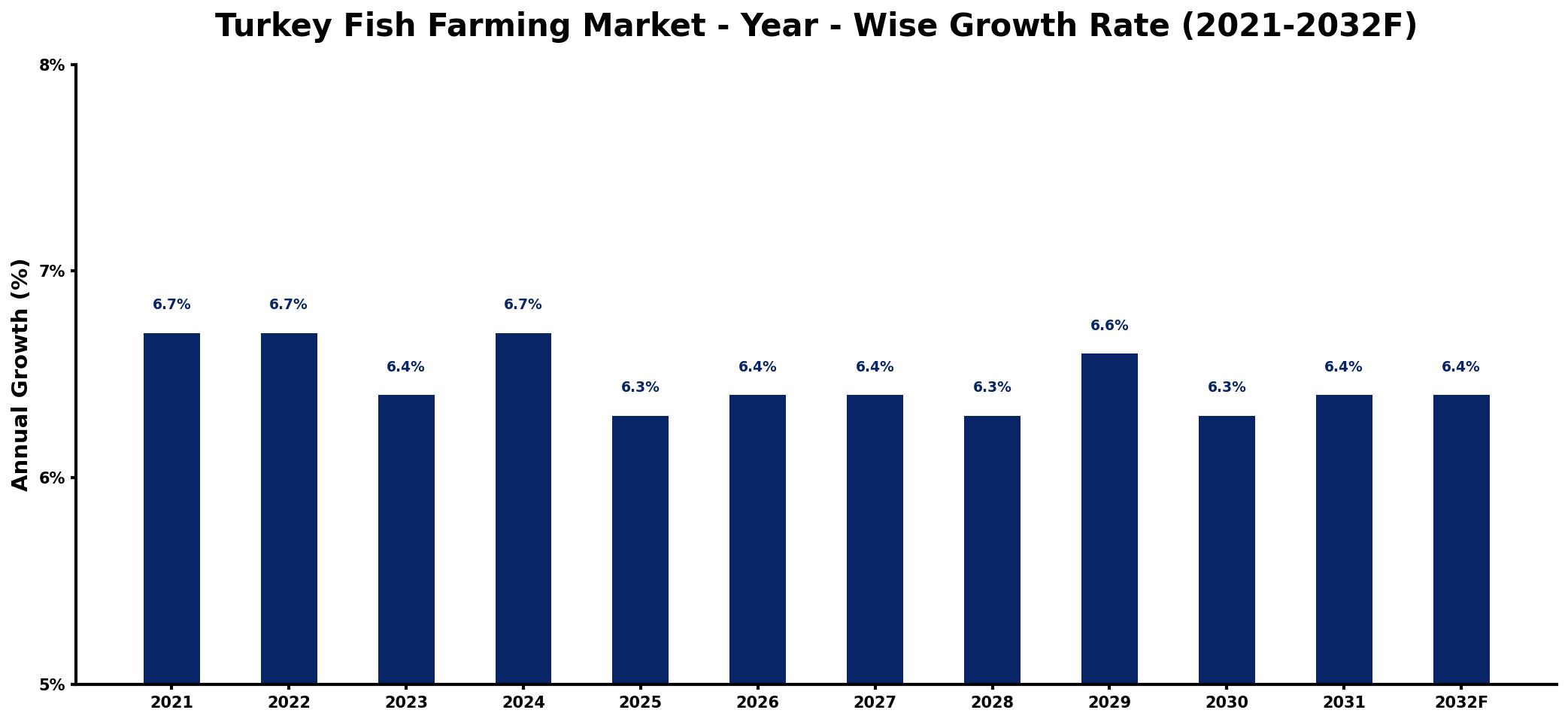
The table below presents the year‑wise growth rates along with the key drivers influencing the market
| Year | Growth Rate | Major Drivers |
| 2021 | 6.7% | Rising consumer health consciousness |
| 2022 | 6.7% | Increased domestic production capacity |
| 2023 | 6.4% | Growing export market opportunities |
| 2024 | 6.7% | Advancements in aquaculture technology |
| 2025 | 6.3% | Strengthened supply chain networks |
| 2026 | 6.4% | Enhanced regulatory support initiatives |
| 2027 | 6.4% | Expansion of local processing facilities |
| 2028 | 6.3% | Diversification of product offerings |
| 2029 | 6.6% | Increased investment in sustainability |
| 2030 | 6.3% | Growing popularity of alternative proteins |
| 2031 | 6.4% | rising demand from electronics |
| 2032 | 6.4% | Strengthening consumer awareness campaigns |
Note: Market size estimations and growth projections presented in this report are based on 6Wresearch's proprietary forecasting methodology, utilizing the latest available industry data, government publications, and primary research inputs.
Turkey Fish Farming Market Synopsis
Sustainability is currently the strongest force shaping the Turkey fish farming market, as consumers increasingly seek eco-friendly seafood options. This shift is propelling farmers to adopt innovative technologies and sustainable practices, enhancing both production efficiency and the quality of farmed fish.
Turkeys strategic geographic location between Europe and Asia presents unique export opportunities, further fueling growth in the fish farming sector. However, while the market thrives on demand, challenges such as disease management and competition from imported seafood remain pressing concerns for local producers.
Turkey Fish Farming Market Key Takeaways
- Significant growth potential exists due to increasing consumer demand for seafood products.
- Modern aquaculture practices are being adopted to enhance efficiency and sustainability.
- Government policies are actively supporting domestic production and reducing import dependency.
- The market is witnessing a rising trend towards premium and organic seafood offerings.
- Challenges remain, particularly in disease control and competition with wild-caught fish.
Evaluation of Restraints in Turkey Fish Farming Market
Despite the positive growth outlook, the Turkey fish farming market faces significant restraints. Environmental concerns related to water quality management and the sustainable disposal of waste pose challenges for fish farmers. Disease outbreaks can severely impact stock levels, leading to considerable economic losses. Furthermore, fluctuating feed prices and regulatory compliance demand careful navigation to ensure profitable operations. These factors require continuous management to secure the long-term viability of the industry.
Turkey Fish Farming Market Trends
Emerging trends in the Turkey fish farming market point towards a heightened emphasis on sustainability. Fish farmers are increasingly exploring alternative feeds, reducing reliance on wild fish for feed production. Additionally, technological advancements, including recirculating aquaculture systems, are being integrated to improve fish health and resource efficiency. The growing popularity of organic and locally-sourced fish products is also reshaping consumer preferences, driving demand for premium offerings.
Turkey Fish Farming Market Opportunities
Investment opportunities abound in the Turkey fish farming market, particularly in modernizing aquaculture systems and practices. Establishing or expanding fish farms focusing on high-demand species such as seabass, seabream, and trout presents a strong potential for profitability. Additionally, diversifying into niche markets, such as organic or specialty seafood, can capture health-conscious consumers eager for sustainable options. The commitment to research and development for innovative farming methods is essential to staying ahead in this competitive landscape.
Government Initiatives in the Turkey Fish Farming Market
The Turkish government has put several initiatives in place to bolster the fish farming industry. These include financial incentives and subsidies aimed at encouraging fish farmers to adopt sustainable practices. Research and development efforts are being funded to enhance the productivity and competitiveness of the sector. Furthermore, regulations are enforced to ensure environmental and health standards in aquaculture operations, along with marketing support to promote Turkish farmed fish domestically and internationally.
Future Insights of the Turkey Fish Farming Market
Looking ahead to 2026-2032, the Turkey fish farming market is expected to benefit from increased seafood consumption driven by population growth and health awareness. Innovations in farming technologies and practices will likely continue to evolve, creating a more sustainable and efficient industry landscape. The preference for fresh and locally sourced fish will further enhance market dynamics, though challenges like environmental management and disease control will require ongoing attention to ensure sustained growth.
Turkey Fish Farming Market Latest Developments (2025 - 2026)
Recent industry developments indicate a shift towards the adoption of advanced aquaculture technologies that prioritize sustainability and efficiency. Research collaborations between universities and aquaculture firms are emerging to pioneer innovative practices, while local governments are enhancing support structures for fish farmers. The market is also witnessing increased participation in international trade shows, showcasing Turkeys farmed fish products and strengthening export opportunities.
Turkey Fish Farming Market - Key Attractiveness of the Report
- 10 Years of Market Numbers
- Historical Data Starting from 2022 to 2025
- Base Year: 2025
- Forecast Data until 2032
- Key Performance Indicators Impacting the Market
- Major Upcoming Developments and Projects
Key Highlights of the Report:
- Turkey Fish Farming Market Outlook
- Market Size of Turkey Fish Farming Market, 2025
- Forecast of Turkey Fish Farming Market, 2032
- Historical Data and Forecast of Turkey Fish Farming Revenues & Volume for the Period 2022-2032F
- Turkey Fish Farming Market Trend Evolution
- Turkey Fish Farming Market Drivers and Challenges
- Turkey Fish Farming Price Trends
- Turkey Fish Farming Porter's Five Forces
- Turkey Fish Farming Industry Life Cycle
- Historical Data and Forecast of Turkey Fish Farming Market Revenues & Volume By Environment for the Period 2022-2032F
- Historical Data and Forecast of Turkey Fish Farming Market Revenues & Volume By Marine Water for the Period 2022-2032F
- Historical Data and Forecast of Turkey Fish Farming Market Revenues & Volume By Fresh Water for the Period 2022-2032F
- Historical Data and Forecast of Turkey Fish Farming Market Revenues & Volume By Brackish Water for the Period 2022-2032F
- Historical Data and Forecast of Turkey Fish Farming Market Revenues & Volume By Fish Type for the Period 2022-2032F
- Historical Data and Forecast of Turkey Fish Farming Market Revenues & Volume By Pompano for the Period 2022-2032F
- Historical Data and Forecast of Turkey Fish Farming Market Revenues & Volume By Snappers for the Period 2022-2032F
- Historical Data and Forecast of Turkey Fish Farming Market Revenues & Volume By Groupers for the Period 2022-2032F
- Historical Data and Forecast of Turkey Fish Farming Market Revenues & Volume By Salmon for the Period 2022-2032F
- Historical Data and Forecast of Turkey Fish Farming Market Revenues & Volume By Milkfish for the Period 2022-2032F
- Historical Data and Forecast of Turkey Fish Farming Market Revenues & Volume By Tuna for the Period 2022-2032F
- Historical Data and Forecast of Turkey Fish Farming Market Revenues & Volume By Tilapia for the Period 2022-2032F
- Historical Data and Forecast of Turkey Fish Farming Market Revenues & Volume By Others for the Period 2022-2032F
- Turkey Fish Farming Import Export Trade Statistics
- Market Opportunity Assessment By Environment
- Market Opportunity Assessment By Fish Type
- Turkey Fish Farming Top Companies Market Share
- Turkey Fish Farming Competitive Benchmarking By Technical and Operational Parameters
- Turkey Fish Farming Company Profiles
- Turkey Fish Farming Key Strategic Recommendations






































