Turkey Gas Chromatography Systems Market Size, Share & Growth Rate
The Turkey Gas Chromatography Systems Market was estimated at USD 273 Million in 2025 and is projected to reach USD 358 Million by 2032, growing at a CAGR of 3.9% from 2026 to 2032. This growth trajectory is largely attributed to the increasing demand from the pharmaceutical and petrochemical sectors, where precise analysis of compounds is crucial. Furthermore, the ongoing investments in research and development reflect the sector's commitment to technological advancement and quality assurance, which are critical for driving market expansion.
Turkey Gas Chromatography Systems Market Year-wise Growth Rate and Key Drivers
This graph highlights how the Turkey Gas Chromatography Systems Market has steadily grown over the years, supported by major growth factors.
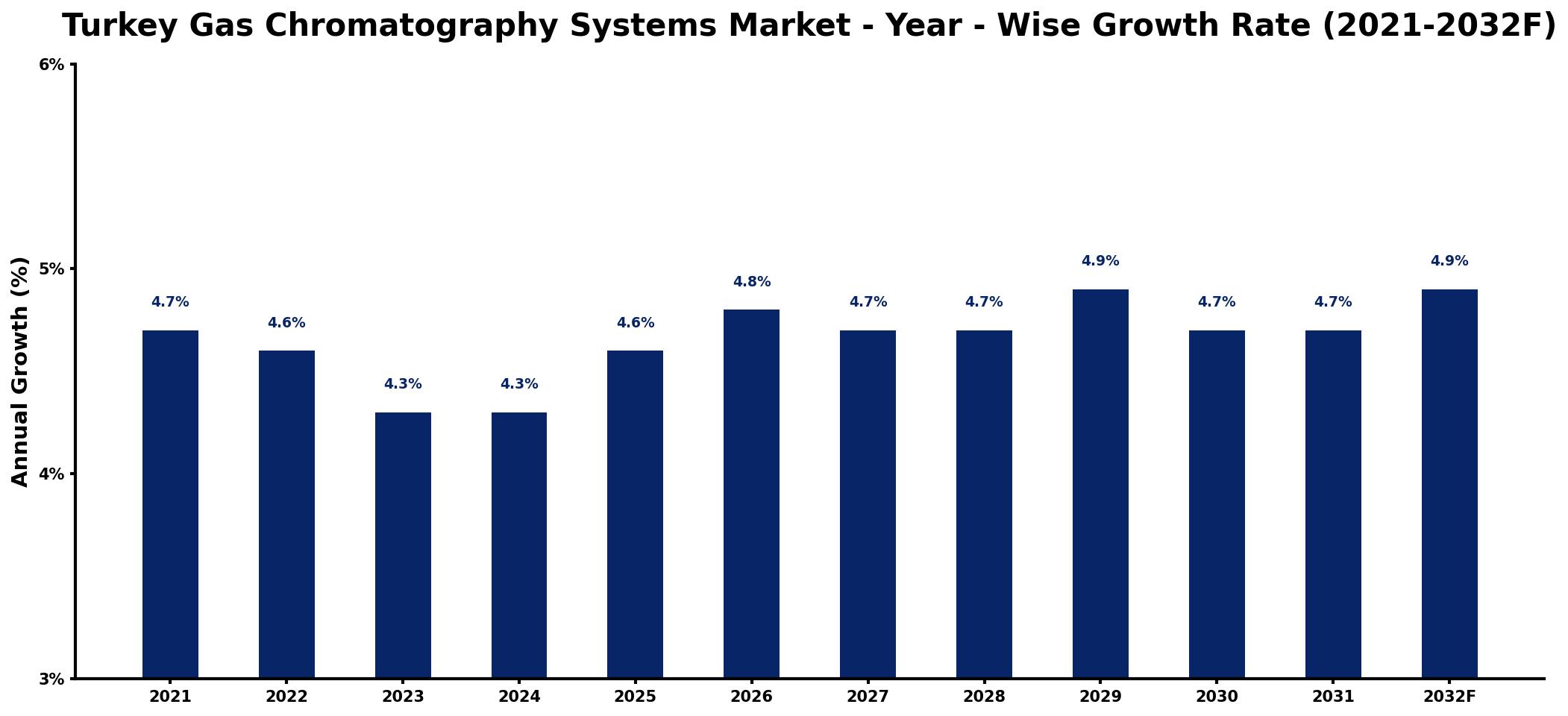
The table below presents the year‑wise growth rates along with the key drivers influencing the market
| Year | Growth Rate | Major Drivers |
| 2021 | 4.7% | Rising demand from pharmaceutical industry |
| 2022 | 4.6% | Increased investments in research facilities |
| 2023 | 4.3% | Growing environmental regulations enforcement |
| 2024 | 4.3% | Expansion of food safety standards |
| 2025 | 4.6% | Technological advancements in laboratories |
| 2026 | 4.8% | Surge in academic research funding |
| 2027 | 4.7% | Increased focus on quality control |
| 2028 | 4.7% | Growth in petrochemical sector investments |
| 2029 | 4.9% | Rising applications in clinical diagnostics |
| 2030 | 4.7% | Enhanced government funding for innovation |
| 2031 | 4.7% | Growing demand in agricultural testing |
| 2032 | 4.9% | increased capital investment inflows |
Note: Market size estimations and growth projections presented in this report are based on 6Wresearch's proprietary forecasting methodology, utilizing the latest available industry data, government publications, and primary research inputs.
Turkey Gas Chromatography Systems Market Synopsis
The primary force currently shaping the Turkey Gas Chromatography Systems Market is the escalating demand for accurate and reliable analytical instruments across multiple industries. This need is driven by stringent regulatory requirements, particularly in sectors like pharmaceuticals and environmental testing, which necessitate high standards for quality control.
As companies strive to innovate and maintain compliance, the market is seeing significant investments in advanced gas chromatography technologies. These advancements not only enhance efficiency but also empower organizations to achieve more accurate results, thereby reinforcing the critical role gas chromatography plays in contemporary analytical applications.
Turkey Gas Chromatography Systems Market Key Takeaways
- Increased regulatory scrutiny is boosting demand for gas chromatography systems in various sectors.
- Innovations in technology are driving advancements in sensitivity, accuracy, and speed of analyses.
- Integration of gas chromatography with mass spectrometry is enhancing analytical capabilities.
- Automated systems are gaining traction due to the increased focus on efficiency and productivity.
- Strategic partnerships and collaborations are critical for market players looking to expand their reach.
Evaluation of Restraints in Turkey Gas Chromatography Systems Market
Despite the growth potential, several constraints hinder the Turkey Gas Chromatography Systems Market. The market faces heightened competition from both local and international manufacturers, leading to pricing pressures and necessitating continuous innovation. Additionally, regulatory changes can complicate compliance, compelling companies to invest heavily in research and development. Economic uncertainties, along with geopolitical factors, may also introduce volatility in demand, making it essential for market participants to navigate these complexities with strategic foresight.
Turkey Gas Chromatography Systems Market Trends
A number of current and emerging trends are shaping the Turkey Gas Chromatography Systems Market. Advanced GC systems are increasingly adopted across industries such as food and beverage, environmental analysis, and petrochemicals, thanks to their improved capabilities. There is a notable trend toward hybrid systems that combine gas chromatography with other analytical techniques, enhancing the versatility and effectiveness of compound analysis. Moreover, the shift towards automation and sophisticated software solutions is revolutionizing operational efficiency and precision in testing.
Turkey Gas Chromatography Systems Market Opportunities
The landscape of the Turkey Gas Chromatography Systems Market is rich with opportunities for growth and investment. As demand for high-quality analytical instrumentation continues to rise, there is ample scope for companies that focus on innovative and efficient GC systems. Tailored solutions that meet specific industry needs can distinguish organizations and drive customer loyalty. Additionally, forming strategic alliances with local distributors can amplify market presence and facilitate access to a broader customer base, thus unlocking further growth potential in this burgeoning sector.
Government Initiatives in the Turkey Gas Chromatography Systems Market
Government policies are crucial in shaping the Turkey Gas Chromatography Systems Market, promoting compliance with environmental and safety standards. Regulations concerning the use of gas chromatography systems across healthcare, food safety, and environmental monitoring are in place to ensure rigorous quality control. Furthermore, initiatives aimed at encouraging the integration of advanced technologies are being emphasized, thereby supporting research and development in the field and fostering innovation to meet evolving market demands.
Future Insights of the Turkey Gas Chromatography Systems Market
Looking ahead to 2026-2032, the Turkey Gas Chromatography Systems Market is expected to thrive, driven by heightened demand from various industries. Advances in technology, along with increased investments in R&D, will underpin market growth. Additionally, the emphasis on stringent regulations regarding food safety and environmental monitoring will promote the adoption of gas chromatography systems for diverse applications, ranging from drug testing to quality control. Companies focusing on product innovation and strategic collaborations are likely to secure a competitive advantage in this evolving landscape.
Turkey Gas Chromatography Systems Market Latest Developments (2025 - 2026)
Recent developments within the Turkey Gas Chromatography Systems Market reveal a trend toward enhanced product offerings and greater integration of advanced technologies. Companies are increasingly focusing on refining their systems to ensure compliance with evolving regulatory standards, while also incorporating automation to improve efficiency. Furthermore, strategic alliances and partnerships are becoming a common approach for firms seeking to broaden their market reach and enhance their capabilities in response to customer demands.
Turkey Gas Chromatography Systems Market - Key Attractiveness of the Report
- 10 Years of Market Numbers
- Historical Data Starting from 2022 to 2025
- Base Year: 2025
- Forecast Data until 2032
- Key Performance Indicators Impacting the Market
- Major Upcoming Developments and Projects
Key Highlights of the Report:
- Turkey Gas Chromatography Systems Market Outlook
- Market Size of Turkey Gas Chromatography Systems Market, 2025
- Forecast of Turkey Gas Chromatography Systems Market, 2032
- Historical Data and Forecast of Turkey Gas Chromatography Systems Revenues & Volume for the Period 2022-2032F
- Turkey Gas Chromatography Systems Market Trend Evolution
- Turkey Gas Chromatography Systems Market Drivers and Challenges
- Turkey Gas Chromatography Systems Price Trends
- Turkey Gas Chromatography Systems Porter's Five Forces
- Turkey Gas Chromatography Systems Industry Life Cycle
- Historical Data and Forecast of Turkey Gas Chromatography Systems Market Revenues & Volume By Product for the Period 2022-2032F
- Historical Data and Forecast of Turkey Gas Chromatography Systems Market Revenues & Volume By Systems for the Period 2022-2032F
- Historical Data and Forecast of Turkey Gas Chromatography Systems Market Revenues & Volume By Detectors for the Period 2022-2032F
- Historical Data and Forecast of Turkey Gas Chromatography Systems Market Revenues & Volume By Auto-samplers for the Period 2022-2032F
- Historical Data and Forecast of Turkey Gas Chromatography Systems Market Revenues & Volume By Fraction Collectors for the Period 2022-2032F
- Historical Data and Forecast of Turkey Gas Chromatography Systems Market Revenues & Volume By Other Products for the Period 2022-2032F
- Historical Data and Forecast of Turkey Gas Chromatography Systems Market Revenues & Volume By End User for the Period 2022-2032F
- Historical Data and Forecast of Turkey Gas Chromatography Systems Market Revenues & Volume By Pharmaceutical and Bioindustries for the Period 2022-2032F
- Historical Data and Forecast of Turkey Gas Chromatography Systems Market Revenues & Volume By Academic Research Institutes for the Period 2022-2032F
- Historical Data and Forecast of Turkey Gas Chromatography Systems Market Revenues & Volume By Other End Users for the Period 2022-2032F
- Turkey Gas Chromatography Systems Import Export Trade Statistics
- Market Opportunity Assessment By Product
- Market Opportunity Assessment By End User
- Turkey Gas Chromatography Systems Top Companies Market Share
- Turkey Gas Chromatography Systems Competitive Benchmarking By Technical and Operational Parameters
- Turkey Gas Chromatography Systems Company Profiles
- Turkey Gas Chromatography Systems Key Strategic Recommendations






































