Turkey Image Recognition Market Size & Growth Rate (2026-2032)
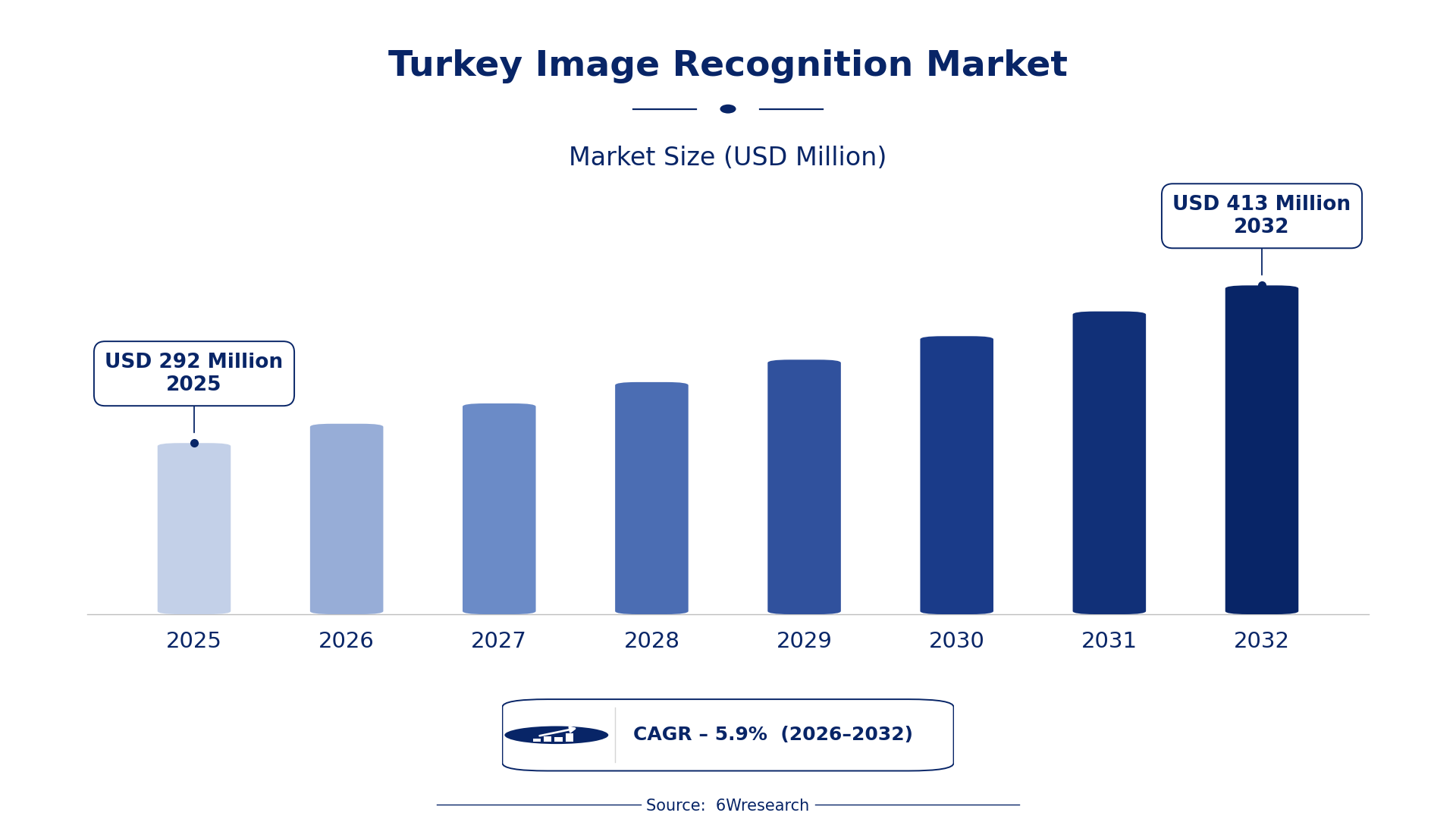
The Turkey Image Recognition Market was estimated at USD 292 Million in 2025 and is projected to reach USD 413 Million by 2032, growing at a CAGR of 5.9% from 2026 to 2032.
Turkey Image Recognition Market Synopsis
The driving force behind the Turkey Image Recognition Market is the rapid adoption of artificial intelligence and machine learning technologies across a multitude of sectors. Industries such as healthcare, retail, and security are increasingly integrating these technologies for applications like facial recognition and object detection.
This growing trend is further amplified by the surge in smartphone usage and the popularity of social media platforms, both of which demand advanced image recognition solutions. As businesses begin to realize the transformative potential of these technologies, the market is expected to see sustained momentum in the coming years.
Turkey Image Recognition Market Year-wise Growth Rate and Key Drivers
This graph illustrates the annual growth rates of the Turkey Image Recognition Market from 2021 to 2032, highlighting a steady upward trajectory and projected expansion over the forecast period.
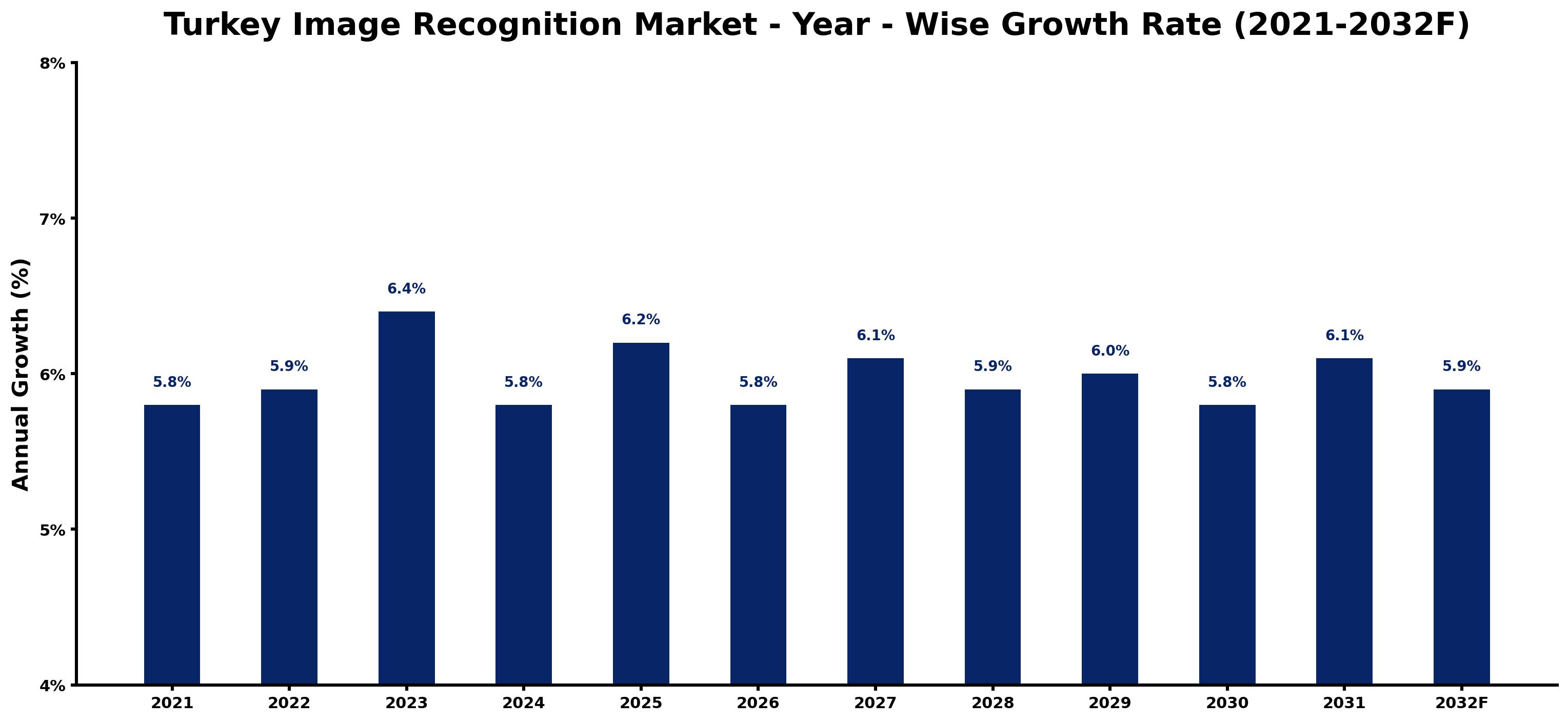
The table below presents the year‑wise growth rates along with the key drivers influencing the market
| Year | Growth Rate | Major Drivers |
| 2021 | 5.8% | Increased security measures under Turkey’s surveillance regulations. |
| 2022 | 5.9% | Growth of e-commerce driving need for visual search tools. |
| 2023 | 6.4% | Government-backed initiatives promoting AI technology in Turkey. |
| 2024 | 5.8% | Adoption of contactless payment solutions enhancing image verification. |
| 2025 | 6.2% | Rise in digital marketing requiring advanced image analytics. |
| 2026 | 5.8% | Expanding local startups innovating in facial recognition technology. |
| 2027 | 6.1% | Investment in smart city projects integrating visual recognition systems. |
| 2028 | 5.9% | Growing online education demand leveraging image recognition for engagement. |
| 2029 | 6.0% | Boost from healthcare digitization requiring image analysis tools. |
| 2030 | 5.8% | Increased demand for personalized advertising using image insights. |
| 2031 | 6.1% | National push for AI literacy driving image tech adoption. |
| 2032 | 5.9% | Tourism recovery spurring interest in visual recognition applications. |
Note: Market size estimations and growth projections presented in this report are based on 6Wresearch's proprietary forecasting methodology, utilizing the latest available industry data, government publications, and primary research inputs.
Turkey Image Recognition Market Key Takeaways
Below are some of the specific key takeaways from the market, including:
- The increasing demand for advanced image recognition solutions across various sectors is a key growth driver.
- Integration with emerging technologies like IoT and augmented reality is expected to enhance market opportunities.
- High-quality data availability remains a challenge, impacting algorithm training and effectiveness.
- Government policies are fostering a conducive environment for technological advancements in the sector.
- Investment opportunities abound in healthcare, retail, and automotive industries for image recognition applications.
Evaluation of Restraints in Turkey Image Recognition Market
Despite its promising growth trajectory, the Turkey Image Recognition Market faces notable restraints. Limited access to high-quality data for training machine learning algorithms poses significant challenges, particularly due to stringent privacy regulations. This scarcity affects the accuracy and efficiency of image recognition technologies, hindering their adoption in critical applications. Additionally, varying image quality and conditions complicate the development of robust algorithms, which are essential for successful implementation. Integration with existing systems also presents compatibility issues, making it more challenging for businesses to adopt these advanced solutions.
Turkey Image Recognition Market Trends
Currently, there is a pronounced trend toward utilizing AI-driven image recognition solutions across diverse sectors. Companies are increasingly focusing on improving algorithm accuracy and processing speed, which are critical for applications in security and healthcare. on top of that, the integration of image recognition technology with IoT devices is becoming more prevalent, enabling smarter and more responsive systems. As augmented reality gains traction, it is anticipated that image recognition will play a crucial role in enhancing user experiences, particularly in retail environments.
Turkey Image Recognition Market Opportunities
Investment opportunities in the Turkey Image Recognition Market are abundant, particularly in sectors such as retail, healthcare, and automotive. In retail, companies can leverage image recognition to personalize customer experiences, streamline inventory management, and enhance marketing strategies. The healthcare industry stands to benefit significantly from these technologies, as they can improve diagnostic accuracy and patient care. on top of that, the automotive sector is increasingly utilizing image recognition for advanced driver assistance systems, positioning itself for future innovations in autonomous vehicles.
Government Initiatives in the Turkey Image Recognition Market
The Turkish government is actively shaping the growth of the image recognition market through targeted policies and initiatives. These efforts focus on enhancing research and development capabilities, promoting collaboration between industry and academia, and establishing a regulatory framework that supports innovation while ensuring data privacy. Such initiatives create a favorable environment for businesses looking to invest in image recognition technologies.
- A national initiative launched in early 2023 aimed at funding research projects in artificial intelligence, including image recognition technologies.
- Currently, the Ministry of Technology is overseeing a program to facilitate partnerships between tech firms and universities, enhancing knowledge transfer in image recognition research.
- A regulatory framework introduced in late 2023 mandates data protection measures, ensuring ethical use of image recognition technologies in the private sector.
- Planned public-private collaborations are expected to be unveiled by 2025, aiming to boost infrastructure for image recognition applications in urban environments.
Future Insights of the Turkey Image Recognition Market
Looking ahead to 2026-2032, the Turkey Image Recognition Market is set for a remarkable expansion. The growing reliance on AI technologies across various industries will drive the demand for image recognition systems. As advancements in deep learning algorithms continue, businesses will increasingly adopt these solutions for enhanced security and efficiency. The integration of image recognition with augmented and virtual reality will also unlock new applications, further propelling market growth.
Turkey Image Recognition Market Latest Developments
Recent activities in the Turkey Image Recognition Market indicate a strong momentum towards innovation and application diversification. Various companies are launching new products and forming strategic partnerships to enhance their offerings. The focus on technological advancements and integration with other systems is clearly evident.
- A major technology vendor announced the launch of an advanced facial recognition system in Q1 2024, targeting the security sector.
- Ongoing initiatives to integrate image recognition with IoT devices are currently in the pilot phase, expected to enhance smart city solutions by mid-2024.
- A leading regional operator is planning to roll out an image recognition-based customer service platform, with a launch anticipated in late 2024.
- By early 2025, a new partnership between academic institutions and tech companies is expected to focus on developing next-generation image recognition algorithms.
Turkey Image Recognition Market - Key Attractiveness of the Report
- 10 Years of Market Numbers
- Historical Data Starting from 2022 to 2025
- Base Year: 2025
- Forecast Data until 2032
- Key Performance Indicators Impacting the Market
- Major Upcoming Developments and Projects
Key Highlights of the Report:
- Turkey Image Recognition Market Outlook
- Market Size of Turkey Image Recognition Market, 2025
- Forecast of Turkey Image Recognition Market, 2032
- Historical Data and Forecast of Turkey Image Recognition Revenues & Volume for the Period 2022-2032F
- Turkey Image Recognition Market Trend Evolution
- Turkey Image Recognition Market Drivers and Challenges
- Turkey Image Recognition Price Trends
- Turkey Image Recognition Porter's Five Forces
- Turkey Image Recognition Industry Life Cycle
- Historical Data and Forecast of Turkey Image Recognition Market Revenues & Volume By Technology for the Period 2022-2032F
- Historical Data and Forecast of Turkey Image Recognition Market Revenues & Volume By Digital Image Processing for the Period 2022-2032F
- Historical Data and Forecast of Turkey Image Recognition Market Revenues & Volume By Facial Recognition for the Period 2022-2032F
- Historical Data and Forecast of Turkey Image Recognition Market Revenues & Volume By Pattern Recognition for the Period 2022-2032F
- Historical Data and Forecast of Turkey Image Recognition Market Revenues & Volume By Deployment Mode for the Period 2022-2032F
- Historical Data and Forecast of Turkey Image Recognition Market Revenues & Volume By On-premises for the Period 2022-2032F
- Historical Data and Forecast of Turkey Image Recognition Market Revenues & Volume By Cloud for the Period 2022-2032F
- Historical Data and Forecast of Turkey Image Recognition Market Revenues & Volume By Component for the Period 2022-2032F
- Historical Data and Forecast of Turkey Image Recognition Market Revenues & Volume By Hardware for the Period 2022-2032F
- Historical Data and Forecast of Turkey Image Recognition Market Revenues & Volume By Software for the Period 2022-2032F
- Historical Data and Forecast of Turkey Image Recognition Market Revenues & Volume By Services for the Period 2022-2032F
- Historical Data and Forecast of Turkey Image Recognition Market Revenues & Volume By Application for the Period 2022-2032F
- Historical Data and Forecast of Turkey Image Recognition Market Revenues & Volume By Scanning and Imaging for the Period 2022-2032F
- Historical Data and Forecast of Turkey Image Recognition Market Revenues & Volume By Security and Surveillance for the Period 2022-2032F
- Historical Data and Forecast of Turkey Image Recognition Market Revenues & Volume By Image Search for the Period 2022-2032F
- Historical Data and Forecast of Turkey Image Recognition Market Revenues & Volume By Augmented Reality for the Period 2022-2032F
- Historical Data and Forecast of Turkey Image Recognition Market Revenues & Volume By Marketing and Advertising for the Period 2022-2032F
- Turkey Image Recognition Import Export Trade Statistics
- Market Opportunity Assessment By Technology
- Market Opportunity Assessment By Deployment Mode
- Market Opportunity Assessment By Component
- Market Opportunity Assessment By Application
- Turkey Image Recognition Top Companies Market Share
- Turkey Image Recognition Competitive Benchmarking By Technical and Operational Parameters
- Turkey Image Recognition Company Profiles
- Turkey Image Recognition Key Strategic Recommendations






































