Turkey Iron Powder Market Size, Share & Growth Rate
The Turkey Iron Powder Market was estimated at USD 173 Million in 2025 and is projected to reach USD 243 Million by 2032, growing at a CAGR of 5.0% from 2026 to 2032. This growth trajectory is primarily driven by the expanding automotive and electronics sectors, where iron powder plays a crucial role in manufacturing components. Furthermore, the increasing adoption of powdered metals in additive manufacturing and surface coating applications is bolstering market demand, reflecting a broader trend towards advanced material solutions.
Turkey Iron Powder Market Year-wise Growth Rate and Key Drivers
This graph highlights how the Turkey Iron Powder Market has steadily grown over the years, supported by major growth factors.
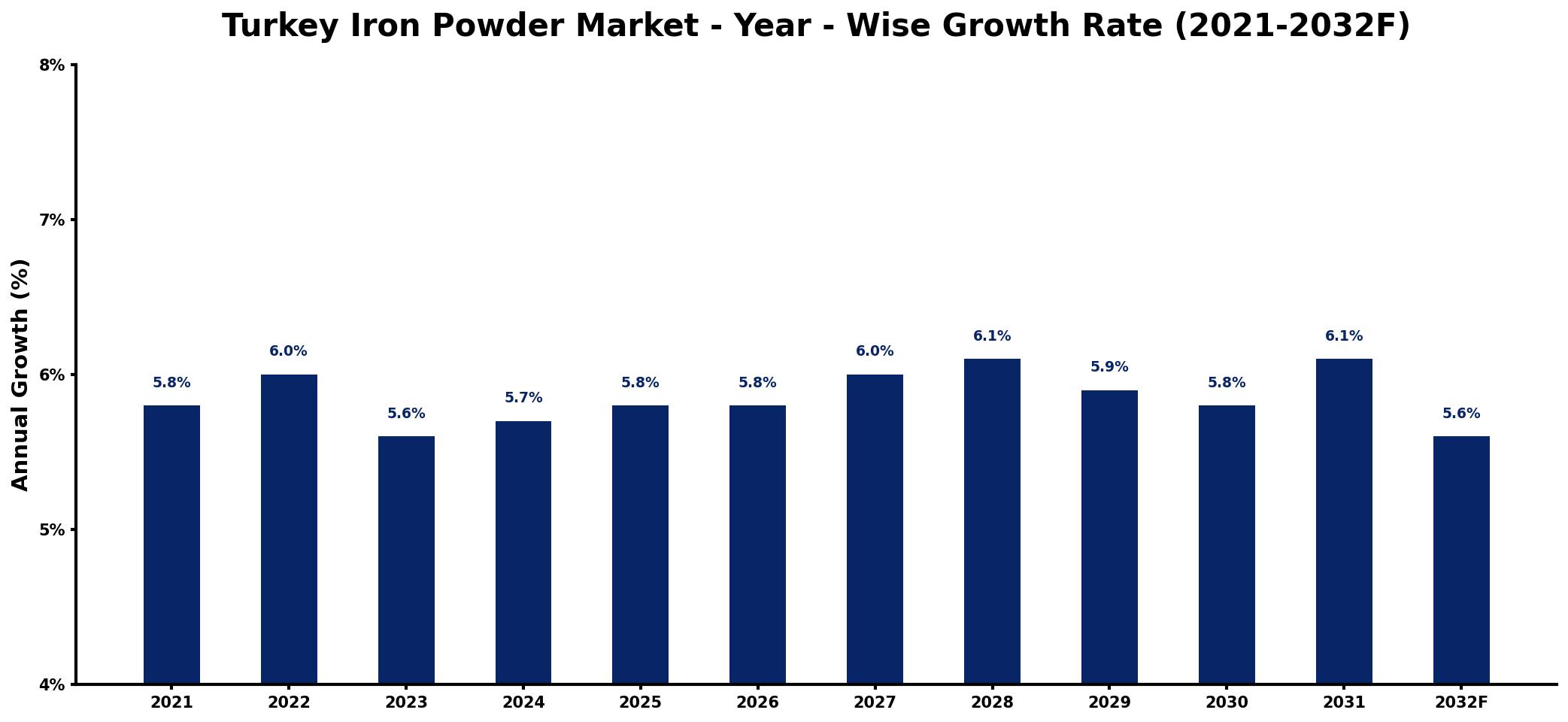
The table below presents the year‑wise growth rates along with the key drivers influencing the market
| Year | Growth Rate | Major Drivers |
| 2021 | 5.8% | Rising demand in automotive industry |
| 2022 | 6.0% | Growth in renewable energy projects |
| 2023 | 5.6% | Expansion of construction activities |
| 2024 | 5.7% | Increased investment in manufacturing |
| 2025 | 5.8% | Surge in consumer electronics sector |
| 2026 | 5.8% | Development of advanced technologies |
| 2027 | 6.0% | Growing interest in sustainable practices |
| 2028 | 6.1% | Boost in infrastructure development plans |
| 2029 | 5.9% | Higher production capacities being established |
| 2030 | 5.8% | Emergence of new market players |
| 2031 | 6.1% | Strengthening of export opportunities |
| 2032 | 5.6% | Enhanced research and development initiatives |
Note: Market size estimations and growth projections presented in this report are based on 6Wresearch's proprietary forecasting methodology, utilizing the latest available industry data, government publications, and primary research inputs.
Turkey Iron Powder Market Synopsis
In Turkey, the demand for iron powder is significantly influenced by the metallurgical industrys growth, with powdered iron being integral to the production of sintered components. Additionally, the electronics sector's evolution has created a substantial market for iron powder, especially in producing magnetic materials essential for various devices.
The Turkish market is witnessing an upward trend in additive manufacturing processes, where iron powder is essential for 3D printing and creating complex geometries. As industries continue to innovate, the versatility of iron powder enhances its appeal across multiple applications, reinforcing its position as a critical material in Turkeys industrial landscape.
Turkey Iron Powder Market Key Takeaways
- The market is set to grow steadily, driven by strong demand from automotive and electronics industries.
- Iron powder's application in additive manufacturing is revolutionizing production capabilities.
- Quality control remains a critical focus area for manufacturers amidst rising production costs.
- Government policies are increasingly favoring technological advancements in production processes.
- Environmental regulations are shaping the operational practices within the iron powder sector.
Evaluation of Restraints in Turkey Iron Powder Market
While the Turkey Iron Powder Market exhibits considerable growth potential, it faces several significant restraints. High production costs associated with the extraction and processing of iron powder limit the ability of manufacturers to scale operations effectively. Moreover, the complexity of integrating iron powder into diverse applications creates challenges, particularly in ensuring product quality and consistency. Regulatory frameworks aimed at addressing environmental concerns further complicate the operational landscape, necessitating compliance investments that can strain resources.
Turkey Iron Powder Market Trends
Current trends indicate a shift towards sustainability and eco-friendliness, with manufacturers exploring innovative production methods that reduce waste and energy consumption. Furthermore, the rise of Industry 4.0 technologies is paving the way for enhanced automation and improved quality control, positioning iron powder as a material of choice in sophisticated manufacturing settings. In addition, research into advanced iron powder properties, aimed at enhancing performance in various applications, is becoming more prevalent.
Turkey Iron Powder Market Opportunities
The most significant growth opportunities in the Turkey Iron Powder Market lie in the burgeoning fields of additive manufacturing and specialty applications. As industries strive for innovation, there is a growing need for tailored iron powder solutions that meet specific engineering requirements. Moreover, investments in R&D to develop higher-quality powders can enhance market competitiveness, creating avenues for new product introductions that cater to niche markets.
Government Initiatives in the Turkey Iron Powder Market
The Turkish government has implemented several initiatives aimed at fostering technological advancements in iron powder production. Policies that promote research and development within the metallurgy and chemical manufacturing sectors are in place, encouraging businesses to innovate. Additionally, public funding for sustainable practices is gradually being increased, further incentivizing manufacturers to adopt environmentally friendly production techniques, which can significantly enhance market sustainability.
Future Insights of the Turkey Iron Powder Market
Looking ahead to 2026-2032, the Turkey Iron Powder Market is expected to evolve in tandem with broader industry trends. A growing emphasis on lightweight materials within the automotive sector and increased demand for high-performance components in electronics will likely propel market expansion. Additionally, as industries become more accustomed to integrating advanced manufacturing technologies, the role of iron powder as a critical input material will continue to grow, reflecting its essential contribution to future industrial innovations.
Turkey Iron Powder Market Latest Developments (2025 - 2026)
Recent developments in the Turkey Iron Powder Market have focused on enhancing production processes to achieve higher efficiency and reduced costs. Companies are increasingly collaborating with research institutions to develop novel applications for iron powder, particularly in additive manufacturing. Furthermore, there is a notable shift towards automation in manufacturing facilities, aimed at improving product quality and meeting the evolving demands of the automotive and electronics industries.
Turkey Iron Powder Market - Key Attractiveness of the Report
- 10 Years of Market Numbers
- Historical Data Starting from 2022 to 2025
- Base Year: 2025
- Forecast Data until 2032
- Key Performance Indicators Impacting the Market
- Major Upcoming Developments and Projects
Key Highlights of the Report:
- Turkey Iron Powder Market Outlook
- Market Size of Turkey Iron Powder Market, 2025
- Forecast of Turkey Iron Powder Market, 2032
- Historical Data and Forecast of Turkey Iron Powder Revenues & Volume for the Period 2022-2032F
- Turkey Iron Powder Market Trend Evolution
- Turkey Iron Powder Market Drivers and Challenges
- Turkey Iron Powder Price Trends
- Turkey Iron Powder Porter's Five Forces
- Turkey Iron Powder Industry Life Cycle
- Historical Data and Forecast of Turkey Iron Powder Market Revenues & Volume By End Use for the Period 2022-2032F
- Historical Data and Forecast of Turkey Iron Powder Market Revenues & Volume By Aerospace & defense for the Period 2022-2032F
- Historical Data and Forecast of Turkey Iron Powder Market Revenues & Volume By Automotive for the Period 2022-2032F
- Historical Data and Forecast of Turkey Iron Powder Market Revenues & Volume By Oil & Gas for the Period 2022-2032F
- Historical Data and Forecast of Turkey Iron Powder Market Revenues & Volume By Medical for the Period 2022-2032F
- Historical Data and Forecast of Turkey Iron Powder Market Revenues & Volume By Others for the Period 2022-2032F
- Historical Data and Forecast of Turkey Iron Powder Market Revenues & Volume By Product Type for the Period 2022-2032F
- Historical Data and Forecast of Turkey Iron Powder Market Revenues & Volume By Unalloyed for the Period 2022-2032F
- Historical Data and Forecast of Turkey Iron Powder Market Revenues & Volume By Alloyed for the Period 2022-2032F
- Historical Data and Forecast of Turkey Iron Powder Market Revenues & Volume By Insulated Iron powder for the Period 2022-2032F
- Historical Data and Forecast of Turkey Iron Powder Market Revenues & Volume By Manufacturing Process for the Period 2022-2032F
- Historical Data and Forecast of Turkey Iron Powder Market Revenues & Volume By Physical for the Period 2022-2032F
- Historical Data and Forecast of Turkey Iron Powder Market Revenues & Volume By Atomization for the Period 2022-2032F
- Historical Data and Forecast of Turkey Iron Powder Market Revenues & Volume By Electro deposition for the Period 2022-2032F
- Historical Data and Forecast of Turkey Iron Powder Market Revenues & Volume By Chemical for the Period 2022-2032F
- Historical Data and Forecast of Turkey Iron Powder Market Revenues & Volume By Reduction for the Period 2022-2032F
- Historical Data and Forecast of Turkey Iron Powder Market Revenues & Volume By Decomposition for the Period 2022-2032F
- Historical Data and Forecast of Turkey Iron Powder Market Revenues & Volume By Mechanical for the Period 2022-2032F
- Historical Data and Forecast of Turkey Iron Powder Market Revenues & Volume By Pulverization for the Period 2022-2032F
- Turkey Iron Powder Import Export Trade Statistics
- Market Opportunity Assessment By End Use
- Market Opportunity Assessment By Product Type
- Market Opportunity Assessment By Manufacturing Process
- Turkey Iron Powder Top Companies Market Share
- Turkey Iron Powder Competitive Benchmarking By Technical and Operational Parameters
- Turkey Iron Powder Company Profiles
- Turkey Iron Powder Key Strategic Recommendations






































