Turkey Magnesium Metal Market Size, Share & Growth Rate
The Turkey Magnesium Metal Market was estimated at USD 375 Million in 2025 and is projected to reach USD 511 Million by 2032, growing at a CAGR of 4.5% from 2026 to 2032. This growth trajectory is primarily driven by robust demand from the automotive sector, as manufacturers increasingly utilize lightweight materials to enhance fuel efficiency and reduce carbon emissions. Additionally, the aerospace industry's expanding reliance on magnesium alloys, coupled with the electronics sector's increasing adoption of magnesium due to its thermal and electrical properties, positions the Turkish market for steady growth.
Turkey Magnesium Metal Market Year-wise Growth Rate and Key Drivers
This graph highlights how the Turkey Magnesium Metal Market has steadily grown over the years, supported by major growth factors.
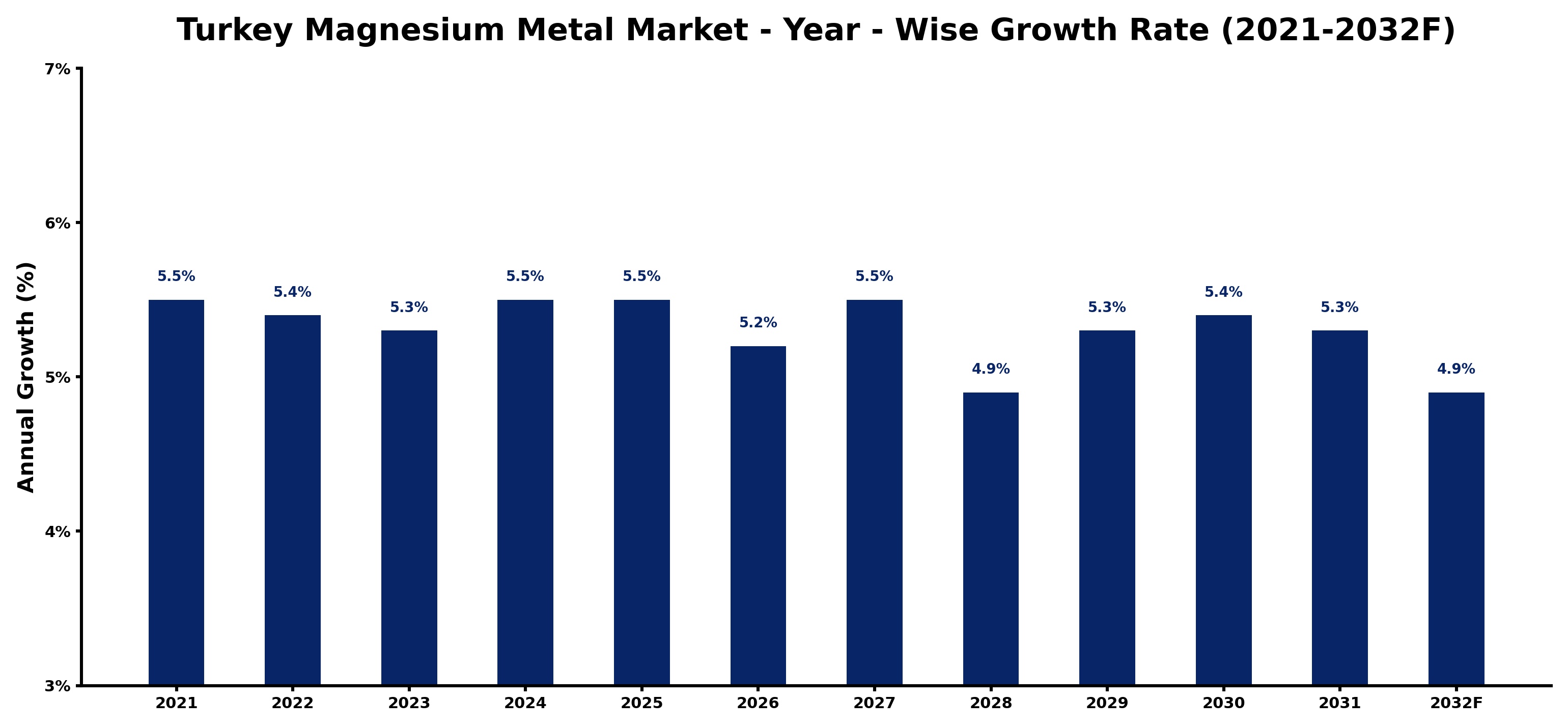
The table below presents the year‑wise growth rates along with the key drivers influencing the market
| Year | Growth Rate | Major Drivers |
| 2021 | 5.5% | Automotive sector demand increased |
| 2022 | 5.4% | Construction projects expanded significantly |
| 2023 | 5.3% | Aerospace industry growth accelerated |
| 2024 | 5.5% | Renewable energy applications expanded |
| 2025 | 5.5% | Electronics manufacturing demand surged |
| 2026 | 5.2% | Defense sector investments increased |
| 2027 | 5.5% | Medical applications gained traction |
| 2028 | 4.9% | Recycling initiatives improved sustainability |
| 2029 | 5.3% | Consumer electronics demand rose |
| 2030 | 5.4% | Industrial applications expanded rapidly |
| 2031 | 5.3% | Research and development investments increased |
| 2032 | 4.9% | Export opportunities enhanced market access |
Note - Market size estimations and growth projections presented in this report are based on 6Wresearch's advanced forecasting approach, validated with industry datasets as of June 2026.
Turkey Magnesium Metal Market Synopsis
The Turkish magnesium metal market benefits from the country's status as one of the largest producers of magnesite, a key raw material for magnesium extraction. This local supply reduces dependency on imports and supports domestic manufacturing processes, giving Turkish manufacturers a competitive edge.
With increasing investments in technology and innovation, the market is seeing advancements in the production of magnesium-based products, which are crucial for applications ranging from automotive components to lightweight electronic housings. As awareness of the material's advantages spreads, its use in various industries is poised for expansion.
Turkey Magnesium Metal Market Key Takeaways
- The market is anticipated to grow significantly due to rising demand from automotive, aerospace, and electronics sectors.
- Turkey's vast reserves of magnesite support local production capabilities, minimizing import reliance.
- Advancements in manufacturing processes are enhancing the performance and applications of magnesium metal.
- Challenges include fluctuating raw material prices and environmental sustainability concerns.
- Government initiatives are aimed at bolstering domestic production and promoting eco-friendly practices.
Evaluation of Restraints in Turkey Magnesium Metal Market
Despite promising growth, the Turkey Magnesium Metal Market faces several challenges that could hinder its expansion. Fluctuating raw material prices, particularly for magnesium ore, pose a significant risk to production costs, thereby affecting profitability. Additionally, competition from alternative lightweight materials in critical sectors such as automotive and aerospace places pressure on magnesium's market position. Furthermore, ensuring consistent quality and performance in magnesium products is crucial; any deviation could impact their suitability across various applications. Lastly, compliance with stringent environmental regulations concerning magnesium extraction and processing mandates that companies adopt sustainable practices, which can require substantial investment.
Turkey Magnesium Metal Market Trends
Current trends in the Turkey Magnesium Metal Market reflect a growing emphasis on lightweight solutions, particularly in transportation sectors, where fuel efficiency is paramount. The aerospace industry continues to explore magnesium alloys for their advantageous strength-to-weight ratios, driving further development. Additionally, the increasing popularity of electric vehicles is heightening interest in magnesium for battery casings and structural components. On the technological front, innovations in production techniques are improving the quality and range of magnesium applications, thus fostering wider market adoption.
Turkey Magnesium Metal Market Opportunities
Opportunities for growth in the Turkey Magnesium Metal Market are abundant, particularly due to the burgeoning automotive and aerospace industries. The increasing shift towards lightweight materials presents a clear path for investments in new production facilities that focus on magnesium processing. Moreover, Turkey's strategic geographic location as a nexus between Europe and Asia opens up extensive export potential for magnesium products. As the demand for eco-friendly solutions escalates, developing sustainable magnesium applications in renewable energy technologies like electric vehicles and wind turbines represents a promising investment avenue.
Government Initiatives in the Turkey Magnesium Metal Market
The Turkish government has established various policies aimed at promoting domestic magnesium production and decreasing reliance on imports. Measures such as import tariffs and protective quotas for local producers are designed to create a more competitive environment for domestic manufacturers. Furthermore, government incentives and subsidies support technological innovations and improvements within the industry, fostering growth and development. Strict environmental regulations ensure that production processes are sustainable, aligning with global sustainability initiatives and enhancing the industry's long-term viability.
Future Insights of the Turkey Magnesium Metal Market
Looking ahead to 2026-2032, the Turkey Magnesium Metal Market is set for sustained growth driven by increasing demand across key industries such as automotive and aerospace. The ongoing shift towards sustainability will further propel the adoption of magnesium as a preferred material due to its lightweight and recyclable properties. As manufacturers continue to innovate, the market is likely to witness improvements in production methodologies that enhance efficiency and reduce costs. Despite potential challenges such as raw material price volatility and regulatory compliance, the overall outlook remains positive, signaling robust opportunities for industry players.
Turkey Magnesium Metal Market Latest Developments (May 2025 - June 2026)
In recent months, the Turkey Magnesium Metal Market has seen significant developments focused on enhancing production capabilities and expanding market reach. Manufacturers are increasingly investing in advanced technologies to improve the efficiency and sustainability of magnesium extraction and processing. Additionally, collaborations within the industry are fostering innovation and driving the development of new applications, particularly in electric vehicles and lightweight structural components. Regulatory frameworks are also evolving to support green production practices, ensuring that the industry remains competitive in an environmentally conscious market.
Turkey Magnesium Metal Market - Key Attractiveness of the Report
- 10 Years of Market Numbers
- Historical Data Starting from 2022 to 2025
- Base Year: 2025
- Forecast Data until 2032
- Key Performance Indicators Impacting the Market
- Major Upcoming Developments and Projects
Key Highlights of the Report:
- Turkey Magnesium Metal Market Outlook
- Market Size of Turkey Magnesium Metal Market, 2025
- Forecast of Turkey Magnesium Metal Market, 2032
- Historical Data and Forecast of Turkey Magnesium Metal Revenues & Volume for the Period 2022-2032F
- Turkey Magnesium Metal Market Trend Evolution
- Turkey Magnesium Metal Market Drivers and Challenges
- Turkey Magnesium Metal Price Trends
- Turkey Magnesium Metal Porter's Five Forces
- Turkey Magnesium Metal Industry Life Cycle
- Historical Data and Forecast of Turkey Magnesium Metal Market Revenues & Volume By Application for the Period 2022-2032F
- Historical Data and Forecast of Turkey Magnesium Metal Market Revenues & Volume By Die Casting for the Period 2022-2032F
- Historical Data and Forecast of Turkey Magnesium Metal Market Revenues & Volume By Aluminum Alloys for the Period 2022-2032F
- Historical Data and Forecast of Turkey Magnesium Metal Market Revenues & Volume By Titanium Reduction for the Period 2022-2032F
- Historical Data and Forecast of Turkey Magnesium Metal Market Revenues & Volume By Iron & Steel Making for the Period 2022-2032F
- Historical Data and Forecast of Turkey Magnesium Metal Market Revenues & Volume By Others for the Period 2022-2032F
- Historical Data and Forecast of Turkey Magnesium Metal Market Revenues & Volume By End-user Industry for the Period 2022-2032F
- Historical Data and Forecast of Turkey Magnesium Metal Market Revenues & Volume By Automotive for the Period 2022-2032F
- Historical Data and Forecast of Turkey Magnesium Metal Market Revenues & Volume By Aerospace for the Period 2022-2032F
- Historical Data and Forecast of Turkey Magnesium Metal Market Revenues & Volume By Electronics for the Period 2022-2032F
- Historical Data and Forecast of Turkey Magnesium Metal Market Revenues & Volume By Sports for the Period 2022-2032F
- Historical Data and Forecast of Turkey Magnesium Metal Market Revenues & Volume By Medical for the Period 2022-2032F
- Historical Data and Forecast of Turkey Magnesium Metal Market Revenues & Volume By Others for the Period 2022-2032F
- Turkey Magnesium Metal Import Export Trade Statistics
- Market Opportunity Assessment By Application
- Market Opportunity Assessment By End-user Industry
- Turkey Magnesium Metal Top Companies Market Share
- Turkey Magnesium Metal Competitive Benchmarking By Technical and Operational Parameters
- Turkey Magnesium Metal Company Profiles
- Turkey Magnesium Metal Key Strategic Recommendations






































