Turkey Men Personal Care Market Summary
The turkey men personal care market was estimated at USD 340 Million in 2025 and is projected to reach USD 448 Million by 2032, growing at a CAGR of 4.9% from 2026 to 2032.
Turkey Men Personal Care Market Year-wise Growth Rate and Key Drivers
This graph highlights how the Turkey Men Personal Care Market has steadily grown over the past five years, supported by major growth factors.
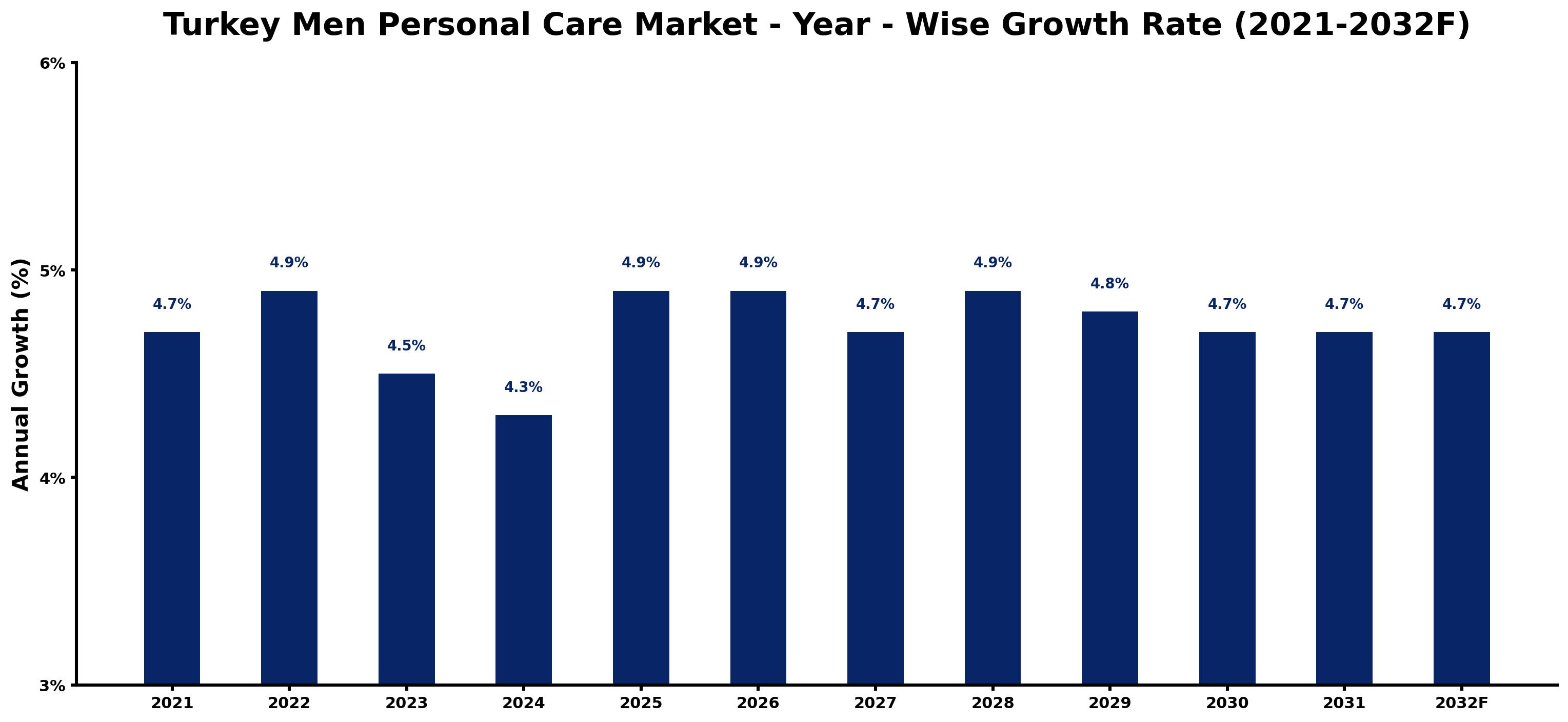
The table below presents the year wise growth rates along with the key drivers influencing the market
| Year | Growth Rate | Major Drivers |
| 2021 | 4.7% | Post-lockdown retail projects emphasized personal care as essential for self-care routines. |
| 2022 | 4.9% | Urbanization trends correlate with increased personal grooming habits among Turkish men. |
| 2023 | 4.5% | E-commerce platforms offer diverse male grooming products, reshaping consumer purchasing habits. |
| 2024 | 4.3% | Digital marketing campaigns target younger demographics, enhancing brand engagement and loyalty. |
| 2025 | 4.9% | The entry of international brands elevates competition, fostering innovation in local offerings. |
| 2026 | 4.9% | Sustainable packaging initiatives resonate with eco-conscious consumers, driving market differentiation. |
| 2027 | 4.7% | Increased media representation of male grooming influences societal perceptions and acceptance. |
| 2028 | 4.9% | Social media influencers play a pivotal role in shaping male beauty standards and preferences. |
| 2029 | 4.8% | Collaborations between grooming brands and lifestyle influencers create buzz and expand reach. |
| 2030 | 4.7% | Health and wellness trends prioritize men's skincare, integrating well-being into personal care. |
| 2031 | 4.7% | Local brands emphasize heritage ingredients, appealing to national pride and authenticity. |
| 2032 | 4.7% | Technological innovations enable personalized grooming solutions, enhancing consumer experience and satisfaction. |
Note - Market size estimations and growth projections presented in this report are based on 6Wresearch's advanced forecasting approach, validated with industry datasets as of June 2026.
Turkey Men Personal Care Market Synopsis
The Turkey Men Personal Care Market is projected to reach 4.9% and witness significant growth during the forecast period (2026-2032). This market is characterized by an increasing emphasis on grooming and self-care among men, leading to a wider acceptance of personal care routines that were historically less common. The market encompasses a diverse array of products including skincare, haircare, shaving items, and fragrances, each designed to meet the particular needs and preferences of male consumers.
Turkey Men Personal Care Market Growth Drivers
Several key drivers contribute to the continuous growth of the Turkey Men Personal Care Market. Firstly, there is a marked shift in societal norms where men are increasingly prioritizing grooming and personal hygiene as integral components of their daily lives. Additionally, the growing awareness of skincare and health issues has led to a rising demand for products that cater specifically to these needs. Moreover, the burgeoning interest in natural and organic ingredients reflects a larger trend towards sustainability and clean living, pushing brands to innovate with eco-friendly products.
- There is a noticeable increase in male consumer awareness regarding the benefits of regular grooming practices.
- Innovative product designs and formulations tailored for men are consistently emerging, appealing to health-conscious consumers.
- Convenience-based products, such as multifunctional items that simplify grooming routines, are becoming increasingly popular.
- The growth of e-commerce platforms enables easier access to a wider range of personal care products for men.
- The influence of social media is creating new marketing avenues, allowing brands to engage directly with their target audience.
Turkey Men Personal Care Market Trends and Opportunities
The Turkey Men Personal Care Market is currently experiencing transformative trends that present notable opportunities for growth. Men are gravitating towards products that promise efficacy while catering to specific needs such as anti-aging, moisturizing, and skincare tailored for sensitive skin. As the demand for natural and organic options escalates, brands focusing on clean beauty are likely to capture significant market share. Additionally, the popularity of grooming subscription services is reshaping purchasing behaviors, with consumers seeking convenience and tailored experiences.
- The demand for beard grooming products, such as oils and balms, is on the rise as beards become a mainstream fashion statement.
- Facial cleansers and exfoliants tailored for men are being recognized as essential components of grooming routines.
- Brands are increasingly adopting eco-friendly packaging solutions in response to consumer preferences for sustainability.
- Social media influencers are playing a pivotal role in shaping product trends, engaging men in the personal care discourse.
- The marketplace is seeing an increase in collaborations and partnerships aimed at expanding skincare awareness among young male demographics.
Turkey Men Personal Care Market Challenges and Restraints
Despite the promising growth trajectory, the Turkey Men Personal Care Market faces several challenges that could hinder its progress. Traditional attitudes towards male grooming can impede the adoption of new products and practices, which makes the industry reliant on changing cultural perceptions. Furthermore, a saturated market dominated by established international brands makes it challenging for local companies to carve out a competitive space. Additionally, economic factors such as pricing strategies and disposable income fluctuations can influence consumer purchasing patterns.
- The cultural perception of grooming among men may slow the adoption of new personal care routines.
- Intense competition from well-established international brands complicates market entry for local companies.
- Consumer hesitance to adopt premium-priced personal care items can restrict potential market growth.
- Economic instability in the region may affect consumer spending habits, impacting demand.
- Educating consumers about the benefits of specialized male grooming products remains an ongoing challenge.
Turkey Men Personal Care Market Government Investment and Initiatives
The Turkish government plays a crucial role in regulating the personal care sector, including products specifically designed for men. The Ministry of Health is responsible for the oversight of product registration and compliance with safety and quality standards. These regulations ensure that men's grooming products are safe and effective, which fosters consumer confidence. Additionally, policies aimed at promoting sustainability influence packaging and ingredient choices within the industry. Government initiatives often focus on encouraging local production and innovation, helping to bolster the domestic men's personal care market.
Turkey Men Personal Care Market Latest Developments (May 2025 - June 2026)
Recent developments in the Turkey Men Personal Care Market between May 2025 and June 2026 indicate a dynamic landscape characterized by a surge of innovative product launches and marketing campaigns. Brands are increasingly focusing on digital marketing strategies to enhance consumer engagement through social media platforms. Additionally, there has been a noticeable uptick in collaborations between brands and influencers aiming to reach a broader male audience. The market has seen a steady introduction of products emphasizing natural ingredients, aligning with the growing consumer demand for clean and ethical personal care options. Furthermore, e-commerce has solidified its position as a key sales channel, reflecting a shift in shopping behaviors among Turkish men.
Turkey Men Personal Care Market - Key Attractiveness of the Report
- 10 Years of Market Numbers
- Historical Data Starting from 2022 to 2025
- Base Year: 2025
- Forecast Data until 2032
- Key Performance Indicators Impacting the Market
- Major Upcoming Developments and Projects
Key Highlights of the Report:
- Turkey Men Personal Care Market Outlook
- Market Size of Turkey Men Personal Care Market, 2025
- Forecast of Turkey Men Personal Care Market, 2032F
- Historical Data and Forecast of Turkey Men Personal Care Revenues & Volume for the Period 2022-2032F
- Turkey Men Personal Care Market Trend Evolution
- Turkey Men Personal Care Market Drivers and Challenges
- Turkey Men Personal Care Price Trends
- Turkey Men Personal Care Porter's Five Forces
- Turkey Men Personal Care Industry Life Cycle
- Historical Data and Forecast of Turkey Men Personal Care Market Revenues & Volume By Types for the Period 2022-2032F
- Historical Data and Forecast of Turkey Men Personal Care Market Revenues & Volume By Hair Care for the Period 2022-2032F
- Historical Data and Forecast of Turkey Men Personal Care Market Revenues & Volume By Shaving for the Period 2022-2032F
- Historical Data and Forecast of Turkey Men Personal Care Market Revenues & Volume By Oral Care for the Period 2022-2032F
- Historical Data and Forecast of Turkey Men Personal Care Market Revenues & Volume By Personal Cleanliness for the Period 2022-2032F
- Historical Data and Forecast of Turkey Men Personal Care Market Revenues & Volume By Skin Care for the Period 2022-2032F
- Historical Data and Forecast of Turkey Men Personal Care Market Revenues & Volume By Others for the Period 2022-2032F
- Historical Data and Forecast of Turkey Men Personal Care Market Revenues & Volume By Distribution Channel for the Period 2022-2032F
- Historical Data and Forecast of Turkey Men Personal Care Market Revenues & Volume By Online for the Period 2022-2032F
- Historical Data and Forecast of Turkey Men Personal Care Market Revenues & Volume By Offline for the Period 2022-2032F
- Turkey Men Personal Care Import Export Trade Statistics
- Market Opportunity Assessment By Types
- Market Opportunity Assessment By Distribution Channel
- Turkey Men Personal Care Top Companies Market Share
- Turkey Men Personal Care Competitive Benchmarking By Technical and Operational Parameters
- Turkey Men Personal Care Company Profiles
- Turkey Men Personal Care Key Strategic Recommendations






































