Turkey Metal Heat Treatment Market (2026-2032) Outlook | Share, Growth, Size, Industry, Companies, Revenue, Analysis, Forecast, Value & Trends
Market Forecast By Material Type (Steel, Cast Iron, Others), By Process Type (Hardening & Tempering, Normalizing, Annealing, Case Hardening, Others), By Equipment Type (Electrically Heated Furnace, Fuel-fired Furnace, Others), By Application (Automotive, Machine, Metalworking, Aerospace, Construction, Others) And Competitive Landscape
| Product Code: ETC332978 | Publication Date: Aug 2022 | Updated Date: Jul 2026 | Product Type: Market Research Report | |
| Publisher: 6Wresearch | Author: Shubham Padhi | No. of Pages: 75 | No. of Figures: 35 | No. of Tables: 20 |
Turkey Metal Heat Treatment Market Size, Share & Growth Rate
The Turkey Metal Heat Treatment Market was estimated at USD 236 Million in 2025 and is projected to reach USD 314 Million by 2032, growing at a CAGR of 4.2% from 2026 to 2032. This growth trajectory can be attributed to the rising demand for heat-treated metal components in key sectors such as automotive, aerospace, and industrial applications, where enhanced mechanical properties are essential. The increasing adoption of advanced heat treatment processes also plays a significant role in boosting market dynamics.
Turkey Metal Heat Treatment Market Year-wise Growth Rate and Key Drivers
This graph highlights how the Turkey Metal Heat Treatment Market has steadily grown over the years, supported by major growth factors.
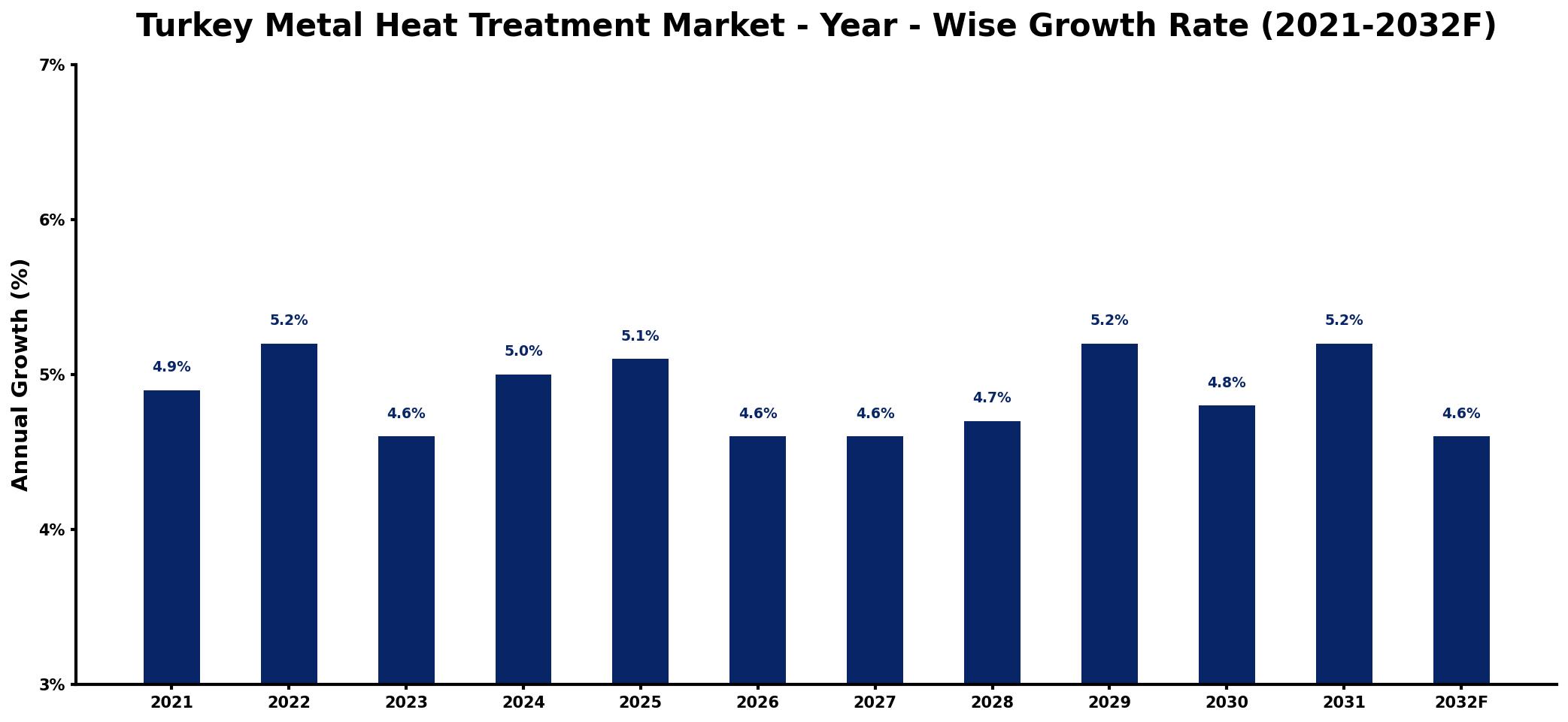
The table below presents the year‑wise growth rates along with the key drivers influencing the market
| Year | Growth Rate | Major Drivers |
| 2021 | 4.9% | Rising automotive manufacturing activities |
| 2022 | 5.2% | Expansion in aerospace sector investments |
| 2023 | 4.6% | Growing demand from construction industry |
| 2024 | 5.0% | Increased exports to European markets |
| 2025 | 5.1% | Surge in renewable energy projects |
| 2026 | 4.6% | Technological advancements in production |
| 2027 | 4.6% | Boost in defense sector requirements |
| 2028 | 4.7% | Growth in machinery manufacturing output |
| 2029 | 5.2% | Higher infrastructure development spending |
| 2030 | 4.8% | Emerging trends in robotics applications |
| 2031 | 5.2% | Investment in advanced manufacturing technologies |
| 2032 | 4.6% | Strengthening supply chain networks |
Note: Market size estimations and growth projections presented in this report are based on 6Wresearch's proprietary forecasting methodology, utilizing the latest available industry data, government publications, and primary research inputs.
Turkey Metal Heat Treatment Market Synopsis
A prominent force driving the Turkey Metal Heat Treatment Market is the automotive industry, which is increasingly reliant on metallurgical processes to achieve required performance standards. The need for heat-treated components, characterized by improved hardness and durability, is critical for the evolving demands of this sector.
Furthermore, advancements in technology, such as energy-efficient furnaces and process automation, are reshaping the landscape of heat treatment services. These innovations not only optimize operational efficiency but also align with sustainability goals, enhancing market prospects.
Turkey Metal Heat Treatment Market Key Takeaways
- The Turkey Metal Heat Treatment Market is driven primarily by the automotive and aerospace sectors.
- Technological advancements are significantly enhancing process efficiencies and product quality.
- Energy efficiency and environmental regulations are shaping operational practices in heat treatment.
- The demand for various heat treatment services, including annealing and tempering, is on the rise.
- Quality control remains a crucial focus, emphasizing the need for uniform results across different metal alloys.
Evaluation of Restraints in Turkey Metal Heat Treatment Market
Despite its growth, the Turkey Metal Heat Treatment Market faces challenges related to the optimization of heat treatment processes across various metal alloys. Achieving consistent results can be difficult, as variations in alloy composition and thermal properties necessitate tailored approaches. Additionally, adherence to rigorous quality control standards is critical, as deviations can impact product performance and safety. These factors contribute to operational complexities that industry players must navigate to sustain growth.
Turkey Metal Heat Treatment Market Trends
Current trends in the Turkey Metal Heat Treatment Market reflect a strong inclination towards automation and digitalization. The integration of Industry 4.0 principles is leading to smarter operational frameworks, enabling real-time monitoring and adjustments that enhance process accuracy. Furthermore, the adoption of sustainable practices, such as waste heat recovery and resource-efficient technologies, is increasingly becoming a priority for businesses.
Moreover, with the expansion of the electric vehicle segment, there is a growing focus on lightweight materials that require specialized heat treatment processes. This shift will likely fuel innovation and demand for advanced metallurgical solutions tailored to meet these new requirements.
Turkey Metal Heat Treatment Market Opportunities
Opportunities for growth in the Turkey Metal Heat Treatment Market are abundant, particularly in the aerospace sector, where stringent performance and safety requirements drive demand for high-quality, heat-treated components. Additionally, the rise of renewable energy technologies opens avenues for specialized heat treatment processes suited for materials used in wind and solar energy applications. Investment in research and development to enhance metallurgical properties will further position companies at the forefront of innovation.
Government Initiatives in the Turkey Metal Heat Treatment Market
The Turkish government is actively promoting energy efficiency and environmental sustainability within the metal heat treatment sector. Regulatory frameworks encourage adherence to quality standards while incentivizing technological advancements in heat treatment processes. Public spending initiatives aimed at fostering innovation within manufacturing processes also contribute to an improved competitive landscape for heat treatment service providers.
Future Insights of the Turkey Metal Heat Treatment Market
Looking ahead to 2026-2032, the Turkey Metal Heat Treatment Market is expected to continue its upward trajectory, driven by technological innovations and increased application in emerging sectors. The growing emphasis on sustainable manufacturing practices will likely shape industry standards, compelling companies to adopt greener technologies. As demand for high-performance materials expands, particularly in the automotive and aerospace industries, heat treatment processes will evolve to meet these specialized needs, creating a dynamic and competitive market environment.
Turkey Metal Heat Treatment Market Latest Developments (2025 - 2026)
Recent developments in the Turkey Metal Heat Treatment Market indicate a strong shift towards enhanced automation and energy efficiency. Companies are increasingly investing in cutting-edge heat treatment technologies that not only optimize process efficiency but also adhere to environmental standards. Furthermore, collaborations between industry stakeholders are emerging, aimed at advancing R&D efforts in metallurgical processes to support the evolving needs of key sectors.
Turkey Metal Heat Treatment Market - Key Attractiveness of the Report
- 10 Years of Market Numbers
- Historical Data Starting from 2022 to 2025
- Base Year: 2025
- Forecast Data until 2032
- Key Performance Indicators Impacting the Market
- Major Upcoming Developments and Projects
Key Highlights of the Report:
- Turkey Metal Heat Treatment Market Outlook
- Market Size of Turkey Metal Heat Treatment Market, 2025
- Forecast of Turkey Metal Heat Treatment Market, 2032
- Historical Data and Forecast of Turkey Metal Heat Treatment Revenues & Volume for the Period 2022-2032F
- Turkey Metal Heat Treatment Market Trend Evolution
- Turkey Metal Heat Treatment Market Drivers and Challenges
- Turkey Metal Heat Treatment Price Trends
- Turkey Metal Heat Treatment Porter's Five Forces
- Turkey Metal Heat Treatment Industry Life Cycle
- Historical Data and Forecast of Turkey Metal Heat Treatment Market Revenues & Volume By Material Type for the Period 2022-2032F
- Historical Data and Forecast of Turkey Metal Heat Treatment Market Revenues & Volume By Steel for the Period 2022-2032F
- Historical Data and Forecast of Turkey Metal Heat Treatment Market Revenues & Volume By Cast Iron for the Period 2022-2032F
- Historical Data and Forecast of Turkey Metal Heat Treatment Market Revenues & Volume By Others for the Period 2022-2032F
- Historical Data and Forecast of Turkey Metal Heat Treatment Market Revenues & Volume By Process Type for the Period 2022-2032F
- Historical Data and Forecast of Turkey Metal Heat Treatment Market Revenues & Volume By Hardening & Tempering for the Period 2022-2032F
- Historical Data and Forecast of Turkey Metal Heat Treatment Market Revenues & Volume By Normalizing for the Period 2022-2032F
- Historical Data and Forecast of Turkey Metal Heat Treatment Market Revenues & Volume By Annealing for the Period 2022-2032F
- Historical Data and Forecast of Turkey Metal Heat Treatment Market Revenues & Volume By Case Hardening for the Period 2022-2032F
- Historical Data and Forecast of Turkey Metal Heat Treatment Market Revenues & Volume By Others for the Period 2022-2032F
- Historical Data and Forecast of Turkey Metal Heat Treatment Market Revenues & Volume By Equipment Type for the Period 2022-2032F
- Historical Data and Forecast of Turkey Metal Heat Treatment Market Revenues & Volume By Electrically Heated Furnace for the Period 2022-2032F
- Historical Data and Forecast of Turkey Metal Heat Treatment Market Revenues & Volume By Fuel-fired Furnace for the Period 2022-2032F
- Historical Data and Forecast of Turkey Metal Heat Treatment Market Revenues & Volume By Others for the Period 2022-2032F
- Historical Data and Forecast of Turkey Metal Heat Treatment Market Revenues & Volume By Application for the Period 2022-2032F
- Historical Data and Forecast of Turkey Metal Heat Treatment Market Revenues & Volume By Automotive for the Period 2022-2032F
- Historical Data and Forecast of Turkey Metal Heat Treatment Market Revenues & Volume By Machine for the Period 2022-2032F
- Historical Data and Forecast of Turkey Metal Heat Treatment Market Revenues & Volume By Metalworking for the Period 2022-2032F
- Historical Data and Forecast of Turkey Metal Heat Treatment Market Revenues & Volume By Aerospace for the Period 2022-2032F
- Historical Data and Forecast of Turkey Metal Heat Treatment Market Revenues & Volume By Construction for the Period 2022-2032F
- Historical Data and Forecast of Turkey Metal Heat Treatment Market Revenues & Volume By Others for the Period 2022-2032F
- Turkey Metal Heat Treatment Import Export Trade Statistics
- Market Opportunity Assessment By Material Type
- Market Opportunity Assessment By Process Type
- Market Opportunity Assessment By Equipment Type
- Market Opportunity Assessment By Application
- Turkey Metal Heat Treatment Top Companies Market Share
- Turkey Metal Heat Treatment Competitive Benchmarking By Technical and Operational Parameters
- Turkey Metal Heat Treatment Company Profiles
- Turkey Metal Heat Treatment Key Strategic Recommendations
Frequently Asked Questions About the Market Study (FAQs):
The Turkey Metal Heat Treatment Market is estimated to be valued at USD 236 Million in 2025, with projections to reach USD 314 Million by 2032, reflecting a steady growth rate of 4.2% CAGR from 2026 to 2032.
The automotive and aerospace sectors are pivotal in driving demand for heat treatment services, as they require specialized processes to enhance mechanical properties and ensure product safety.
Innovations such as automation, energy-efficient furnaces, and process digitization are enhancing operational efficiency, reducing costs, and improving product quality in the Turkey Metal Heat Treatment Market.
Companies must navigate the complexities of optimizing heat treatment for diverse metal alloys while ensuring uniformity and meeting rigorous quality control standards.
The Turkish government is promoting energy efficiency and environmental sustainability in the metal heat treatment sector through regulatory frameworks that encourage technological advancements and adherence to quality standards.
The market is likely to see an increase in demand for specialized heat treatments tailored to lightweight materials, particularly in the expanding electric vehicle segment and renewable energy technologies.
6Wresearch actively monitors the Turkey Metal Heat Treatment Market and publishes its comprehensive annual report, highlighting emerging trends, growth drivers, revenue analysis, and forecast outlook. Our insights help businesses to make data-backed strategic decisions with ongoing market dynamics. Our analysts track relevent industries related to the Turkey Metal Heat Treatment Market, allowing our clients with actionable intelligence and reliable forecasts tailored to emerging regional needs.
Yes, we provide customisation as per your requirements. To learn more, feel free to contact us on sales@6wresearch.com
1 Executive Summary |
2 Introduction |
2.1 Key Highlights of the Report |
2.2 Report Description |
2.3 Market Scope & Segmentation |
2.4 Research Methodology |
2.5 Assumptions |
3 Turkey Metal Heat Treatment Market Overview |
3.1 Turkey Country Macro Economic Indicators |
3.2 Turkey Metal Heat Treatment Market Revenues & Volume, 2022 & 2032F |
3.3 Turkey Metal Heat Treatment Market - Industry Life Cycle |
3.4 Turkey Metal Heat Treatment Market - Porter's Five Forces |
3.5 Turkey Metal Heat Treatment Market Revenues & Volume Share, By Material Type, 2022 & 2032F |
3.6 Turkey Metal Heat Treatment Market Revenues & Volume Share, By Process Type, 2022 & 2032F |
3.7 Turkey Metal Heat Treatment Market Revenues & Volume Share, By Equipment Type, 2022 & 2032F |
3.8 Turkey Metal Heat Treatment Market Revenues & Volume Share, By Application, 2022 & 2032F |
4 Turkey Metal Heat Treatment Market Dynamics |
4.1 Impact Analysis |
4.2 Market Drivers |
4.2.1 Increasing demand for high-quality metal components in industries such as automotive, aerospace, and manufacturing |
4.2.2 Growing emphasis on energy efficiency and sustainability, driving the adoption of advanced heat treatment technologies |
4.2.3 Technological advancements in heat treatment processes leading to improved efficiency and cost-effectiveness |
4.3 Market Restraints |
4.3.1 Fluctuating raw material prices impacting the overall cost of metal heat treatment processes |
4.3.2 Stringent environmental regulations leading to additional compliance costs for metal heat treatment facilities |
4.3.3 Intense market competition putting pressure on pricing and profit margins |
5 Turkey Metal Heat Treatment Market Trends |
6 Turkey Metal Heat Treatment Market, By Types |
6.1 Turkey Metal Heat Treatment Market, By Material Type |
6.1.1 Overview and Analysis |
6.1.2 Turkey Metal Heat Treatment Market Revenues & Volume, By Material Type, 2022-2032F |
6.1.3 Turkey Metal Heat Treatment Market Revenues & Volume, By Steel, 2022-2032F |
6.1.4 Turkey Metal Heat Treatment Market Revenues & Volume, By Cast Iron, 2022-2032F |
6.1.5 Turkey Metal Heat Treatment Market Revenues & Volume, By Others, 2022-2032F |
6.2 Turkey Metal Heat Treatment Market, By Process Type |
6.2.1 Overview and Analysis |
6.2.2 Turkey Metal Heat Treatment Market Revenues & Volume, By Hardening & Tempering, 2022-2032F |
6.2.3 Turkey Metal Heat Treatment Market Revenues & Volume, By Normalizing, 2022-2032F |
6.2.4 Turkey Metal Heat Treatment Market Revenues & Volume, By Annealing, 2022-2032F |
6.2.5 Turkey Metal Heat Treatment Market Revenues & Volume, By Case Hardening, 2022-2032F |
6.2.6 Turkey Metal Heat Treatment Market Revenues & Volume, By Others, 2022-2032F |
6.3 Turkey Metal Heat Treatment Market, By Equipment Type |
6.3.1 Overview and Analysis |
6.3.2 Turkey Metal Heat Treatment Market Revenues & Volume, By Electrically Heated Furnace, 2022-2032F |
6.3.3 Turkey Metal Heat Treatment Market Revenues & Volume, By Fuel-fired Furnace, 2022-2032F |
6.3.4 Turkey Metal Heat Treatment Market Revenues & Volume, By Others, 2022-2032F |
6.4 Turkey Metal Heat Treatment Market, By Application |
6.4.1 Overview and Analysis |
6.4.2 Turkey Metal Heat Treatment Market Revenues & Volume, By Automotive, 2022-2032F |
6.4.3 Turkey Metal Heat Treatment Market Revenues & Volume, By Machine, 2022-2032F |
6.4.4 Turkey Metal Heat Treatment Market Revenues & Volume, By Metalworking, 2022-2032F |
6.4.5 Turkey Metal Heat Treatment Market Revenues & Volume, By Aerospace, 2022-2032F |
6.4.6 Turkey Metal Heat Treatment Market Revenues & Volume, By Construction, 2022-2032F |
6.4.7 Turkey Metal Heat Treatment Market Revenues & Volume, By Others, 2022-2032F |
7 Turkey Metal Heat Treatment Market Import-Export Trade Statistics |
7.1 Turkey Metal Heat Treatment Market Export to Major Countries |
7.2 Turkey Metal Heat Treatment Market Imports from Major Countries |
8 Turkey Metal Heat Treatment Market Key Performance Indicators |
8.1 Energy efficiency improvements in heat treatment processes |
8.2 Adoption rate of advanced heat treatment technologies |
8.3 Percentage of metal components meeting industry quality standards |
8.4 Number of new entrants in the metal heat treatment market |
8.5 Investment in research and development for innovative heat treatment solutions |
9 Turkey Metal Heat Treatment Market - Opportunity Assessment |
9.1 Turkey Metal Heat Treatment Market Opportunity Assessment, By Material Type, 2022 & 2032F |
9.2 Turkey Metal Heat Treatment Market Opportunity Assessment, By Process Type, 2022 & 2032F |
9.3 Turkey Metal Heat Treatment Market Opportunity Assessment, By Equipment Type, 2022 & 2032F |
9.4 Turkey Metal Heat Treatment Market Opportunity Assessment, By Application, 2022 & 2032F |
10 Turkey Metal Heat Treatment Market - Competitive Landscape |
10.1 Turkey Metal Heat Treatment Market Revenue Share, By Companies, 2025 |
10.2 Turkey Metal Heat Treatment Market Competitive Benchmarking, By Operating and Technical Parameters |
11 Company Profiles |
12 Recommendations |
13 Disclaimer |
Global Go To Market Strategy - 2030
Export potential enables firms to identify high-growth global markets with greater confidence by combining advanced trade intelligence with a structured quantitative methodology. The framework analyzes emerging demand trends and country-level import patterns while integrating macroeconomic and trade datasets such as GDP and population forecasts, bilateral import–export flows, tariff structures, elasticity differentials between developed and developing economies, geographic distance, and import demand projections. Using weighted trade values from 2020–2024 as the base period to project country-to-country export potential for 2030, these inputs are operationalized through calculated drivers such as gravity model parameters, tariff impact factors, and projected GDP per-capita growth. Through an analysis of hidden potentials, demand hotspots, and market conditions that are most favorable to success, this method enables firms to focus on target countries, maximize returns, and global expansion with data, backed by accuracy.
By factoring in the projected importer demand gap that is currently unmet and could be potential opportunity, it identifies the potential for the Exporter (Country) among 190 countries, against the general trade analysis, which identifies the biggest importer or exporter.
To discover high-growth global markets and optimize your business strategy:
Click Here
Pricing
- Single User License$ 1,995
- Department License$ 2,400
- Site License$ 3,120
- Global License$ 3,795

Leadership Perspectives from Industry Events
Search
Thought Leadership and Analyst Meet





Our Clients








6WResearch In News
- India Air Conditioner Market Set for Strong Rebound in 2026 After Weather-Led Correction and GST-Driven Recovery: 6Wresearch
- ADAS in India: How Automatic Emergency Braking, Blind Spot Detection & Driver Monitoring are Transforming Road Safety
- Doha a strategic location for EV manufacturing hub: IPA Qatar
- Demand for luxury TVs surging in the GCC, says Samsung
- Empowering Growth: The Thriving Journey of Bangladesh’s Cable Industry
- Demand for luxury TVs surging in the GCC, says Samsung
Latest Reports
- Nicaragua RPG Gaming Market (2026-2032)
- New Zealand RPG Gaming Market (2026-2032)
- Netherlands RPG Gaming Market (2026-2032)
- Nauru RPG Gaming Market (2026-2032)
- Namibia RPG Gaming Market (2026-2032)
- Mozambique RPG Gaming Market (2026-2032)
- Montenegro RPG Gaming Market (2026-2032)
- Mongolia RPG Gaming Market (2026-2032)
- Monaco RPG Gaming Market (2026-2032)
- Micronesia RPG Gaming Market (2026-2032)
Industry Events and Analyst Meet

EV India Expo 2026

HIMTEX 2026

India Refining Summit 2026

India EV Show 2026

EV tech India Expo 2026
Whitepaper
- Middle East & Africa Commercial Security Market Click here to view more.
- Middle East & Africa Fire Safety Systems & Equipment Market Click here to view more.
- GCC Drone Market Click here to view more.
- Middle East Lighting Fixture Market Click here to view more.
- GCC Physical & Perimeter Security Market Click here to view more.


