Turkey Online Advertising Market Size & Growth Rate (2026-2032)
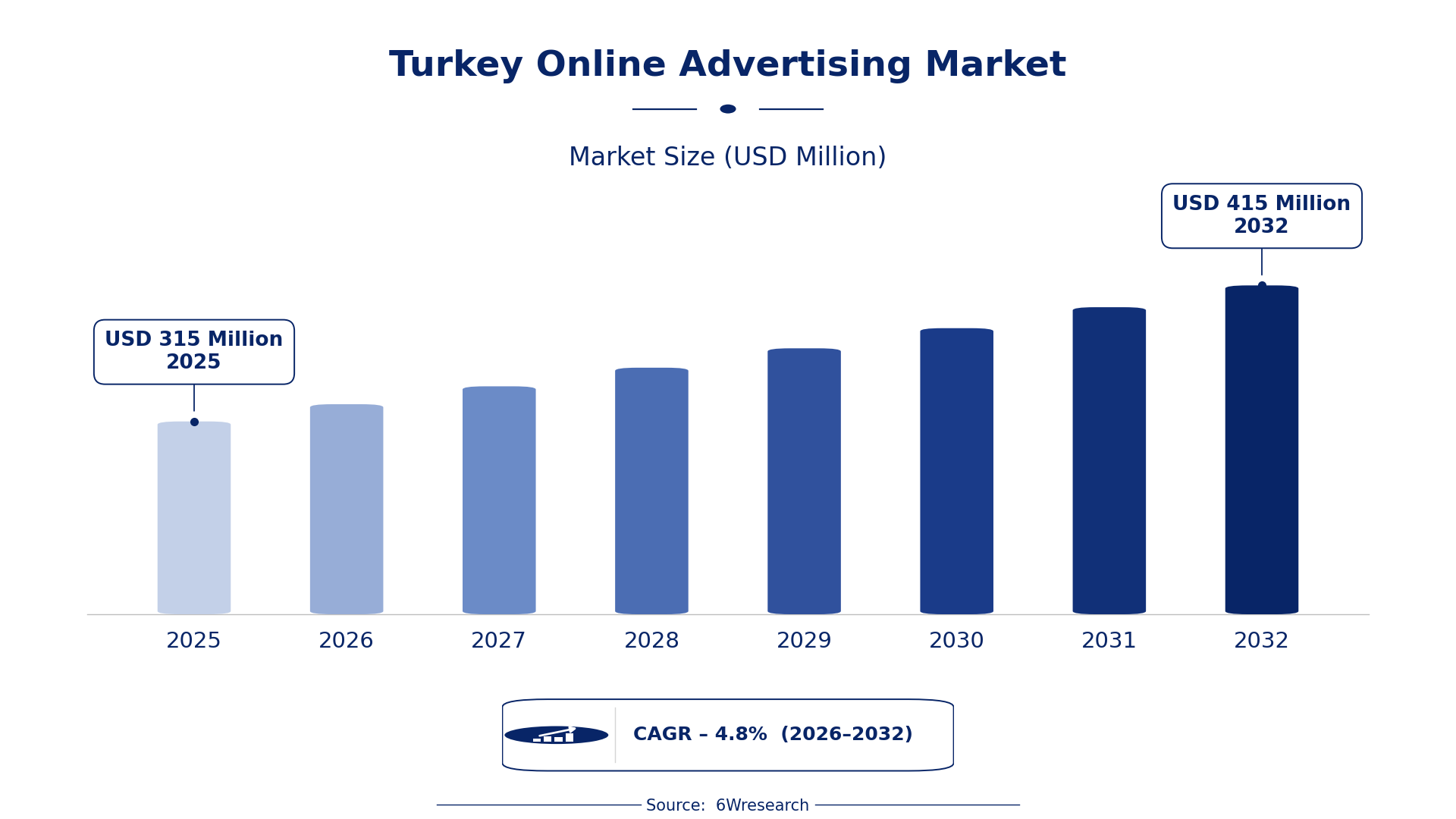
The Turkey Online Advertising Market was estimated at USD 315 Million in 2025 and is projected to reach USD 415 Million by 2032, growing at a CAGR of 4.8% from 2026 to 2032.
Turkey Online Advertising Market Synopsis
The Turkey Online Advertising Market has witnessed remarkable momentum, fueled by soaring internet penetration and the digital transformation of businesses. This growth is not merely a passing phase; it's indicative of a broader shift towards online platforms as advertisers aim to connect with Turkey's youthful, tech-savvy demographic.
As the market looks forward, the emphasis on mobile and social media advertising is intensifying. With more consumers engaging through smartphones, advertisers are prioritizing mobile strategies. Coupled with the rise of programmatic advertising, the future promises a more targeted and effective approach to digital marketing.
Turkey Online Advertising Market Year-wise Growth Rate and Key Drivers
This graph illustrates the annual growth rates of the Turkey Online Advertising Market from 2021 to 2032, highlighting a steady upward trajectory and projected expansion over the forecast period.
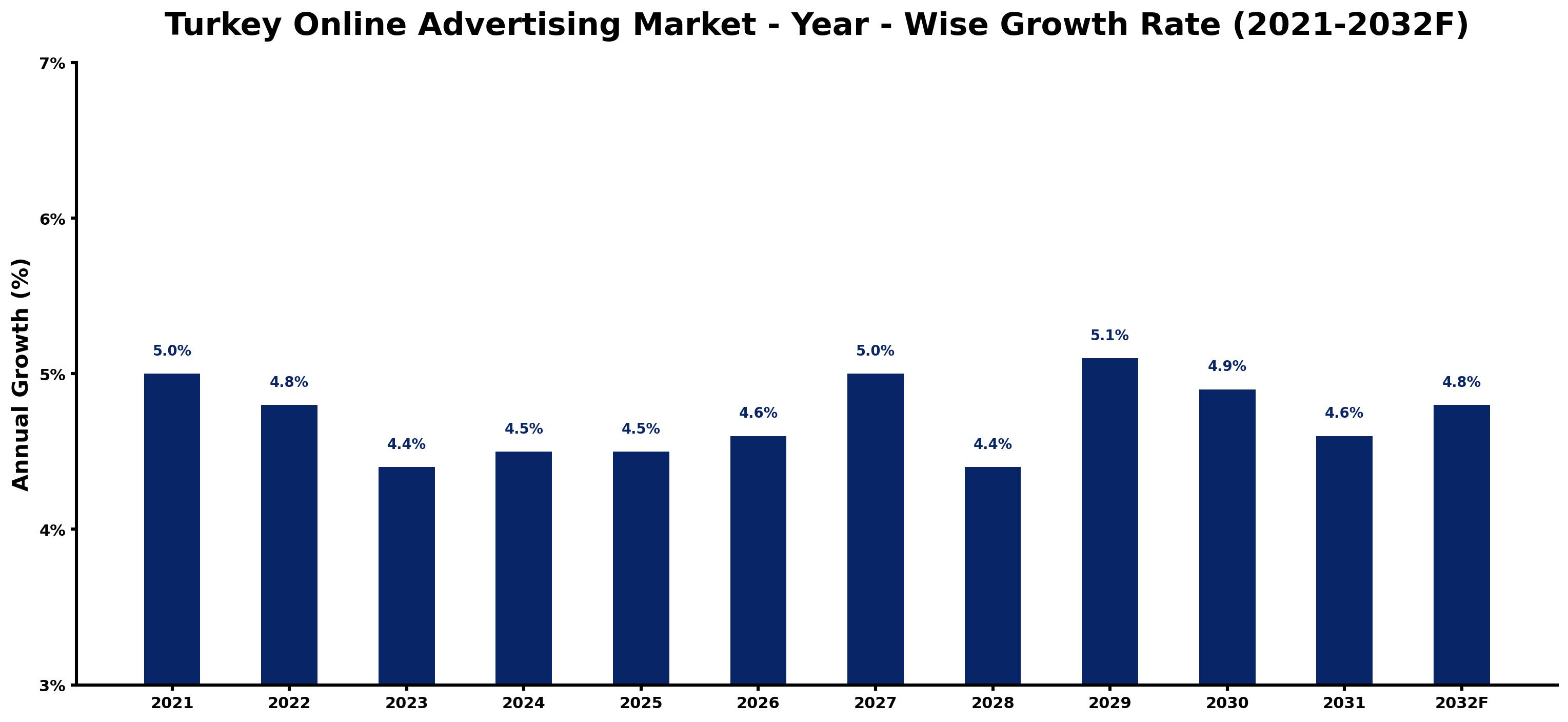
The table below presents the year‑wise growth rates along with the key drivers influencing the market
| Year | Growth Rate | Major Drivers |
| 2021 | 5.0% | Increased e-commerce activity boosting online ad spending. |
| 2022 | 4.8% | Growing presence of social media influencers in Turkey. |
| 2023 | 4.4% | Adoption of advanced analytics by local advertisers. |
| 2024 | 4.5% | Rise in mobile advertising due to 5G rollout. |
| 2025 | 4.5% | Increased digital literacy among younger Turkish demographics. |
| 2026 | 4.6% | Higher internet access in rural areas enhancing market reach. |
| 2027 | 5.0% | Growing interest in programmatic advertising technologies. |
| 2028 | 4.4% | Investments in localized digital platforms by SMEs. |
| 2029 | 5.1% | Emergence of new video advertising platforms in Turkey. |
| 2030 | 4.9% | Strengthening regulations on traditional advertising formats. |
| 2031 | 4.6% | Increased use of augmented reality in advertising campaigns. |
| 2032 | 4.8% | Enhanced data privacy measures driving targeted advertising growth. |
Note: Market size estimations and growth projections presented in this report are based on 6Wresearch's proprietary forecasting methodology, utilizing the latest available industry data, government publications, and primary research inputs.
Turkey Online Advertising Market Key Takeaways
Below are some of the specific key takeaways from the market, including:
- Rapid growth in mobile advertising due to high smartphone penetration.
- Social media platforms are pivotal for targeted advertising strategies.
- Programmatic advertising is becoming increasingly popular, enhancing efficiency.
- Data-driven approaches are key for optimizing advertising campaigns.
- Video content is capturing a larger share of advertising budgets.
Evaluation of Restraints in Turkey Online Advertising Market
Despite the promising growth trajectory, the Turkey Online Advertising Market faces several constraints that could impede progress. Navigating the complex regulatory framework remains a significant hurdle for advertisers. The need for compliance with evolving laws, particularly concerning consumer protection and data privacy, adds an extra layer of complexity.
on top of that, the prevalence of ad fraud and viewability issues poses challenges in ensuring that marketing budgets yield maximum returns. As mobile usage continues to grow, optimizing ads for various platforms while maintaining a quality user experience is crucial for success in this competitive space.
Turkey Online Advertising Market Trends
Current trends in the Turkey Online Advertising Market reflect a strong shift towards mobile and social media advertising. As consumers increasingly prefer to access content on mobile devices, advertisers are reallocating budgets accordingly. Social media continues to dominate, with brands leveraging platforms to engage users through targeted ads.
Additionally, video advertising is gaining traction as consumer preferences shift towards dynamic content. The move towards data analytics for personalized marketing is reshaping how advertisers approach their campaigns, focusing on effective audience targeting and engagement strategies.
Turkey Online Advertising Market Opportunities
Investment opportunities abound in the Turkey Online Advertising Market, primarily due to the country's youthful population and growing internet penetration. The demand for innovative online advertising solutions is surging, particularly in mobile advertising and social media marketing.
Companies that invest in data-driven strategies and advanced technologies will likely find themselves at a competitive advantage. As the e-commerce sector grows, advertisers have an opportunity to tap into retail advertising, maximizing their outreach through digital channels.
Government Initiatives in the Turkey Online Advertising Market
In Turkey, government policy plays a significant role in shaping the online advertising market. Regulatory frameworks established by the Information Technologies and Communication Authority (BTK) focus on consumer protection and data privacy, impacting how businesses operate within this space.
- A national initiative recently launched to enhance consumer protection laws regarding online advertising content.
- Currently ongoing is a review of the Personal Data Protection Law to strengthen user consent requirements in advertising practices.
- A planned digital infrastructure improvement program is expected to roll out by 2026, aiming to enhance connectivity and access for advertisers.
- New regulations aimed at increasing transparency in online advertising metrics are set to be introduced in the next legislative session.
Future Insights of the Turkey Online Advertising Market
Looking ahead to 2026-2032, the Turkey Online Advertising Market is on track for steady growth. The increasing prevalence of mobile and social media advertising will continue to define this market's evolution. Advertisers will likely invest more in personalized and targeted strategies, leveraging data analytics to enhance their campaigns.
The ongoing rise of e-commerce will further fuel ad spending, particularly in the retail sector. As technological advancements continue to reshape consumer behaviors, those who adapt swiftly will find themselves leading the charge in this dynamic market.
Turkey Online Advertising Market Latest Developments
Recent activity in the Turkey Online Advertising Market has been marked by rapid advancements and strategic initiatives. Over the past year, businesses have increasingly embraced mobile-first advertising strategies as consumer habits shift towards mobile engagement.
- A major advertising firm launched a new mobile platform in late 2025, enhancing targeted ad capabilities for local businesses.
- In Q1 2026, a technology vendor initiated a collaboration with a leading social media platform to improve ad placement algorithms.
- Currently underway is a project aimed at integrating augmented reality (AR) features into online advertising, expected to be completed by mid-2026.
- A planned expansion of programmatic advertising services is anticipated to begin in the second half of 2026, enhancing efficiency for advertisers.
Turkey Online Advertising Market - Key Attractiveness of the Report
- 10 Years of Market Numbers
- Historical Data Starting from 2022 to 2025
- Base Year: 2025
- Forecast Data until 2032
- Key Performance Indicators Impacting the Market
- Major Upcoming Developments and Projects
Key Highlights of the Report:
- Turkey Online Advertising Market Outlook
- Market Size of Turkey Online Advertising Market, 2025
- Forecast of Turkey Online Advertising Market, 2032
- Historical Data and Forecast of Turkey Online Advertising Revenues & Volume for the Period 2022-2032F
- Turkey Online Advertising Market Trend Evolution
- Turkey Online Advertising Market Drivers and Challenges
- Turkey Online Advertising Price Trends
- Turkey Online Advertising Porter's Five Forces
- Turkey Online Advertising Industry Life Cycle
- Historical Data and Forecast of Turkey Online Advertising Market Revenues & Volume By Format for the Period 2022-2032F
- Historical Data and Forecast of Turkey Online Advertising Market Revenues & Volume By Search Engine Marketing for the Period 2022-2032F
- Historical Data and Forecast of Turkey Online Advertising Market Revenues & Volume By Display Advertising for the Period 2022-2032F
- Historical Data and Forecast of Turkey Online Advertising Market Revenues & Volume By Classified for the Period 2022-2032F
- Historical Data and Forecast of Turkey Online Advertising Market Revenues & Volume By Mobile for the Period 2022-2032F
- Historical Data and Forecast of Turkey Online Advertising Market Revenues & Volume By Digital Video for the Period 2022-2032F
- Historical Data and Forecast of Turkey Online Advertising Market Revenues & Volume By Lead Generation for the Period 2022-2032F
- Historical Data and Forecast of Turkey Online Advertising Market Revenues & Volume By Rich Media for the Period 2022-2032F
- Historical Data and Forecast of Turkey Search Engine Marketing Online Advertising Market Revenues & Volume By Others for the Period 2022-2032F
- Historical Data and Forecast of Turkey Online Advertising Market Revenues & Volume By Vertical for the Period 2022-2032F
- Historical Data and Forecast of Turkey Online Advertising Market Revenues & Volume By Automotive for the Period 2022-2032F
- Historical Data and Forecast of Turkey Online Advertising Market Revenues & Volume By BFSI for the Period 2022-2032F
- Historical Data and Forecast of Turkey Online Advertising Market Revenues & Volume By CPG for the Period 2022-2032F
- Historical Data and Forecast of Turkey Online Advertising Market Revenues & Volume By Education for the Period 2022-2032F
- Historical Data and Forecast of Turkey Online Advertising Market Revenues & Volume By Healthcare for the Period 2022-2032F
- Historical Data and Forecast of Turkey Online Advertising Market Revenues & Volume By Industrial for the Period 2022-2032F
- Historical Data and Forecast of Turkey Online Advertising Market Revenues & Volume By Media and Entertainment for the Period 2022-2032F
- Historical Data and Forecast of Turkey Online Advertising Market Revenues & Volume By Retail for the Period 2022-2032F
- Turkey Online Advertising Import Export Trade Statistics
- Market Opportunity Assessment By Format
- Market Opportunity Assessment By Vertical
- Turkey Online Advertising Top Companies Market Share
- Turkey Online Advertising Competitive Benchmarking By Technical and Operational Parameters
- Turkey Online Advertising Company Profiles
- Turkey Online Advertising Key Strategic Recommendations






































