Turkey Pearl Jewelry Market Size, Share & Growth Rate
The Turkey Pearl Jewelry Market was estimated at USD 424 Million in 2025 and is projected to reach USD 555 Million by 2032, growing at a CAGR of 3.9% from 2026 to 2032. This upward trajectory is fueled by a confluence of cultural appreciation for pearl jewelry and an increasing shift towards sustainable and ethically sourced products among consumers. With the rise of e-commerce and a burgeoning middle-class demographic, the market is set to expand, catering to diverse consumer preferences.
Turkey Pearl Jewelry Market Year-wise Growth Rate and Key Drivers
This graph highlights how the Turkey Pearl Jewelry Market has steadily grown over the years, supported by major growth factors.
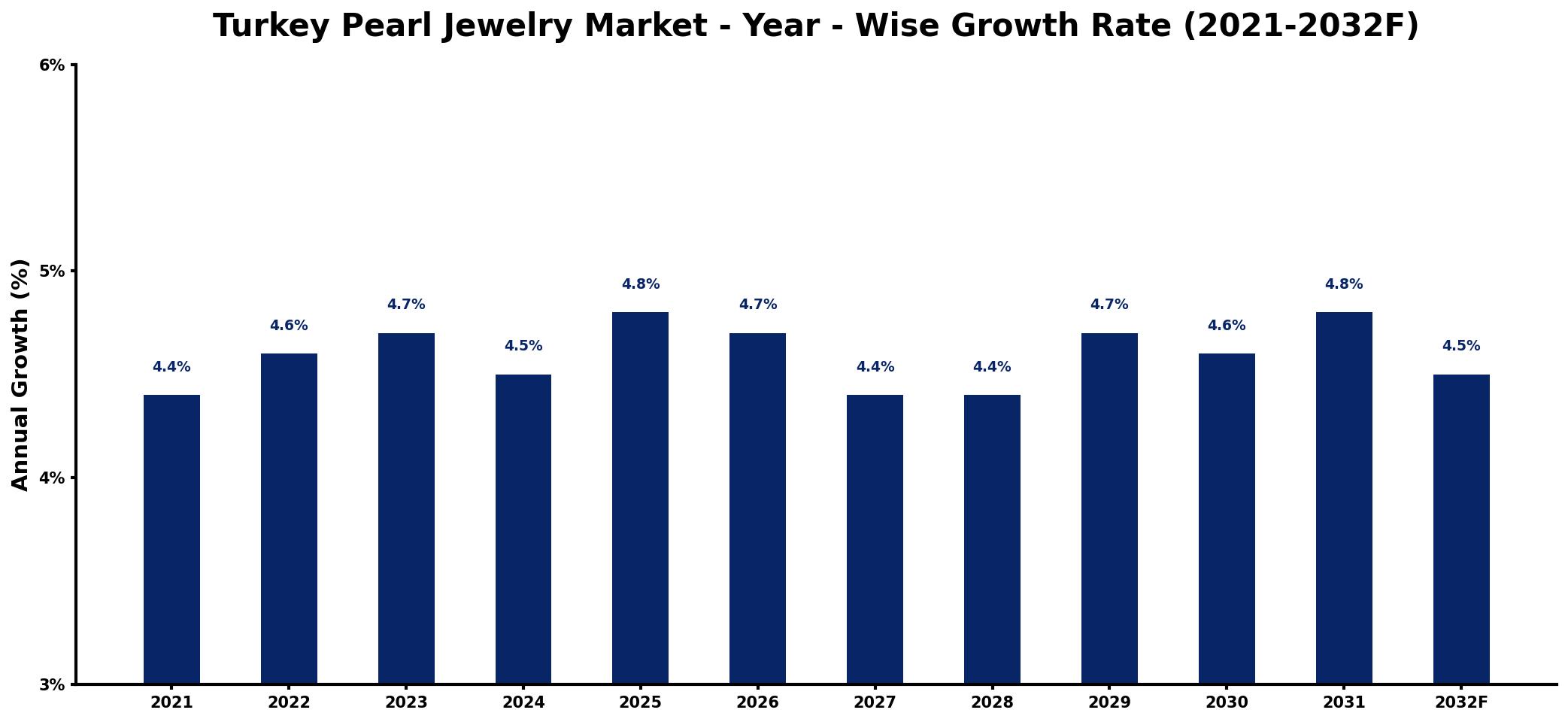
The table below presents the year‑wise growth rates along with the key drivers influencing the market
| Year | Growth Rate | Major Drivers |
| 2021 | 4.4% | Rising consumer disposable income |
| 2022 | 4.6% | Growing interest in luxury items |
| 2023 | 4.7% | Increase in online shopping platforms |
| 2024 | 4.5% | Expansion of retail distribution channels |
| 2025 | 4.8% | Growth in tourism and gifting |
| 2026 | 4.7% | Emergence of sustainable sourcing trends |
| 2027 | 4.4% | Innovative marketing strategies implemented |
| 2028 | 4.4% | Strengthening of local artisan communities |
| 2029 | 4.7% | Collaboration with fashion influencers |
| 2030 | 4.6% | Increasing popularity of customization options |
| 2031 | 4.8% | Enhanced digital marketing initiatives |
| 2032 | 4.5% | Development of premium packaging solutions |
Note: Market size estimations and growth projections presented in this report are based on 6Wresearch's proprietary forecasting methodology, utilizing the latest available industry data, government publications, and primary research inputs.
Turkey Pearl Jewelry Market Synopsis
The strongest force shaping the Turkey Pearl Jewelry Market today is the growing consumer demand for sustainability and ethical sourcing. As awareness increases regarding the environmental impact of luxury goods, Turkish consumers are gravitating towards responsibly sourced pearls, leading to innovative practices among local artisans.
Alongside this, the cultural significance of pearls as symbols of luxury and sophistication in Turkish society continues to drive interest in pearl jewelry. The market showcases a vibrant assortment of designs—from contemporary minimalist styles to bespoke creations—allowing consumers to express individuality while embracing timeless elegance.
Turkey Pearl Jewelry Market Key Takeaways
- The market is witnessing a significant shift towards sustainable and ethically sourced pearl jewelry, aligning with global consumer trends.
- Contemporary and minimalist designs are rapidly gaining popularity, appealing to modern consumers seeking versatile accessories.
- Custom and personalized pearl jewelry pieces are becoming prominent, reflecting a desire for unique and meaningful gifts.
- Local artisans play a pivotal role in the market, offering handcrafted pieces that resonate with both domestic and international buyers.
- The increasing middle-class population in Turkey is expanding the customer base for pearl jewelry, creating new opportunities for growth.
Evaluation of Restraints in Turkey Pearl Jewelry Market
Despite the promising landscape, several constraints challenge the Turkey Pearl Jewelry Market. The emergence of synthetic and imitation pearls has led to increased competition, often causing consumer confusion regarding quality. Additionally, fluctuations in the natural pearl prices pose challenges for businesses and consumers alike. Heightened awareness about the sustainability of sourcing practices requires companies to adapt quickly, not only to remain competitive but also to satisfy the growing demand for ethically produced jewelry.
Turkey Pearl Jewelry Market Trends
Several key trends are currently shaping the Turkey Pearl Jewelry Market. There is a marked preference for dainty pieces that can be layered or easily integrated into various fashion styles, catering to a versatile consumer base. Furthermore, as buyers become more environmentally conscious, the demand for sustainably harvested pearls is on the rise. The customization trend is also evident, with consumers increasingly seeking unique pieces that tell their personal stories or celebrate special moments.
Turkey Pearl Jewelry Market Opportunities
The Turkey Pearl Jewelry Market presents substantial investment opportunities, particularly in expanding local manufacturing and promoting high-quality craftsmanship. Investors can explore avenues in online retail platforms and strategic digital marketing to reach a broader audience. Collaborating with artisans to create exclusive collections can offer a competitive advantage, tapping into the growing appreciation for handcrafted, culturally significant jewelry.
Government Initiatives in the Turkey Pearl Jewelry Market
The Turkish government has implemented supportive policies aimed at promoting the growth of the pearl jewelry market. Regulatory frameworks are in place to ensure quality standards and protect consumer interests. Furthermore, initiatives focusing on sustainability and innovation encourage research and development within the industry, fostering a conducive environment for businesses engaged in pearl jewelry.
Future Insights of the Turkey Pearl Jewelry Market
Looking ahead to 2026-2032, the Turkey Pearl Jewelry Market is poised for steady growth, driven by evolving consumer preferences towards ethically sourced products. As disposable incomes rise and e-commerce becomes more prominent, access to a broader array of pearl jewelry options will increase. These dynamics suggest a promising future for market players willing to innovate and respond to the needs of a discerning customer base.
Turkey Pearl Jewelry Market Latest Developments (2025 - 2026)
Recent developments in the Turkey Pearl Jewelry Market indicate a growing emphasis on sustainability and customization. Many local artisans have started adopting eco-friendly practices in sourcing and production, which is resonating with consumers. Additionally, increased engagement on social media platforms has led to the successful launch of unique collections and personalized jewelry services, expanding market reach and consumer engagement.
Turkey Pearl Jewelry Market - Key Attractiveness of the Report
- 10 Years of Market Numbers
- Historical Data Starting from 2022 to 2025
- Base Year: 2025
- Forecast Data until 2032
- Key Performance Indicators Impacting the Market
- Major Upcoming Developments and Projects
Key Highlights of the Report:
- Turkey Pearl Jewelry Market Outlook
- Market Size of Turkey Pearl Jewelry Market, 2025
- Forecast of Turkey Pearl Jewelry Market, 2032
- Historical Data and Forecast of Turkey Pearl Jewelry Revenues & Volume for the Period 2022-2032F
- Turkey Pearl Jewelry Market Trend Evolution
- Turkey Pearl Jewelry Market Drivers and Challenges
- Turkey Pearl Jewelry Price Trends
- Turkey Pearl Jewelry Porter's Five Forces
- Turkey Pearl Jewelry Industry Life Cycle
- Historical Data and Forecast of Turkey Pearl Jewelry Market Revenues & Volume By Pearl Type for the Period 2022-2032F
- Historical Data and Forecast of Turkey Pearl Jewelry Market Revenues & Volume By Freshwater for the Period 2022-2032F
- Historical Data and Forecast of Turkey Pearl Jewelry Market Revenues & Volume By Saltwater for the Period 2022-2032F
- Historical Data and Forecast of Turkey Pearl Jewelry Market Revenues & Volume By Material Type for the Period 2022-2032F
- Historical Data and Forecast of Turkey Pearl Jewelry Market Revenues & Volume By Gold for the Period 2022-2032F
- Historical Data and Forecast of Turkey Pearl Jewelry Market Revenues & Volume By Silver for the Period 2022-2032F
- Historical Data and Forecast of Turkey Pearl Jewelry Market Revenues & Volume By Others for the Period 2022-2032F
- Historical Data and Forecast of Turkey Pearl Jewelry Market Revenues & Volume By Jewelry Type for the Period 2022-2032F
- Historical Data and Forecast of Turkey Pearl Jewelry Market Revenues & Volume By Necklace for the Period 2022-2032F
- Historical Data and Forecast of Turkey Pearl Jewelry Market Revenues & Volume By Earrings for the Period 2022-2032F
- Historical Data and Forecast of Turkey Pearl Jewelry Market Revenues & Volume By Rings for the Period 2022-2032F
- Historical Data and Forecast of Turkey Pearl Jewelry Market Revenues & Volume By Others for the Period 2022-2032F
- Turkey Pearl Jewelry Import Export Trade Statistics
- Market Opportunity Assessment By Pearl Type
- Market Opportunity Assessment By Material Type
- Market Opportunity Assessment By Jewelry Type
- Turkey Pearl Jewelry Top Companies Market Share
- Turkey Pearl Jewelry Competitive Benchmarking By Technical and Operational Parameters
- Turkey Pearl Jewelry Company Profiles
- Turkey Pearl Jewelry Key Strategic Recommendations






































