Turkey Physiotherapy Equipment Market Summary
The turkey physiotherapy equipment market was estimated at USD 1186 Million in 2025 and is projected to reach USD 1687 Million by 2032, growing at a CAGR of 6.1% from 2026 to 2032.
Turkey Physiotherapy Equipment Market Year-wise Growth Rate and Key Drivers
This graph highlights how the Turkey Physiotherapy Equipment Market has steadily grown over the past five years, supported by major growth factors.
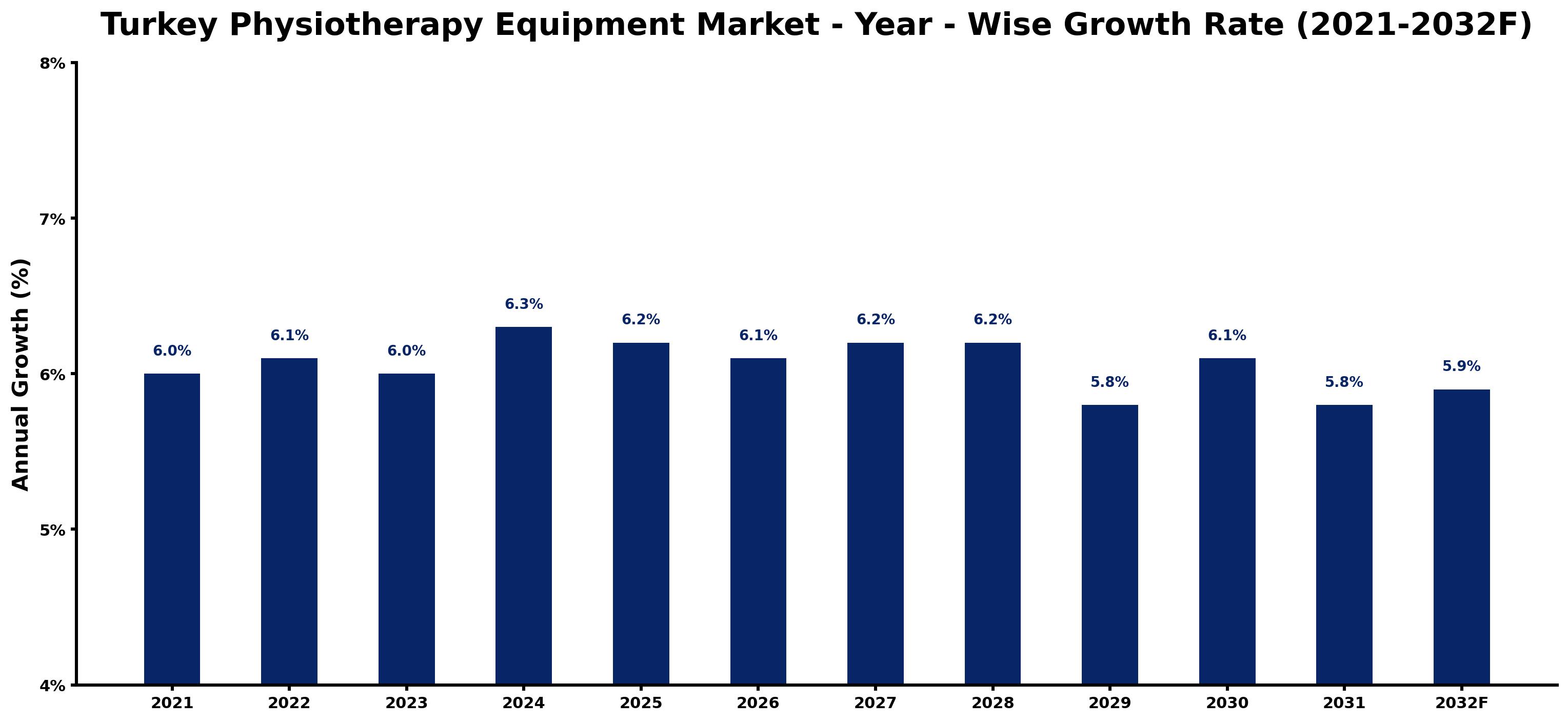
The table below presents the year wise growth rates along with the key drivers influencing the market
| Year | Growth Rate | Major Drivers |
| 2021 | 6.0% | Post-lockdown healthcare recovery highlighted the importance of physiotherapy in rehabilitation. |
| 2022 | 6.1% | Increased awareness of musculoskeletal disorders spurred investment in physiotherapy equipment. |
| 2023 | 6.0% | Technological integration in treatments led to a surge in demand for advanced devices. |
| 2024 | 6.3% | Expansion of healthcare facilities directly correlates with the need for physiotherapy tools. |
| 2025 | 6.2% | Insurance coverage enhancements for physiotherapy services support market penetration strategies. |
| 2026 | 6.1% | Urbanization trends contribute to heightened accessibility and availability of physiotherapy services. |
| 2027 | 6.2% | Fitness culture growth influences demand for preventative physiotherapy equipment and services. |
| 2028 | 6.2% | Aging population requires more specialized physiotherapy solutions for chronic conditions management. |
| 2029 | 5.8% | Corporate wellness programs increasingly integrate physiotherapy, expanding market reach significantly. |
| 2030 | 6.1% | Emerging startups focused on physiotherapy innovations attract substantial venture capital investment. |
| 2031 | 5.8% | Sustainability initiatives push manufacturers towards eco-friendly physiotherapy equipment development. |
| 2032 | 5.9% | Telehealth services for physiotherapy enhance outreach, transforming traditional service delivery models. |
Note - Market size estimations and growth projections presented in this report are based on 6Wresearch's advanced forecasting approach, validated with industry datasets as of June 2026.
Turkey Physiotherapy Equipment Market Synopsis
The Turkey Physiotherapy Equipment Market is projected to reach 6.1% and witness significant growth during the forecast period (2026-2032). This market is experiencing favorable conditions driven by demographic changes, rising health awareness, and technological advancements in healthcare infrastructure. The demand for various physiotherapy equipment—including therapy mats, exercise balls, resistance bands, and electrotherapy devices—is on the rise as both healthcare providers and patients adapt to innovative treatment modalities and improved healthcare services.
Turkey Physiotherapy Equipment Market Growth Drivers
Several key factors are propelling the Turkey Physiotherapy Equipment Market forward. First, the increasing geriatric population necessitates enhanced physiotherapy services to manage age-related health issues. Second, there is a notable rise in awareness regarding the benefits of physiotherapy among the general public, contributing to higher demand for related equipment. Third, advancements in healthcare infrastructure have facilitated better access to physiotherapy services, further driving equipment sales. Fourth, technological innovations, including advanced electrotherapy devices and robotic rehabilitation systems, are creating new opportunities within the market. Lastly, government initiatives aimed at promoting physical therapy services are boosting the market's growth potential significantly.
Turkey Physiotherapy Equipment Market Trends and Opportunities
The Turkey Physiotherapy Equipment Market is currently witnessing significant trends that present various opportunities for stakeholders. One of the primary trends is the growing prevalence of musculoskeletal disorders, leading to increased demand for therapeutic equipment. Additionally, technological advancements in equipment design have seen the introduction of portable and user-friendly devices, which are particularly appealing to the home healthcare segment. Moreover, the integration of digital health technologies, such as tele-rehabilitation platforms and remote monitoring solutions, is gaining traction, offering personalized treatment plans. Furthermore, the demand for ergonomic and aesthetically pleasing equipment is on the rise as patients and healthcare providers seek to enhance treatment experiences.
Turkey Physiotherapy Equipment Market Challenges and Restraints
Despite the promising growth of the Turkey Physiotherapy Equipment Market, several challenges pose a threat to expansion. High equipment costs often deter potential buyers, particularly in regions with limited insurance coverage for physiotherapy services. Intense competition from both domestic and international manufacturers is leading to pricing pressures, which may compromise profit margins. Additionally, regulatory hurdles create complications for compliance, impacting the speed at which new products can enter the market. Continuous innovation is crucial to meet evolving customer demands; however, economic uncertainties can affect consumer spending on healthcare equipment. Lastly, the lingering effects of the COVID-19 pandemic continue to disrupt supply chains, reducing patient visits to physiotherapy clinics and creating overall market instability.
Turkey Physiotherapy Equipment Market Investment Opportunities
The Turkey Physiotherapy Equipment Market presents several investment opportunities, primarily driven by the growing demand for advanced healthcare services. Investors may find potential in developing and distributing innovative physiotherapy equipment, particularly in the categories of electrotherapy devices, ultrasound machines, and personalized exercise equipment. Investing in technology-driven solutions such as tele-rehabilitation platforms and wearable devices for remote monitoring is also favorable. Furthermore, collaborations with local healthcare facilities, clinics, and rehabilitation centers can enhance market penetration and offer state-of-the-art equipment to fulfill the evolving needs of patients and providers.
Turkey Physiotherapy Equipment Market Government Investment and Initiatives
The Turkish government has enacted several policies aimed at regulating the physiotherapy equipment market while promoting its growth. These policies include stringent requirements ensuring that physiotherapy equipment adheres to safety and quality standards defined by relevant regulatory bodies. Additionally, government initiatives provide incentives for local production, reducing dependency on imports and fostering the domestic industry. Import regulations are strictly enforced to monitor foreign equipment entries, ensuring that quality standards are maintained. Furthermore, the government underscores the importance of comprehensive training for physiotherapists to guarantee effective treatment delivery and proper equipment usage. These collective efforts aim to bolster the Turkey physiotherapy equipment market while ensuring consumer safety.
Turkey Physiotherapy Equipment Market Latest Developments (May 2025 - June 2026)
The Turkey Physiotherapy Equipment Market has seen significant developments between May 2025 and June 2026, particularly in the realm of technological advancements. New innovations in electrotherapy devices and robotic rehabilitation systems have emerged, improving treatment efficiency and patient outcomes. Furthermore, a noticeable increase in partnerships between healthcare providers and technology firms has facilitated the integration of tele-rehabilitation services, enhancing patient access to physiotherapy from home. The emphasis on ergonomic designs and user-friendly equipment has gained momentum, responding to the needs of both patients and physiotherapists. Lastly, ongoing discussions surrounding regulatory measures have resulted in more streamlined processes for introducing new products into the market.
Turkey Physiotherapy Equipment Market - Key Attractiveness of the Report
- 10 Years of Market Numbers
- Historical Data Starting from 2022 to 2025
- Base Year: 2025
- Forecast Data until 2032
- Key Performance Indicators Impacting the Market
- Major Upcoming Developments and Projects
Key Highlights of the Report:
- Turkey Physiotherapy Equipment Market Outlook
- Market Size of Turkey Physiotherapy Equipment Market, 2025
- Forecast of Turkey Physiotherapy Equipment Market, 2032F
- Historical Data and Forecast of Turkey Physiotherapy Equipment Revenues & Volume for the Period 2022-2032F
- Turkey Physiotherapy Equipment Market Trend Evolution
- Turkey Physiotherapy Equipment Market Drivers and Challenges
- Turkey Physiotherapy Equipment Price Trends
- Turkey Physiotherapy Equipment Porter's Five Forces
- Turkey Physiotherapy Equipment Industry Life Cycle
- Historical Data and Forecast of Turkey Physiotherapy Equipment Market Revenues & Volume By Product Types for the Period 2022-2032F
- Historical Data and Forecast of Turkey Physiotherapy Equipment Market Revenues & Volume By Equipment for the Period 2022-2032F
- Historical Data and Forecast of Turkey Physiotherapy Equipment Market Revenues & Volume By Accessories for the Period 2022-2032F
- Historical Data and Forecast of Turkey Physiotherapy Equipment Market Revenues & Volume By Application? for the Period 2022-2032F
- Historical Data and Forecast of Turkey Physiotherapy Equipment Market Revenues & Volume By Musculoskeletal Applications for the Period 2022-2032F
- Historical Data and Forecast of Turkey Physiotherapy Equipment Market Revenues & Volume By Neurological Applications for the Period 2022-2032F
- Historical Data and Forecast of Turkey Physiotherapy Equipment Market Revenues & Volume By Cardiovascular & Pulmonary Applications for the Period 2022-2032F
- Historical Data and Forecast of Turkey Physiotherapy Equipment Market Revenues & Volume By Pediatric Applications for the Period 2022-2032F
- Historical Data and Forecast of Turkey Physiotherapy Equipment Market Revenues & Volume By Gynecological Applications for the Period 2022-2032F
- Historical Data and Forecast of Turkey Physiotherapy Equipment Market Revenues & Volume By Other? for the Period 2022-2032F
- Historical Data and Forecast of Turkey Physiotherapy Equipment Market Revenues & Volume By End-user for the Period 2022-2032F
- Historical Data and Forecast of Turkey Physiotherapy Equipment Market Revenues & Volume By Physiotherapy & Rehabilitation Centers for the Period 2022-2032F
- Historical Data and Forecast of Turkey Physiotherapy Equipment Market Revenues & Volume By Hospitals for the Period 2022-2032F
- Historical Data and Forecast of Turkey Physiotherapy Equipment Market Revenues & Volume By Home Care Settings for the Period 2022-2032F
- Historical Data and Forecast of Turkey Physiotherapy Equipment Market Revenues & Volume By Physician Offices for the Period 2022-2032F
- Historical Data and Forecast of Turkey Physiotherapy Equipment Market Revenues & Volume By Others for the Period 2022-2032F
- Turkey Physiotherapy Equipment Import Export Trade Statistics
- Market Opportunity Assessment By Product Types
- Market Opportunity Assessment By Application?
- Market Opportunity Assessment By End-user
- Turkey Physiotherapy Equipment Top Companies Market Share
- Turkey Physiotherapy Equipment Competitive Benchmarking By Technical and Operational Parameters
- Turkey Physiotherapy Equipment Company Profiles
- Turkey Physiotherapy Equipment Key Strategic Recommendations






































