Turkey Power Generation Market Size, Share & Growth Rate
The Turkey Power Generation Market was estimated at USD 396 Million in 2025 and is projected to reach USD 540 Million by 2032, growing at a CAGR of 4.5% from 2026 to 2032. This growth trajectory is largely driven by Turkeys increasing electricity demand, coupled with a strong government commitment to enhance the share of renewable energy in the energy mix. Additionally, ongoing investments in modernizing infrastructure and the privatization of the power sector are poised to further stimulate market growth.
Turkey Power Generation Market Year-wise Growth Rate and Key Drivers
This graph highlights how the Turkey Power Generation Market has steadily grown over the years, supported by major growth factors.
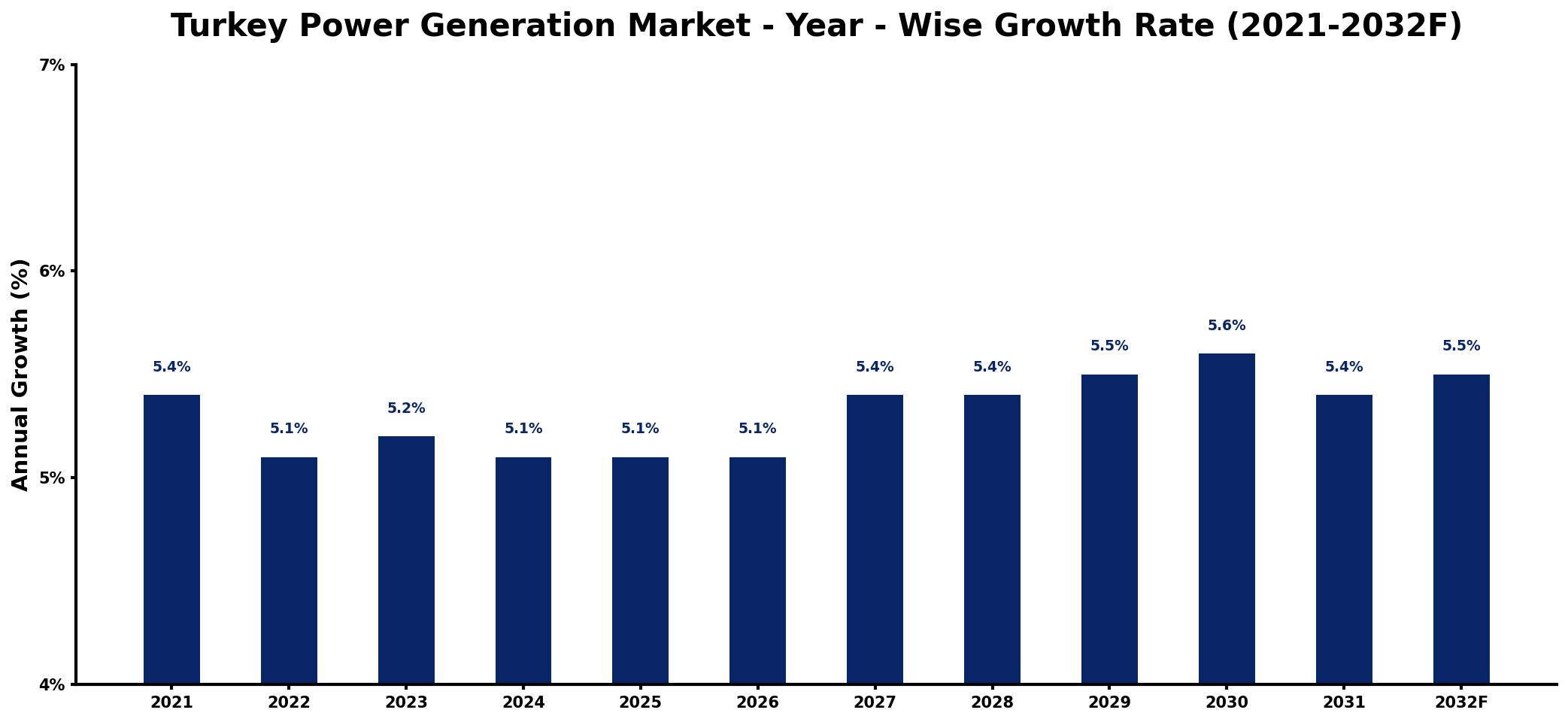
The table below presents the year‑wise growth rates along with the key drivers influencing the market
| Year | Growth Rate | Major Drivers |
| 2021 | 5.4% | Rising industrial energy demand |
| 2022 | 5.1% | Increased renewable energy investments |
| 2023 | 5.2% | Expansion of energy efficiency programs |
| 2024 | 5.1% | Growing urban population needs |
| 2025 | 5.1% | Advancements in clean technologies |
| 2026 | 5.1% | Strengthening regulatory frameworks support |
| 2027 | 5.4% | Development of new infrastructure projects |
| 2028 | 5.4% | Higher consumer awareness initiatives |
| 2029 | 5.5% | Emerging electric vehicle market growth |
| 2030 | 5.6% | Increased international energy cooperation |
| 2031 | 5.4% | Significant corporate sustainability commitments |
| 2032 | 5.5% | Technological innovations in energy storage |
Note: Market size estimations and growth projections presented in this report are based on 6Wresearch's proprietary forecasting methodology, utilizing the latest available industry data, government publications, and primary research inputs.
Turkey Power Generation Market Synopsis
Recent momentum in Turkey's power generation sector reflects a significant shift towards a diversified energy portfolio, blending traditional and renewable sources. As the country moves towards ambitious renewable energy targets, the future landscape is expected to evolve rapidly, prioritizing sustainability and energy security.
Looking ahead, the Turkey Power Generation Market is set to undergo transformative changes, with the government implementing policies that favor renewable technologies such as solar and wind. This evolution not only aligns with global energy trends but also enhances the overall resilience of the national grid.
Turkey Power Generation Market Key Takeaways
- The market is transitioning to a renewable-centric energy mix, driven by government initiatives.
- Significant investments are being directed towards modernizing existing power generation infrastructure.
- Energy storage solutions are gaining traction to mitigate the intermittency of renewables.
- Privatization efforts are attracting both domestic and international investments in the sector.
- Turkeys strategic position between Europe and Asia enhances cross-border energy project opportunities.
Evaluation of Restraints in Turkey Power Generation Market
The Turkey Power Generation Market faces several restraints that could impede its growth trajectory. One significant limitation is the reliance on imported fossil fuels, which makes the country vulnerable to price volatility and geopolitical tensions. Moreover, regulatory uncertainties surrounding new energy projects can deter potential investors. Additionally, the existing infrastructure requires substantial modernization to meet the burgeoning demand for electricity and reduce emissions from traditional sources, posing further challenges. Addressing these limitations is crucial for sustaining market growth and ensuring energy security.
Turkey Power Generation Market Trends
Current trends in the Turkey Power Generation Market indicate a pronounced shift towards renewable energy sources, particularly solar and wind. The Turkish government has set ambitious goals to elevate the share of renewables in the energy mix, backed by substantial investments in infrastructure. Moreover, there's a clear movement towards modernization of power plants, enhancing their efficiency and reducing carbon footprints. Energy storage technologies are emerging as vital components to ensure consistent power supply amidst the fluctuations inherent in renewable energy generation. Sustainability practices are increasingly at the forefront, shaping project designs and operational strategies across the market.
Turkey Power Generation Market Opportunities
The Turkey Power Generation Market is ripe with investment opportunities, particularly in renewable energy sectors like solar, wind, and hydroelectric power. With government incentives, such as feed-in tariffs for renewable projects, the financial environment is conducive for private investments. The ongoing privatization trend offers additional avenues for participation in power generation, operation, and infrastructure development. Furthermore, Turkey's strategic geographic location presents unique opportunities for cross-border energy initiatives that can enhance regional cooperation and energy security.
Government Initiatives in the Turkey Power Generation Market
The Turkish government has implemented various policies to foster growth in the power generation market, emphasizing renewable energy and energy security. The Renewable Energy Law provides crucial incentives, including feed-in tariffs and priority grid access for renewable projects. Additionally, efforts to diversify the energy mix have led to increased support for nuclear power projects and domestic coal production. These initiatives underscore the governments commitment to improving energy efficiency and reducing reliance on fossil fuels, thereby driving innovation and investments in the sector.
Future Insights of the Turkey Power Generation Market
Looking towards 2026-2032, the Turkey Power Generation Market is anticipated to witness steady growth, largely fueled by rising electricity demands and a strong push for renewable energy integration. The government's focus on reducing dependence on imports will likely drive further investments in domestic renewable projects and energy efficiency measures. Additionally, the anticipated privatization and modernization of the sector are expected to enhance operational performance and attract international interest, paving the way for a more sustainable energy future.
Turkey Power Generation Market Latest Developments (2025 - 2026)
Recent developments in the Turkey Power Generation Market highlight a dynamic shift towards renewable energy investment and infrastructure upgrades. The government continues to roll out programs aimed at encouraging private sector participation, particularly in solar and wind projects. Concurrently, there has been an emphasis on exploring energy storage technologies to complement the increasing share of renewables. These initiatives are transforming the landscape, positioning Turkey as a regional leader in sustainable energy development.
Turkey Power Generation Market - Key Attractiveness of the Report
- 10 Years of Market Numbers
- Historical Data Starting from 2022 to 2025
- Base Year: 2025
- Forecast Data until 2032
- Key Performance Indicators Impacting the Market
- Major Upcoming Developments and Projects
Key Highlights of the Report:
- Turkey Power Generation Market Outlook
- Market Size of Turkey Power Generation Market, 2025
- Forecast of Turkey Power Generation Market, 2032
- Historical Data and Forecast of Turkey Power Generation Revenues & Volume for the Period 2022-2032F
- Turkey Power Generation Market Trend Evolution
- Turkey Power Generation Market Drivers and Challenges
- Turkey Power Generation Price Trends
- Turkey Power Generation Porter's Five Forces
- Turkey Power Generation Industry Life Cycle
- Historical Data and Forecast of Turkey Power Generation Market Revenues & Volume By Application for the Period 2022-2032F
- Historical Data and Forecast of Turkey Power Generation Market Revenues & Volume By Commercial for the Period 2022-2032F
- Historical Data and Forecast of Turkey Power Generation Market Revenues & Volume By Industrial for the Period 2022-2032F
- Historical Data and Forecast of Turkey Power Generation Market Revenues & Volume By Residential for the Period 2022-2032F
- Historical Data and Forecast of Turkey Power Generation Market Revenues & Volume By Source for the Period 2022-2032F
- Historical Data and Forecast of Turkey Power Generation Market Revenues & Volume By Non-Renewable for the Period 2022-2032F
- Historical Data and Forecast of Turkey Power Generation Market Revenues & Volume By Renewable for the Period 2022-2032F
- Turkey Power Generation Import Export Trade Statistics
- Market Opportunity Assessment By Application
- Market Opportunity Assessment By Source
- Turkey Power Generation Top Companies Market Share
- Turkey Power Generation Competitive Benchmarking By Technical and Operational Parameters
- Turkey Power Generation Company Profiles
- Turkey Power Generation Key Strategic Recommendations






































