Turkey Refined Petroleum Products Market Size, Share & Growth Rate
The Turkey Refined Petroleum Products Market was estimated at USD 306 Million in 2025 and is projected to reach USD 414 Million by 2032, growing at a CAGR of 4.4% from 2026 to 2032. This growth trajectory is fueled by rising urbanization and industrialization, coupled with increasing transportation demands. Additionally, Turkeys unique geographical position as a transit hub between Europe and Asia plays a crucial role in enhancing its appeal as a significant player in the global petroleum market.
Turkey Refined Petroleum Products Market Year-wise Growth Rate and Key Drivers
This graph highlights how the Turkey Refined Petroleum Products Market has steadily grown over the years, supported by major growth factors.
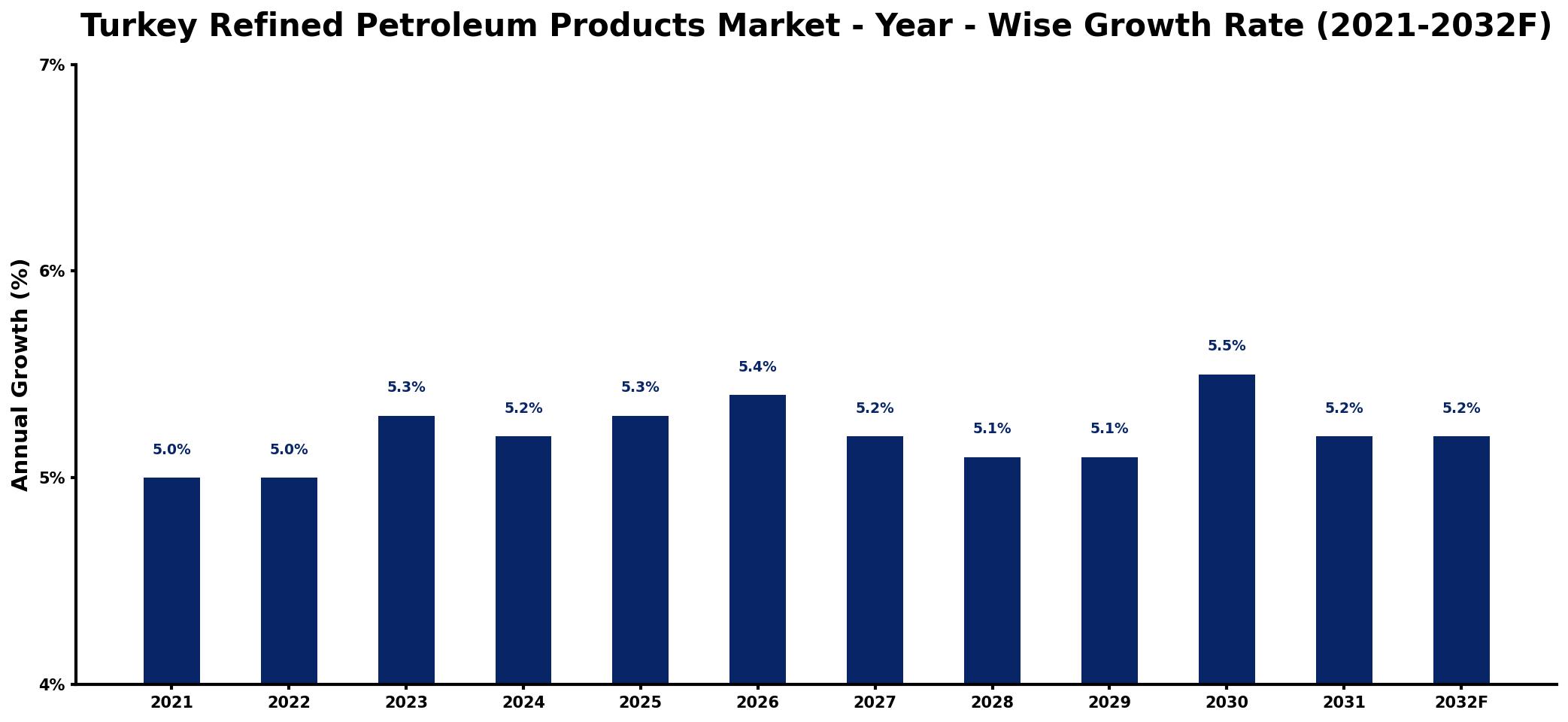
The table below presents the year‑wise growth rates along with the key drivers influencing the market
| Year | Growth Rate | Major Drivers |
| 2021 | 5.0% | Rising energy consumption trends |
| 2022 | 5.0% | Increased industrial output demand |
| 2023 | 5.3% | Growing transportation sector needs |
| 2024 | 5.2% | Expansion in logistics infrastructure |
| 2025 | 5.3% | Boost in domestic investment projects |
| 2026 | 5.4% | Surge in export opportunities |
| 2027 | 5.2% | Higher urbanization rates observed |
| 2028 | 5.1% | Development of alternative energy sources |
| 2029 | 5.1% | Increase in consumer mobility preferences |
| 2030 | 5.5% | Advancements in refining technologies |
| 2031 | 5.2% | Strengthened regulatory support frameworks |
| 2032 | 5.2% | Emergence of new market players |
Note: Market size estimations and growth projections presented in this report are based on 6Wresearch's proprietary forecasting methodology, utilizing the latest available industry data, government publications, and primary research inputs.
Turkey Refined Petroleum Products Market Synopsis
The most influential factor shaping the Turkey Refined Petroleum Products Market today is the transition towards cleaner and more sustainable energy sources. Heightened environmental awareness, along with government regulations, is compelling companies to invest in cleaner technologies and alternative fuels.
This shift is not merely reactive but also proactive, as it reflects a growing commitment from both the public and private sectors to reduce carbon emissions. As a result, the market is diversifying, not only in the types of fuels produced but also in the technologies employed in refining processes.
Turkey Refined Petroleum Products Market Key Takeaways
- The market is experiencing a significant shift towards cleaner fuels and sustainable energy solutions.
- Government policies are fostering investments in refining capacity and infrastructure development.
- Turkey's strategic position enhances its potential for regional energy trade.
- Fluctuating global oil prices remain a critical factor impacting market dynamics.
- Investment opportunities lie in the growth of transportation fuels amid urbanization trends.
Evaluation of Restraints in Turkey Refined Petroleum Products Market
Despite the markets promising outlook, several constraints may hinder growth. Volatility in global oil prices often leads to unpredictable profit margins, posing a challenge for investors. Regulatory changes, particularly regarding import and export restrictions, add another layer of complexity. Furthermore, the rising competition from alternative energy sources and increasing geopolitical tensions can disrupt supply chains. These factors necessitate a cautious approach to long-term investment planning within the Turkey Refined Petroleum Products Market.
Turkey Refined Petroleum Products Market Trends
A significant trend emerging within the Turkey Refined Petroleum Products Market is the increasing demand for biofuels and natural gas. This is a direct result of stringent governmental policies aimed at promoting energy efficiency and reducing greenhouse gas emissions. Advanced refining technologies are also gaining traction, focusing on reducing carbon footprints while enhancing production efficiency. As companies adapt to these trends, we can expect innovative solutions that reshape the market landscape.
Turkey Refined Petroleum Products Market Opportunities
The Turkey Refined Petroleum Products Market offers substantial growth opportunities driven by urbanization and an expanding consumer base. As demand for transportation fuels like gasoline and diesel continues to rise, there is also a pressing need to upgrade and modernize existing refining infrastructure. Furthermore, the burgeoning interest in renewable energy and alternative fuels provides a strategic entry point for investors looking to capitalize on a more sustainable energy future. The market's adaptability to evolving consumer preferences makes it ripe for innovative ventures.
Government Initiatives in the Turkey Refined Petroleum Products Market
The Turkish government has introduced various initiatives aimed at regulating the Refined Petroleum Products Market. Key policies include setting price controls on essential petroleum products to maintain affordability, enforcing quality standards to safeguard public health, and promoting investments in domestic refining capacities. Additionally, tax incentives are being offered to encourage the production and utilization of cleaner fuels, aligning with broader sustainability goals.
Future Insights of the Turkey Refined Petroleum Products Market
Looking ahead to 2026-2032, the Turkey Refined Petroleum Products Market is poised for a promising trajectory. With ongoing industrial growth and the government's commitment to enhancing refining capacities, the market is set to expand. The increasing focus on alternative fuels and renewable energy solutions will likely foster innovation, making it imperative for stakeholders to stay ahead of emerging trends. Overall, a combination of strategic location, evolving consumer preferences, and regulatory support positions the market for steady growth in the coming years.
Turkey Refined Petroleum Products Market Latest Developments (2025 - 2026)
Recent developments within the Turkey Refined Petroleum Products Market indicate a marked shift towards investment in cleaner technologies and infrastructure. Major refiners are actively pursuing collaborations aimed at enhancing their sustainable practices. Additionally, government initiatives to bolster domestic production capabilities are paving the way for significant infrastructure projects, which could reshape the operational dynamics of the market.
Turkey Refined Petroleum Products Market - Key Attractiveness of the Report
- 10 Years of Market Numbers
- Historical Data Starting from 2022 to 2025
- Base Year: 2025
- Forecast Data until 2032
- Key Performance Indicators Impacting the Market
- Major Upcoming Developments and Projects
Key Highlights of the Report:
- Turkey Refined Petroleum Products Market Outlook
- Market Size of Turkey Refined Petroleum Products Market, 2025
- Forecast of Turkey Refined Petroleum Products Market, 2032
- Historical Data and Forecast of Turkey Refined Petroleum Products Revenues & Volume for the Period 2022-2032F
- Turkey Refined Petroleum Products Market Trend Evolution
- Turkey Refined Petroleum Products Market Drivers and Challenges
- Turkey Refined Petroleum Products Price Trends
- Turkey Refined Petroleum Products Porter's Five Forces
- Turkey Refined Petroleum Products Industry Life Cycle
- Historical Data and Forecast of Turkey Refined Petroleum Products Market Revenues & Volume By Product Type for the Period 2022-2032F
- Historical Data and Forecast of Turkey Refined Petroleum Products Market Revenues & Volume By Diesel for the Period 2022-2032F
- Historical Data and Forecast of Turkey Refined Petroleum Products Market Revenues & Volume By Gasoline for the Period 2022-2032F
- Historical Data and Forecast of Turkey Refined Petroleum Products Market Revenues & Volume By Fuel Oils for the Period 2022-2032F
- Historical Data and Forecast of Turkey Refined Petroleum Products Market Revenues & Volume By Kerosene for the Period 2022-2032F
- Historical Data and Forecast of Turkey Refined Petroleum Products Market Revenues & Volume By Others for the Period 2022-2032F
- Historical Data and Forecast of Turkey Refined Petroleum Products Market Revenues & Volume By Application for the Period 2022-2032F
- Historical Data and Forecast of Turkey Refined Petroleum Products Market Revenues & Volume By Fuel for the Period 2022-2032F
- Historical Data and Forecast of Turkey Refined Petroleum Products Market Revenues & Volume By Chemical for the Period 2022-2032F
- Historical Data and Forecast of Turkey Refined Petroleum Products Market Revenues & Volume By Others for the Period 2022-2032F
- Historical Data and Forecast of Turkey Refined Petroleum Products Market Revenues & Volume By Fraction for the Period 2022-2032F
- Historical Data and Forecast of Turkey Refined Petroleum Products Market Revenues & Volume By Light Distillates for the Period 2022-2032F
- Historical Data and Forecast of Turkey Refined Petroleum Products Market Revenues & Volume By Middle Distillates for the Period 2022-2032F
- Historical Data and Forecast of Turkey Refined Petroleum Products Market Revenues & Volume By Heavy Oils for the Period 2022-2032F
- Turkey Refined Petroleum Products Import Export Trade Statistics
- Market Opportunity Assessment By Product Type
- Market Opportunity Assessment By Application
- Market Opportunity Assessment By Fraction
- Turkey Refined Petroleum Products Top Companies Market Share
- Turkey Refined Petroleum Products Competitive Benchmarking By Technical and Operational Parameters
- Turkey Refined Petroleum Products Company Profiles
- Turkey Refined Petroleum Products Key Strategic Recommendations






































