Turkey Retail Industry Market Size, Share & Growth Rate
The Turkey Retail Industry Market was estimated at USD 1082 Million in 2025 and is projected to reach USD 1784 Million by 2032, growing at a CAGR of 7.4% from 2026 to 2032. This impressive growth trajectory is largely fueled by rising disposable incomes and an urban population increasingly turning to organized retail formats. Additionally, the relentless rise of e-commerce and digital transformation further accelerates demand, positioning the Turkish retail sector as one of the most dynamic markets in the region.
Turkey Retail Industry Market Year-wise Growth Rate and Key Drivers
This graph highlights how the Turkey Retail Industry Market has steadily grown over the years, supported by major growth factors.
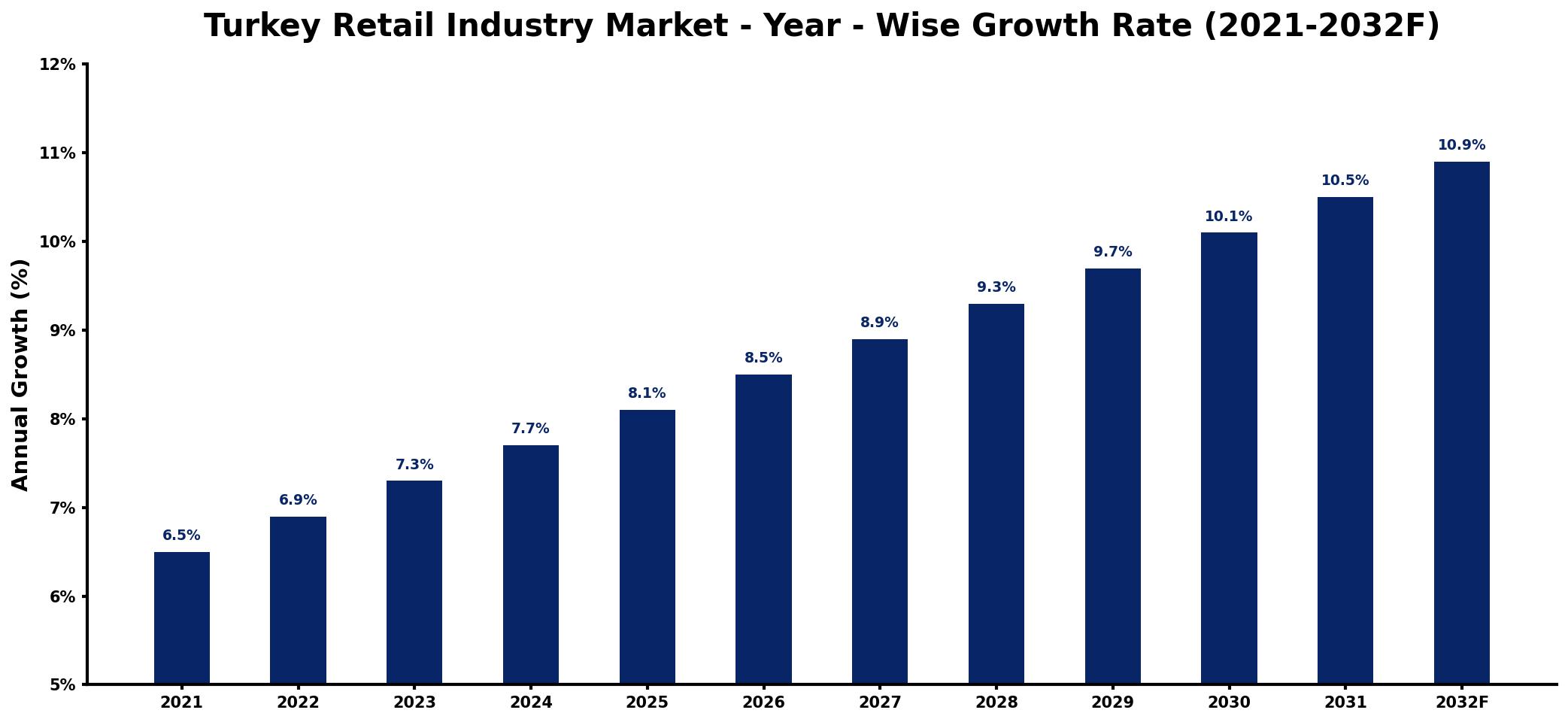
The table below presents the year‑wise growth rates along with the key drivers influencing the market
| Year | Growth Rate | Major Drivers |
| 2021 | 6.5% | E-commerce adoption accelerates significantly |
| 2022 | 6.9% | Foreign investments increase market presence |
| 2023 | 7.3% | Consumer confidence rebounds strongly |
| 2024 | 7.7% | Digital payment solutions expand rapidly |
| 2025 | 8.1% | Sustainable practices gain widespread traction |
| 2026 | 8.5% | Urbanization drives new shopping experiences |
| 2027 | 8.9% | Omnichannel strategies enhance customer engagement |
| 2028 | 9.3% | Local brands gain market share |
| 2029 | 9.7% | Technology integration enhances operational efficiency |
| 2030 | 10.1% | stronger distribution network expansion |
| 2031 | 10.5% | Personalized marketing strategies attract customers |
| 2032 | 10.9% | Social media influences purchasing behavior |
Note: Market size estimations and growth projections presented in this report are based on 6Wresearch's proprietary forecasting methodology, utilizing the latest available industry data, government publications, and primary research inputs.
Turkey Retail Industry Market Synopsis
The Turkish retail industry is currently witnessing a significant transformation, with urbanization and evolving consumer lifestyles at its core. This shift is prompting a migration toward more structured and organized retail avenues, setting the stage for a vibrant and competitive marketplace.
Consumer behavior is also undergoing a notable change, with an increasing preference for online shopping and mobile transactions. As a result, retailers are investing heavily in digital channels, seeking to enhance their omnichannel strategies and meet the demands of a tech-savvy consumer base.
Turkey Retail Industry Market Key Takeaways
- Urbanization and rising disposable incomes are primary drivers of growth in the Turkish retail sector.
- E-commerce continues to reshape consumer preferences, necessitating the need for robust digital transformation.
- The market is characterized by the expansion of organized retail formats and the influx of international retail chains.
- Government policies promote fair competition and consumer rights, ensuring a transparent marketplace.
- Technological innovations in mobile shopping and digital payment systems are pivotal for future market success.
Evaluation of Restraints in Turkey Retail Industry Market
Despite its promising growth, the Turkish retail market faces several restraints that could limit its full potential. Economic fluctuations often lead to unpredictable consumer spending, which can create volatility in the market. Additionally, the fierce competition from e-commerce platforms challenges traditional retailers to adapt swiftly to changing consumer preferences. Without embracing digital transformation and developing omnichannel strategies, many retailers may struggle to maintain a competitive edge.
Turkey Retail Industry Market Trends
Several trends are currently shaping the Turkish retail landscape. The rise of sustainable and ethical consumption has gained traction among younger consumers, prompting retailers to incorporate eco-friendly practices. Moreover, the integration of artificial intelligence and data analytics is enhancing inventory management and personalized marketing strategies. As social media continues to influence shopping behavior, brands are increasingly leveraging digital platforms to engage with customers, further blurring the lines between online and offline retail.
Turkey Retail Industry Market Opportunities
There are numerous growth and investment opportunities within the Turkish retail market. The expansion of e-commerce presents a significant avenue for traditional retailers to reach a broader audience. Additionally, enhancing logistics and supply chain capabilities can lead to improved customer satisfaction and retention. Furthermore, investing in technology to offer a seamless shopping experience can attract a diverse range of consumers, from tech-savvy millennials to discerning older shoppers.
Government Initiatives in the Turkey Retail Industry Market
The Turkish government is actively promoting the retail sector through policies aimed at fostering fair competition and protecting consumer rights. Regulations address various aspects such as pricing transparency, product standards, and business practices. By ensuring a level playing field, these initiatives are designed to enhance consumer trust and encourage further investments in the retail industry.
Future Insights of the Turkey Retail Industry Market
Looking ahead to 2026-2032, the Turkish retail market is poised for continued expansion, driven by urbanization and digital adoption. As consumers become more accustomed to online shopping, traditional retailers will need to innovate and adapt. The importance of omnichannel strategies will only increase, as businesses strive to create integrated shopping experiences. Additionally, the growing interest in sustainability is likely to compel retailers to align their offerings with consumer values, further shaping the future of the market.
Turkey Retail Industry Market Latest Developments (2025 - 2026)
Recently, the Turkish retail industry has experienced a surge in digital initiatives, with many retailers launching new e-commerce platforms to capitalize on the growing online shopping trend. Concurrently, an increased focus on customer experience has prompted retailers to refine their omnichannel strategies, leading to enhanced engagement and loyalty. Moreover, ongoing governmental support for the sector indicates a positive outlook as stakeholders seek to leverage new technologies and consumer trends.
Turkey Retail Industry Market - Key Attractiveness of the Report
- 10 Years of Market Numbers
- Historical Data Starting from 2022 to 2025
- Base Year: 2025
- Forecast Data until 2032
- Key Performance Indicators Impacting the Market
- Major Upcoming Developments and Projects
Key Highlights of the Report:
- Turkey Retail Industry Market Outlook
- Market Size of Turkey Retail Industry Market, 2025
- Forecast of Turkey Retail Industry Market, 2032
- Historical Data and Forecast of Turkey Retail Industry Revenues & Volume for the Period 2022-2032F
- Turkey Retail Industry Market Trend Evolution
- Turkey Retail Industry Market Drivers and Challenges
- Turkey Retail Industry Price Trends
- Turkey Retail Industry Porter's Five Forces
- Turkey Retail Industry Industry Life Cycle
- Historical Data and Forecast of Turkey Retail Industry Market Revenues & Volume By Product for the Period 2022-2032F
- Historical Data and Forecast of Turkey Retail Industry Market Revenues & Volume By Food and Beverages for the Period 2022-2032F
- Historical Data and Forecast of Turkey Retail Industry Market Revenues & Volume By Personal and Household Care for the Period 2022-2032F
- Historical Data and Forecast of Turkey Retail Industry Market Revenues & Volume By Apparel, Footwear, and Accessories for the Period 2022-2032F
- Historical Data and Forecast of Turkey Retail Industry Market Revenues & Volume By Furniture, Toys, and Hobby for the Period 2022-2032F
- Historical Data and Forecast of Turkey Retail Industry Market Revenues & Volume By Electronic and Household Appliances for the Period 2022-2032F
- Historical Data and Forecast of Turkey Retail Industry Market Revenues & Volume By Other Products for the Period 2022-2032F
- Historical Data and Forecast of Turkey Retail Industry Market Revenues & Volume By Distribution Channel for the Period 2022-2032F
- Historical Data and Forecast of Turkey Retail Industry Market Revenues & Volume By Supermarkets/Hypermarkets for the Period 2022-2032F
- Historical Data and Forecast of Turkey Retail Industry Market Revenues & Volume By Convenience Stores for the Period 2022-2032F
- Historical Data and Forecast of Turkey Retail Industry Market Revenues & Volume By Department Stores for the Period 2022-2032F
- Historical Data and Forecast of Turkey Retail Industry Market Revenues & Volume By Specialty Stores for the Period 2022-2032F
- Historical Data and Forecast of Turkey Retail Industry Market Revenues & Volume By Online for the Period 2022-2032F
- Historical Data and Forecast of Turkey Retail Industry Market Revenues & Volume By Other Distribution Channels for the Period 2022-2032F
- Turkey Retail Industry Import Export Trade Statistics
- Market Opportunity Assessment By Product
- Market Opportunity Assessment By Distribution Channel
- Turkey Retail Industry Top Companies Market Share
- Turkey Retail Industry Competitive Benchmarking By Technical and Operational Parameters
- Turkey Retail Industry Company Profiles
- Turkey Retail Industry Key Strategic Recommendations






































