Turkey Silicon Alloys Market Size, Share & Growth Rate
The Turkey Silicon Alloys Market was estimated at USD 846 Million in 2025 and is projected to reach USD 1233 Million by 2032, growing at a CAGR of 5.5% from 2026 to 2032. This robust growth is primarily fueled by the increasing demand from key sectors such as automotive and construction, where silicon alloys are essential for enhancing material properties. Moreover, the expanding investments in renewable energy, particularly in solar power, further bolster the market, creating a diverse array of applications for silicon alloys in modern manufacturing.
Turkey Silicon Alloys Market Year-wise Growth Rate and Key Drivers
This graph highlights how the Turkey Silicon Alloys Market has steadily grown over the years, supported by major growth factors.
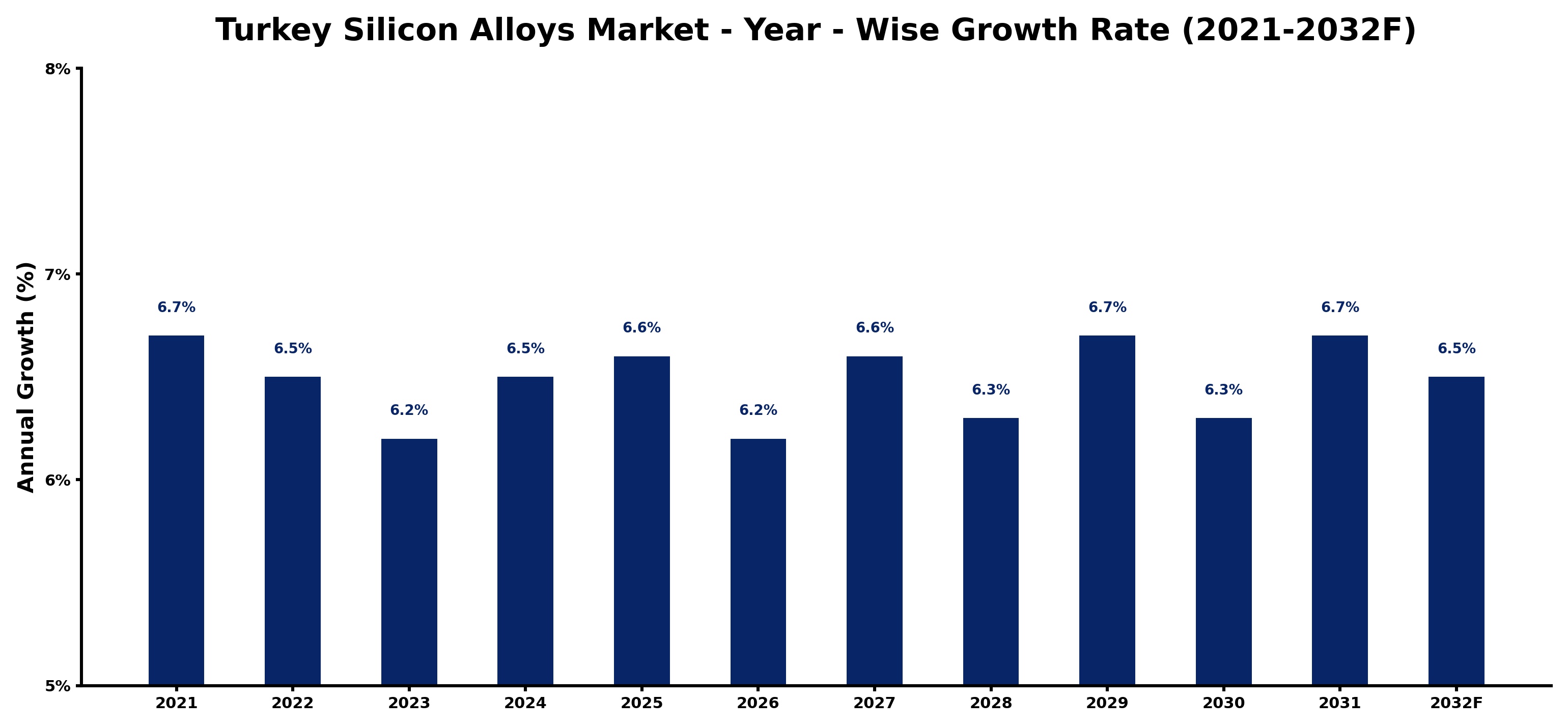
The table below presents the year‑wise growth rates along with the key drivers influencing the market
| Year | Growth Rate | Major Drivers |
| 2021 | 6.7% | Manufacturing investments boost domestic silicon alloy production capabilities |
| 2022 | 6.5% | Increased infrastructure investments boost demand for silicon alloy production |
| 2023 | 6.2% | Advanced alloy processing technology boosted local steel production efficiency |
| 2024 | 6.5% | Capacity enhancements in local smelters boosted silicon alloy production |
| 2025 | 6.6% | Export driven semiconductor demand fuels silicon alloy production expansion |
| 2026 | 6.2% | Silicon alloy production capacity expansion drives domestic steel manufacturing growth |
| 2027 | 6.6% | Domestic silicon alloy production expansion boosts regional export competitiveness |
| 2028 | 6.3% | Improved steel production technologies enhanced silicon alloy quality standards |
| 2029 | 6.7% | New silicon alloy plants enhance Turkey's metal manufacturing capacity |
| 2030 | 6.3% | Smelter upgrades boosted silicon alloy production efficiency in Turkey |
| 2031 | 6.7% | Export demand surge prompts increased silicon alloy production capacity |
| 2032 | 6.5% | Technology integration in steel production enhances energy efficiency measures |
Note - Market size estimations and growth projections presented in this report are based on 6Wresearch’s advanced forecasting approach, validated with industry datasets as of June 2026.
Turkey Silicon Alloys Market Synopsis
In recent years, the Turkey Silicon Alloys Market has gained momentum, driven largely by industrial demand across various sectors. As the market evolves, it is transitioning towards more sustainable practices while simultaneously addressing the need for high-performance materials in manufacturing.
Looking ahead, the Turkey Silicon Alloys Market is poised for further expansion, underpinned by technological advancements and innovations in production techniques. While challenges exist, including fluctuating raw material prices, the overall outlook remains positive, with significant opportunities for growth across multiple industries.
Turkey Silicon Alloys Market Key Takeaways
- The market is projected to grow at a CAGR of 5.5%, reaching USD 1233 Million by 2032.
- Increased demand for silicon alloys from automotive, construction, and electronics sectors drives market growth.
- There is a marked shift towards sustainable manufacturing processes and environmental compliance.
- Investments in renewable energy technologies, particularly solar power, are expanding the applicability of silicon alloys.
- Regulatory frameworks are evolving, emphasizing environmental sustainability while supporting domestic production initiatives.
Evaluation of Restraints in Turkey Silicon Alloys Market
The Turkey Silicon Alloys Market faces several constraints that could impede growth. Fluctuations in raw material prices present significant challenges for producers, often leading to unpredictable production costs and compromised profit margins. Additionally, intense global competition can put pressure on local manufacturers who must compete against larger international entities. Regulatory complexities regarding environmental emissions require ongoing investment in cleaner technologies, further complicating operational dynamics. These factors necessitate strategic planning and innovation to ensure sustainability and competitiveness in the market.
Turkey Silicon Alloys Market Trends
Current trends in the Turkey Silicon Alloys Market indicate a strong shift towards sustainable practices, with manufacturers increasingly adopting environmentally friendly production methods. Technological innovations are reshaping production processes, enhancing efficiency while reducing costs. Furthermore, the rising demand for high-performance materials in the automotive and construction sectors is leading to a greater emphasis on the properties of silicon alloys, such as heat resistance and strength. The growing integration of silicon alloys in renewable energy applications, particularly in solar technology, is also notable.
Turkey Silicon Alloys Market Opportunities
The Turkey Silicon Alloys market is ripe with investment opportunities, especially as demand rises across automotive, construction, and electronics industries. The nation's strategic positioning within the global steel production landscape enhances the relevance of silicon alloys as critical additives. Additionally, the increasing focus on renewable energy sources, like solar panels and batteries, presents promising avenues for growth. Investors may also find value in companies dedicated to advancing research and development initiatives that prioritize sustainability and efficiency in silicon alloy production.
Government Initiatives in the Turkey Silicon Alloys Market
The Turkish government is actively supporting the Silicon Alloys Market through various initiatives aimed at bolstering domestic production. Incentives and subsidies are provided to encourage local manufacturers, while import tariffs on raw materials have been reduced to alleviate operational costs. Furthermore, there is a significant emphasis on promoting research and development activities to drive innovation. Regulations focused on environmental sustainability and worker safety are also being implemented to ensure a competitive yet responsible industry.
Future Insights of the Turkey Silicon Alloys Market
Looking toward 2026-2032, the Turkey Silicon Alloys Market is expected to thrive, spurred by continued industrial demand and advancements in production technologies. The transition towards lightweight and durable materials will catalyze the usage of silicon alloys across various applications. The growing integration of silicon alloys in renewable energy solutions, particularly for solar panels and storage batteries, will enhance market viability. While challenges related to pricing and regulatory compliance will persist, proactive strategies and innovation will be vital for capitalizing on emerging opportunities.
Turkey Silicon Alloys Market Latest Developments (May 2025 - June 2026)
In recent months, the Turkey Silicon Alloys Market has seen a surge in activities focused on sustainability and technological innovation. Manufacturers are increasingly adopting advanced technologies to optimize production processes and reduce environmental impact. Collaborations between industry stakeholders aim to improve product efficiency while addressing regulatory requirements. Additionally, there has been a noticeable increase in investment towards developing applications in the renewable energy sector, reflecting a strategic pivot towards sustainability in manufacturing.
Turkey Silicon Alloys Market - Key Attractiveness of the Report
- 10 Years of Market Numbers
- Historical Data Starting from 2022 to 2025
- Base Year: 2025
- Forecast Data until 2032
- Key Performance Indicators Impacting the Market
- Major Upcoming Developments and Projects
Key Highlights of the Report:
- Turkey Silicon Alloys Market Outlook
- Market Size of Turkey Silicon Alloys Market, 2025
- Forecast of Turkey Silicon Alloys Market, 2032
- Historical Data and Forecast of Turkey Silicon Alloys Revenues & Volume for the Period 2022-2032F
- Turkey Silicon Alloys Market Trend Evolution
- Turkey Silicon Alloys Market Drivers and Challenges
- Turkey Silicon Alloys Price Trends
- Turkey Silicon Alloys Porter's Five Forces
- Turkey Silicon Alloys Industry Life Cycle
- Historical Data and Forecast of Turkey Silicon Alloys Market Revenues & Volume By Type for the Period 2022-2032F
- Historical Data and Forecast of Turkey Silicon Alloys Market Revenues & Volume By Ferrosilicon for the Period 2022-2032F
- Historical Data and Forecast of Turkey Silicon Alloys Market Revenues & Volume By Deoxidizers for the Period 2022-2032F
- Historical Data and Forecast of Turkey Silicon Alloys Market Revenues & Volume By Inoculants for the Period 2022-2032F
- Historical Data and Forecast of Turkey Silicon Alloys Market Revenues & Volume By Others for the Period 2022-2032F
- Historical Data and Forecast of Turkey Silicon Alloys Market Revenues & Volume By Application for the Period 2022-2032F
- Historical Data and Forecast of Turkey Silicon Alloys Market Revenues & Volume By Carbon Steel & Other Alloy Steel for the Period 2022-2032F
- Historical Data and Forecast of Turkey Silicon Alloys Market Revenues & Volume By Stainless Steel for the Period 2022-2032F
- Historical Data and Forecast of Turkey Silicon Alloys Market Revenues & Volume By Electrical Steel for the Period 2022-2032F
- Historical Data and Forecast of Turkey Silicon Alloys Market Revenues & Volume By Cast Iron for the Period 2022-2032F
- Historical Data and Forecast of Turkey Silicon Alloys Market Revenues & Volume By Others for the Period 2022-2032F
- Turkey Silicon Alloys Import Export Trade Statistics
- Market Opportunity Assessment By Type
- Market Opportunity Assessment By Application
- Turkey Silicon Alloys Top Companies Market Share
- Turkey Silicon Alloys Competitive Benchmarking By Technical and Operational Parameters
- Turkey Silicon Alloys Company Profiles
- Turkey Silicon Alloys Key Strategic Recommendations






































