Turkey Submarine Market Size, Share & Growth Rate
The Turkey Submarine Market was estimated at USD 274 Million in 2025 and is projected to reach USD 359 Million by 2032, growing at a CAGR of 3.9% from 2026 to 2032. This growth trajectory is primarily driven by Turkeys strategic emphasis on enhancing its naval capabilities amid regional geopolitical tensions. Additionally, ongoing investments in indigenous submarine development and advanced technologies are crucial to bolstering Turkey's maritime security and defense posture.
Turkey Submarine Market Year-wise Growth Rate and Key Drivers
This graph highlights how the Turkey Submarine Market has steadily grown over the years, supported by major growth factors.
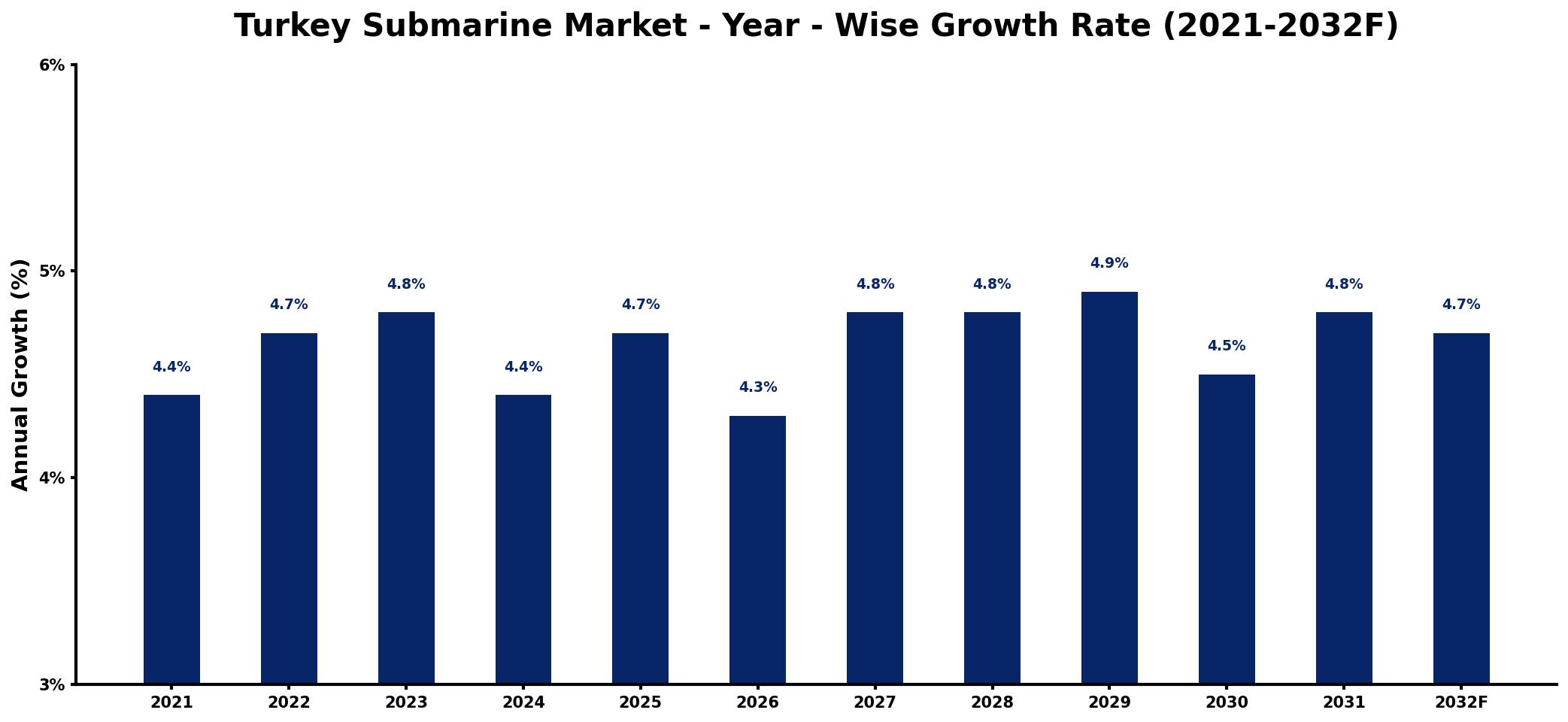
The table below presents the year‑wise growth rates along with the key drivers influencing the market
| Year | Growth Rate | Major Drivers |
| 2021 | 4.4% | Increased defense spending initiatives |
| 2022 | 4.7% | Growing maritime security concerns |
| 2023 | 4.8% | Expansion of naval modernization projects |
| 2024 | 4.4% | Rising demand for underwater capabilities |
| 2025 | 4.7% | Investments in advanced technologies |
| 2026 | 4.3% | Strengthened international defense partnerships |
| 2027 | 4.8% | Surge in regional geopolitical tensions |
| 2028 | 4.8% | Boost in research and development |
| 2029 | 4.9% | Enhanced focus on defense innovation |
| 2030 | 4.5% | Development of strategic military alliances |
| 2031 | 4.8% | Growing emphasis on fleet diversification |
| 2032 | 4.7% | Increased collaboration with defense contractors |
Note: Market size estimations and growth projections presented in this report are based on 6Wresearch's proprietary forecasting methodology, utilizing the latest available industry data, government publications, and primary research inputs.
Turkey Submarine Market Synopsis
The most significant force currently shaping the Turkey Submarine Market is the country's commitment to modernizing its naval fleet. This is exemplified by the development of the Reis-class submarines, which reflect a strategic move toward indigenous production and technological independence in defense capabilities.
Furthermore, Turkeys submarine fleet plays an essential role in safeguarding its interests across key maritime areas, including the Black Sea and Eastern Mediterranean. As geopolitical dynamics evolve, the Turkish government remains focused on enhancing naval strength to address emerging security challenges and ensure maritime sovereignty.
Turkey Submarine Market Key Takeaways
- Turkey is emphasizing indigenous submarine development to reduce dependency on foreign technologies.
- The market is characterized by increasing investment in next-generation submarines featuring advanced stealth and surveillance systems.
- There is a rising demand for unmanned underwater vehicles (UUVs) to enhance reconnaissance and security capabilities.
- Partnerships with international suppliers are crucial for technology transfer and collaboration on advanced submarine systems.
- Government support and incentives significantly drive growth in local manufacturing and development of submarine technologies.
Evaluation of Restraints in Turkey Submarine Market
The Turkey Submarine Market faces several restraints that could impede its growth trajectory. The complexity of submarine technology necessitates a high degree of expertise and significant resources, which can translate to elevated research and development costs. Additionally, geopolitical uncertainties in the Eastern Mediterranean add layers of complexity to procurement strategies and international partnerships. Compliance with international standards and managing competition from established global submarine manufacturers also represent critical challenges for local companies striving for market penetration.
Turkey Submarine Market Trends
Current trends in the Turkey Submarine Market indicate a strong shift towards modernization and innovation. The Turkish government is increasingly focused on developing advanced submarine technologies that incorporate state-of-the-art systems for stealth, communication, and surveillance. Moreover, there is a notable rise in demand for unmanned underwater vehicles (UUVs), driven by a need for improved maritime security and reconnaissance capabilities. As Turkey seeks to enhance its naval capabilities, partnerships with international defense contractors are becoming more frequent, facilitating technology transfer and joint ventures.
Turkey Submarine Market Opportunities
Investment opportunities in the Turkey Submarine Market are abundant, largely due to Turkey's strategic geographical positioning and the ongoing modernization of its naval forces. There is a growing demand for sophisticated submarine technologies and maintenance services. Investors might consider collaborating with domestic shipyards or defense manufacturers to tap into construction projects. Moreover, the push for indigenous defense capabilities presents opportunities for research and development partnerships focusing on next-generation submarine technologies.
Government Initiatives in the Turkey Submarine Market
The Turkey Submarine Market is guided by several government initiatives aimed at bolstering national defense. The Defense Industry Support Fund is instrumental in providing financial backing to local submarine manufacturers. Furthermore, the Defense Industry Executive Committee outlines strategic directions for procurement decisions, ensuring alignment with national defense objectives. The government's offset policy mandates foreign suppliers to invest in local defense industry projects, thereby facilitating technology transfer and enhancing domestic production capabilities.
Future Insights of the Turkey Submarine Market
Looking ahead to the period from 2026 to 2032, the Turkey Submarine Market is poised for steady growth fueled by the country's emphasis on enhancing its naval strength amid regional uncertainties. As Turkey continues to modernize its submarine fleet, the demand for advanced technologies and collaborative partnerships will likely intensify. This proactive approach not only aims to bolster maritime security but also positions Turkey as a significant player in the global submarine manufacturing landscape.
Turkey Submarine Market Latest Developments (2025 - 2026)
Recent developments in the Turkey Submarine Market highlight a continuing trend towards enhanced indigenous capabilities. Turkish defense authorities have been focused on finalizing contracts for new submarine projects, emphasizing the integration of advanced technological systems. Moreover, ongoing collaborations with international partners are expected to yield new innovations in submarine design and production, setting a trajectory for a more robust naval presence.
Turkey Submarine Market - Key Attractiveness of the Report
- 10 Years of Market Numbers
- Historical Data Starting from 2022 to 2025
- Base Year: 2025
- Forecast Data until 2032
- Key Performance Indicators Impacting the Market
- Major Upcoming Developments and Projects
Key Highlights of the Report:
- Turkey Submarine Market Outlook
- Market Size of Turkey Submarine Market, 2025
- Forecast of Turkey Submarine Market, 2032
- Historical Data and Forecast of Turkey Submarine Revenues & Volume for the Period 2022-2032F
- Turkey Submarine Market Trend Evolution
- Turkey Submarine Market Drivers and Challenges
- Turkey Submarine Price Trends
- Turkey Submarine Porter's Five Forces
- Turkey Submarine Industry Life Cycle
- Historical Data and Forecast of Turkey Submarine Market Revenues & Volume By Type for the Period 2022-2032F
- Historical Data and Forecast of Turkey Submarine Market Revenues & Volume By Nuclear Powered Submarine for the Period 2022-2032F
- Historical Data and Forecast of Turkey Submarine Market Revenues & Volume By Diesel Electric Submarine & Ballistic Missile Submarine for the Period 2022-2032F
- Historical Data and Forecast of Turkey Submarine Market Revenues & Volume By Application for the Period 2022-2032F
- Historical Data and Forecast of Turkey Submarine Market Revenues & Volume By Surveillance for the Period 2022-2032F
- Historical Data and Forecast of Turkey Submarine Market Revenues & Volume By Combat for the Period 2022-2032F
- Historical Data and Forecast of Turkey Submarine Market Revenues & Volume By Marine Environmental Monitoring for the Period 2022-2032F
- Historical Data and Forecast of Turkey Submarine Market Revenues & Volume By Detection Of Oil Resources for the Period 2022-2032F
- Historical Data and Forecast of Turkey Submarine Market Revenues & Volume By Scientific Research for the Period 2022-2032F
- Historical Data and Forecast of Turkey Submarine Market Revenues & Volume By Others for the Period 2022-2032F
- Historical Data and Forecast of Turkey Submarine Market Revenues & Volume By Platform for the Period 2022-2032F
- Historical Data and Forecast of Turkey Submarine Market Revenues & Volume By Commercial for the Period 2022-2032F
- Historical Data and Forecast of Turkey Submarine Market Revenues & Volume By Military for the Period 2022-2032F
- Turkey Submarine Import Export Trade Statistics
- Market Opportunity Assessment By Type
- Market Opportunity Assessment By Application
- Market Opportunity Assessment By Platform
- Turkey Submarine Top Companies Market Share
- Turkey Submarine Competitive Benchmarking By Technical and Operational Parameters
- Turkey Submarine Company Profiles
- Turkey Submarine Key Strategic Recommendations






































