Turkey Sulphur Market Size, Share & Growth Rate
The Turkey Sulphur Market was estimated at USD 162 Million in 2025 and is projected to reach USD 226 Million by 2032, growing at a CAGR of 4.9% from 2026 to 2032. This growth is fueled by strong demand from agriculture, where sulphur is vital for enhancing soil fertility and boosting crop yields. The chemical and pharmaceutical sectors also play significant roles, utilizing sulphur in a variety of products and processes, further propelling the market forward.
Turkey Sulphur Market Year-wise Growth Rate and Key Drivers
This graph highlights how the Turkey Sulphur Market has steadily grown over the years, supported by major growth factors.
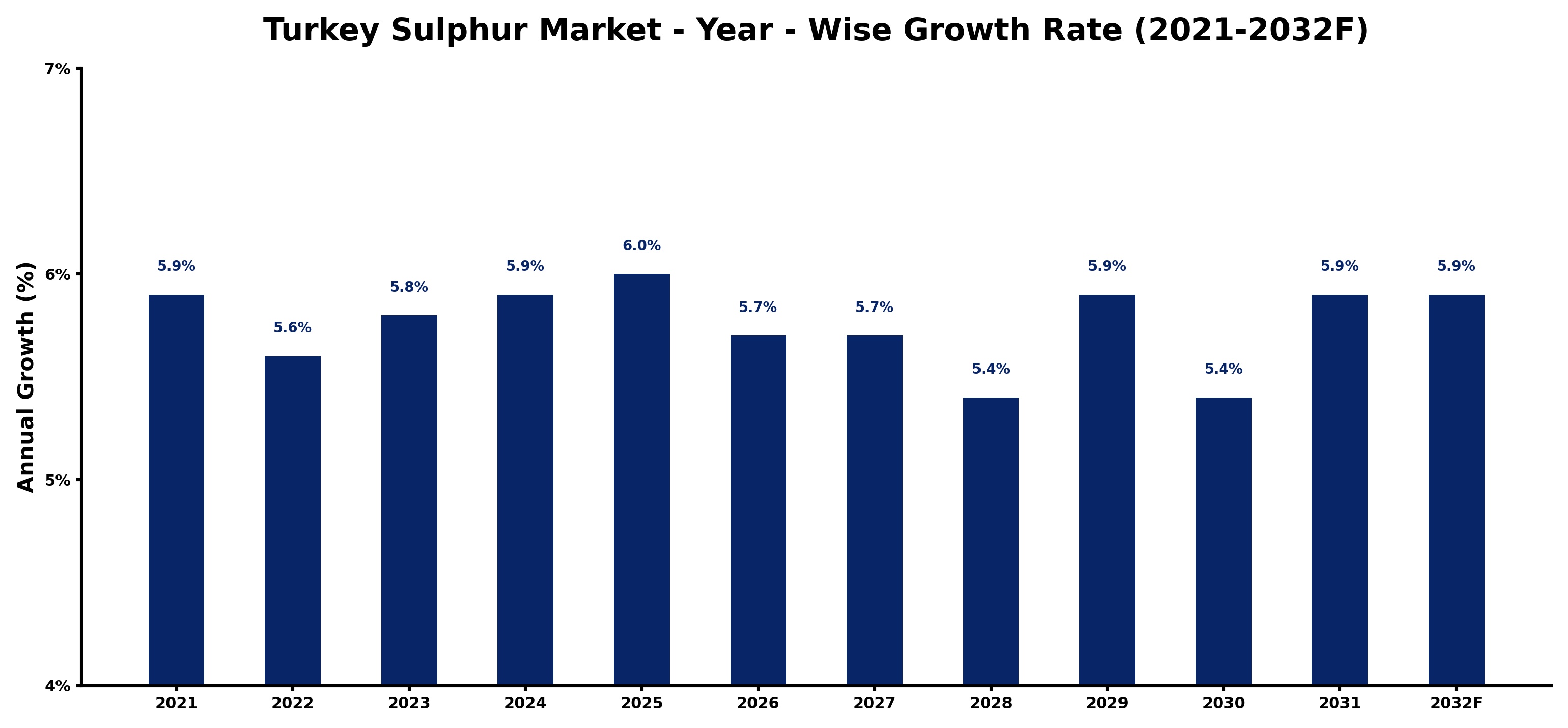
The table below presents the year‑wise growth rates along with the key drivers influencing the market
| Year | Growth Rate | Major Drivers |
| 2021 | 5.9% | Increased industrial applications expanded demand |
| 2022 | 5.6% | Agricultural sector growth boosted consumption |
| 2023 | 5.8% | Energy sector investments enhanced usage |
| 2024 | 5.9% | Construction industry growth drove needs |
| 2025 | 6.0% | Chemical manufacturing expansion increased requirements |
| 2026 | 5.7% | Environmental regulations spurred innovation efforts |
| 2027 | 5.7% | Technological advancements improved production efficiency |
| 2028 | 5.4% | Export opportunities expanded market reach |
| 2029 | 5.9% | Sustainability initiatives drove product development |
| 2030 | 5.4% | Infrastructure projects increased material needs |
| 2031 | 5.9% | Rising population boosted overall consumption |
| 2032 | 5.9% | Strategic partnerships enhanced market presence |
Note - Market size estimations and growth projections presented in this report are based on 6Wresearch's advanced forecasting approach, validated with industry datasets as of June 2026.
Turkey Sulphur Market Synopsis
The most influential force shaping the Turkey Sulphur Market is its agricultural sector. With a robust agricultural output, the need for sulphur-based fertilizers has surged, ensuring the crop yields meet both domestic and export demands.
Moreover, the chemical and pharmaceutical industries are expanding their use of sulphur for diverse applications, including the production of sulfuric acid and various medicinal compounds. This multifaceted demand lays a strong foundation for sustained market growth.
Turkey Sulphur Market Key Takeaways
- Turkey's sulphur demand is predominantly driven by the agricultural sector, crucial for enhancing crop productivity.
- The country's reliance on sulphur imports highlights significant opportunities for investment in domestic production capabilities.
- Environmental regulations are shaping the market, encouraging sustainable practices in sulphur usage across industries.
- The government's initiatives in agriculture and industrial development foster an environment conducive to sulphur market growth.
- Technological innovations in sulphur processing are vital for enhancing operational efficiency and reducing environmental impacts.
Evaluation of Restraints in Turkey Sulphur Market
Several constraints are currently impacting the Turkey Sulphur Market. Notably, fluctuations in global sulphur prices can significantly affect the cost structure for local suppliers who depend on imports. Regulatory constraints, particularly those aimed at minimizing environmental impacts from sulphur emissions, can also impose limitations on production processes. Furthermore, geopolitical factors may disrupt supply chains, creating additional uncertainty in market dynamics. Addressing these challenges will require strategic risk management and innovative solutions from industry players.
Turkey Sulphur Market Trends
A prominent trend in the Turkey Sulphur Market is the increasing adoption of sustainable agricultural practices. Farmers are becoming increasingly aware of the benefits of sulphur in improving not only crop yields but also soil health. Additionally, there's a notable rise in the production of sulphuric acid within the chemical industry, as various industrial applications continue to expand.
Moreover, innovations in sulphur processing technologies are beginning to emerge, aimed at enhancing efficiency and minimizing waste. As environmental considerations gain importance, the market is likely to embrace solutions that align with global sustainability goals.
Turkey Sulphur Market Opportunities
The Turkey Sulphur Market is ripe with opportunities, particularly in investment avenues related to sulphur production and distribution. The ongoing expansion of the agricultural sector presents an attractive prospect for investors looking to capitalize on the increasing demand for sulphur-based fertilizers. Additionally, collaborations with local firms could enhance supply chain efficiency, while advancements in mining operations may bolster local production capabilities. As Turkey progresses towards a more industrialized economy, the need for sulphur is expected to rise substantially, offering further investment potential.
Government Initiatives in the Turkey Sulphur Market
Government policies in Turkey are increasingly focused on regulating the import and export of sulphur to promote environmental sustainability. These regulations aim to control sulphur emissions from various industries, particularly in energy production, to mitigate air pollution. The government is also working on incentives to support domestic sulphur production while ensuring compliance with international environmental standards. Such initiatives are crucial for fostering a responsible and sustainable sulphur market in Turkey.
Future Insights of the Turkey Sulphur Market
The Turkey Sulphur Market is poised for positive growth from 2026 to 2032. Increasing agricultural output and industrial activity are expected to drive demand for sulphur-based products. Additionally, the government's emphasis on sustainable agricultural practices and compliance with environmental regulations will likely further catalyze market expansion. Despite potential challenges related to raw material prices and competition from substitutes, the outlook remains optimistic as the market adapts to changing dynamics and harnesses emerging opportunities.
Turkey Sulphur Market Latest Developments (May 2025 - June 2026)
Recent trends in the Turkey Sulphur Market indicate a heightened focus on sustainability, with industry stakeholders increasingly adopting eco-friendly practices. Investment in sulphur extraction technology has been a focal point, aiming to improve efficiency and reduce environmental footprints. Additionally, partnerships between agricultural producers and sulphur suppliers are becoming more common, enhancing the integration of sulphur products into modern farming practices.
Turkey Sulphur Market - Key Attractiveness of the Report
- 10 Years of Market Numbers
- Historical Data Starting from 2022 to 2025
- Base Year: 2025
- Forecast Data until 2032
- Key Performance Indicators Impacting the Market
- Major Upcoming Developments and Projects
Key Highlights of the Report:
- Turkey Sulphur Market Outlook
- Market Size of Turkey Sulphur Market, 2025
- Forecast of Turkey Sulphur Market, 2032
- Historical Data and Forecast of Turkey Sulphur Revenues & Volume for the Period 2022-2032F
- Turkey Sulphur Market Trend Evolution
- Turkey Sulphur Market Drivers and Challenges
- Turkey Sulphur Price Trends
- Turkey Sulphur Porter's Five Forces
- Turkey Sulphur Industry Life Cycle
- Historical Data and Forecast of Turkey Sulphur Market Revenues & Volume By Product Type for the Period 2022-2032F
- Historical Data and Forecast of Turkey Sulphur Market Revenues & Volume By Natural Gas for the Period 2022-2032F
- Historical Data and Forecast of Turkey Sulphur Market Revenues & Volume By Crude Oil for the Period 2022-2032F
- Historical Data and Forecast of Turkey Sulphur Market Revenues & Volume By Others for the Period 2022-2032F
- Historical Data and Forecast of Turkey Sulphur Market Revenues & Volume By End Users for the Period 2022-2032F
- Historical Data and Forecast of Turkey Sulphur Market Revenues & Volume By Sulfuric Acid (Fertilizers) for the Period 2022-2032F
- Historical Data and Forecast of Turkey Sulphur Market Revenues & Volume By Sulfuric Acid (Metal Manufacturing) for the Period 2022-2032F
- Historical Data and Forecast of Turkey Sulphur Market Revenues & Volume By Chemical Processing for the Period 2022-2032F
- Turkey Sulphur Import Export Trade Statistics
- Market Opportunity Assessment By Product Type
- Market Opportunity Assessment By End Users
- Turkey Sulphur Top Companies Market Share
- Turkey Sulphur Competitive Benchmarking By Technical and Operational Parameters
- Turkey Sulphur Company Profiles
- Turkey Sulphur Key Strategic Recommendations






































