Turkey Zinc Market Summary
The turkey zinc market was estimated at USD 411 Million in 2025 and is projected to reach USD 569 Million by 2032, growing at a CAGR of 5.7% from 2026 to 2032.
Turkey Zinc Market Year-wise Growth Rate and Key Drivers
This graph highlights how the Turkey Zinc Market has steadily grown over the past five years, supported by major growth factors.
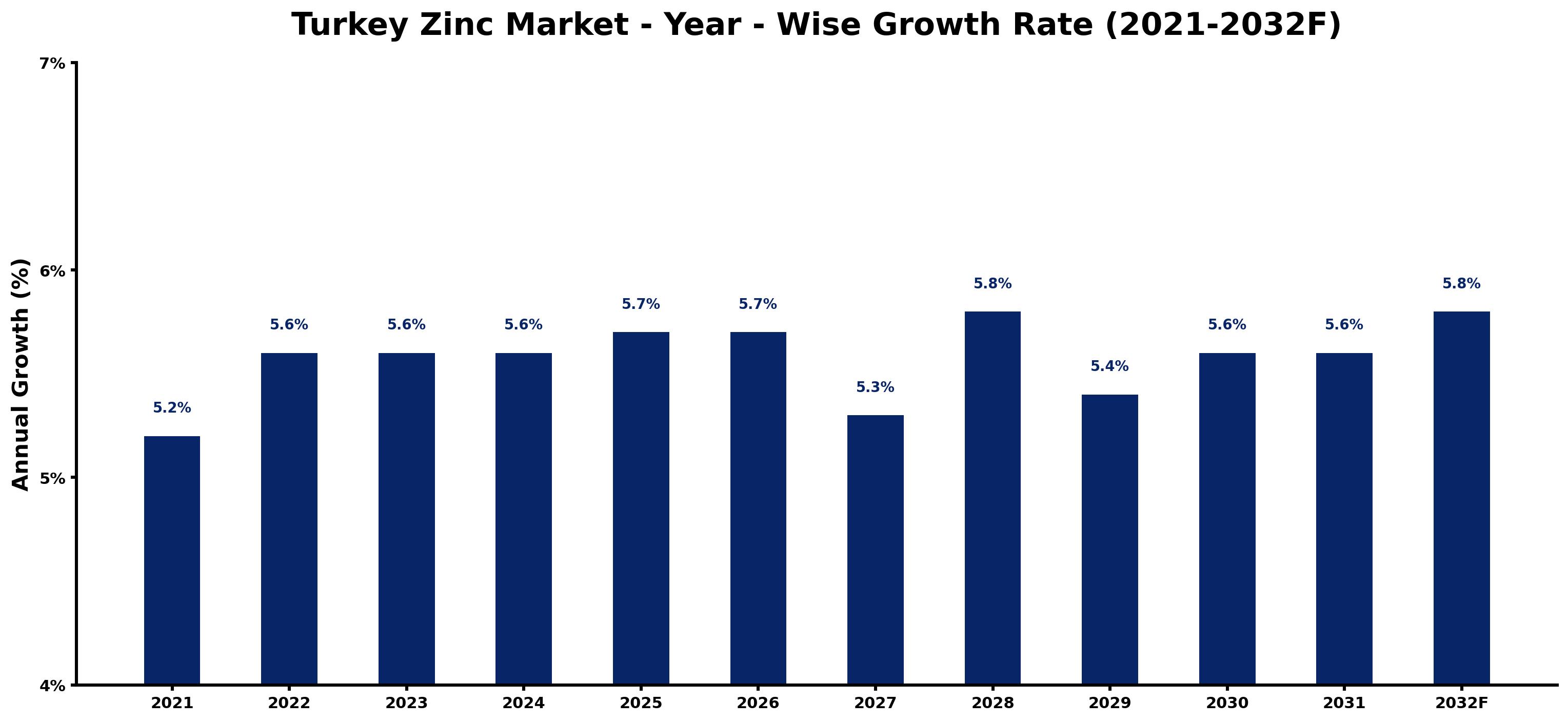
The table below presents the year wise growth rates along with the key drivers influencing the market
| Year | Growth Rate | Major Drivers |
| 2021 | 5.2% | Post-pandemic recovery in construction stimulated zinc demand for infrastructure projects. |
| 2022 | 5.6% | Growing automotive sector increased zinc usage in galvanizing processes for corrosion protection. |
| 2023 | 5.6% | Emerging electric vehicle market shifted focus to lighter materials including zinc alternatives. |
| 2024 | 5.6% | Local manufacturing initiatives enhanced zinc production capabilities within Turkey's industrial landscape. |
| 2025 | 5.7% | International trade agreements expanded market access for Turkish zinc producers in Europe. |
| 2026 | 5.7% | Investment in green technologies fostered new applications for zinc in renewable energy systems. |
| 2027 | 5.3% | Increased awareness of sustainable practices encouraged zinc recycling initiatives across industries. |
| 2028 | 5.8% | Urbanization trends drove higher demand for galvanized steel in construction and housing. |
| 2029 | 5.4% | Research advancements made zinc alloy applications more viable in innovative product designs. |
| 2030 | 5.6% | Technological upgrades in mining processes improved efficiency and reduced operational costs significantly. |
| 2031 | 5.6% | Growing interest in construction materials highlighted zinc's contribution to energy efficiency standards. |
| 2032 | 5.8% | Regional collaborations in the GCC enhanced Turkey's zinc market presence through joint ventures. |
Note - Market size estimations and growth projections presented in this report are based on 6Wresearch's advanced forecasting approach, validated with industry datasets as of June 2026.
Turkey Zinc Market Synopsis
The Turkey Zinc Market is projected to reach 5.7% and witness significant growth during the forecast period (2026-2032). This growth trajectory is primarily driven by increasing demand for galvanized steel, a surge in construction activities, and a booming automotive sector. Turkey has positioned itself as one of Europe's largest consumers and producers of zinc, attributed to its substantial population, robust economic growth, and proactive infrastructure investments. Government initiatives, such as 'Vision 2023' and 'Made In Turkey', serve to further enhance domestic production and consumption of zinc, reinforcing the market's positive outlook.
Turkey Zinc Market Growth Drivers
The Turkey Zinc Market's growth can be attributed to several interlinked factors. Primarily, the increasing demand for galvanized steel in various industries acts as a catalyst for zinc consumption. The construction sector remains a significant consumer, driven by ongoing urbanization and infrastructure projects, which are expected to escalate in tandem with governmental reforms.
- Galvanized steel is vital in construction, used for reinforcing structures and providing corrosion resistance, thereby enhancing longevity.
- The automotive industry's expansion has elevated the need for zinc, utilized in manufacturing car components that require durability and corrosion resistance.
- Increased public and private infrastructure investments foster a conducive environment for zinc consumption, supporting project longevity and efficiency.
- Turkey's strategic geographical position enhances its trade capabilities, allowing for the efficient movement of zinc materials both domestically and internationally.
- Ongoing technological advancements in zinc production processes are likely to improve efficiency and reduce costs, fostering market growth.
Turkey Zinc Market Trends and Opportunities
A notable trend within the Turkey Zinc Market is the rising emphasis on sustainable practices and eco-friendly production processes. This is driving innovation and creating opportunities for manufacturers to capitalize on evolving consumer preferences towards greener materials.
- The emphasis on recycling and utilizing secondary zinc sources is gaining traction, thereby reducing environmental impact and resource dependence.
- Strategic partnerships between government entities and private sectors aim to bolster the domestic zinc supply chain, facilitating market stability.
- Innovation in protective coatings that utilize zinc is growing, presenting opportunities for applications in diverse sectors beyond traditional uses.
- As global economies pivot towards sustainability, Turkey's initiatives may attract foreign investments, creating further market opportunities.
- Heightened awareness about the benefits of zinc in health and nutrition sectors may foster demand in pharmaceuticals, broadening the market's application scope.
Turkey Zinc Market Challenges and Restraints
Despite the favorable outlook, the Turkey Zinc Market faces several challenges that could impede its growth. Fluctuations in raw material prices can pose significant hurdles for production profitability and supply chain stability.
- Volatility in global zinc prices may create unpredictability for producers, complicating budgetary and operational planning.
- Environmental regulations may impose additional compliance costs, challenging manufacturers to adopt stricter sustainability measures.
- International trade policies and tariffs can potentially limit market accessibility and affect export capabilities for Turkish zinc products.
- Competition from alternative materials that offer similar benefits may divert market share away from zinc, impacting demand.
- Lack of skilled labor in the zinc production processes can restrict operational efficiency, affecting overall market competitiveness.
Turkey Zinc Market Government Investment and Initiatives
The Turkish government has been actively promoting initiatives to bolster the zinc industry in line with broader economic objectives. Policies such as 'Vision 2023' aim to enhance domestic manufacturing capabilities and promote industrial growth, particularly within the zinc sector.
- Investment in infrastructure development, as outlined in governmental plans, underscores the need for zinc in construction, fostering market demand.
- Incentives for technology adoption in zinc production are being encouraged, supporting advancements that enhance production efficiency.
- Public-private partnerships are being established to facilitate investment in mining and processing facilities, aiming to increase domestic zinc output.
- Government funding and grants are available for enterprises focusing on environmentally sustainable practices within the zinc industry.
- Policy frameworks are being developed to address and mitigate the environmental impact of zinc production, improving market sustainability.
Turkey Zinc Market Latest Developments (May 2025 - June 2026)
The Turkey Zinc Market has witnessed significant developments in recent months, reflecting evolving industry dynamics. Increased government focus on infrastructure has led to heightened zinc demand across construction projects, propelling market activity. Furthermore, technological advancements have driven production efficiency, allowing manufacturers to optimize their operations.
- There has been a noticeable uptick in investments towards innovative processing technologies aimed at enhancing zinc production and reducing waste.
- Market players are exploring sustainable practices, reflecting a growing trend towards environmentally friendly production processes.
- Collaborations between local producers and international firms are indicative of an expanding market landscape focused on innovation.
- Increased consumer awareness around the importance of zinc in various applications is influencing market demand positively.
- Government initiatives are anticipated to further support infrastructure projects, ensuring sustained growth in the zinc sector.
Turkey Zinc Market - Key Attractiveness of the Report
- 10 Years of Market Numbers
- Historical Data Starting from 2022 to 2025
- Base Year: 2025
- Forecast Data until 2032
- Key Performance Indicators Impacting the Market
- Major Upcoming Developments and Projects
Key Highlights of the Report:
- Turkey Zinc Market Outlook
- Market Size of Turkey Zinc Market, 2025
- Forecast of Turkey Zinc Market, 2032F
- Historical Data and Forecast of Turkey Zinc Revenues & Volume for the Period 2022-2032F
- Turkey Zinc Market Trend Evolution
- Turkey Zinc Market Drivers and Challenges
- Turkey Zinc Price Trends
- Turkey Zinc Porter's Five Forces
- Turkey Zinc Industry Life Cycle
- Historical Data and Forecast of Turkey Zinc Market Revenues & Volume By Applications for the Period 2022-2032F
- Historical Data and Forecast of Turkey Zinc Market Revenues & Volume By Galvanizing? for the Period 2022-2032F
- Historical Data and Forecast of Turkey Zinc Market Revenues & Volume By Die casting for the Period 2022-2032F
- Historical Data and Forecast of Turkey Zinc Market Revenues & Volume By Brass and bronze for the Period 2022-2032F
- Historical Data and Forecast of Turkey Zinc Market Revenues & Volume By Others? for the Period 2022-2032F
- Historical Data and Forecast of Turkey Zinc Market Revenues & Volume By End-users for the Period 2022-2032F
- Historical Data and Forecast of Turkey Zinc Market Revenues & Volume By Construction? for the Period 2022-2032F
- Historical Data and Forecast of Turkey Zinc Market Revenues & Volume By Transportation? for the Period 2022-2032F
- Historical Data and Forecast of Turkey Zinc Market Revenues & Volume By Consumer goods for the Period 2022-2032F
- Historical Data and Forecast of Turkey Zinc Market Revenues & Volume By Others? for the Period 2022-2032F
- Turkey Zinc Import Export Trade Statistics
- Market Opportunity Assessment By Applications
- Market Opportunity Assessment By End-users
- Turkey Zinc Top Companies Market Share
- Turkey Zinc Competitive Benchmarking By Technical and Operational Parameters
- Turkey Zinc Company Profiles
- Turkey Zinc Key Strategic Recommendations






































