UAE Cyber Security Market Size & Growth Rate
According to 6Wresearch internal database and industry insights, the UAE Cyber Security Market was valued at USD 540 Million in 2025 and is projected to reach USD 710.60 Million by 2032, growing at a CAGR of approximately 4% during 2026–2032.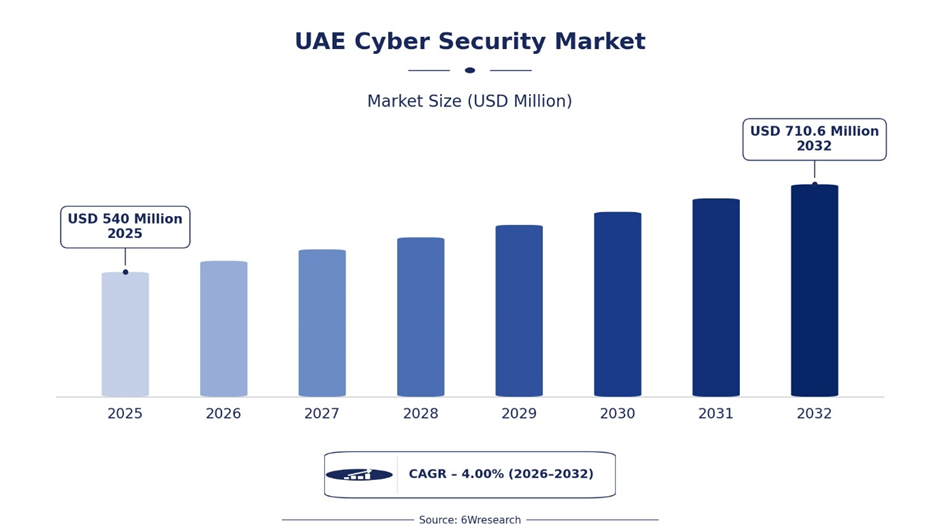
UAE Cyber Security Market Highlights
|
Report Metric |
Details |
|
Report Name |
UAE Cyber Security Market (2026-2032) |
|
Market Size 2025 |
USD 540 Million |
|
Market Size 2032 |
USD 710.60 Million |
|
Absolute Growth 2025–2032 |
USD 170.60 Million |
|
CAGR 2026–2032 |
4% |
|
Peak Annual Growth |
6.4% in 2022 (forecast peak of 4.7% in 2028) |
|
Forecast Period |
2026–2032 |
|
Historical Data |
2022–2025 |
|
Base Year |
2025 |
|
Leading Components, 2025 |
Solutions (58% share) |
|
Fastest-Growing Components |
Services (4.5% CAGR) |
|
Leading Offerings, 2025 |
Infrastructure Security (26% share) |
|
Fastest-Growing Offerings |
Data Security And Privacy Service (5.4% CAGR) |
|
Leading Deployments, 2025 |
On-Premises (54% share) |
|
Fastest-Growing Deployments |
Cloud (5.5% CAGR) |
|
Leading Verticals, 2025 |
BFSI (21% share) |
|
Fastest-Growing Verticals |
Energy And Utilities (5.0% CAGR) |
|
Growing Sector |
Energy And Utilities and Aerospace And Defense |
|
Key End Users |
Banks and insurers, government and defence entities, energy and utility operators, telecom operators, healthcare and retail enterprises |
UAE Cyber Security Market Year-wise Growth Rate and Key Drivers (2022–2032)
This graph illustrates the annual growth rates of the market from 2022 to 2032, highlighting a steady upward trajectory and projected market expansion over the forecast period.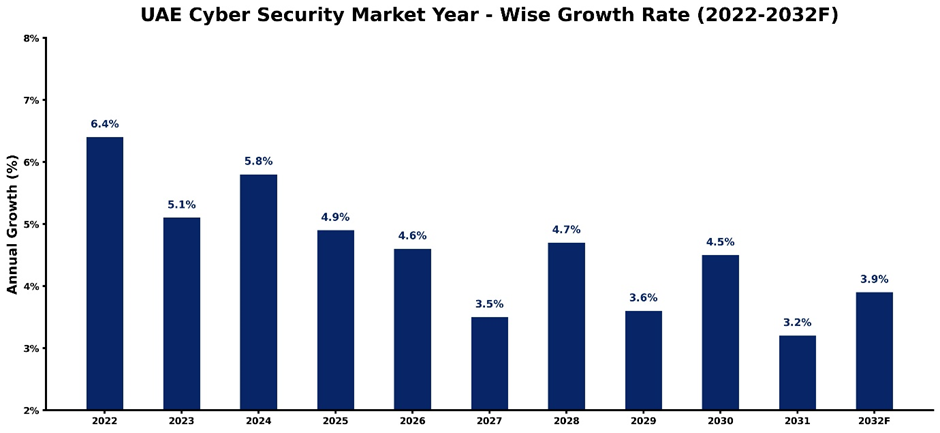 The following table presents the estimated annual growth rate for each year together with the principal factor influencing market performance.
|
Year |
Estimated Annual Growth (%) |
Market Rationale |
|
2022 |
6.4% |
Expo 2020 Dubai, which ran until March 2022, required extensive protection of connected venues and systems, lifting spending. |
|
2023 |
5.1% |
Global inflation and higher interest rates led enterprises to defer discretionary security projects, moderating growth. |
|
2024 |
5.8% |
Heightened regional geopolitical tension from late 2023 raised threat levels and prompted critical-sector operators to increase monitoring and response investment. |
|
2025 |
4.9% |
Completion of first-wave compliance programmes and cautious trade conditions following April 2025 tariff announcements moderated growth. |
|
2026 |
4.6% |
Large enterprises are expected to complete first-wave authentication upgrades required by banking regulators, moderating incremental spending. |
|
2027 |
3.5% |
Maturing managed-service contracts and price competition among providers are expected to restrain revenue growth. |
|
2028 |
4.7% |
Platforms procured in 2022 and 2023 are expected to reach refresh age, lifting replacement demand. |
|
2029 |
3.6% |
Consolidation onto fewer integrated security platforms is expected to reduce spending on point products, moderating growth. |
|
2030 |
4.5% |
Post-quantum cryptography migration programmes are expected to begin in earnest, raising demand for encryption, key management and advisory services. |
|
2031 |
3.2% |
Maturing automation is expected to lower per-incident service effort, moderating revenue growth for managed providers. |
|
2032 |
3.9% |
Expansion of connected infrastructure and next-generation network deployments is expected to support a modest recovery in security spending. |
Note: Market size estimations and growth projections presented in this report are based on 6Wresearch proprietary forecasting methodology, utilizing the latest available industry data, government publications, and primary research inputs.
UAE Cyber Security Market Synopsis
The UAE Cyber Security Market includes identity and access management, infrastructure security, governance and compliance tools, vulnerability management and data protection services that safeguard networks, applications and information. Demand is rising owing to frequent attacks on vital sectors, the national digital identity programme, data-protection legislation and expanding data centre capacity in Abu Dhabi and Dubai. However, a limited domestic talent pool and the high cost of managed services for smaller firms continue to restrain adoption. Additionally, increasing cloud adoption is encouraging organisations to strengthen their cybersecurity infrastructure and risk management capabilities.
Market Dynamics Impact Analysis (2026–2032)
|
Factor |
Type |
Impact |
Primary Segment Affected |
|
Rising attack volumes on vital sectors |
Driver |
High |
Infrastructure Security |
|
Enforcement of data-protection legislation |
Driver |
High |
Data Security And Privacy Service |
|
Managed security operations for mid-sized firms |
Opportunity |
High |
Services |
|
Operational technology protection for utilities |
Opportunity |
Medium |
Energy And Utilities |
|
Limited budgets of smaller enterprises |
Restraint |
Medium |
Commercial Offices |
|
Data localisation requirements |
Restraint |
Medium |
Cloud |
|
Shortage of skilled professionals |
Challenge |
High |
Services |
|
Integration of multi-vendor environments |
Challenge |
Medium |
Infrastructure Security |
Evaluation of Drivers in UAE Cyber Security Market (2026–2032)
Below mentioned are some major drivers and their influence on market dynamics.
|
Drivers |
Primary Segment Affected |
Why It Matters (Evidence) |
|
Rising attack volumes on vital sectors |
Infrastructure Security |
Persistent intrusion attempts on energy, finance and government networks oblige operators to deploy continuous monitoring and perimeter controls, and the Cyber Security Council has reported more than 200,000 daily attacks on vital sectors. |
|
Expansion of national digital identity and e-government services |
Identity And Access Management |
Every new digital service requires strong authentication and access governance, and the UAE PASS national digital identity now serves more than 7 million users across federal and local services. |
|
Enforcement of data-protection law |
Data Security And Privacy Service |
Federal Decree-Law No. 45 of 2021 requires controllers and processors to safeguard personal data, which creates recurring demand for data discovery, encryption and privacy assessments. |
|
Defence-sector in-house cyber capability |
Aerospace And Defense |
Defence-industrial consolidation under EDGE Group, formed in 2019, includes its own cyber arm CPX, which creates demand for secure engineering, threat intelligence and classified-network protection. |
|
Digitised power generation |
Energy And Utilities |
Operational technology networks at power and desalination assets now connect to enterprise systems, and the four-unit Barakah nuclear plant, fully operational since 2024, supplies about a quarter of UAE electricity and requires continuous protection. |
The UAE Cyber Security Market is supported by high levels of digital adoption, with internet penetration reaching approximately 99%, thereby increasing the number of connected users, devices and transactions requiring protection. Rising enterprise technology spending further strengthens this demand, as organisations increasingly consider security budgets an integral part of their digital programmes. Additionally, a growing technology workforce is enabling the expansion of in-country security operations, while private and foreign investments, including Microsoft 2024 investment in G42, are strengthening the artificial intelligence and data infrastructure that requires continuous protection. Moreover, increasing data centre capacity continues to support demand for security solutions and managed monitoring services.
Evaluation of Restraints in UAE Cyber Security Market
Below mentioned are some major restraints and their influence on market dynamics.
|
Market Restraint |
Primary Segment Affected |
Why It Matters (Evidence) |
|
Limited budgets and security maturity among smaller firms |
Commercial Offices |
Smaller enterprises cannot absorb the licence and staffing costs of enterprise-grade tools, and they account for about 94% of UAE companies, which caps overall penetration. |
|
Legacy and operational technology integration |
Infrastructure Security |
Control systems with service lives of 20 to 30 years cannot easily accept modern agents or patches, which slows upgrades and extends project timelines at utilities and industrial sites. |
|
Data localisation requirements |
Cloud |
Federal Law No. 2 of 2019 on information and communication technology in health fields restricts storing health data outside the country, forcing providers to build in-country architectures and limiting use of global platforms. |
|
Long procurement cycles in government and defence |
Aerospace And Defense |
Purchases require security clearance, in-country value scoring used by major Abu Dhabi buyers and multi-stage approval, which extends sales cycles for new suppliers and delays revenue recognition. |
|
Dependence on imported technology |
Solutions |
Almost all enterprise firewalls, endpoint and access products come from foreign vendors, and dirham pricing pegged to the dollar at 3.6725 transmits global price and licensing changes directly to local buyers. |
UAE Cyber Security Market Challenges
The UAE Cyber Security Industry faces several operational challenges. A global shortage of approximately 4 million cyber security professionals compels local providers to recruit talent from abroad, thereby increasing salary costs and delaying the staffing of new security operations centres. Additionally, buyers operating across the seven emirates and financial free zones must comply with differing digital regulations, increasing duplication in audits and security tools. Preparation for post-quantum cryptography, with legacy public-key algorithms expected to be disallowed by 2035, requires organisations to inventory encryption assets well in advance. Meanwhile, security solutions bundled within large platform contracts intensify price competition for specialist vendors.
Trends in the UAE Cyber Security Market
The following are some of the key trends shaping the growth of the UAE Cyber Security Market.
- Shift from SMS One-Time Passwords to In-App Authentication: The Central Bank of the UAE has directed licensed financial institutions to phase out SMS and email one-time passwords in favour of in-app authentication, with the transition scheduled around March 2026. Consequently, banks are adopting device binding, biometrics and risk-based checks. This shift favours authentication and fraud-prevention vendors capable of embedding their controls within mobile banking applications.
- Transition from In-House Security Teams to Managed Security Operations: Large UAE organisations are increasingly moving away from establishing their own monitoring teams, as local providers such as CPX and Help AG operate in-country security operations centres serving government and enterprise clients. As a result, buyers gain round-the-clock coverage without recruiting scarce analysts. This trend benefits suppliers offering detection, response and reporting through a single service contract with local data residency.
- AI Emerging as Both a Threat Vector and a Defensive Tool: UAE authorities have publicly warned about artificial intelligence-enabled phishing and deepfake fraud, while security teams are increasingly adopting machine-learning detection and automated response to manage rising alert volumes. Consequently, this development favours vendors that integrate analytics into endpoint, network and access products, as well as providers capable of adapting models to Arabic-language content and regional threat patterns.
Investment Opportunities in the UAE Cyber Security Market
Some of the key investment opportunities in the UAE Cyber Security Market are outlined below.
- Managed Detection and Response for Mid-Sized Enterprises: Mid-sized UAE firms face similar cyber threats to large enterprises but often lack the personnel required to operate round-the-clock monitoring systems. Therefore, investors can establish in-country security operations centres offering managed detection, incident response and threat intelligence subscriptions. Market entry is practical through joint ventures with integrators in Dubai and Abu Dhabi, supported by licences in free zones such as DIFC and ADGM.
- Operational Technology Security for Utilities and Oil and Gas: Power, water and hydrocarbon operators are increasingly connecting plant systems to enterprise networks, thereby creating demand for network segmentation, asset discovery and industrial threat monitoring. Accordingly, suppliers can invest in specialised monitoring products and certified engineers, while entering the market through partnerships with engineering contractors or system integrators already approved by major operators in Abu Dhabi and Dubai.
- Data Discovery and Privacy Compliance Services: Stricter enforcement of data-protection regulations is encouraging firms to identify and classify the personal data they hold. Consequently, investment opportunities include data discovery tools, data loss prevention, privacy impact assessments and breach response retainers. Providers can enter the market through certified consultancies, alliances with law firms and registration with the relevant federal data authority, initially targeting banks, hospitals and retailers.
Leading Players in UAE Cyber Security Market
Stated below are some of the leading companies contributing significantly to the UAE Cyber Security Market share.
1. Help AG
| Company Name | Help AG |
|---|---|
| Established Year | 1995 |
| Headquarters | Dubai, UAE |
| Official Website | Click Here |
Help AG is a cyber security services and solutions provider that offers consulting, managed security and systems integration to government and enterprise clients across the Gulf. It plays an established role in the UAE market as a local integrator and managed services partner.
2. CPX Holding
| Company Name | CPX Holding |
|---|---|
| Established Year | 2020 |
| Headquarters | Abu Dhabi, UAE |
| Official Website | Click Here |
CPX Holding is a national cyber security company operating within EDGE Group, providing advisory, managed detection and response and critical infrastructure protection services. It serves government, defence and strategic sector entities in the UAE.
3. Palo Alto Networks
| Company Name | Palo Alto Networks |
|---|---|
| Established Year | 2005 |
| Headquarters | Santa Clara, USA |
| Official Website | Click Here |
Palo Alto Networks is a global network and cloud security vendor supplying firewalls, secure access and security operations platforms. It supports UAE government and enterprise customers through regional operations and channel partners.
4. Fortinet
| Company Name | Fortinet |
|---|---|
| Established Year | 2000 |
| Headquarters | Sunnyvale, USA |
| Official Website | Click Here |
Fortinet is a global provider of integrated security appliances, software and services. It maintains an established regional presence in the UAE, serving telecom, financial and public-sector customers through local distributors and partners.
Government Initiatives in the UAE Cyber Security Market
The UAE cyber security framework is based on the National Cybersecurity Strategy of 2019 and the Cyber Security Council, which was established by the Cabinet in 2020 to coordinate national policy and protect critical sectors. Furthermore, this framework is supported by Federal Decree-Law No. 34 of 2021 on combatting cybercrime and the Digital Economy Strategy, which aims to increase the digital economy contribution to GDP to 19.4% by 2031.
Additionally, implementation responsibilities are shared among federal and emirate-level authorities. Dubai established the Dubai Electronic Security Center in 2014 and launched its Cyber Security Strategy in 2017, which applies the Information Security Regulation to government entities. Meanwhile, Abu Dhabi Government Digital Strategy for 2025–2027 allocates AED 13 billion towards digital and artificial intelligence transformation, thereby extending security requirements across its public agencies.
Future Insight of the UAE Cyber Security Market
The UAE Cyber Security Market is expected to benefit from the wider adoption of artificial intelligence in threat detection, which will improve the speed and coverage of security operations while encouraging investment in automation. Moreover, increasingly stringent regulatory enforcement will continue to generate compliance-driven spending, while national digital programmes will expand the range of connected public services requiring protection. Large-scale infrastructure investments are also expected to generate additional demand, as the planned 5 GW UAE-US artificial intelligence campus in Abu Dhabi is scheduled to deliver its first 200 MW in 2026. Furthermore, sustained foreign partnerships will strengthen technology transfer and support market development.
Market Segmentation Analysis
The report offers a comprehensive study of the following market segments and their leading categories in the market.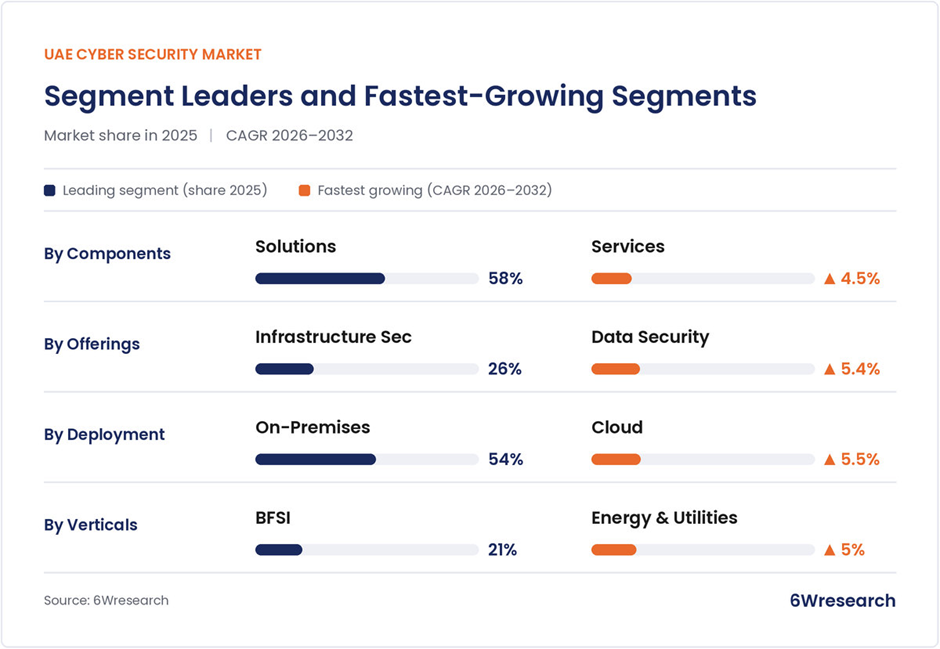
By Components – Solutions Led, Services Expected to Grow Fastest
According to Ravi Bhandari, Research Head at 6Wresearch, Solutions led the UAE Cyber Security Market with a 58% share in 2025, as banks, government bodies and energy operators continued to procure firewalls, endpoint protection and security analytics platforms for their extensive installed networks. Meanwhile, Services are expected to record the fastest growth during 2026 to 2032 at a CAGR of 4.5%, as the shortage of in-house expertise encourages organisations in Dubai and Abu Dhabi to adopt managed security operations and outsourced response services.
By Offerings – Infrastructure Security Led, Data Security and Privacy Services Expected to Grow Fastest
Infrastructure Security held the largest share of 26% in 2025, reflecting the extensive network, endpoint and perimeter infrastructure of UAE banks, telecom operators and public entities. Meanwhile, Data Security and Privacy Services are projected to record the fastest expansion at a CAGR of 5.4% through 2026 to 2032, as stricter enforcement of personal data regulations and rapidly increasing data volumes drive demand for discovery, encryption and privacy assessments.
By Deployments – On-Premises Led, Cloud Expected to Grow Fastest
On-Premises deployments accounted for 54% of the market in 2025, as government, defence and banking organisations continue to retain sensitive workloads within their own facilities to meet data residency and confidentiality requirements. Meanwhile, Cloud is forecast to record the highest CAGR of 5.5% during 2026 to 2032, supported by in-country regions operated by Microsoft, Oracle and Amazon Web Services, enabling organisations to adopt security services delivered from within the UAE.
By Verticals – BFSI Led, Energy and Utilities Expected to Grow Fastest
BFSI led the market in 2025 with a 21% share, supported by the concentration of regional banks and financial free zones in Dubai and Abu Dhabi, along with stringent oversight of fraud and operational resilience. Furthermore, Energy and Utilities is expected to register the fastest growth at a CAGR of 5% through 2026 to 2032, as operators increasingly digitalise power, water and hydrocarbon assets, thereby creating demand for protection across operational technology networks.
Key Attractiveness of the Report
- 10 Years of Market Numbers
- Historical Data Starting from 2022 to 2025
- Base Year 2025
- Forecast Data until 2032
- Key Performance Indicators Impacting the Market
- Major Upcoming Developments and Projects
Key Highlights of the Report:
- UAE Cyber Security Market Overview
- UAE Cyber Security Market Outlook
- UAE Cyber Security Market Forecast
- UAE Cyber Security Market Size
- Historical Data of UAE Cyber Security Market Revenues and Volume for the period, 2022-2032.
- UAE Cyber Security Market Forecast of Revenues and Volume, Until 2032
- Historical Data of UAE Cyber Security Market Revenues and Volume for the period, By Components, Offerings, Deployments, and Verticals, 2022-2032.
- Forecast of UAE Cyber Security Market Revenues and Volume, By Components, Offerings, Deployments, and Verticals, Until 2032
- UAE Cyber Security Market Overview on Drivers and Restraints
- UAE Cyber Security Market Trends
- UAE Cyber Security Industry Life Cycle
- Porter’s Five Force Analysis
- UAE Cyber Security Market Opportunity Assessment
- UAE Cyber Security Market Share, By Company
- UAE Cyber Security Market Overview on Competitive Benchmarking
- Company Profiles
- Key Strategic Recommendations
Market Covered
By Components
- Solutions
- Services
By Offerings
- Identity and Access Management
- Infrastructure Security
- Governance, Risk and Compliance
- Unified Vulnerability Management
- Data Security and Privacy
- Others
By Deployment
- Cloud
- On-Premises
By Verticals
- Aerospace and Defense
- BFSI
- Retail
- Healthcare and Hospitality
- IT and Telecom
- Energy and Utilities
- Manufacturing
- Commercial Offices
- Others































