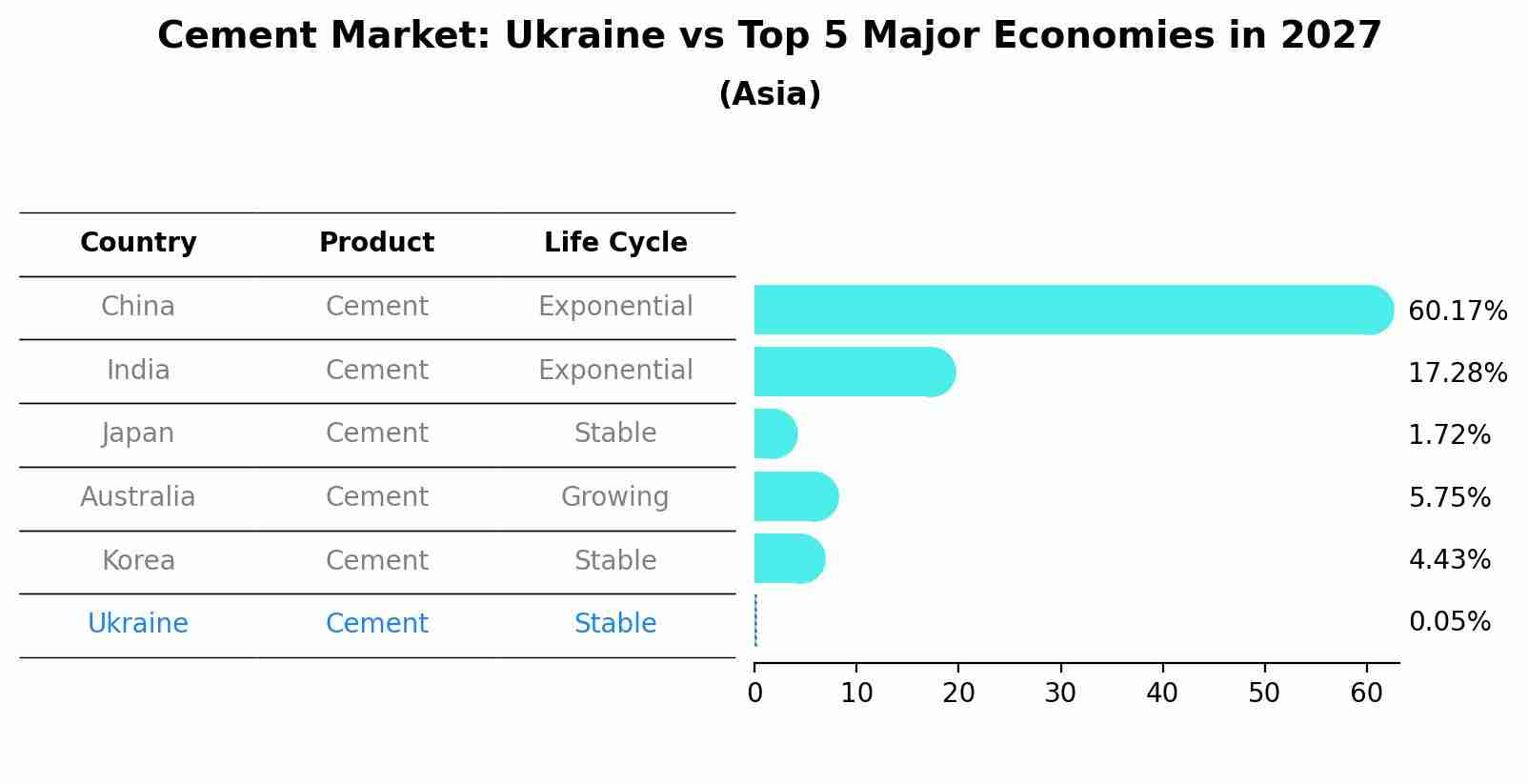
Cement Market: Ukraine vs Top 5 Major Economies in 2027 (Asia)
By 2027, Ukraine's Cement market is forecasted to achieve a stable growth rate of 0.05%, with China leading the Asia region, followed by India, Japan, Australia and South Korea.
Ukraine Cement Market Synopsis
The Ukraine cement market is one of the largest in Eastern Europe. In 2018, it reached over 10 million tons, with a compound annual growth rate (CAGR) of 2.4% from 2013 to 2018. The majority (~66%) of domestic production is consumed domestically, while the remainder is exported mainly to other European countries as well as certain regions in North Africa and South America.
Ukraine cement producers are primarily focused on modernizing their production lines and increasing efficiency through investments in new technologies such as dry process kilns and better quality control measurements. Additionally, they have become more resilient to macroeconomic fluctuations by diversifying their customer base both regionally and internationally.
In recent years, however, there has been increased pressure on Ukraine?s cement industry due to rising fuel costs and a slightly declining construction sector which can affect demand for cement products. Looking ahead into 2020-2025, these trends could potentially cause further disruptions if not addressed properly by producers or government authorities in terms of pricing policies or other incentives aimed at maintaining competitiveness within the industry.
Key Highlights of the Report:
- Ukraine Cement Market Outlook
- Market Size of Ukraine Cement Market, 2019
- Forecast of Ukraine Cement Market, 2026
- Historical Data and Forecast of Ukraine Cement Revenues & Volume for the Period 2016 - 2026
- Ukraine Cement Market Trend Evolution
- Ukraine Cement Market Drivers and Challenges
- Ukraine Cement Price Trends
- Ukraine Cement Porter's Five Forces
- Ukraine Cement Industry Life Cycle
- Historical Data and Forecast of Ukraine Cement Market Revenues & Volume By Product for the Period 2016 - 2026
- Historical Data and Forecast of Ukraine Cement Market Revenues & Volume By Portland for the Period 2016 - 2026
- Historical Data and Forecast of Ukraine Cement Market Revenues & Volume By Others for the Period 2016 - 2026
- Historical Data and Forecast of Ukraine Cement Market Revenues & Volume By Application for the Period 2016 - 2026
- Historical Data and Forecast of Ukraine Cement Market Revenues & Volume By Residential for the Period 2016 - 2026
- Historical Data and Forecast of Ukraine Cement Market Revenues & Volume By Non-residential/Infrastructure for the Period 2016 - 2026
- Ukraine Cement Import Export Trade Statistics
- Market Opportunity Assessment By Product
- Market Opportunity Assessment By Application
- Ukraine Cement Top Companies Market Share
- Ukraine Cement Competitive Benchmarking By Technical and Operational Parameters
- Ukraine Cement Company Profiles
- Ukraine Cement Key Strategic Recommendations






































