Ukraine Real Estate Market Size, Share & Growth Rate
The Ukraine Real Estate Market was estimated at USD 1320 Million in 2025 and is projected to reach USD 1900 Million by 2032, growing at a CAGR of 5.3% from 2026 to 2032. This growth trajectory is primarily driven by a combination of increasing urbanization, a burgeoning middle class, and significant foreign investment. The revitalization of key urban areas and infrastructure projects further underscores the positive outlook for the sector.
Ukraine Real Estate Market Year-wise Growth Rate and Key Drivers
This graph highlights how the Ukraine Real Estate Market has steadily grown over the years, supported by major growth factors.
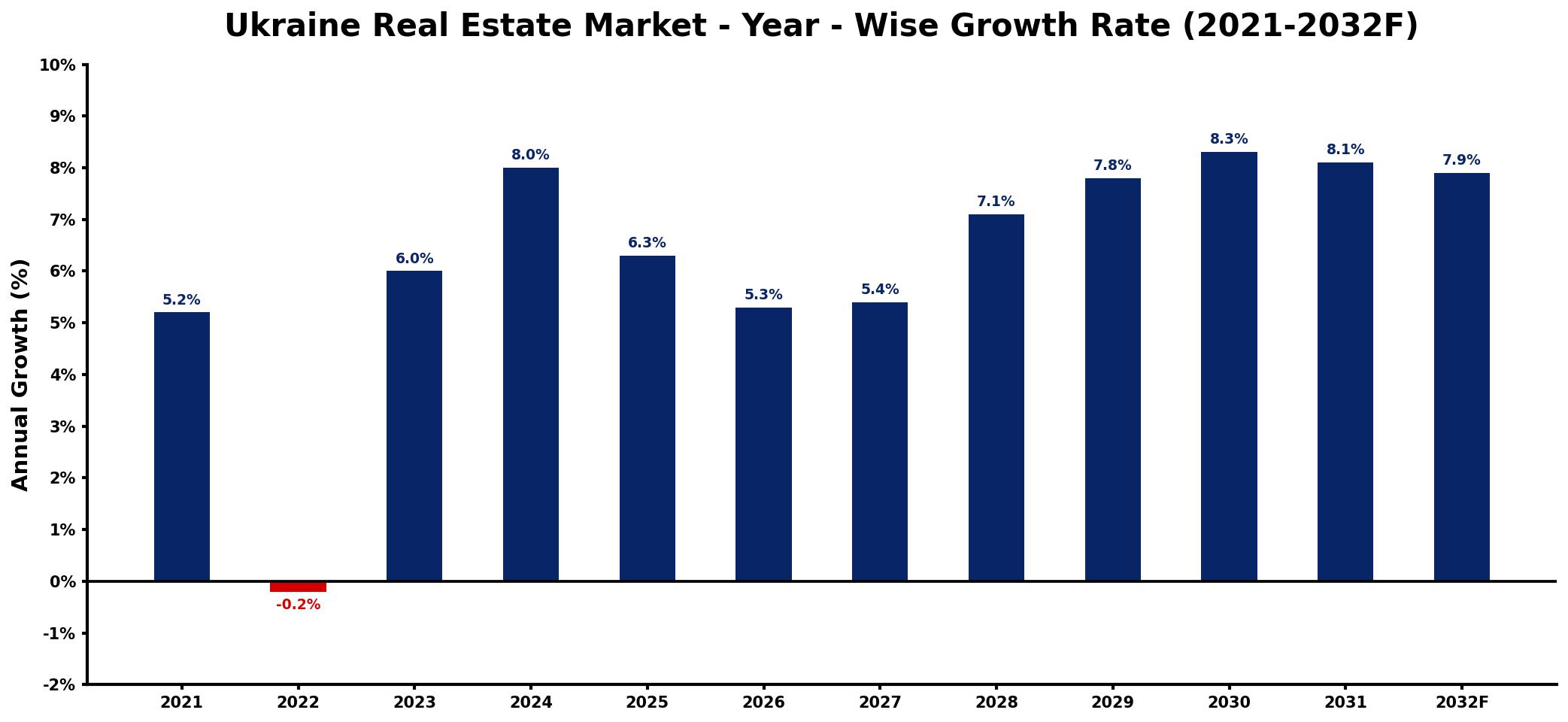
The table below presents the year‑wise growth rates along with the key drivers influencing the market
| Year | Growth Rate | Major Drivers |
| 2021 | 5.2% | Rising foreign investment interest |
| 2022 | -0.2% | Decreased buyer confidence observed |
| 2023 | 6.0% | Increased urban development projects |
| 2024 | 8.0% | Surge in residential construction demand |
| 2025 | 6.3% | Growing interest in green buildings |
| 2026 | 5.3% | Expansion of commercial leasing activity |
| 2027 | 5.4% | Boost in infrastructure development plans |
| 2028 | 7.1% | Increase in international tourism influx |
| 2029 | 7.8% | Strengthened mortgage financing options |
| 2030 | 8.3% | Rising demand for luxury housing |
| 2031 | 8.1% | Growth in rental market stability |
| 2032 | 7.9% | Enhanced urban revitalization initiatives |
Note: Market size estimations and growth projections presented in this report are based on 6Wresearch's proprietary forecasting methodology, utilizing the latest available industry data, government publications, and primary research inputs.
Ukraine Real Estate Market Synopsis
In recent years, urbanization has sharply increased demand for modern residential properties in major cities like Kyiv, Lviv, and Odesa. This surge is largely fueled by a growing population seeking quality housing and amenities within urban centers.
On the supply side, there has been a noticeable influx of foreign investments into commercial real estate, particularly in office spaces and retail outlets. Investors are drawn to the relatively low property prices in Ukraine compared to other European nations, presenting a unique opportunity for growth and expansion.
Ukraine Real Estate Market Key Takeaways
- The market is experiencing a robust upward trend due to urbanization and demographic shifts.
- Foreign investors are increasingly attracted to commercial real estate opportunities in Ukraine.
- Infrastructure developments are enhancing the desirability of various property types across key urban locations.
- Political challenges remain, but recent reforms are aiming to improve market transparency.
- Residential property demand is on the rise, particularly in metropolitan areas.
Evaluation of Restraints in Ukraine Real Estate Market
Despite its potential, the Ukraine real estate market faces substantial restraints that could impede its growth. Political instability continues to breed uncertainty, making investors wary. The lack of transparency in property transactions and the prevalence of corruption complicate due diligence processes. Additionally, outdated property laws present obstacles to foreign investments, while ongoing conflicts in specific regions dampen property values and market confidence.
Ukraine Real Estate Market Trends
Current trends show an escalating interest in eco-friendly and energy-efficient housing solutions, driven by the global shift toward sustainability. Moreover, as local economies strengthen, there is a growing demand for mixed-use developments that combine residential, commercial, and recreational spaces. The integration of technology into real estate services, such as virtual tours and digital transactions, is also reshaping consumer expectations and market dynamics.
Ukraine Real Estate Market Opportunities
Investors can find considerable opportunities within the residential real estate sector, especially in high-demand urban locales like Kyiv. The development of upscale apartments aimed at middle-class families is particularly promising. Additionally, commercial real estate, including retail spaces and modern office complexes, is expected to thrive due to increasing foreign investments. Infrastructure projects enhancing connectivity and access also present opportunities for strategic real estate investments.
Government Initiatives in the Ukraine Real Estate Market
The Ukrainian government has undertaken numerous initiatives aimed at revitalizing the real estate market. Key reforms include the establishment of a land market aimed at facilitating property transactions and combatting corruption. Furthermore, streamlined processes for construction permitting and incentives for foreign investment are critical steps toward creating a more conducive environment for real estate development, thereby enhancing market transparency and competitiveness.
Future Insights of the Ukraine Real Estate Market
Looking ahead to 2026-2032, the Ukraine real estate market is likely to evolve significantly. Ongoing urbanization and infrastructure enhancements will remain central to market dynamics. The residential sector is poised for substantial growth as urban centers continue to attract new residents. Moreover, with ongoing reforms aimed at improving the investment climate, a resurgence in commercial real estate activity can be expected, highlighting the potential for long-term profitability amidst inherent risks.
Ukraine Real Estate Market Latest Developments (2025 - 2026)
Recent developments in the Ukraine real estate sector have included increased activity in residential housing projects in metropolitan areas, reflecting a rising demand from both local and foreign buyers. Additionally, investment in infrastructure has seen a renewed focus, with government initiatives aimed at bolstering transport and utilities contributing to enhanced market accessibility. There is also a growing trend towards mixed-use developments that cater to the evolving needs of urban residents.
Ukraine Real Estate Market - Key Attractiveness of the Report
- 10 Years of Market Numbers
- Historical Data Starting from 2022 to 2025
- Base Year: 2025
- Forecast Data until 2032
- Key Performance Indicators Impacting the Market
- Major Upcoming Developments and Projects
Key Highlights of the Report:
- Ukraine Real Estate Market Outlook
- Market Size of Ukraine Real Estate Market, 2025
- Forecast of Ukraine Real Estate Market, 2032
- Historical Data and Forecast of Ukraine Real Estate Revenues & Volume for the Period 2022-2032F
- Ukraine Real Estate Market Trend Evolution
- Ukraine Real Estate Market Drivers and Challenges
- Ukraine Real Estate Price Trends
- Ukraine Real Estate Porter's Five Forces
- Ukraine Real Estate Industry Life Cycle
- Historical Data and Forecast of Ukraine Real Estate Market Revenues & Volume By Property for the Period 2022-2032F
- Historical Data and Forecast of Ukraine Real Estate Market Revenues & Volume By Residential for the Period 2022-2032F
- Historical Data and Forecast of Ukraine Real Estate Market Revenues & Volume By Commercial for the Period 2022-2032F
- Historical Data and Forecast of Ukraine Real Estate Market Revenues & Volume By Industrial for the Period 2022-2032F
- Historical Data and Forecast of Ukraine Real Estate Market Revenues & Volume By Land for the Period 2022-2032F
- Historical Data and Forecast of Ukraine Real Estate Market Revenues & Volume By Others for the Period 2022-2032F
- Historical Data and Forecast of Ukraine Real Estate Market Revenues & Volume By Type for the Period 2022-2032F
- Historical Data and Forecast of Ukraine Real Estate Market Revenues & Volume By Sales for the Period 2022-2032F
- Historical Data and Forecast of Ukraine Real Estate Market Revenues & Volume By Rental for the Period 2022-2032F
- Historical Data and Forecast of Ukraine Real Estate Market Revenues & Volume By Lease for the Period 2022-2032F
- Ukraine Real Estate Import Export Trade Statistics
- Market Opportunity Assessment By Property
- Market Opportunity Assessment By Type
- Ukraine Real Estate Top Companies Market Share
- Ukraine Real Estate Competitive Benchmarking By Technical and Operational Parameters
- Ukraine Real Estate Company Profiles
- Ukraine Real Estate Key Strategic Recommendations






































