United Arab Emirates (UAE) Alternative Building Materials Market Size, Share & Growth Rate
The United Arab Emirates (UAE) Alternative Building Materials Market was estimated at USD 629 Million in 2025 and is projected to reach USD 894 Million by 2032, growing at a CAGR of 5.2% from 2026 to 2032. This robust growth trajectory is fueled by increasing governmental support for sustainable practices and a strong push towards energy-efficient construction. With heightened awareness around environmental concerns, the adoption of alternative materials is being recognized as a viable solution to traditional construction challenges.
United Arab Emirates (UAE) Alternative Building Materials Market Year-wise Growth Rate and Key Drivers
This graph highlights how the United Arab Emirates (UAE) Alternative Building Materials Market has steadily grown over the years, supported by major growth factors.
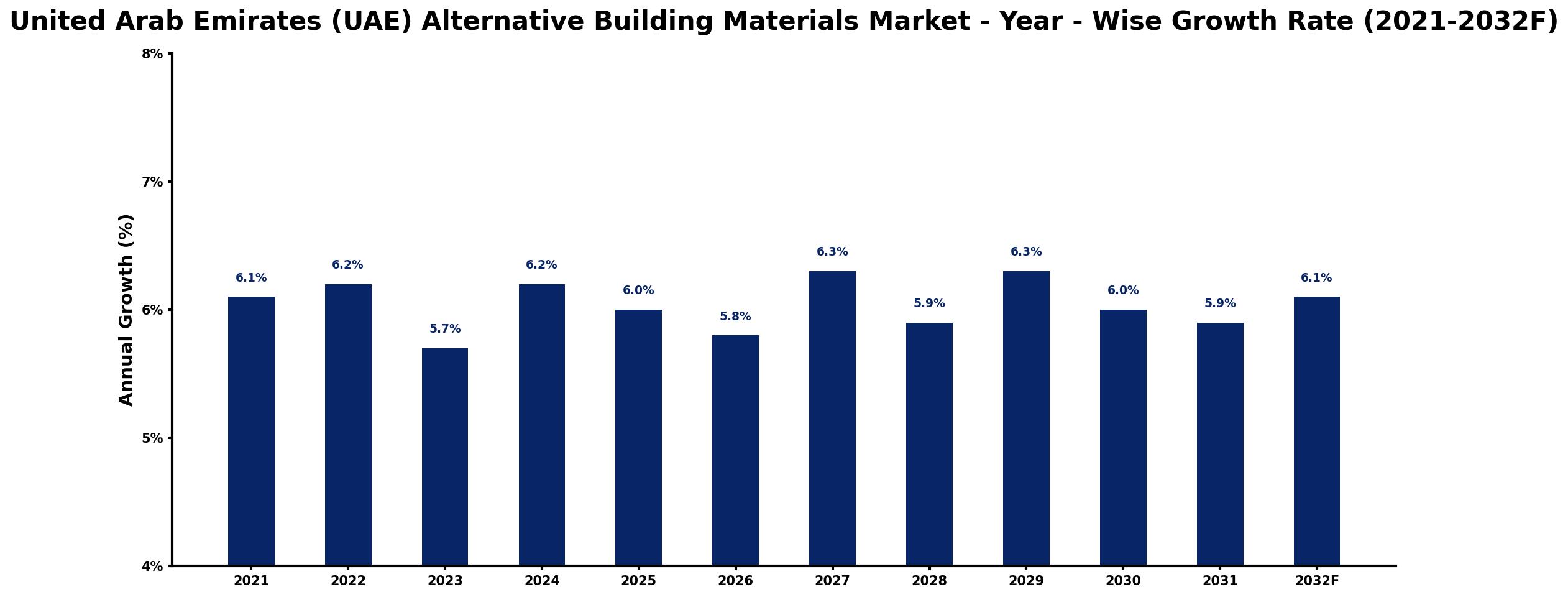
The table below presents the year‑wise growth rates along with the key drivers influencing the market
| Year | Growth Rate | Major Drivers |
| 2021 | 6.1% | Rising demand for sustainable solutions |
| 2022 | 6.2% | Increased investment in green technologies |
| 2023 | 5.7% | Focus on energy efficiency regulations |
| 2024 | 6.2% | Expansion of eco-friendly construction projects |
| 2025 | 6.0% | Growing popularity of innovative designs |
| 2026 | 5.8% | Surge in residential development projects |
| 2027 | 6.3% | Heightened awareness of environmental impact |
| 2028 | 5.9% | Boost in government sustainability initiatives |
| 2029 | 6.3% | Strengthened partnerships in construction sector |
| 2030 | 6.0% | Emergence of new eco-conscious consumers |
| 2031 | 5.9% | Development of resilient infrastructure projects |
| 2032 | 6.1% | Investment in research and development |
Note: Market size estimations and growth projections presented in this report are based on 6Wresearch's proprietary forecasting methodology, utilizing the latest available industry data, government publications, and primary research inputs.
United Arab Emirates (UAE) Alternative Building Materials Market Synopsis
A noteworthy aspect of the UAE Alternative Building Materials market is the increasing demand for materials like recycled concrete and hempcrete. These alternatives not only offer sustainable construction solutions but also significantly reduce the carbon footprint associated with building projects. Furthermore, the ongoing urbanization in the UAE is driving the need for innovative construction materials that meet strict environmental standards.
The emergence of eco-friendly alternatives is also accompanied by a growing supply of products meeting local regulations and standards. As construction firms pivot towards sustainable practices, the alternative materials segment is becoming pivotal in addressing the demands of both the market and regulatory bodies. This shift indicates a readiness within the industry to adapt and embrace materials that support a greener future.
United Arab Emirates (UAE) Alternative Building Materials Market Key Takeaways
- The market is experiencing a significant shift towards sustainable and eco-friendly building materials.
- Government policies are increasingly favoring green construction practices, driving market growth.
- Alternative materials are gaining popularity, offering solutions to traditional construction limitations.
- The post-pandemic recovery is expected to enhance investment in alternative building practices.
- Companies in the region are innovating to meet the rising demand for sustainable solutions.
Evaluation of Restraints in United Arab Emirates (UAE) Alternative Building Materials Market
Despite its potential, the UAE Alternative Building Materials market grapples with significant constraints. The entrenched dominance of traditional construction methods complicates the acceptance of innovative alternatives. Moreover, the initial costs associated with switching to alternative materials can dissuade developers from embracing this shift. Existing building codes often prioritize conventional materials, which necessitates a reevaluation of regulations to facilitate broader adoption of eco-friendly options. Tackling these barriers will be essential for promoting the full spectrum of alternative building materials in the region.
United Arab Emirates (UAE) Alternative Building Materials Market Trends
Current trends reveal a growing preference for materials like bamboo and hempcrete, which are being recognized for their environmental benefits and structural integrity. Companies are increasingly engaging in research and development to enhance material performance while adhering to sustainability criteria. Additionally, the integration of technology in the production of alternative building materials is set to revolutionize the market, offering innovative solutions that meet modern construction demands.
United Arab Emirates (UAE) Alternative Building Materials Market Opportunities
Opportunities within the UAE Alternative Building Materials market are expansive, particularly for innovators focused on sustainable materials. Increased investment in green infrastructure and urban development creates a fertile ground for businesses developing cutting-edge alternative materials. Furthermore, collaborations between government and private sectors to enhance sustainable building practices present avenues for growth and market penetration.
Government Initiatives in the United Arab Emirates (UAE) Alternative Building Materials Market
The UAE government is actively promoting policies aimed at sustainable building practices, including initiatives that incentivize the use of alternative materials. Public funding towards green infrastructure projects is on the rise, along with regulatory frameworks designed to facilitate the adoption of eco-friendly building solutions. These initiatives are aligned with the UAE's vision for a sustainable future, ensuring that alternative building materials gain the traction they need within the construction sector.
Future Insights of the United Arab Emirates (UAE) Alternative Building Materials Market
Looking ahead, the United Arab Emirates Alternative Building Materials market is expected to expand significantly between 2026 and 2032. The convergence of government support, an increasing emphasis on sustainability, and technological advancements are likely to drive innovation and adoption of alternative materials. As the region continues to address environmental concerns, the market will evolve to incorporate more diverse and effective building solutions, thereby enhancing its resilience and relevance in the construction landscape.
United Arab Emirates (UAE) Alternative Building Materials Market Latest Developments (2025 - 2026)
Recent developments in the UAE Alternative Building Materials market reflect a dynamic shift towards sustainability. Increased collaboration among stakeholders is fostering innovation and improving the availability of eco-friendly materials. In addition, emerging technologies are being integrated into production processes, enhancing efficiency and reducing costs. The market is poised to witness an influx of new products designed to meet the evolving needs of environmentally-conscious consumers.
United Arab Emirates (UAE) Alternative Building Materials Market - Key Attractiveness of the Report
- 10 Years of Market Numbers
- Historical Data Starting from 2022 to 2025
- Base Year: 2025
- Forecast Data until 2032
- Key Performance Indicators Impacting the Market
- Major Upcoming Developments and Projects
Key Highlights of the Report:
- United Arab Emirates (UAE) Alternative Building Materials Market Outlook
- Market Size of United Arab Emirates (UAE) Alternative Building Materials Market, 2025
- Forecast of United Arab Emirates (UAE) Alternative Building Materials Market, 2032
- Historical Data and Forecast of United Arab Emirates (UAE) Alternative Building Materials Revenues & Volume for the Period 2022-2032F
- United Arab Emirates (UAE) Alternative Building Materials Market Trend Evolution
- United Arab Emirates (UAE) Alternative Building Materials Market Drivers and Challenges
- United Arab Emirates (UAE) Alternative Building Materials Price Trends
- United Arab Emirates (UAE) Alternative Building Materials Porter's Five Forces
- United Arab Emirates (UAE) Alternative Building Materials Industry Life Cycle
- Historical Data and Forecast of United Arab Emirates (UAE) Alternative Building Materials Market Revenues & Volume By Material for the Period 2022-2032F
- Historical Data and Forecast of United Arab Emirates (UAE) Alternative Building Materials Market Revenues & Volume By Bamboo for the Period 2022-2032F
- Historical Data and Forecast of United Arab Emirates (UAE) Alternative Building Materials Market Revenues & Volume By Recycled Plastic for the Period 2022-2032F
- Historical Data and Forecast of United Arab Emirates (UAE) Alternative Building Materials Market Revenues & Volume By Wood for the Period 2022-2032F
- Historical Data and Forecast of United Arab Emirates (UAE) Alternative Building Materials Market Revenues & Volume By Others for the Period 2022-2032F
- Historical Data and Forecast of United Arab Emirates (UAE) Alternative Building Materials Market Revenues & Volume By End User for the Period 2022-2032F
- Historical Data and Forecast of United Arab Emirates (UAE) Alternative Building Materials Market Revenues & Volume By Residential for the Period 2022-2032F
- Historical Data and Forecast of United Arab Emirates (UAE) Alternative Building Materials Market Revenues & Volume By Non-residential for the Period 2022-2032F
- Historical Data and Forecast of United Arab Emirates (UAE) Alternative Building Materials Market Revenues & Volume By Application for the Period 2022-2032F
- Historical Data and Forecast of United Arab Emirates (UAE) Alternative Building Materials Market Revenues & Volume By Construction for the Period 2022-2032F
- Historical Data and Forecast of United Arab Emirates (UAE) Alternative Building Materials Market Revenues & Volume By Furniture for the Period 2022-2032F
- Historical Data and Forecast of United Arab Emirates (UAE) Alternative Building Materials Market Revenues & Volume By Flooring for the Period 2022-2032F
- United Arab Emirates (UAE) Alternative Building Materials Import Export Trade Statistics
- Market Opportunity Assessment By Material
- Market Opportunity Assessment By End User
- Market Opportunity Assessment By Application
- United Arab Emirates (UAE) Alternative Building Materials Top Companies Market Share
- United Arab Emirates (UAE) Alternative Building Materials Competitive Benchmarking By Technical and Operational Parameters
- United Arab Emirates (UAE) Alternative Building Materials Company Profiles
- United Arab Emirates (UAE) Alternative Building Materials Key Strategic Recommendations






































