United Arab Emirates (UAE) App Analytics Market Size & Growth Rate (2026-2032)
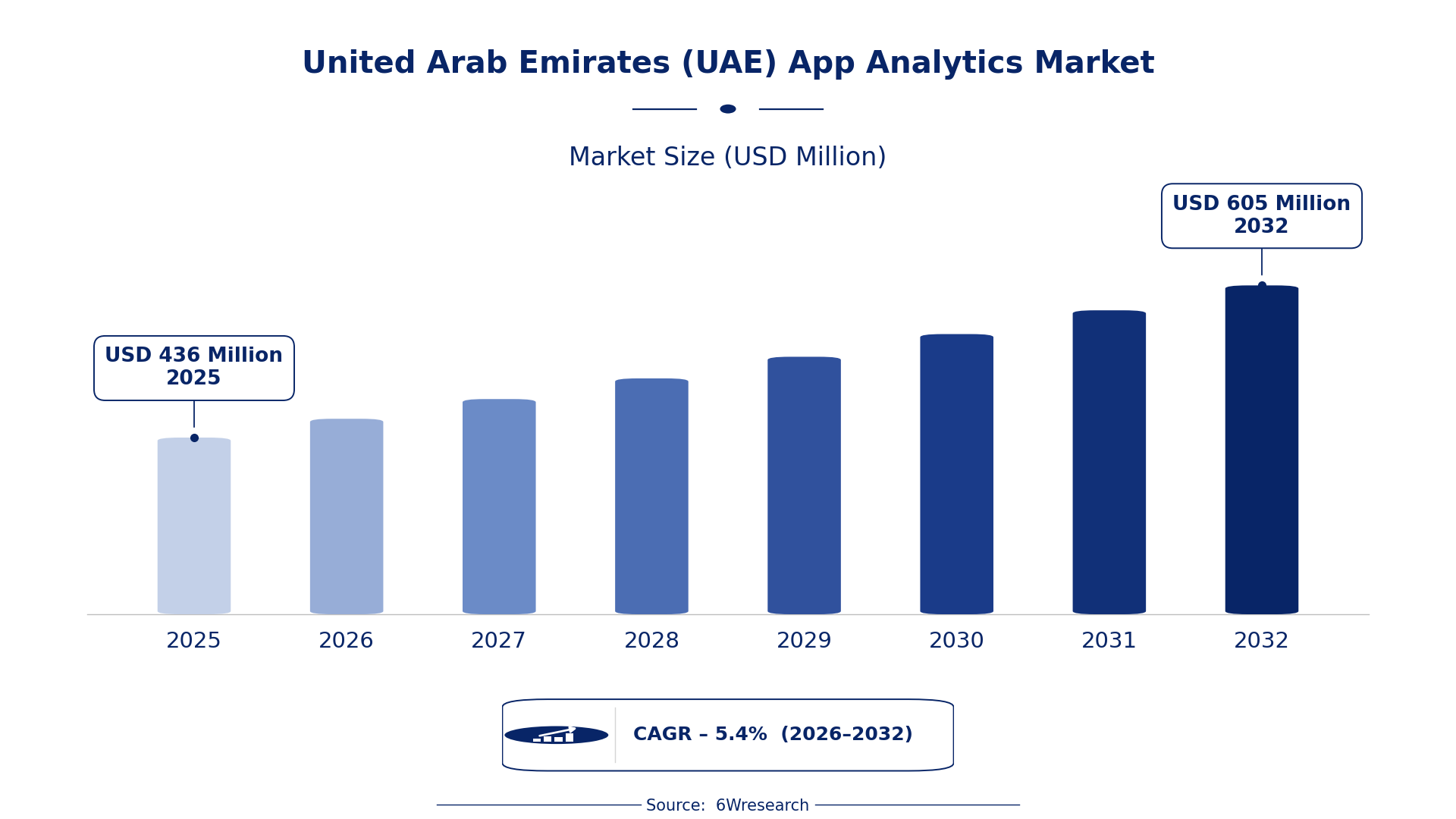
The United Arab Emirates (UAE) App Analytics Market was estimated at USD 436 Million in 2025 and is projected to reach USD 605 Million by 2032, growing at a CAGR of 5.4% from 2026 to 2032.
United Arab Emirates (UAE) App Analytics Market Synopsis
The rising tide of mobile app usage is the strongest force shaping the UAE App Analytics Market. As consumers increasingly turn to mobile applications for everything from shopping to entertainment, businesses are compelled to invest in analytics to understand user engagement and optimize performance.
Data-driven insights have become essential for success, prompting app developers to adopt comprehensive analytics solutions. The urgency to enhance user experience and boost retention rates has never been higher, making app analytics a cornerstone of the app development process in the UAE.
United Arab Emirates (UAE) App Analytics Market Year-wise Growth Rate and Key Drivers
This graph illustrates the annual growth rates of the United Arab Emirates (UAE) App Analytics Market from 2021 to 2032, highlighting a steady upward trajectory and projected expansion over the forecast period.
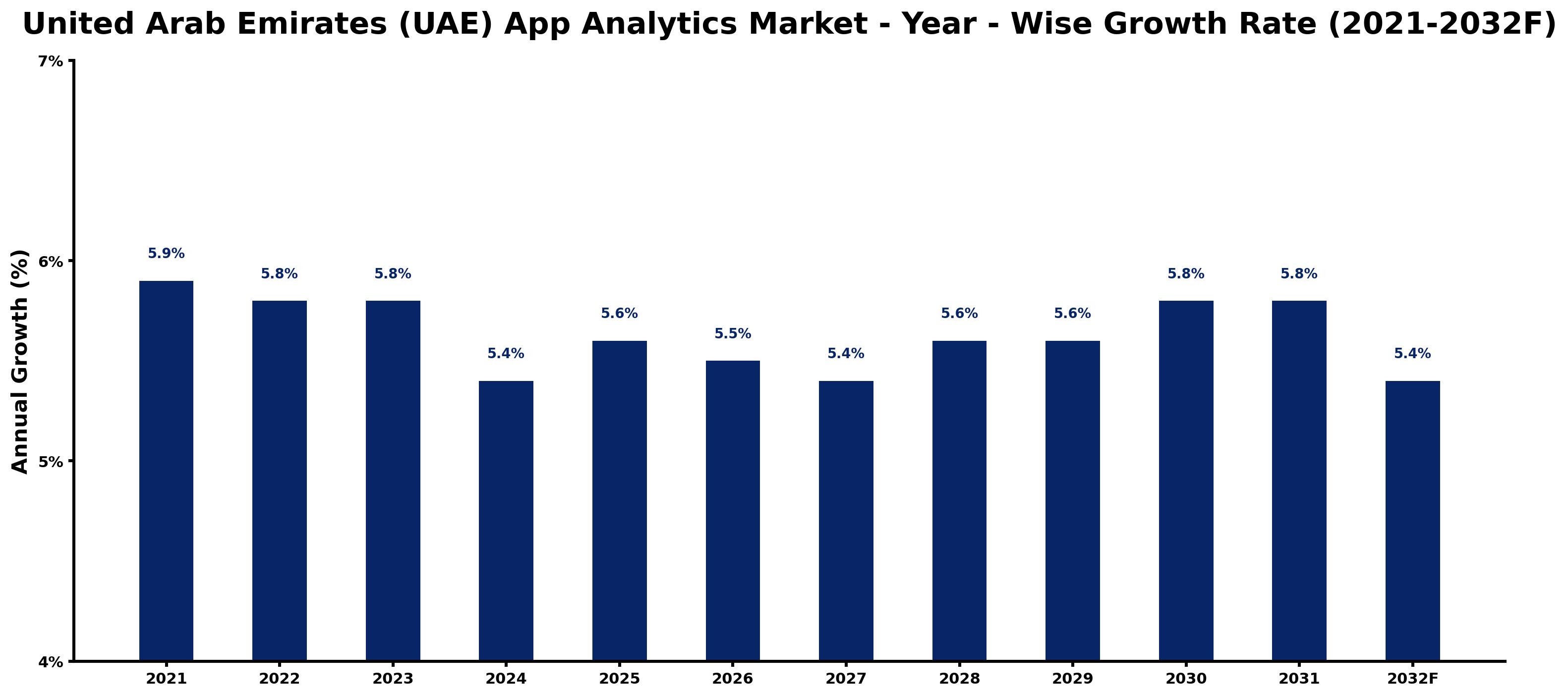
The table below presents the year‑wise growth rates along with the key drivers influencing the market
| Year | Growth Rate | Major Drivers |
| 2021 | 5.9% | UAE digital transformation strategy boosting mobile app investments. |
| 2022 | 5.8% | Increased smartphone penetration accelerating app usage in UAE. |
| 2023 | 5.8% | Rise in e-commerce driving demand for app analytics. |
| 2024 | 5.4% | Smart Dubai initiative enhancing mobile app development ecosystem. |
| 2025 | 5.6% | Growing focus on data-driven decisions among UAE businesses. |
| 2026 | 5.5% | Local startups leveraging app analytics for competitive edge. |
| 2027 | 5.4% | Increased consumer spending on mobile applications in UAE. |
| 2028 | 5.6% | UAE youth demographic favoring mobile-first experiences. |
| 2029 | 5.6% | Emerging interest in AI enhancements for app performance. |
| 2030 | 5.8% | Government promoting tech adoption in educational app sector. |
| 2031 | 5.8% | Rising digital content consumption heightening app engagement. |
| 2032 | 5.4% | Enhanced privacy regulations spurring demand for app analytics. |
Note: Market size estimations and growth projections presented in this report are based on 6Wresearch's proprietary forecasting methodology, utilizing the latest available industry data, government publications, and primary research inputs.
United Arab Emirates (UAE) App Analytics Market Key Takeaways
Below are some of the specific key takeaways from the market, including:
- Rapid growth driven by the increasing adoption of mobile applications across various sectors.
- Emphasis on user experience has become a primary driver for analytics investment.
- Data privacy and security are leading to higher demand for compliant analytics solutions.
- COVID-19 accelerated the shift toward mobile solutions and analytics adoption.
- Key players are continuously innovating to meet evolving market demands.
Evaluation of Restraints in United Arab Emirates (UAE) App Analytics Market
Despite robust growth, the UAE App Analytics Market faces challenges that hinder its full potential. Accurately tracking user behavior across multiple devices and platforms remains a complex issue. on top of that, ensuring compliance with stringent data privacy regulations adds another layer of difficulty for businesses. Integrating analytics seamlessly into the app development lifecycle and making sense of the vast amounts of generated data are also significant hurdles. Until these issues are effectively addressed, the market's growth may be constrained.
United Arab Emirates (UAE) App Analytics Market Trends
The current trends in the UAE App Analytics Market point toward increased automation and AI integration in analytics tools. Companies are adopting machine learning algorithms to derive actionable insights from user data with greater accuracy. Real-time analytics is becoming more prevalent, allowing businesses to make swift decisions based on user behavior. Additionally, there’s a growing trend toward personalized user experiences, where analytics help tailor app content to individual preferences.
United Arab Emirates (UAE) App Analytics Market Opportunities
Opportunities for growth in the UAE App Analytics Market are abundant. As businesses continue their digital transformation journeys, there’s an increasing demand for sophisticated analytics solutions that can provide deeper insights. The expansion of e-commerce and mobile payment solutions further drives the need for analytics to optimize customer interactions. on top of that, the push for data privacy compliance creates a niche for analytics tools that prioritize security and transparency.
Government Initiatives in the United Arab Emirates (UAE) App Analytics Market
The UAE government is actively shaping the App Analytics Market through various initiatives aimed at enhancing digital infrastructure and ensuring data security. With a regulatory environment that encourages innovation while prioritizing user privacy, public policy plays a critical role in this sector. The focus on building a data-driven economy aligns with the government's vision of fostering technological advancements.
- A national digital infrastructure upgrade programme that was launched recently to enhance connectivity and support app development.
- Ongoing initiatives aimed at establishing a regulatory framework for data privacy and security in app analytics, ensuring compliance with international standards.
- Plans for a public-private partnership to develop analytics training programmes, expected to launch by mid-2026.
- Current efforts to promote awareness around the benefits of app analytics in the business community through government-sponsored workshops and seminars.
Future Insights of the United Arab Emirates (UAE) App Analytics Market
Looking ahead to 2026-2032, the UAE App Analytics Market is set to evolve significantly. The increasing integration of AI and machine learning technologies will likely redefine how businesses interpret analytics data. As competition intensifies across sectors, companies will prioritize the user experience, making analytics tools indispensable. Additionally, regulatory developments regarding data privacy will push for even more sophisticated analytics solutions that prioritize compliance.
United Arab Emirates (UAE) App Analytics Market Latest Developments
In the past year, the UAE App Analytics Market has seen a surge in activity, with several key developments shaping the direction of the industry. Companies are investing in innovative analytics solutions to stay competitive, and the emphasis on user privacy has prompted significant advancements in compliance technologies. This dynamic environment is fostering a culture of continuous improvement and adaptation among market players.
- A major technology vendor launched a new analytics platform in Q2 2025 that incorporates AI-driven insights for app developers.
- In early 2025, a regional operator initiated a partnership with an analytics firm to enhance data security measures for its app offerings.
- Ongoing development of a comprehensive analytics tool aimed at small and medium enterprises, projected to be completed by late 2025.
- Plans for a major conference on app analytics innovations scheduled for Q4 2026, focusing on best practices and emerging technologies.
United Arab Emirates (UAE) App Analytics Market - Key Attractiveness of the Report
- 10 Years of Market Numbers
- Historical Data Starting from 2022 to 2025
- Base Year: 2025
- Forecast Data until 2032
- Key Performance Indicators Impacting the Market
- Major Upcoming Developments and Projects
Key Highlights of the Report:
- United Arab Emirates (UAE) App Analytics Market Outlook
- Market Size of United Arab Emirates (UAE) App Analytics Market, 2025
- Forecast of United Arab Emirates (UAE) App Analytics Market, 2032
- Historical Data and Forecast of United Arab Emirates (UAE) App Analytics Revenues & Volume for the Period 2022-2032F
- United Arab Emirates (UAE) App Analytics Market Trend Evolution
- United Arab Emirates (UAE) App Analytics Market Drivers and Challenges
- United Arab Emirates (UAE) App Analytics Price Trends
- United Arab Emirates (UAE) App Analytics Porter's Five Forces
- United Arab Emirates (UAE) App Analytics Industry Life Cycle
- Historical Data and Forecast of United Arab Emirates (UAE) App Analytics Market Revenues & Volume By Component for the Period 2022-2032F
- Historical Data and Forecast of United Arab Emirates (UAE) App Analytics Market Revenues & Volume By Software for the Period 2022-2032F
- Historical Data and Forecast of United Arab Emirates (UAE) App Analytics Market Revenues & Volume By Services for the Period 2022-2032F
- Historical Data and Forecast of United Arab Emirates (UAE) App Analytics Market Revenues & Volume By Application for the Period 2022-2032F
- Historical Data and Forecast of United Arab Emirates (UAE) App Analytics Market Revenues & Volume By Revenue analytics for the Period 2022-2032F
- Historical Data and Forecast of United Arab Emirates (UAE) App Analytics Market Revenues & Volume By App performance analytics and operations for the Period 2022-2032F
- Historical Data and Forecast of United Arab Emirates (UAE) App Analytics Market Revenues & Volume By User analytics for the Period 2022-2032F
- Historical Data and Forecast of United Arab Emirates (UAE) App Analytics Market Revenues & Volume By Ad monitoring and marketing analytics for the Period 2022-2032F
- Historical Data and Forecast of United Arab Emirates (UAE) App Analytics Market Revenues & Volume By Type for the Period 2022-2032F
- Historical Data and Forecast of United Arab Emirates (UAE) App Analytics Market Revenues & Volume By Mobile app analytics for the Period 2022-2032F
- Historical Data and Forecast of United Arab Emirates (UAE) App Analytics Market Revenues & Volume By Web app analytics for the Period 2022-2032F
- Historical Data and Forecast of United Arab Emirates (UAE) App Analytics Market Revenues & Volume By Vertical for the Period 2022-2032F
- Historical Data and Forecast of United Arab Emirates (UAE) App Analytics Market Revenues & Volume By Banking, Financial Services, and Insurance (BFSI) for the Period 2022-2032F
- Historical Data and Forecast of United Arab Emirates (UAE) App Analytics Market Revenues & Volume By Retail for the Period 2022-2032F
- Historical Data and Forecast of United Arab Emirates (UAE) App Analytics Market Revenues & Volume By Media and entertainment for the Period 2022-2032F
- Historical Data and Forecast of United Arab Emirates (UAE) App Analytics Market Revenues & Volume By Logistics, travel, and transportation for the Period 2022-2032F
- Historical Data and Forecast of United Arab Emirates (UAE) App Analytics Market Revenues & Volume By Telecom and IT for the Period 2022-2032F
- Historical Data and Forecast of United Arab Emirates (UAE) App Analytics Market Revenues & Volume By Others for the Period 2022-2032F
- United Arab Emirates (UAE) App Analytics Import Export Trade Statistics
- Market Opportunity Assessment By Component
- Market Opportunity Assessment By Application
- Market Opportunity Assessment By Type
- Market Opportunity Assessment By Vertical
- United Arab Emirates (UAE) App Analytics Top Companies Market Share
- United Arab Emirates (UAE) App Analytics Competitive Benchmarking By Technical and Operational Parameters
- United Arab Emirates (UAE) App Analytics Company Profiles
- United Arab Emirates (UAE) App Analytics Key Strategic Recommendations






































