United Arab Emirates (UAE) Asphalt Market Summary
The united arab emirates (uae) asphalt market was estimated at USD 188 Million in 2025 and is projected to reach USD 256 Million by 2032, growing at a CAGR of 5.6% from 2026 to 2032.
United Arab Emirates (UAE) Asphalt Market Year-wise Growth Rate and Key Drivers
This graph highlights how the United Arab Emirates (UAE) Asphalt Market has steadily grown over the past five years, supported by major growth factors.
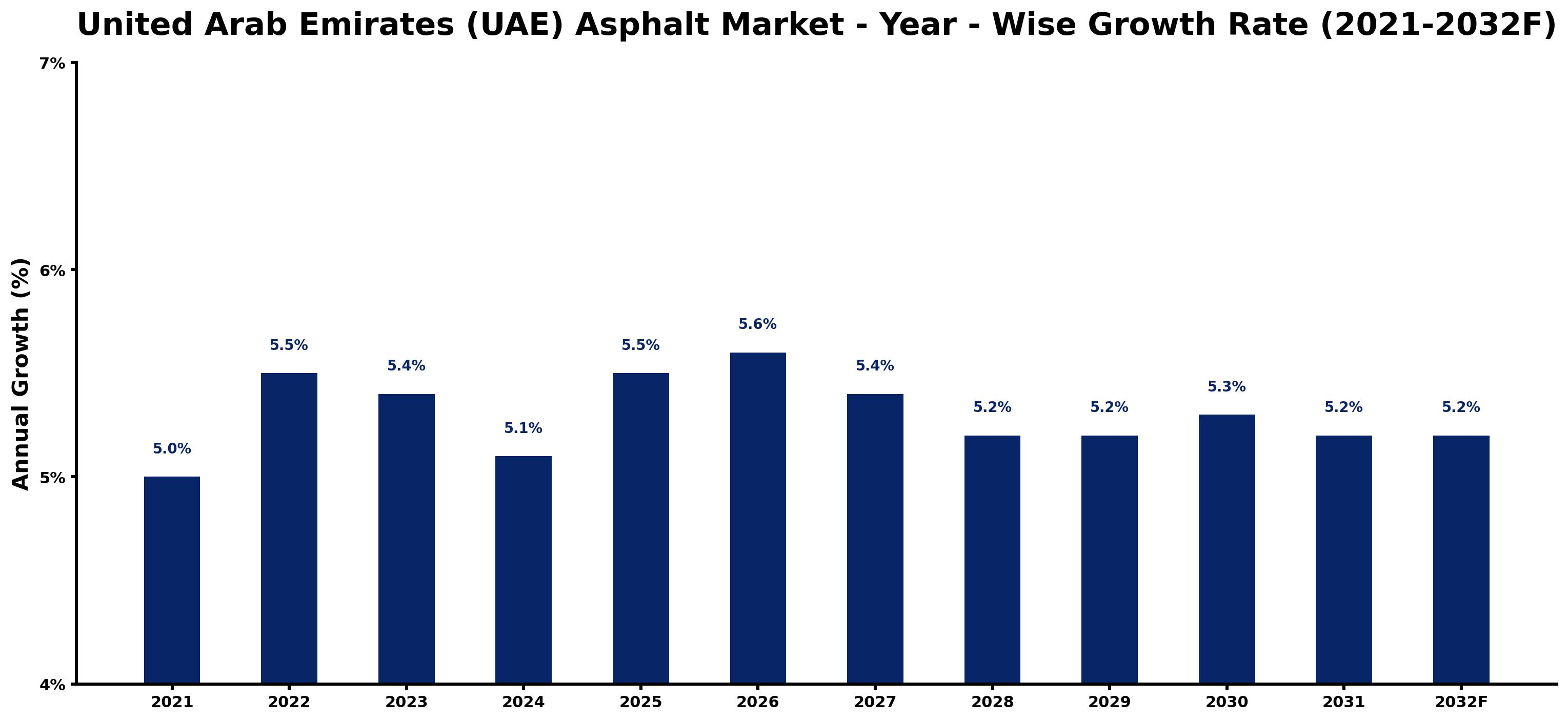
The table below presents the year wise growth rates along with the key drivers influencing the market
| Year | Growth Rate | Major Drivers |
| 2021 | 5.0% | Infrastructure projects revitalizing urban landscapes contribute to asphalt demand in UAE. |
| 2022 | 5.5% | Increased construction activities, particularly in Dubai and Abu Dhabi, boost asphalt consumption. |
| 2023 | 5.4% | Sustainable practices gain traction, leading to eco-friendly asphalt formulations being explored. |
| 2024 | 5.1% | Expansion of transportation networks highlights the need for durable asphalt solutions. |
| 2025 | 5.5% | Investment in smart cities emphasizes quality asphalt for effective urban mobility. |
| 2026 | 5.6% | Technological innovations in asphalt production enhance performance and application efficiency. |
| 2027 | 5.4% | Rising temperatures necessitate high-performance asphalt to withstand extreme heat conditions. |
| 2028 | 5.2% | Public-private partnerships initiate large-scale infrastructure projects, creating asphalt market opportunities. |
| 2029 | 5.2% | Regional trade agreements lower barriers, facilitating easier asphalt product imports and exports. |
| 2030 | 5.3% | Focus on sustainability encourages the use of recycled materials in asphalt production. |
| 2031 | 5.2% | Economic diversification initiatives lead to increased infrastructure investments and asphalt demand. |
| 2032 | 5.2% | Emerging construction trends, like modular building, require tailored asphalt solutions for flexibility. |
Note - Market size estimations and growth projections presented in this report are based on 6Wresearch's advanced forecasting approach, validated with industry datasets as of June 2026.
United Arab Emirates (UAE) Asphalt Market Synopsis
The United Arab Emirates (UAE) Asphalt Market is projected to reach 5.6% and witness significant growth during the forecast period (2026-2032). Asphalt serves as a fundamental component within the construction sector, utilized extensively for road paving, airport runways, and various infrastructure projects. The market growth can be attributed to the UAE's robust focus on infrastructure development, rising urbanization, and substantial investments in both construction and transportation initiatives.
United Arab Emirates (UAE) Asphalt Market Growth Drivers
Several key factors are propelling the growth of the United Arab Emirates (UAE) Asphalt Market. Firstly, the government's commitment to developing world-class infrastructure and transportation networks underpins the high demand for asphalt in road construction and maintenance. Secondly, urbanization trends and a steadily increasing population are driving the expansion of residential and commercial areas, leading to a heightened need for asphalt in various construction projects. Furthermore, the UAE's strategic geographical location as a trade and logistics hub has generated considerable demand for asphalt in airport runways and port facilities.
- The ongoing development of high-speed roads and public transport systems fosters a continuous need for asphalt solutions.
- Major construction projects such as highways, bridges, and tunnels further amplify asphalt consumption.
- The increasing emphasis on smart cities and sustainable urban development reinforces asphalt's role in construction.
- Investment in repair and maintenance of existing road infrastructures also sustains asphalt demand.
- Technological advancements in asphalt production are enhancing performance and durability, attracting more applications.
United Arab Emirates (UAE) Asphalt Market Challenges and Restraints
Despite the positive growth trajectory, the United Arab Emirates (UAE) Asphalt Market faces several challenges during the forecast period. One significant hurdle is the fluctuating prices of raw materials, particularly crude oil, which directly affects the production costs for asphalt manufacturers. Additionally, compliance with stringent environmental regulations and a growing emphasis on sustainability necessitate the adoption of eco-friendly asphalt mixtures, which can be challenging for some companies within the sector. The Covid-19 pandemic has also contributed to temporary disruptions in construction activities and supply chains, impacting the demand and distribution of asphalt.
- Environmental concerns are prompting industry players to seek sustainable and high-performance asphalt alternatives.
- Raw material price volatility can lead to uncertainty in project costs and profitability.
- The transition to innovative asphalt mixtures often requires significant research and development investment.
- Economic fluctuations and geopolitical tensions can introduce risks to construction project timelines and funding.
- Skilled labor shortages may hinder the execution of asphalt-related projects, impacting overall market growth.
United Arab Emirates (UAE) Asphalt Market Government Investment and Initiatives
The UAE government has made substantial investments and implemented several initiatives aimed at bolstering the United Arab Emirates (UAE) Asphalt Market. Strategic development plans focus on enhancing transportation and infrastructure capabilities, which facilitate the effective use of asphalt in various projects. Public spending on infrastructure projects has increased with an aim to diversify the economy beyond oil dependency, thus fostering the demand for asphalt. Initiatives such as the UAE Vision 2021 and the Dubai Integrated Transport Plan emphasize the development of an efficient and sustainable transport network, creating a favorable environment for asphalt usage. Moreover, government incentives for adopting innovative construction techniques and eco-friendly materials are likely to further influence market dynamics positively.
United Arab Emirates (UAE) Asphalt Market Latest Developments (May 2025 - June 2026)
Recent industry developments from May 2025 to June 2026 have shown a noteworthy shift in the United Arab Emirates (UAE) Asphalt Market landscape. Efforts to enhance asphalt production processes have gained momentum, driven by advancements in technology aimed at improving sustainability and performance. The government has ramped up investment in major infrastructure projects, providing a conducive environment for increased asphalt demand. Moreover, there has been a growing trend towards using recycled materials in asphalt production, reflecting a strong commitment towards sustainability. These developments signal a robust response to evolving market needs, as stakeholders adapt to environmental considerations while positioning themselves for future growth.
United Arab Emirates (UAE) Asphalt Market - Key Attractiveness of the Report
- 10 Years of Market Numbers
- Historical Data Starting from 2022 to 2025
- Base Year: 2025
- Forecast Data until 2032
- Key Performance Indicators Impacting the Market
- Major Upcoming Developments and Projects
Key Highlights of the Report:
- United Arab Emirates (UAE) Asphalt Market Outlook
- Market Size of United Arab Emirates (UAE) Asphalt Market, 2025
- Forecast of United Arab Emirates (UAE) Asphalt Market, 2032
- Historical Data and Forecast of United Arab Emirates (UAE) Asphalt Revenues & Volume for the Period 2022-2032F
- United Arab Emirates (UAE) Asphalt Market Trend Evolution
- United Arab Emirates (UAE) Asphalt Market Drivers and Challenges
- United Arab Emirates (UAE) Asphalt Price Trends
- United Arab Emirates (UAE) Asphalt Porter's Five Forces
- United Arab Emirates (UAE) Asphalt Industry Life Cycle
- Historical Data and Forecast of United Arab Emirates (UAE) Asphalt Market Revenues & Volume By Type for the Period 2022-2032F
- Historical Data and Forecast of United Arab Emirates (UAE) Asphalt Market Revenues & Volume By Paving Petroleum Asphalt for the Period 2022-2032F
- Historical Data and Forecast of United Arab Emirates (UAE) Asphalt Market Revenues & Volume By Industrial Petroleum Asphalt for the Period 2022-2032F
- Historical Data and Forecast of United Arab Emirates (UAE) Asphalt Market Revenues & Volume By Others for the Period 2022-2032F
- Historical Data and Forecast of United Arab Emirates (UAE) Asphalt Market Revenues & Volume By Application for the Period 2022-2032F
- Historical Data and Forecast of United Arab Emirates (UAE) Asphalt Market Revenues & Volume By Paving for the Period 2022-2032F
- Historical Data and Forecast of United Arab Emirates (UAE) Asphalt Market Revenues & Volume By Roofing for the Period 2022-2032F
- Historical Data and Forecast of United Arab Emirates (UAE) Asphalt Market Revenues & Volume By Others for the Period 2022-2032F
- United Arab Emirates (UAE) Asphalt Import Export Trade Statistics
- Market Opportunity Assessment By Type
- Market Opportunity Assessment By Application
- United Arab Emirates (UAE) Asphalt Top Companies Market Share
- United Arab Emirates (UAE) Asphalt Competitive Benchmarking By Technical and Operational Parameters
- United Arab Emirates (UAE) Asphalt Company Profiles
- United Arab Emirates (UAE) Asphalt Key Strategic Recommendations






































