United Arab Emirates (UAE) BBQ Charcoal Market Size, Share & Growth Rate
The United Arab Emirates (UAE) BBQ Charcoal Market was estimated at USD 347 Million in 2025 and is projected to reach USD 469 Million by 2032, growing at a CAGR of 4.4% from 2026 to 2032. This trajectory is predominantly driven by the UAEs strong culture of outdoor gatherings, where barbecuing serves as a vital social activity. Additionally, the increasing inclination towards gourmet grilling experiences is compelling consumers to seek high-quality charcoal products that enhance flavor and sustainability.
United Arab Emirates (UAE) BBQ Charcoal Market Year-wise Growth Rate and Key Drivers
This graph highlights how the United Arab Emirates (UAE) BBQ Charcoal Market has steadily grown over the years, supported by major growth factors.
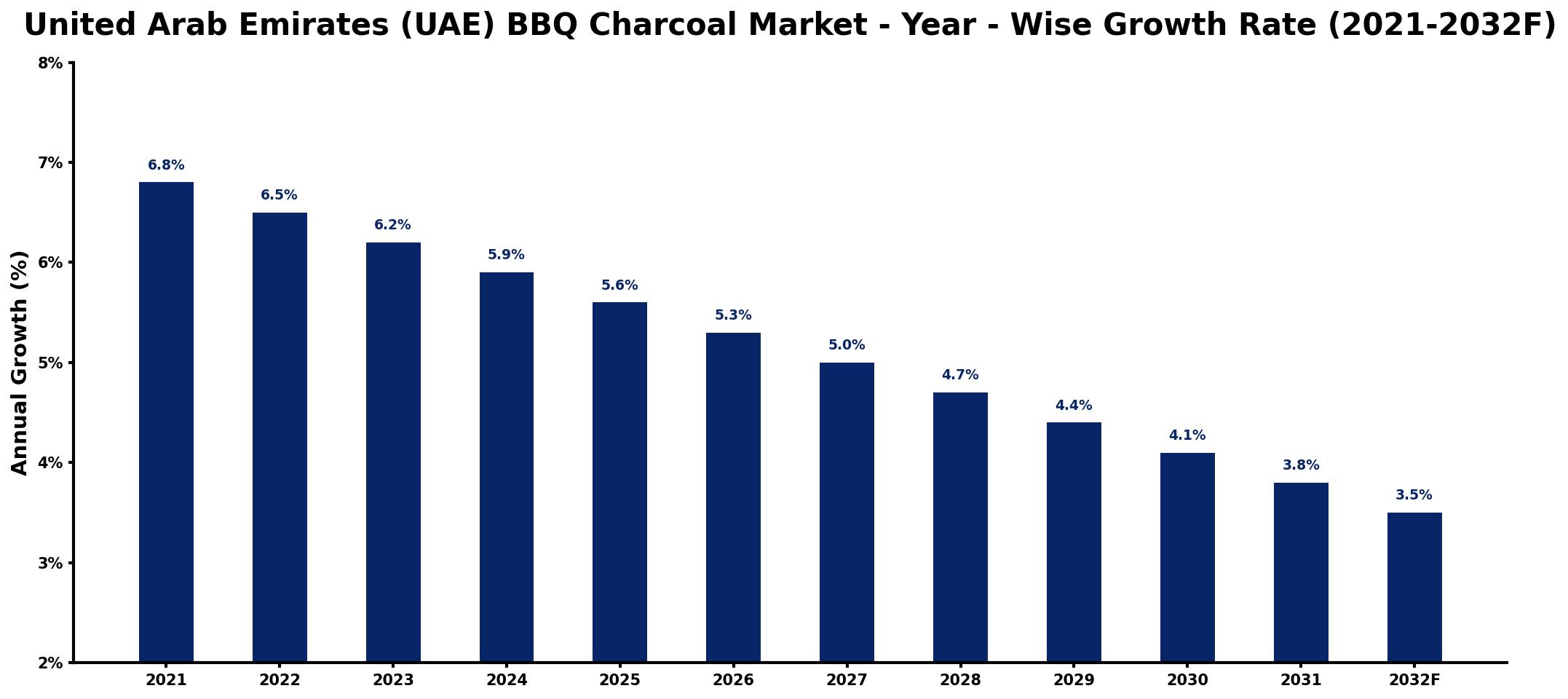
The table below presents the year‑wise growth rates along with the key drivers influencing the market
| Year | Growth Rate | Major Drivers |
| 2021 | 6.8% | Rise in outdoor cooking popularity |
| 2022 | 6.5% | Increased festival and event hosting |
| 2023 | 6.2% | Growing interest in culinary experiences |
| 2024 | 5.9% | Expansion of retail distribution networks |
| 2025 | 5.6% | Emergence of new grilling techniques |
| 2026 | 5.3% | Higher disposable income levels |
| 2027 | 5.0% | Surge in tourism and hospitality |
| 2028 | 4.7% | Innovations in grilling accessories |
| 2029 | 4.4% | Shift towards sustainable cooking methods |
| 2030 | 4.1% | Increase in home entertainment spending |
| 2031 | 3.8% | Growth in backyard renovation projects |
| 2032 | 3.5% | Rising popularity of food trucks |
Note: Market size estimations and growth projections presented in this report are based on 6Wresearch's proprietary forecasting methodology, utilizing the latest available industry data, government publications, and primary research inputs.
United Arab Emirates (UAE) BBQ Charcoal Market Synopsis
The BBQ charcoal market in the UAE is deeply embedded in the local lifestyle, where outdoor cooking is a favored weekend and festive tradition. This cultural affinity, combined with a burgeoning tourism sector that promotes outdoor dining, significantly elevates the markets growth prospects.
Quality and sustainability are central to consumer preferences, with a rising demand for various charcoal types—such as hardwood, coconut, and bamboo—appealing to environmentally-conscious consumers. The market caters not only to individual households but also to the vibrant hospitality industry, which heavily relies on premium charcoal products for its culinary offerings.
United Arab Emirates (UAE) BBQ Charcoal Market Key Takeaways
- The BBQ charcoal market thrives on the UAE's cultural inclination towards outdoor cooking and social gatherings.
- There is a growing consumer preference for natural and sustainable charcoal options, driving product diversity.
- The hospitality sectors expansion significantly boosts demand for quality BBQ charcoal products.
- Challenges related to environmental sustainability are prompting innovation in eco-friendly charcoal sourcing.
- The market exhibits resilience, bouncing back from COVID-19 disruptions as consumer behavior shifts towards home-based barbecues.
Evaluation of Restraints in United Arab Emirates (UAE) BBQ Charcoal Market
Despite its growth, the UAE BBQ charcoal market faces significant constraints primarily linked to environmental sustainability. The traditional production processes associated with charcoal manufacturing raise serious concerns regarding deforestation and carbon emissions. As awareness of these issues increases, consumers are becoming more discerning, demanding responsibly-sourced products. This shift necessitates a transformation within the industry to adopt sustainable practices, a challenge that requires strategic foresight and investment.
United Arab Emirates (UAE) BBQ Charcoal Market Trends
Emerging trends in the UAE BBQ charcoal market include the rise of gourmet grilling, where consumers are exploring artisanal charcoal options that provide unique flavor profiles. Additionally, an increase in eco-friendly practices is reshaping product offerings, with more brands focusing on sustainable sourcing and packaging. The integration of advanced grilling technologies and specialized equipment is also fostering innovation in how BBQs are experienced, making them more appealing to a diverse range of consumers.
United Arab Emirates (UAE) BBQ Charcoal Market Opportunities
The market presents numerous opportunities for investment, particularly in sustainable charcoal production methods. Companies that innovate in eco-friendly sourcing can capitalize on the growing segment of environmentally-conscious consumers. Additionally, the expansion of the hospitality sector opens doors for partnerships with restaurants and resorts, allowing for tailored BBQ experiences that leverage high-quality charcoal products. As the cultural significance of outdoor cooking continues to evolve, niche markets focused on gourmet and specialty grilling will also emerge.
Government Initiatives in the United Arab Emirates (UAE) BBQ Charcoal Market
The UAE government has been actively promoting sustainable practices across various industries, including the BBQ charcoal market. Initiatives aimed at environmental conservation are encouraging businesses to adopt eco-friendly production methods. Public spending on green technologies and sustainable sourcing, along with incentives for companies demonstrating environmentally responsible practices, are reshaping the market landscape. These initiatives align with national goals for sustainability and responsible resource management.
Future Insights of the United Arab Emirates (UAE) BBQ Charcoal Market
Looking ahead to 2026-2032, the UAE BBQ charcoal market is poised for sustained growth, driven by a deep-rooted cultural affinity for outdoor cooking and the increasing popularity of gourmet grilling experiences. The demand for high-quality and sustainable charcoal will likely continue to escalate as consumer preferences evolve. Moreover, as the hospitality sector grows, innovative offerings tailored to diverse culinary experiences will further cement the importance of premium BBQ charcoal in the market.
United Arab Emirates (UAE) BBQ Charcoal Market Latest Developments (2025 - 2026)
Recent trends in the UAE BBQ charcoal market indicate a shift towards more sustainable and premium products. Companies are increasingly focusing on eco-friendly sourcing practices, spurred by consumer demand for responsible products. There is also a noticeable uptick in the introduction of innovative grilling accessories and equipment that enhance the overall outdoor cooking experience. Moreover, local businesses are collaborating with tourism boards to promote BBQ experiences as a unique dining option for visitors.
United Arab Emirates (UAE) BBQ Charcoal Market - Key Attractiveness of the Report
- 10 Years of Market Numbers
- Historical Data Starting from 2022 to 2025
- Base Year: 2025
- Forecast Data until 2032
- Key Performance Indicators Impacting the Market
- Major Upcoming Developments and Projects
Key Highlights of the Report:
- United Arab Emirates (UAE) BBQ Charcoal Market Outlook
- Market Size of United Arab Emirates (UAE) BBQ Charcoal Market, 2025
- Forecast of United Arab Emirates (UAE) BBQ Charcoal Market, 2032
- Historical Data and Forecast of United Arab Emirates (UAE) BBQ Charcoal Revenues & Volume for the Period 2022-2032F
- United Arab Emirates (UAE) BBQ Charcoal Market Trend Evolution
- United Arab Emirates (UAE) BBQ Charcoal Market Drivers and Challenges
- United Arab Emirates (UAE) BBQ Charcoal Price Trends
- United Arab Emirates (UAE) BBQ Charcoal Porter's Five Forces
- United Arab Emirates (UAE) BBQ Charcoal Industry Life Cycle
- Historical Data and Forecast of United Arab Emirates (UAE) BBQ Charcoal Market Revenues & Volume By Form for the Period 2022-2032F
- Historical Data and Forecast of United Arab Emirates (UAE) BBQ Charcoal Market Revenues & Volume By Briquettes BBQ Charcoal for the Period 2022-2032F
- Historical Data and Forecast of United Arab Emirates (UAE) BBQ Charcoal Market Revenues & Volume By Lump Wood BBQ Charcoal for the Period 2022-2032F
- Historical Data and Forecast of United Arab Emirates (UAE) BBQ Charcoal Market Revenues & Volume By Sales Channel for the Period 2022-2032F
- Historical Data and Forecast of United Arab Emirates (UAE) BBQ Charcoal Market Revenues & Volume By Direct BBQ Charcoal Sales for the Period 2022-2032F
- Historical Data and Forecast of United Arab Emirates (UAE) BBQ Charcoal Market Revenues & Volume By Retail BBQ Charcoal Sales for the Period 2022-2032F
- Historical Data and Forecast of United Arab Emirates (UAE) BBQ Charcoal Market Revenues & Volume By End User for the Period 2022-2032F
- Historical Data and Forecast of United Arab Emirates (UAE) BBQ Charcoal Market Revenues & Volume By BBQ Charcoal for Hotels, Restaurants and Catering (HoReCa) for the Period 2022-2032F
- Historical Data and Forecast of United Arab Emirates (UAE) BBQ Charcoal Market Revenues & Volume By BBQ Charcoal for Households for the Period 2022-2032F
- Historical Data and Forecast of United Arab Emirates (UAE) BBQ Charcoal Market Revenues & Volume By Source for the Period 2022-2032F
- Historical Data and Forecast of United Arab Emirates (UAE) BBQ Charcoal Market Revenues & Volume By BBQ Charcoal made from Agricultural Waste for the Period 2022-2032F
- Historical Data and Forecast of United Arab Emirates (UAE) BBQ Charcoal Market Revenues & Volume By BBQ Charcoal made from Coconut Shells for the Period 2022-2032F
- Historical Data and Forecast of United Arab Emirates (UAE) BBQ Charcoal Market Revenues & Volume By BBQ Charcoal made from Nutshells for the Period 2022-2032F
- Historical Data and Forecast of United Arab Emirates (UAE) BBQ Charcoal Market Revenues & Volume By BBQ Charcoal made from Hardwood for the Period 2022-2032F
- Historical Data and Forecast of United Arab Emirates (UAE) BBQ Charcoal Market Revenues & Volume By BBQ Charcoal made from Bamboo for the Period 2022-2032F
- United Arab Emirates (UAE) BBQ Charcoal Import Export Trade Statistics
- Market Opportunity Assessment By Form
- Market Opportunity Assessment By Sales Channel
- Market Opportunity Assessment By End User
- Market Opportunity Assessment By Source
- United Arab Emirates (UAE) BBQ Charcoal Top Companies Market Share
- United Arab Emirates (UAE) BBQ Charcoal Competitive Benchmarking By Technical and Operational Parameters
- United Arab Emirates (UAE) BBQ Charcoal Company Profiles
- United Arab Emirates (UAE) BBQ Charcoal Key Strategic Recommendations






































