United Arab Emirates (UAE) Biscuits and Crackers Market Summary
The united arab emirates (uae) biscuits and crackers market was estimated at USD 363 Million in 2025 and is projected to reach USD 487 Million by 2032, growing at a CAGR of 4.8% from 2026 to 2032.
United Arab Emirates (UAE) Biscuits and Crackers Market Year-wise Growth Rate and Key Drivers
This graph highlights how the United Arab Emirates (UAE) Biscuits and Crackers Market has steadily grown over the past five years, supported by major growth factors.
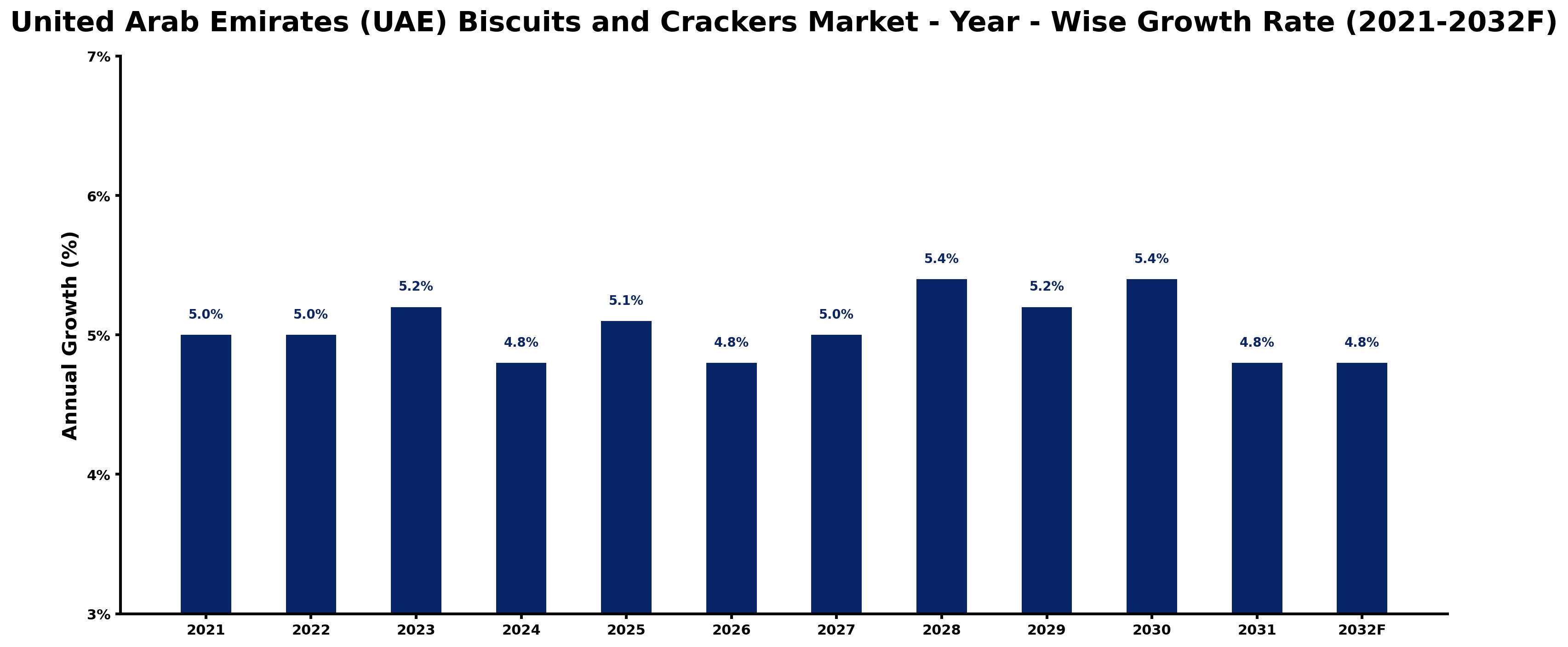
The table below presents the year wise growth rates along with the key drivers influencing the market
| Year | Growth Rate | Major Drivers |
| 2021 | 5.0% | Post-lockdown retail projects led to a surge in impulse buying behaviors. |
| 2022 | 5.0% | Increased consumer health consciousness prompted interest in healthier biscuit options. |
| 2023 | 5.2% | E-commerce platforms expanded, transforming how consumers purchase biscuits and crackers. |
| 2024 | 4.8% | Regional taste preferences shifted towards premium and artisanal biscuit offerings. |
| 2025 | 5.1% | Growing tourism attracted diverse consumers, enhancing demand for local snack products. |
| 2026 | 4.8% | Innovative packaging solutions gained popularity, appealing to environmentally conscious shoppers. |
| 2027 | 5.0% | Corporate social responsibility initiatives shifted marketing strategies towards sustainable options. |
| 2028 | 5.4% | Increased competition among brands led to unique flavors and product variations emerging. |
| 2029 | 5.2% | Collaboration between local bakers and international brands diversified the market landscape. |
| 2030 | 5.4% | Cultural events and festivals created seasonal spikes in biscuit and cracker sales. |
| 2031 | 4.8% | Health-focused trends introduced functional snacks, catering to wellness-oriented consumers. |
| 2032 | 4.8% | Technological advancements in production streamlined operations, reducing costs and enhancing quality. |
Note - Market size estimations and growth projections presented in this report are based on 6Wresearch's advanced forecasting approach, validated with industry datasets as of June 2026.
United Arab Emirates (UAE) Biscuits and Crackers Market Synopsis
The United Arab Emirates (UAE) Biscuits and Crackers Market is projected to reach 4.8% and witness significant growth during the forecast period (2026-2032). This market has benefitted from the rising popularity of baked snacks, which are favored for their convenience, taste variety, and accessibility. The evolution in consumer preferences, influenced by urbanization and changing lifestyles, has fueled the demand for these products throughout the region.
United Arab Emirates (UAE) Biscuits and Crackers Market Growth Drivers
Several key factors are driving the growth of the United Arab Emirates (UAE) Biscuits and Crackers Market. Firstly, the rapid urbanization in the UAE has led to an increase in the number of working individuals and busy lifestyles, positioning biscuits and crackers as ideal on-the-go snacks. Additionally, the expansion of retail outlets, including supermarkets and convenience stores, has improved product accessibility and visibility, allowing consumers to easily purchase their preferred snack options.
- Urbanization has contributed to changing consumer habits, leading to an increased demand for convenient snack options.
- The extensive development of the retail sector has enhanced the availability of biscuits and crackers in the market.
- Consumer interest in healthier snack alternatives has prompted manufacturers to innovate with low-sugar and low-calorie offerings.
- The growing focus on health and wellness among consumers has shifted preferences towards nutritious biscuit and cracker options.
- Marketing campaigns aimed at promoting the versatility of biscuits and crackers have successfully attracted a wider consumer base.
United Arab Emirates (UAE) Biscuits and Crackers Market Trends and Opportunities
The United Arab Emirates (UAE) Biscuits and Crackers Market is witnessing several trends that represent both challenges and opportunities for stakeholders. A notable trend is the increasing inclination towards healthier eating, which has encouraged companies to diversify their product offerings to include whole grain, organic, and gluten-free options. Moreover, the rise of e-commerce platforms is reshaping the traditional retail landscape, presenting new channels through which consumers can purchase biscuits and crackers.
- Health-conscious consumers are seeking products with clean labels and minimal artificial ingredients.
- The emergence of online shopping has created a convenient avenue for consumers to access a broader range of biscuit and cracker products.
- Innovation in flavor profiles and ingredients is becoming vital as brands strive to capture consumer interest.
- Collaborations between manufacturers and health-focused brands are likely to gain traction in the coming years.
- The popularity of plant-based diets may lead to increased demand for vegan biscuit and cracker options.
United Arab Emirates (UAE) Biscuits and Crackers Market Challenges and Restraints
Despite the robust growth potential, the United Arab Emirates (UAE) Biscuits and Crackers Market faces several challenges. Competition from alternative snack categories poses a significant threat, as consumers often have fluctuating preferences influenced by health trends and marketing strategies. Additionally, economic factors, such as fluctuations in raw material prices, can have substantial impacts on production costs, thereby affecting retail pricing strategies.
- Competition from other snack foods may divert consumer attention away from biscuits and crackers.
- Health concerns regarding sugar and fat content can lead consumers to choose alternatives over traditional biscuits and crackers.
- Rising prices of essential raw materials like wheat, sugar, and oil pose risks to profitability for manufacturers.
- Market-specific regulations and compliance requirements can also challenge the speed of product development.
- Changing lifestyles and dietary habits may influence purchasing decisions away from conventional snack options.
United Arab Emirates (UAE) Biscuits and Crackers Market Government Investment and Initiatives
The United Arab Emirates (UAE) government has been proactive in supporting the food and beverage sector, including the biscuits and crackers market. Various initiatives aimed at enhancing food security and promoting local production have been established. Investments in infrastructure and logistics will likely improve supply chains for domestic manufacturers, thus facilitating smoother operations and reduced costs.
- Government policies focused on food security are encouraging local manufacturers to innovate and expand production capabilities.
- Public spending on infrastructure development is expected to enhance the distribution networks for biscuits and crackers.
- Policy initiatives aimed at promoting sustainability may lead to increased interest in environmentally-friendly packaging solutions.
- Incentives for research and development in the food sector can stimulate innovation in product offerings.
- Collaborative programs between the government and the private sector are likely to support the growth of food-related SMEs.
United Arab Emirates (UAE) Biscuits and Crackers Market Latest Developments (May 2025 - June 2026)
Recent developments in the United Arab Emirates (UAE) Biscuits and Crackers Market from May 2025 to June 2026 indicate a continued evolution of consumer preferences and industry dynamics. Manufacturers are increasingly focusing on sustainability, with many exploring eco-friendly packaging options to appeal to environmentally-conscious consumers. Additionally, collaborations between brands and health organizations have emerged, where healthier product lines are co-developed to ensure they meet the growing demand for nutritious snacks.
- There has been a significant surge in the launch of gluten-free and organic biscuit products in response to health trends.
- Companies are enhancing their online presence to cater to the growing e-commerce market segment.
- New marketing strategies emphasize the nutritional benefits of biscuit and cracker products.
- Industry players are investing in technology to improve production efficiency and reduce waste.
- Public campaigns promoting healthy eating have positively influenced consumer demand for nutritious snack options.
United Arab Emirates (UAE) Biscuits and Crackers Market - Key Attractiveness of the Report
- 10 Years of Market Numbers
- Historical Data Starting from 2022 to 2025
- Base Year: 2025
- Forecast Data until 2032
- Key Performance Indicators Impacting the Market
- Major Upcoming Developments and Projects
Key Highlights of the Report:
- United Arab Emirates (UAE) Biscuits and Crackers Market Outlook
- Market Size of United Arab Emirates (UAE) Biscuits and Crackers Market, 2025
- Forecast of United Arab Emirates (UAE) Biscuits and Crackers Market, 2032
- Historical Data and Forecast of United Arab Emirates (UAE) Biscuits and Crackers Revenues & Volume for the Period 2022-2032F
- United Arab Emirates (UAE) Biscuits and Crackers Market Trend Evolution
- United Arab Emirates (UAE) Biscuits and Crackers Market Drivers and Challenges
- United Arab Emirates (UAE) Biscuits and Crackers Price Trends
- United Arab Emirates (UAE) Biscuits and Crackers Porter's Five Forces
- United Arab Emirates (UAE) Biscuits and Crackers Industry Life Cycle
- Historical Data and Forecast of United Arab Emirates (UAE) Biscuits and Crackers Market Revenues & Volume By Product for the Period 2022-2032F
- Historical Data and Forecast of United Arab Emirates (UAE) Biscuits and Crackers Market Revenues & Volume By Biscuits for the Period 2022-2032F
- Historical Data and Forecast of United Arab Emirates (UAE) Biscuits and Crackers Market Revenues & Volume By Crackers for the Period 2022-2032F
- Historical Data and Forecast of United Arab Emirates (UAE) Biscuits and Crackers Market Revenues & Volume By Applications for the Period 2022-2032F
- Historical Data and Forecast of United Arab Emirates (UAE) Biscuits and Crackers Market Revenues & Volume By Online for the Period 2022-2032F
- Historical Data and Forecast of United Arab Emirates (UAE) Biscuits and Crackers Market Revenues & Volume By Supermarket for the Period 2022-2032F
- Historical Data and Forecast of United Arab Emirates (UAE) Biscuits and Crackers Market Revenues & Volume By Food Store for the Period 2022-2032F
- United Arab Emirates (UAE) Biscuits and Crackers Import Export Trade Statistics
- Market Opportunity Assessment By Product
- Market Opportunity Assessment By Applications
- United Arab Emirates (UAE) Biscuits and Crackers Top Companies Market Share
- United Arab Emirates (UAE) Biscuits and Crackers Competitive Benchmarking By Technical and Operational Parameters
- United Arab Emirates (UAE) Biscuits and Crackers Company Profiles
- United Arab Emirates (UAE) Biscuits and Crackers Key Strategic Recommendations






































