United Arab Emirates (UAE) Building And Construction Plastic Market Size, Share & Growth Rate
The United Arab Emirates (UAE) Building And Construction Plastic Market was estimated at USD 337 Million in 2025 and is projected to reach USD 477 Million by 2032, growing at a CAGR of 5.1% from 2026 to 2032. This growth trajectory is propelled by the ongoing expansion of the construction sector, spurred by government-led infrastructure projects and an increasing emphasis on sustainable building practices. Moreover, the adaptation of innovative plastic materials that cater to both functionality and environmental considerations plays a critical role in shaping the market's future.
United Arab Emirates (UAE) Building And Construction Plastic Market Year-wise Growth Rate and Key Drivers
This graph highlights how the United Arab Emirates (UAE) Building And Construction Plastic Market has steadily grown over the years, supported by major growth factors.
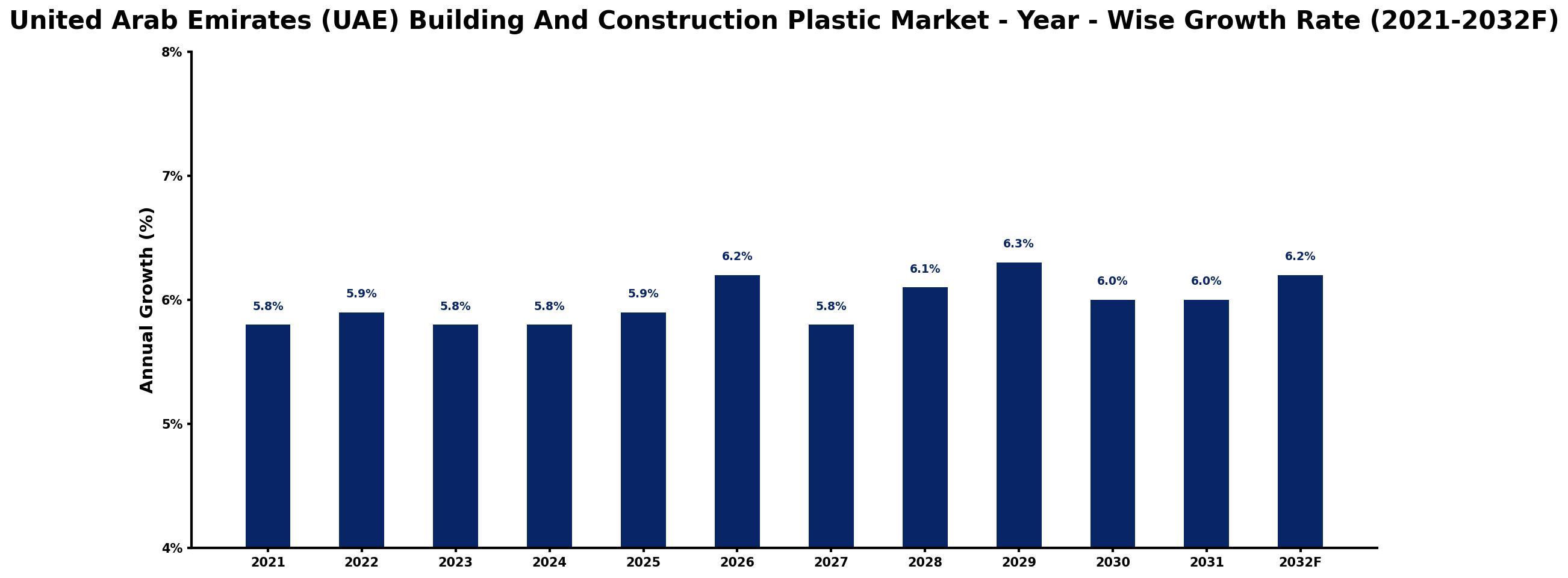
The table below presents the year‑wise growth rates along with the key drivers influencing the market
| Year | Growth Rate | Major Drivers |
| 2021 | 5.8% | Rising infrastructure investment trends |
| 2022 | 5.9% | Growing demand for sustainable materials |
| 2023 | 5.8% | Expansion of residential projects |
| 2024 | 5.8% | Increased public sector initiatives |
| 2025 | 5.9% | Surge in commercial developments |
| 2026 | 6.2% | Technological advancements in manufacturing |
| 2027 | 5.8% | Higher consumer spending power |
| 2028 | 6.1% | Focus on eco-friendly solutions |
| 2029 | 6.3% | Growth in renovation activities |
| 2030 | 6.0% | Strengthening of regional partnerships |
| 2031 | 6.0% | Emergence of smart technologies |
| 2032 | 6.2% | Boost in regional trade agreements |
Note: Market size estimations and growth projections presented in this report are based on 6Wresearch's proprietary forecasting methodology, utilizing the latest available industry data, government publications, and primary research inputs.
United Arab Emirates (UAE) Building And Construction Plastic Market Synopsis
In the UAE, construction plastics have become essential to modern architecture, with applications ranging from pipes to insulation solutions. This trend highlights the growing reliance on plastic materials that offer enhanced durability and flexibility, essential for the region's diverse climatic conditions.
Additionally, the UAE's commitment to green building initiatives has led to an increased demand for eco-friendly plastic solutions. As construction projects align with sustainability goals, the market's focus is shifting towards products that comply with stringent environmental regulations, thus reinforcing the relevance of construction plastics in the sector.
United Arab Emirates (UAE) Building And Construction Plastic Market Key Takeaways
- The market is experiencing robust growth driven by infrastructure development and sustainable building practices.
- Government initiatives are increasingly promoting the use of eco-friendly materials within the construction sector.
- Demand for innovative plastic solutions is rising, particularly for applications that enhance energy efficiency.
- Concerns regarding plastic waste and regulatory measures are pushing the market towards recycling and sustainable practices.
- The recovery post-COVID-19 is set to catalyze growth in construction activities, positively impacting plastic demand.
Evaluation of Restraints in United Arab Emirates (UAE) Building And Construction Plastic Market
While the UAE Building and Construction Plastic Market shows promising growth, it faces several significant restraints. Growing public concern regarding plastic waste and its environmental impact has led to stringent regulations on plastic use, particularly concerning single-use plastics. Moreover, market players are under pressure to innovate in recycling and disposal methods to mitigate these environmental concerns. Additionally, fluctuations in the prices of plastic resins can disrupt supply chains, affecting profitability and operational strategies.
United Arab Emirates (UAE) Building And Construction Plastic Market Trends
The market is currently witnessing several pivotal trends, including the shift towards bio-based plastics and advanced recycling technologies. There's also a growing preference for modular construction practices, which utilize plastic products for their lightweight and durable characteristics. Additionally, the increasing integration of smart technologies within construction processes is leading to the development of advanced plastic solutions that contribute to overall project efficiency and sustainability.
United Arab Emirates (UAE) Building And Construction Plastic Market Opportunities
Opportunities for growth in the UAE Building and Construction Plastic Market are significant, particularly in the realm of sustainable materials. Investment in research and development to create high-performance, eco-friendly plastic products is crucial. Furthermore, as the country continues to diversify its economy, emerging sectors like renewable energy and green building will likely drive demand for innovative plastic applications, creating a fertile landscape for investment and expansion.
Government Initiatives in the United Arab Emirates (UAE) Building And Construction Plastic Market
The UAE government has implemented numerous initiatives aimed at promoting sustainable building practices, which are vital for the country's long-term development goals. Programs that encourage the use of recycled and environmentally friendly materials are increasingly being supported. Additionally, public spending on infrastructure and urban development projects continues to provide a robust foundation for the growth of the building and construction plastic market, aligning with national sustainability objectives.
Future Insights of the United Arab Emirates (UAE) Building And Construction Plastic Market
Looking ahead to 2026-2032, the UAE Building and Construction Plastic Market is poised for continued growth, driven by technological advancements and increasing sustainability efforts. As the construction landscape evolves, the demand for innovative, durable plastic materials that meet environmental standards will intensify. Additionally, the growing trend of smart cities and enhanced infrastructural projects will further elevate the role of plastics within the building sector, making this an exciting time for market participants.
United Arab Emirates (UAE) Building And Construction Plastic Market Latest Developments (2025 - 2026)
Recent developments in the UAE Building and Construction Plastic Market have reflected a strong industry focus on innovation and sustainability. Initiatives to develop biodegradable plastic solutions have gained momentum, indicating a shift towards eco-conscious manufacturing practices. Additionally, collaborative efforts between private companies and governmental bodies have led to increased investments in recycling infrastructure, setting the stage for a more circular economy in construction plastics.
United Arab Emirates (UAE) Building And Construction Plastic Market - Key Attractiveness of the Report
- 10 Years of Market Numbers
- Historical Data Starting from 2022 to 2025
- Base Year: 2025
- Forecast Data until 2032
- Key Performance Indicators Impacting the Market
- Major Upcoming Developments and Projects
Key Highlights of the Report:
- United Arab Emirates (UAE) Building And Construction Plastic Market Outlook
- Market Size of United Arab Emirates (UAE) Building And Construction Plastic Market, 2025
- Forecast of United Arab Emirates (UAE) Building And Construction Plastic Market, 2032
- Historical Data and Forecast of United Arab Emirates (UAE) Building And Construction Plastic Revenues & Volume for the Period 2022-2032F
- United Arab Emirates (UAE) Building And Construction Plastic Market Trend Evolution
- United Arab Emirates (UAE) Building And Construction Plastic Market Drivers and Challenges
- United Arab Emirates (UAE) Building And Construction Plastic Price Trends
- United Arab Emirates (UAE) Building And Construction Plastic Porter's Five Forces
- United Arab Emirates (UAE) Building And Construction Plastic Industry Life Cycle
- Historical Data and Forecast of United Arab Emirates (UAE) Building And Construction Plastic Market Revenues & Volume By Type for the Period 2022-2032F
- Historical Data and Forecast of United Arab Emirates (UAE) Building And Construction Plastic Market Revenues & Volume By Thermoplastic for the Period 2022-2032F
- Historical Data and Forecast of United Arab Emirates (UAE) Building And Construction Plastic Market Revenues & Volume By Thermosetting Plastic for the Period 2022-2032F
- Historical Data and Forecast of United Arab Emirates (UAE) Building And Construction Plastic Market Revenues & Volume By Application for the Period 2022-2032F
- Historical Data and Forecast of United Arab Emirates (UAE) Building And Construction Plastic Market Revenues & Volume By Flooring for the Period 2022-2032F
- Historical Data and Forecast of United Arab Emirates (UAE) Building And Construction Plastic Market Revenues & Volume By Window and Door Panel for the Period 2022-2032F
- Historical Data and Forecast of United Arab Emirates (UAE) Building And Construction Plastic Market Revenues & Volume By Siding for the Period 2022-2032F
- Historical Data and Forecast of United Arab Emirates (UAE) Building And Construction Plastic Market Revenues & Volume By Piping for the Period 2022-2032F
- Historical Data and Forecast of United Arab Emirates (UAE) Building And Construction Plastic Market Revenues & Volume By Roofing for the Period 2022-2032F
- Historical Data and Forecast of United Arab Emirates (UAE) Building And Construction Plastic Market Revenues & Volume By Insulation for the Period 2022-2032F
- Historical Data and Forecast of United Arab Emirates (UAE) Building And Construction Plastic Market Revenues & Volume By Others for the Period 2022-2032F
- United Arab Emirates (UAE) Building And Construction Plastic Import Export Trade Statistics
- Market Opportunity Assessment By Type
- Market Opportunity Assessment By Application
- United Arab Emirates (UAE) Building And Construction Plastic Top Companies Market Share
- United Arab Emirates (UAE) Building And Construction Plastic Competitive Benchmarking By Technical and Operational Parameters
- United Arab Emirates (UAE) Building And Construction Plastic Company Profiles
- United Arab Emirates (UAE) Building And Construction Plastic Key Strategic Recommendations






































