United Arab Emirates (UAE) Cloud Mobile Backend as a Service (BaaS) Market Size & Growth Rate (2026-2032)
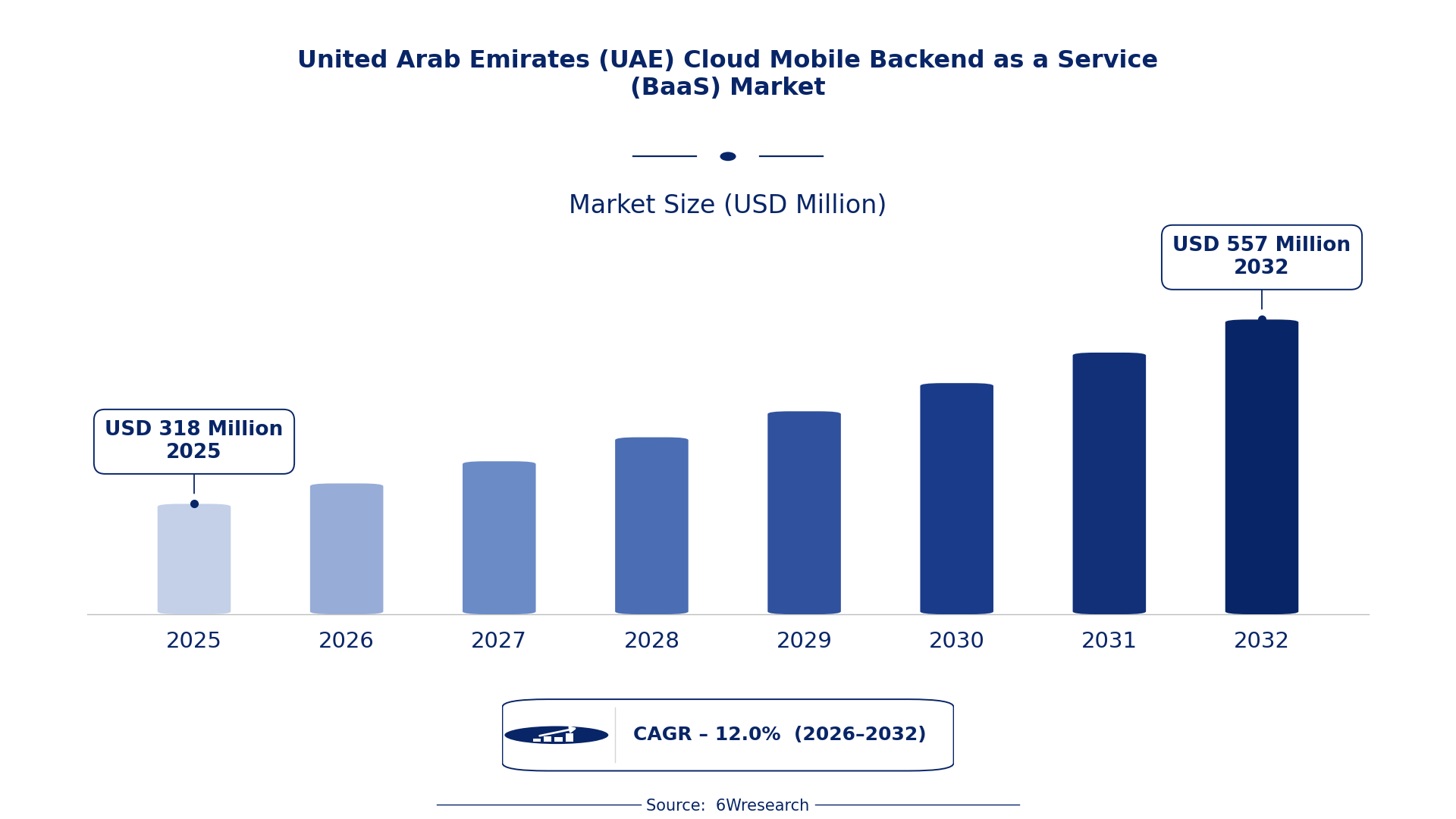
The United Arab Emirates (UAE) Cloud Mobile Backend as a Service (BaaS) Market was estimated at USD 318 Million in 2025 and is projected to reach USD 557 Million by 2032, growing at a CAGR of 12.0% from 2026 to 2032.
United Arab Emirates (UAE) Cloud Mobile Backend as a Service (BaaS) Market Synopsis
The UAE is witnessing a surge in demand for Cloud Mobile Backend as a Service (BaaS) solutions, driven by the rapid growth of mobile applications across various sectors. Companies are recognizing the efficiency of BaaS in accelerating app development and improving operational agility, which is vital in today’s fast-paced market environment.
As the UAE continues to embrace digital transformation, businesses are increasingly adopting BaaS for its ability to provide scalable, secure, and reliable backend services. This shift not only enhances user experience but also significantly reduces the time-to-market for new applications, positioning the UAE as a competitive player in the global app development arena.
United Arab Emirates (UAE) Cloud Mobile Backend as a Service (BaaS) Market Year-wise Growth Rate and Key Drivers
This graph illustrates the annual growth rates of the United Arab Emirates (UAE) Cloud Mobile Backend as a Service (BaaS) Market from 2021 to 2032, highlighting a steady upward trajectory and projected expansion over the forecast period.
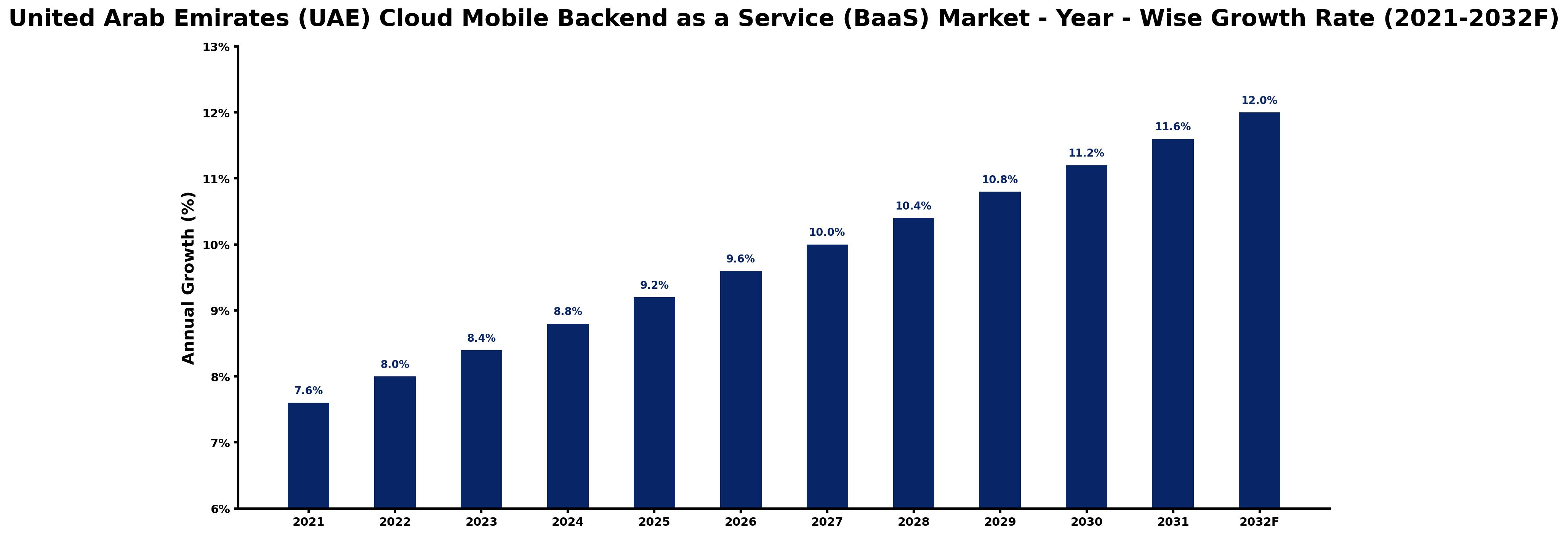
The table below presents the year‑wise growth rates along with the key drivers influencing the market
| Year | Growth Rate | Major Drivers |
| 2021 | 7.6% | Dubai Smart City initiative bolsters cloud solutions adoption. |
| 2022 | 8.0% | Increase in mobile app development boosts BaaS demand. |
| 2023 | 8.4% | UAE's digital economy strategy accelerates tech investments. |
| 2024 | 8.8% | Growing youth demographic drives mobile backend service usage. |
| 2025 | 9.2% | Government support for startups enhances BaaS market growth. |
| 2026 | 9.6% | Adoption of IoT devices increases demand for backend services. |
| 2027 | 10.0% | UAE's 5G rollout enhances mobile application capabilities. |
| 2028 | 10.4% | Rise in e-commerce stimulates backend as a service needs. |
| 2029 | 10.8% | BaaS integration with fintech expands service opportunities. |
| 2030 | 11.2% | Digital transformation initiatives fuel enterprise cloud service uptake. |
| 2031 | 11.6% | Increased cybersecurity regulations enhance BaaS market trust. |
| 2032 | 12.0% | Collaboration between tech hubs drives innovation in BaaS. |
Note: Market size estimations and growth projections presented in this report are based on 6Wresearch's proprietary forecasting methodology, utilizing the latest available industry data, government publications, and primary research inputs.
United Arab Emirates (UAE) Cloud Mobile Backend as a Service (BaaS) Market Key Takeaways
Below are some of the specific key takeaways from the market, including:
- The UAE's tech-savvy population drives a strong demand for innovative mobile applications.
- BaaS providers are essential for businesses looking to streamline app development processes.
- Data security and compliance with local regulations remain critical concerns for businesses utilizing BaaS.
- The ongoing digital transformation initiatives in the UAE bolster the BaaS market's growth potential.
- Major global players are increasing their presence in the UAE BaaS market, enhancing competition.
Evaluation of Restraints in United Arab Emirates (UAE) Cloud Mobile Backend as a Service (BaaS) Market
Despite the promising growth trajectory, the UAE BaaS market faces certain restraints. Chief among these are the data security and privacy concerns that have become increasingly relevant as businesses migrate sensitive information to cloud platforms. The complexity of complying with evolving data protection laws presents an additional hurdle for companies looking to adopt BaaS solutions. These challenges necessitate a heightened focus on robust security measures and compliance strategies to maintain consumer trust and regulatory adherence.
United Arab Emirates (UAE) Cloud Mobile Backend as a Service (BaaS) Market Trends
A notable trend in the UAE BaaS market is the integration of advanced technologies like artificial intelligence and machine learning into backend services. These technologies enhance app functionalities, providing businesses with deeper insights into user behavior. Additionally, the rise of low-code and no-code development platforms is making BaaS solutions more accessible to a broader range of developers, further stimulating market growth.
There is also a growing emphasis on multi-cloud strategies among businesses, allowing them to utilize various BaaS providers for different application needs. This approach not only enhances flexibility but also mitigates risks associated with vendor lock-in, shaping the future direction of the UAE BaaS market.
United Arab Emirates (UAE) Cloud Mobile Backend as a Service (BaaS) Market Opportunities
The UAE BaaS market presents several growth opportunities, particularly in sectors such as e-commerce, healthcare, and finance, where mobile applications are increasingly integral. Companies are seeking BaaS solutions to enhance user engagement through personalized experiences, which creates a ripe environment for providers to innovate and expand their service offerings. on top of that, partnerships between local startups and established BaaS providers can lead to the development of tailored solutions that cater specifically to the unique demands of the UAE market.
Government Initiatives in the United Arab Emirates (UAE) Cloud Mobile Backend as a Service (BaaS) Market
The UAE government is actively shaping the Cloud Mobile Backend as a Service (BaaS) market through various initiatives aimed at fostering digital innovation and enhancing regulatory frameworks. With a strong focus on creating a favorable environment for tech advancements, the government prioritizes cybersecurity and data protection, essential for the growth of cloud services. This proactive approach not only encourages local businesses to adopt BaaS but also attracts international players looking to invest in the region.
- A national digital infrastructure upgrade programme launched in 2025 aims to enhance connectivity across urban and rural areas.
- Currently ongoing initiatives focus on establishing a regulatory framework to ensure data protection compliance for cloud services.
- A public-private partnership expected to expand telecom infrastructure access by 2028 is also underway.
- The government recently completed a cybersecurity policy framework designed to protect sensitive data in cloud environments.
- Plans for a national innovation strategy targeting tech startups are scheduled for rollout in 2026.
Future Insights of the United Arab Emirates (UAE) Cloud Mobile Backend as a Service (BaaS) Market
Looking ahead to 2026-2032, the UAE Cloud Mobile Backend as a Service (BaaS) market is expected to experience substantial growth as businesses continue to digitize operations. The increasing reliance on mobile applications will drive demand for efficient backend solutions, and advancements in technology will further enhance the capabilities of BaaS providers. As competition intensifies, innovation will be key, with providers needing to offer unique features and exceptional customer support to differentiate themselves in a crowded market.
United Arab Emirates (UAE) Cloud Mobile Backend as a Service (BaaS) Market Latest Developments
Recent industry activity in the UAE Cloud Mobile Backend as a Service (BaaS) market indicates a vibrant landscape characterized by innovation and strategic partnerships. Companies are focusing on enhancing their service offerings to meet the growing demand for mobile applications. The overall climate suggests that providers are positioning themselves to capitalize on emerging trends in technology and user expectations.
- A major technology vendor launched a new BaaS platform tailored for the regional market in early 2025.
- Partnerships between local startups and BaaS providers are currently underway to develop specialized solutions for the healthcare sector.
- In late 2025, a regional operator completed an upgrade to its cloud infrastructure, enhancing service reliability.
- An initiative aimed at integrating artificial intelligence into BaaS solutions is planned to commence in Q1 2026.
- A service upgrade focused on user data security features is expected to be rolled out by mid-2026.
United Arab Emirates (UAE) Cloud Mobile Backend as a Service (BaaS) Market - Key Attractiveness of the Report
- 10 Years of Market Numbers
- Historical Data Starting from 2022 to 2025
- Base Year: 2025
- Forecast Data until 2032
- Key Performance Indicators Impacting the Market
- Major Upcoming Developments and Projects
Key Highlights of the Report:
- United Arab Emirates (UAE) Cloud Mobile Backend as a Service (BaaS) Market Outlook
- Market Size of United Arab Emirates (UAE) Cloud Mobile Backend as a Service (BaaS) Market, 2025
- Forecast of United Arab Emirates (UAE) Cloud Mobile Backend as a Service (BaaS) Market, 2032
- Historical Data and Forecast of United Arab Emirates (UAE) Cloud Mobile Backend as a Service (BaaS) Revenues & Volume for the Period 2022-2032F
- United Arab Emirates (UAE) Cloud Mobile Backend as a Service (BaaS) Market Trend Evolution
- United Arab Emirates (UAE) Cloud Mobile Backend as a Service (BaaS) Market Drivers and Challenges
- United Arab Emirates (UAE) Cloud Mobile Backend as a Service (BaaS) Price Trends
- United Arab Emirates (UAE) Cloud Mobile Backend as a Service (BaaS) Porter's Five Forces
- United Arab Emirates (UAE) Cloud Mobile Backend as a Service (BaaS) Industry Life Cycle
- Historical Data and Forecast of United Arab Emirates (UAE) Cloud Mobile Backend as a Service (BaaS) Market Revenues & Volume By Application for the Period 2022-2032F
- Historical Data and Forecast of United Arab Emirates (UAE) Cloud Mobile Backend as a Service (BaaS) Market Revenues & Volume By Cloud storage and Backup for the Period 2022-2032F
- Historical Data and Forecast of United Arab Emirates (UAE) Cloud Mobile Backend as a Service (BaaS) Market Revenues & Volume By User authentication for the Period 2022-2032F
- Historical Data and Forecast of United Arab Emirates (UAE) Cloud Mobile Backend as a Service (BaaS) Market Revenues & Volume By Database Management for the Period 2022-2032F
- Historical Data and Forecast of United Arab Emirates (UAE) Cloud Mobile Backend as a Service (BaaS) Market Revenues & Volume By Push Notifications for the Period 2022-2032F
- Historical Data and Forecast of United Arab Emirates (UAE) Cloud Mobile Backend as a Service (BaaS) Market Revenues & Volume By Others for the Period 2022-2032F
- Historical Data and Forecast of United Arab Emirates (UAE) Cloud Mobile Backend as a Service (BaaS) Market Revenues & Volume By Platform for the Period 2022-2032F
- Historical Data and Forecast of United Arab Emirates (UAE) Cloud Mobile Backend as a Service (BaaS) Market Revenues & Volume By Android for the Period 2022-2032F
- Historical Data and Forecast of United Arab Emirates (UAE) Cloud Mobile Backend as a Service (BaaS) Market Revenues & Volume By iOS for the Period 2022-2032F
- Historical Data and Forecast of United Arab Emirates (UAE) Cloud Mobile Backend as a Service (BaaS) Market Revenues & Volume By others for the Period 2022-2032F
- Historical Data and Forecast of United Arab Emirates (UAE) Cloud Mobile Backend as a Service (BaaS) Market Revenues & Volume By Vertical for the Period 2022-2032F
- Historical Data and Forecast of United Arab Emirates (UAE) Cloud Mobile Backend as a Service (BaaS) Market Revenues & Volume By BFSI for the Period 2022-2032F
- Historical Data and Forecast of United Arab Emirates (UAE) Cloud Mobile Backend as a Service (BaaS) Market Revenues & Volume By IT and ITeS for the Period 2022-2032F
- Historical Data and Forecast of United Arab Emirates (UAE) Cloud Mobile Backend as a Service (BaaS) Market Revenues & Volume By Manufacturing for the Period 2022-2032F
- Historical Data and Forecast of United Arab Emirates (UAE) Cloud Mobile Backend as a Service (BaaS) Market Revenues & Volume By Healthcare and pharmaceuticals for the Period 2022-2032F
- Historical Data and Forecast of United Arab Emirates (UAE) Cloud Mobile Backend as a Service (BaaS) Market Revenues & Volume By Retail and eCommerce for the Period 2022-2032F
- Historical Data and Forecast of United Arab Emirates (UAE) Cloud Mobile Backend as a Service (BaaS) Market Revenues & Volume By Media, entertainment for the Period 2022-2032F
- Historical Data and Forecast of United Arab Emirates (UAE) Cloud Mobile Backend as a Service (BaaS) Market Revenues & Volume By Gaming for the Period 2022-2032F
- Historical Data and Forecast of United Arab Emirates (UAE) Cloud Mobile Backend as a Service (BaaS) Market Revenues & Volume By Telecommunications for the Period 2022-2032F
- Historical Data and Forecast of United Arab Emirates (UAE) Cloud Mobile Backend as a Service (BaaS) Market Revenues & Volume By Enterprise Size for the Period 2022-2032F
- Historical Data and Forecast of United Arab Emirates (UAE) Cloud Mobile Backend as a Service (BaaS) Market Revenues & Volume By Small and Medium-sized Enterprises (SMEs) for the Period 2022-2032F
- Historical Data and Forecast of United Arab Emirates (UAE) Cloud Mobile Backend as a Service (BaaS) Market Revenues & Volume By Large Enterprises for the Period 2022-2032F
- United Arab Emirates (UAE) Cloud Mobile Backend as a Service (BaaS) Import Export Trade Statistics
- Market Opportunity Assessment By Application
- Market Opportunity Assessment By Platform
- Market Opportunity Assessment By Vertical
- Market Opportunity Assessment By Enterprise Size
- United Arab Emirates (UAE) Cloud Mobile Backend as a Service (BaaS) Top Companies Market Share
- United Arab Emirates (UAE) Cloud Mobile Backend as a Service (BaaS) Competitive Benchmarking By Technical and Operational Parameters
- United Arab Emirates (UAE) Cloud Mobile Backend as a Service (BaaS) Company Profiles
- United Arab Emirates (UAE) Cloud Mobile Backend as a Service (BaaS) Key Strategic Recommendations






































