United Arab Emirates (UAE) Data Migration Market Size & Growth Rate (2026-2032)
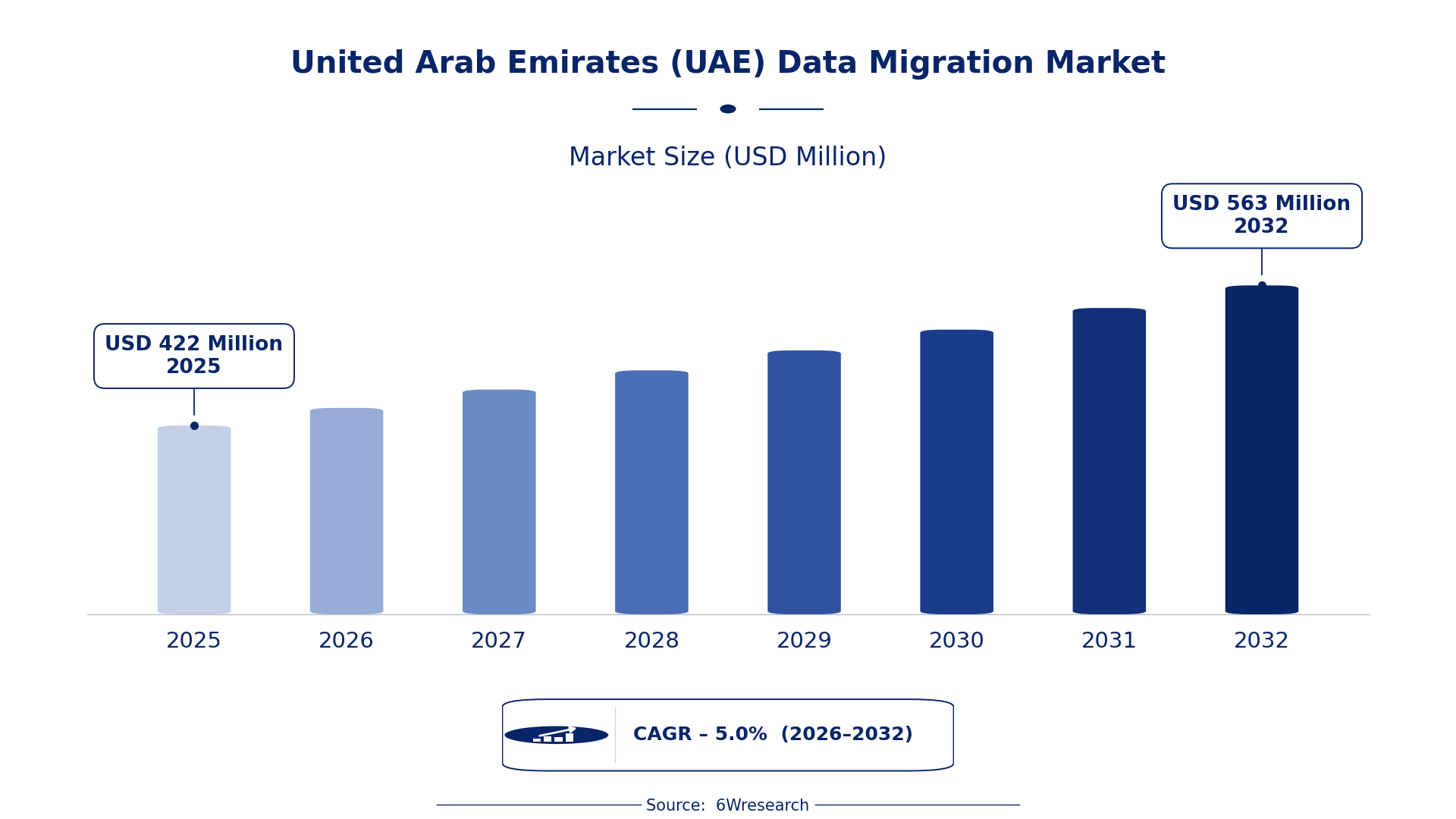
The United Arab Emirates (UAE) Data Migration Market was estimated at USD 422 Million in 2025 and is projected to reach USD 563 Million by 2032, growing at a CAGR of 5.0% from 2026 to 2032.
United Arab Emirates (UAE) Data Migration Market Synopsis
The UAE Data Migration Market is on an upward trajectory, fueled by a surge in digital transformation initiatives across various sectors. Organizations are increasingly migrating data from legacy systems to modern, cloud-based platforms, driven by the necessity to enhance operational efficiency and data accessibility.
As companies in the UAE embrace advanced technologies, the demand for AI-powered data migration solutions is rising. These solutions not only streamline the migration process but also ensure data integrity and security during transitions. The ongoing shift towards agile and scalable data management further underscores the market's growth potential.
United Arab Emirates (UAE) Data Migration Market Year-wise Growth Rate and Key Drivers
This graph illustrates the annual growth rates of the United Arab Emirates (UAE) Data Migration Market from 2021 to 2032, highlighting a steady upward trajectory and projected expansion over the forecast period.
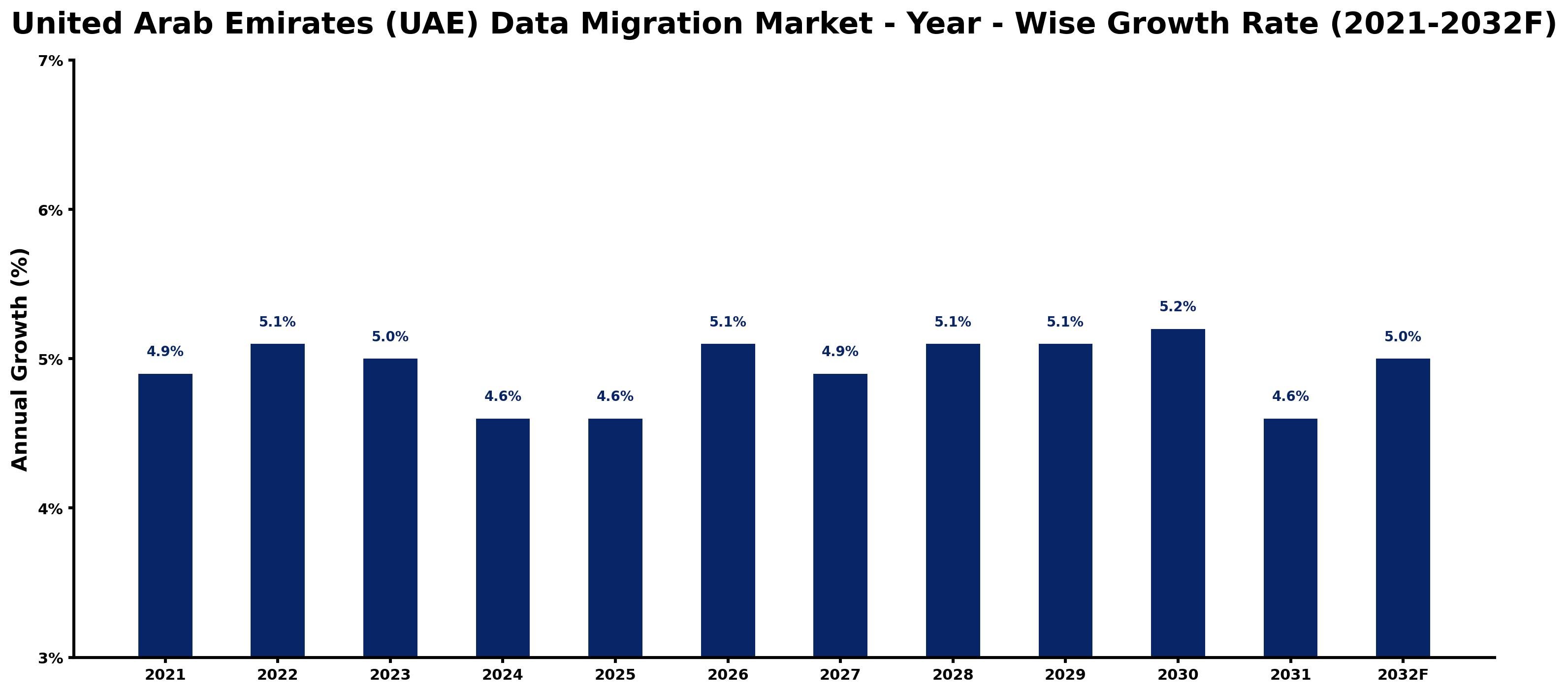
The table below presents the year‑wise growth rates along with the key drivers influencing the market
| Year | Growth Rate | Major Drivers |
| 2021 | 4.9% | Increased cloud adoption by local enterprises driving demand. |
| 2022 | 5.1% | UAE's ongoing digital transformation initiatives expedite data migration. |
| 2023 | 5.0% | Growth in fintech sector boosts secure data handling needs. |
| 2024 | 4.6% | New data protection regulations enhance compliance migration demand. |
| 2025 | 4.6% | Rising investment in smart infrastructure necessitates data transitions. |
| 2026 | 5.1% | Government mandates push for enhanced cybersecurity frameworks. |
| 2027 | 4.9% | Surge in e-commerce drives necessity for scalable data solutions. |
| 2028 | 5.1% | UAE Vision 2030 aligns with data-centric business models. |
| 2029 | 5.1% | Growing regional tech startups fuel data migration projects. |
| 2030 | 5.2% | Focus on AI integration increases legacy system migrations. |
| 2031 | 4.6% | Telecommunications upgrades prompt renewed data management strategies. |
| 2032 | 5.0% | Local demand for analytics drives continuous data relocations. |
Note: Market size estimations and growth projections presented in this report are based on 6Wresearch's proprietary forecasting methodology, utilizing the latest available industry data, government publications, and primary research inputs.
United Arab Emirates (UAE) Data Migration Market Key Takeaways
Below are some of the specific key takeaways from the market, including:
- Digital transformation initiatives are driving the demand for data migration services across industries.
- AI-driven solutions are becoming essential for efficient and secure data transfer.
- Compliance with data protection regulations is a major consideration for businesses undertaking migration projects.
- Organizations are increasingly seeking cost-effective and scalable data management solutions.
- Challenges related to data integrity and compatibility continue to impact migration efforts.
Evaluation of Restraints in United Arab Emirates (UAE) Data Migration Market
Despite its growth, the UAE Data Migration Market faces notable constraints that can hinder progress. One primary concern is the risk of data loss or corruption during migration, which demands meticulous planning and execution to mitigate. Compatibility issues between diverse data formats complicate the process, often requiring organizations to invest in sophisticated data mapping strategies. Additionally, the pressure to minimize downtime during transitions can create significant operational challenges, making it critical for businesses to address these concerns effectively.
United Arab Emirates (UAE) Data Migration Market Trends
Several trends are shaping the UAE Data Migration Market. The rapid adoption of cloud technologies is a key driver, as businesses look to leverage the benefits of cloud computing for enhanced scalability and flexibility. Additionally, the integration of AI and machine learning in data migration tools is gaining traction, facilitating faster and more accurate data transfers. There is also a growing emphasis on data governance and compliance, prompting organizations to prioritize secure migration processes that align with regulatory requirements.
United Arab Emirates (UAE) Data Migration Market Opportunities
The UAE Data Migration Market presents numerous growth opportunities. Businesses are increasingly investing in modern data management systems, creating demand for migration services that can facilitate smooth transitions. The rise of big data analytics is another avenue for growth, as organizations seek to harness data insights more effectively. on top of that, public-private partnerships aimed at enhancing digital infrastructure can create additional avenues for investment in data migration solutions.
Government Initiatives in the United Arab Emirates (UAE) Data Migration Market
The UAE government is actively shaping the Data Migration Market through various initiatives focused on digital transformation and regulatory compliance. Public sector priorities are increasingly aligned with technological advancements, creating a favorable environment for businesses to invest in data migration solutions. The regulatory framework is evolving to support secure and efficient data migration, ensuring that organizations adhere to necessary compliance standards.
- A national digital infrastructure upgrade program launched in early 2025 aims to enhance data processing capabilities across sectors.
- Ongoing initiatives are underway to develop a regulatory framework that mandates data protection measures during migration processes.
- A planned public-private partnership expected to expand cloud infrastructure is set to commence in late 2026.
- Recent efforts have been made to streamline data migration compliance requirements, aiding businesses in navigating regulatory challenges.
- Upcoming workshops and training programs are designed to enhance skills related to data migration strategies among industry professionals.
Future Insights of the United Arab Emirates (UAE) Data Migration Market
Looking ahead to 2026-2032, the UAE Data Migration Market is expected to continue its upward trajectory. The ongoing digital transformation across various sectors will necessitate further investment in data migration services. As organizations increasingly adopt cloud technologies, the demand for secure and efficient migration solutions will only heighten. Additionally, advancements in AI and machine learning will enhance migration processes, making them faster and more reliable. Companies that focus on compliance and data governance will find themselves well-positioned to capitalize on these trends.
United Arab Emirates (UAE) Data Migration Market Latest Developments
In the past year, the UAE Data Migration Market has seen significant activity reflecting the broader trends of digital transformation. Companies are rapidly adopting new technologies and solutions to enhance their data migration capabilities, ensuring they remain competitive in a dynamic environment.
- A major technology vendor launched a new AI-driven data migration platform in Q1 2025, enhancing automation and accuracy in data transfers.
- An initiative focused on improving data security during migration processes is currently underway, aiming to establish industry best practices by mid-2026.
- A partnership between leading firms was formed in late 2025 to develop integrated solutions for smoother data migration to cloud environments.
- Upcoming upgrades to existing data migration tools are expected to roll out in early 2026, focusing on enhanced user experience and performance.
- A pilot program for a national data repository project is set to launch in Q3 2025, aimed at improving data accessibility and sharing across sectors.
United Arab Emirates (UAE) Data Migration Market - Key Attractiveness of the Report
- 10 Years of Market Numbers
- Historical Data Starting from 2022 to 2025
- Base Year: 2025
- Forecast Data until 2032
- Key Performance Indicators Impacting the Market
- Major Upcoming Developments and Projects
Key Highlights of the Report:
- United Arab Emirates (UAE) Data Migration Market Outlook
- Market Size of United Arab Emirates (UAE) Data Migration Market, 2025
- Forecast of United Arab Emirates (UAE) Data Migration Market, 2032
- Historical Data and Forecast of United Arab Emirates (UAE) Data Migration Revenues & Volume for the Period 2022-2032F
- United Arab Emirates (UAE) Data Migration Market Trend Evolution
- United Arab Emirates (UAE) Data Migration Market Drivers and Challenges
- United Arab Emirates (UAE) Data Migration Price Trends
- United Arab Emirates (UAE) Data Migration Porter's Five Forces
- United Arab Emirates (UAE) Data Migration Industry Life Cycle
- Historical Data and Forecast of United Arab Emirates (UAE) Data Migration Market Revenues & Volume By Data Type for the Period 2022-2032F
- Historical Data and Forecast of United Arab Emirates (UAE) Data Migration Market Revenues & Volume By Customer data for the Period 2022-2032F
- Historical Data and Forecast of United Arab Emirates (UAE) Data Migration Market Revenues & Volume By Product data for the Period 2022-2032F
- Historical Data and Forecast of United Arab Emirates (UAE) Data Migration Market Revenues & Volume By Financial data for the Period 2022-2032F
- Historical Data and Forecast of United Arab Emirates (UAE) Data Migration Market Revenues & Volume By Compliance data for the Period 2022-2032F
- Historical Data and Forecast of United Arab Emirates (UAE) Data Migration Market Revenues & Volume By Supplier data for the Period 2022-2032F
- Historical Data and Forecast of United Arab Emirates (UAE) Data Migration Market Revenues & Volume By Business Function for the Period 2022-2032F
- Historical Data and Forecast of United Arab Emirates (UAE) Data Migration Market Revenues & Volume By Marketing for the Period 2022-2032F
- Historical Data and Forecast of United Arab Emirates (UAE) Data Migration Market Revenues & Volume By Sales for the Period 2022-2032F
- Historical Data and Forecast of United Arab Emirates (UAE) Data Migration Market Revenues & Volume By Finance for the Period 2022-2032F
- Historical Data and Forecast of United Arab Emirates (UAE) Data Migration Market Revenues & Volume By Legal for the Period 2022-2032F
- Historical Data and Forecast of United Arab Emirates (UAE) Data Migration Market Revenues & Volume By Operations for the Period 2022-2032F
- Historical Data and Forecast of United Arab Emirates (UAE) Data Migration Market Revenues & Volume By Human Resources (HR) for the Period 2022-2032F
- Historical Data and Forecast of United Arab Emirates (UAE) Data Migration Market Revenues & Volume By Component for the Period 2022-2032F
- Historical Data and Forecast of United Arab Emirates (UAE) Data Migration Market Revenues & Volume By Software for the Period 2022-2032F
- Historical Data and Forecast of United Arab Emirates (UAE) Data Migration Market Revenues & Volume By Services for the Period 2022-2032F
- Historical Data and Forecast of United Arab Emirates (UAE) Data Migration Market Revenues & Volume By Deployment Model for the Period 2022-2032F
- Historical Data and Forecast of United Arab Emirates (UAE) Data Migration Market Revenues & Volume By On-premises for the Period 2022-2032F
- Historical Data and Forecast of United Arab Emirates (UAE) Data Migration Market Revenues & Volume By Cloud for the Period 2022-2032F
- Historical Data and Forecast of United Arab Emirates (UAE) Data Migration Market Revenues & Volume By Organization Size for the Period 2022-2032F
- Historical Data and Forecast of United Arab Emirates (UAE) Data Migration Market Revenues & Volume By Small and Medium-sized Enterprises (SMEs) for the Period 2022-2032F
- Historical Data and Forecast of United Arab Emirates (UAE) Data Migration Market Revenues & Volume By Large enterprises for the Period 2022-2032F
- Historical Data and Forecast of United Arab Emirates (UAE) Data Migration Market Revenues & Volume By Industry Vertical for the Period 2022-2032F
- Historical Data and Forecast of United Arab Emirates (UAE) Data Migration Market Revenues & Volume By Banking, Financial Services, and Insurance (BFSI) for the Period 2022-2032F
- Historical Data and Forecast of United Arab Emirates (UAE) Data Migration Market Revenues & Volume By Retail and consumer goods for the Period 2022-2032F
- Historical Data and Forecast of United Arab Emirates (UAE) Data Migration Market Revenues & Volume By Government and defense for the Period 2022-2032F
- Historical Data and Forecast of United Arab Emirates (UAE) Data Migration Market Revenues & Volume By Healthcare and life sciences for the Period 2022-2032F
- Historical Data and Forecast of United Arab Emirates (UAE) Data Migration Market Revenues & Volume By Manufacturing for the Period 2022-2032F
- Historical Data and Forecast of United Arab Emirates (UAE) Data Migration Market Revenues & Volume By Telecommunications and IT for the Period 2022-2032F
- Historical Data and Forecast of United Arab Emirates (UAE) Data Migration Market Revenues & Volume By Energy and utilities for the Period 2022-2032F
- Historical Data and Forecast of United Arab Emirates (UAE) Data Migration Market Revenues & Volume By Media and entertainment for the Period 2022-2032F
- United Arab Emirates (UAE) Data Migration Import Export Trade Statistics
- Market Opportunity Assessment By Data Type
- Market Opportunity Assessment By Business Function
- Market Opportunity Assessment By Component
- Market Opportunity Assessment By Deployment Model
- Market Opportunity Assessment By Organization Size
- Market Opportunity Assessment By Industry Vertical
- United Arab Emirates (UAE) Data Migration Top Companies Market Share
- United Arab Emirates (UAE) Data Migration Competitive Benchmarking By Technical and Operational Parameters
- United Arab Emirates (UAE) Data Migration Company Profiles
- United Arab Emirates (UAE) Data Migration Key Strategic Recommendations






































