United Arab Emirates (UAE) Electric Housewares and Fans Market Summary
The united arab emirates (uae) electric housewares and fans market was estimated at USD 794 Million in 2025 and is projected to reach USD 1154 Million by 2032, growing at a CAGR of 6.5% from 2026 to 2032.
United Arab Emirates (UAE) Electric Housewares and Fans Market Year-wise Growth Rate and Key Drivers
This graph highlights how the United Arab Emirates (UAE) Electric Housewares and Fans Market has steadily grown over the past five years, supported by major growth factors.
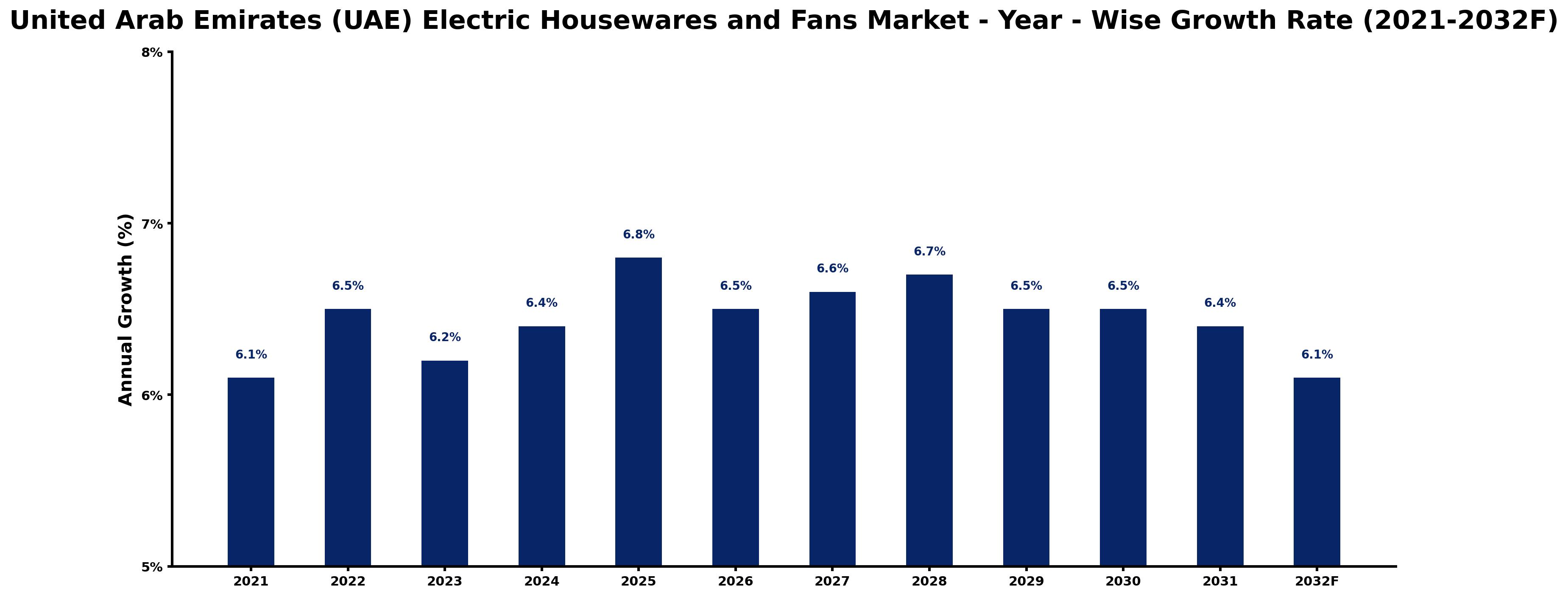
The table below presents the year wise growth rates along with the key drivers influencing the market
| Year | Growth Rate | Major Drivers |
| 2021 | 6.1% | Consumer preferences shifted towards energy-efficient electric housewares amidst rising utility costs. |
| 2022 | 6.5% | Increased urbanization spurred demand for smart home solutions and modern appliances. |
| 2023 | 6.2% | Local manufacturers focused on customization to meet diverse consumer tastes and preferences. |
| 2024 | 6.4% | The hospitality sector's recovery led to significant investments in electric kitchen appliances. |
| 2025 | 6.8% | E-commerce platforms expanded, enhancing accessibility to a wider range of electric products. |
| 2026 | 6.5% | High humidity levels prompted innovation in cooling solutions, particularly in ceiling fans. |
| 2027 | 6.6% | Sustainability awareness influenced purchasing decisions toward eco-friendly electric housewares. |
| 2028 | 6.7% | Technological integration with IoT enhanced consumer experiences in smart home appliance usage. |
| 2029 | 6.5% | Expansion of commercial ventures and new residential projects drove demand for electric fans. |
| 2030 | 6.5% | Local regulations encouraged manufacturers to shift toward more energy-efficient production processes. |
| 2031 | 6.4% | The UAE's vision for smart cities spurred investments in connected home technologies. |
| 2032 | 6.1% | Emerging trends highlight a preference for multifunctional appliances within compact living spaces. |
Note - Market size estimations and growth projections presented in this report are based on 6Wresearch's advanced forecasting approach, validated with industry datasets as of June 2026.
United Arab Emirates (UAE) Electric Housewares and Fans Market Synopsis
The United Arab Emirates (UAE) Electric Housewares and Fans Market is projected to reach 6.5% and witness significant growth during the forecast period (2026-2032). The market has evolved in response to various socio-economic dynamics, including urbanization, increased disposable income, and a shift towards advanced consumer technologies in household appliances.
United Arab Emirates (UAE) Electric Housewares and Fans Market Growth Drivers
A confluence of factors is driving the expansion of the United Arab Emirates (UAE) Electric Housewares and Fans Market. Key growth drivers include:
- The rapid economic development in the UAE has resulted in higher per capita incomes, enabling consumers to invest more in electric housewares and fans, thereby enhancing their overall quality of life.
- Urbanization is leading to a higher number of households in urban centers, creating a greater demand for electric appliances that cater to modern living standards.
- The growth of the tourism and hospitality sectors in the UAE has spurred demand for electric housewares and fans in accommodation facilities, where customer satisfaction is paramount.
- With an increasing focus on energy efficiency, consumers are gravitating towards smart home technologies that offer convenience, further propelling market growth.
- The rise in health-conscious consumers is leading to increased purchases of electric appliances designed to improve indoor air quality and facilitate easier cleaning processes.
United Arab Emirates (UAE) Electric Housewares and Fans Market Challenges and Restraints
Despite the positive growth trajectory, the United Arab Emirates (UAE) Electric Housewares and Fans Market faces several challenges:
- Price sensitivity among a segment of consumers may impede the sales of higher-end electric housewares and fans, necessitating strategic pricing approaches by manufacturers.
- Extreme climate conditions, particularly the intense heat during summer months, can lead to seasonal demand fluctuations for fans, presenting challenges for inventory management.
- Supply chain disruptions, exacerbated by global economic conditions, can adversely affect the timely availability of products in the market.
- Consumer awareness regarding product safety and energy efficiency standards is critical, with an increase in regulations potentially affecting product offerings.
- Competition from international markets and local manufacturers necessitates constant innovation and improved features to stand out in a crowded marketplace.
United Arab Emirates (UAE) Electric Housewares and Fans Market Government Investment and Initiatives
The UAE government is proactively investing in initiatives that support the growth of the Electric Housewares and Fans Market. Various policies have been implemented to enhance public spending on infrastructure and housing, which subsequently boosts the demand for electric appliances. The government's commitment to sustainable development encourages the adoption of energy-efficient products, in line with global standards. Initiatives focusing on innovation and technological advancement are fostering a conducive environment for manufacturers to develop smarter products. Furthermore, strategic partnerships between public and private sectors aim to promote research and development projects that enhance the product offerings in the market.
United Arab Emirates (UAE) Electric Housewares and Fans Market Latest Developments (May 2025 - June 2026)
The period between May 2025 and June 2026 witnessed several key developments in the United Arab Emirates (UAE) Electric Housewares and Fans Market. Innovations in product design continued to emerge, with a focus on integrating smart technologies into traditional appliances, enhancing user experience and energy efficiency. Additionally, manufacturers began offering more environmentally friendly options, addressing the growing consumer demand for sustainable products. Market strategies also shifted towards online retail platforms as a response to changing consumer purchasing behaviors. Trade exhibitions and showcases played a critical role in highlighting the latest electric housewares and fans, further driving consumer awareness and engagement.
United Arab Emirates (UAE) Electric Housewares and Fans Market - Key Attractiveness of the Report
- 10 Years of Market Numbers
- Historical Data Starting from 2022 to 2025
- Base Year: 2025
- Forecast Data until 2032
- Key Performance Indicators Impacting the Market
- Major Upcoming Developments and Projects
Key Highlights of the Report:
- United Arab Emirates (UAE) Electric Housewares and Fans Market Outlook
- Market Size of United Arab Emirates (UAE) Electric Housewares and Fans Market, 2025
- Forecast of United Arab Emirates (UAE) Electric Housewares and Fans Market, 2032
- Historical Data and Forecast of United Arab Emirates (UAE) Electric Housewares and Fans Revenues & Volume for the Period 2022-2032F
- United Arab Emirates (UAE) Electric Housewares and Fans Market Trend Evolution
- United Arab Emirates (UAE) Electric Housewares and Fans Market Drivers and Challenges
- United Arab Emirates (UAE) Electric Housewares and Fans Price Trends
- United Arab Emirates (UAE) Electric Housewares and Fans Porter's Five Forces
- United Arab Emirates (UAE) Electric Housewares and Fans Industry Life Cycle
- Historical Data and Forecast of United Arab Emirates (UAE) Electric Housewares and Fans Market Revenues & Volume By Types for the Period 2022-2032F
- Historical Data and Forecast of United Arab Emirates (UAE) Electric Housewares and Fans Market Revenues & Volume By Housewares for the Period 2022-2032F
- Historical Data and Forecast of United Arab Emirates (UAE) Electric Housewares and Fans Market Revenues & Volume By Fans for the Period 2022-2032F
- Historical Data and Forecast of United Arab Emirates (UAE) Electric Housewares and Fans Market Revenues & Volume By Electric Fans Types for the Period 2022-2032F
- Historical Data and Forecast of United Arab Emirates (UAE) Electric Housewares and Fans Market Revenues & Volume By Ceiling Fans for the Period 2022-2032F
- Historical Data and Forecast of United Arab Emirates (UAE) Electric Housewares and Fans Market Revenues & Volume By Floor Fans for the Period 2022-2032F
- Historical Data and Forecast of United Arab Emirates (UAE) Electric Housewares and Fans Market Revenues & Volume By Wall-mounted Fans for the Period 2022-2032F
- Historical Data and Forecast of United Arab Emirates (UAE) Electric Housewares and Fans Market Revenues & Volume By Electric Housewares Types for the Period 2022-2032F
- Historical Data and Forecast of United Arab Emirates (UAE) Electric Housewares and Fans Market Revenues & Volume By Air purifiers for the Period 2022-2032F
- Historical Data and Forecast of United Arab Emirates (UAE) Electric Housewares and Fans Market Revenues & Volume By Blenders for the Period 2022-2032F
- Historical Data and Forecast of United Arab Emirates (UAE) Electric Housewares and Fans Market Revenues & Volume By Broilers for the Period 2022-2032F
- Historical Data and Forecast of United Arab Emirates (UAE) Electric Housewares and Fans Market Revenues & Volume By Hair curlers for the Period 2022-2032F
- Historical Data and Forecast of United Arab Emirates (UAE) Electric Housewares and Fans Market Revenues & Volume By Heaters for the Period 2022-2032F
- Historical Data and Forecast of United Arab Emirates (UAE) Electric Housewares and Fans Market Revenues & Volume By Toothbrushes for the Period 2022-2032F
- Historical Data and Forecast of United Arab Emirates (UAE) Electric Housewares and Fans Market Revenues & Volume By Others for the Period 2022-2032F
- United Arab Emirates (UAE) Electric Housewares and Fans Import Export Trade Statistics
- Market Opportunity Assessment By Types
- Market Opportunity Assessment By Electric Fans Types
- Market Opportunity Assessment By Electric Housewares Types
- United Arab Emirates (UAE) Electric Housewares and Fans Top Companies Market Share
- United Arab Emirates (UAE) Electric Housewares and Fans Competitive Benchmarking By Technical and Operational Parameters
- United Arab Emirates (UAE) Electric Housewares and Fans Company Profiles
- United Arab Emirates (UAE) Electric Housewares and Fans Key Strategic Recommendations






































