United Arab Emirates (UAE) Energy Saving & Fluorescent Market Summary
The united arab emirates (uae) energy saving & fluorescent market was estimated at USD 1369 Million in 2025 and is projected to reach USD 1966 Million by 2032, growing at a CAGR of 6.0% from 2026 to 2032.
United Arab Emirates (UAE) Energy Saving & Fluorescent Market Year-wise Growth Rate and Key Drivers
This graph highlights how the United Arab Emirates (UAE) Energy Saving & Fluorescent Market has steadily grown over the past five years, supported by major growth factors.
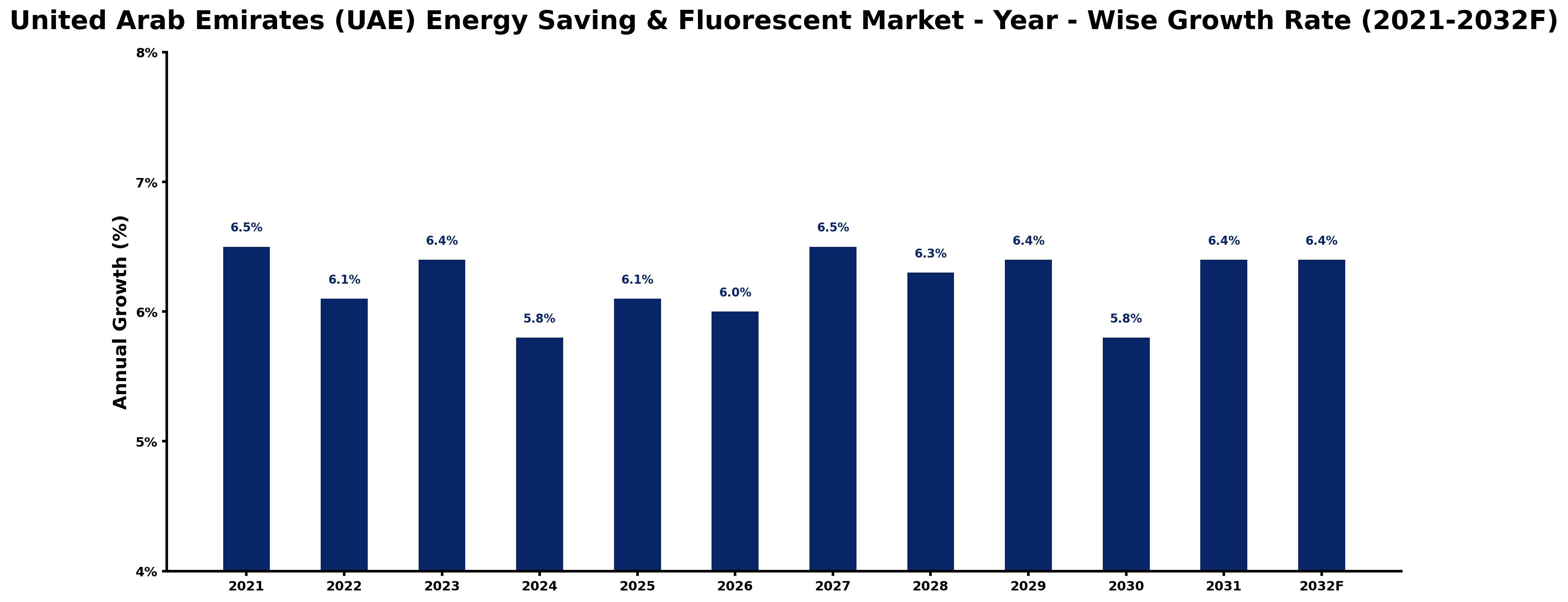
The table below presents the year wise growth rates along with the key drivers influencing the market
| Year | Growth Rate | Major Drivers |
| 2021 | 6.5% | Post-lockdown retail projects revived consumer interest in energy-efficient lighting solutions. |
| 2022 | 6.1% | Corporate budgets began prioritizing sustainable practices, directly influencing energy-saving technologies. |
| 2023 | 6.4% | Rising energy costs compelled businesses to seek effective energy management strategies. |
| 2024 | 5.8% | Hot climate requirements pressured industries to enhance energy efficiency across operations. |
| 2025 | 6.1% | Localization initiatives in the GCC emphasized the need for regional energy solutions. |
| 2026 | 6.0% | The integration of smart technology in buildings transformed energy consumption patterns significantly. |
| 2027 | 6.5% | Market players faced increasing competition, pushing innovation in fluorescent lighting options. |
| 2028 | 6.3% | Consumer awareness campaigns highlighted the benefits of energy-saving products in households. |
| 2029 | 6.4% | Major construction pipelines required adherence to energy efficiency standards and certifications. |
| 2030 | 5.8% | Partnerships between technology firms and manufacturers fostered new energy-efficient solutions. |
| 2031 | 6.4% | Investments in renewable energy created synergies with energy-saving technologies in commercial sectors. |
| 2032 | 6.4% | Emerging trends in sustainability led to shifts in consumer preferences towards eco-friendly products. |
Note - Market size estimations and growth projections presented in this report are based on 6Wresearch's advanced forecasting approach, validated with industry datasets as of June 2026.
United Arab Emirates (UAE) Energy Saving & Fluorescent Market Synopsis
The United Arab Emirates (UAE) Energy Saving Fluorescent Market is projected to reach 6.0% and witness significant growth during the forecast period (2026-2032). The UAE government has been aggressively promoting initiatives aimed at enhancing energy efficiency across various sectors. This includes residential, commercial, and industrial applications, driven by the need for electricity conservation. Additionally, the demand from the oil and gas sectors is expected to further propel the growth of this market throughout the forecast period.
United Arab Emirates (UAE) Energy Saving & Fluorescent Market Growth Drivers
Several factors are contributing to the expansion of the UAE Energy Saving & Fluorescent Market. Key among them are:
- Government initiatives that enforce mandatory labeling standards for lighting products, providing incentives for the adoption of efficient lighting solutions.
- Technological advancements in the oil and gas sectors, which drive the need for more efficient lighting solutions, further increasing market demand.
- An emphasis on sustainability, with policies focused on reducing greenhouse gas emissions and promoting environmentally friendly lighting products.
- Increased investments in infrastructure development, which often incorporate energy-efficient lighting systems, augmenting overall market growth.
- The rising consumer awareness regarding electricity costs and environmental impact, leading to a shift towards energy-saving products in households and businesses.
United Arab Emirates (UAE) Energy Saving & Fluorescent Market Challenges and Restraints
Despite the optimistic outlook for growth in the UAE Energy Saving & Fluorescent Market, several challenges may impede its progress:
- The high upfront costs of LED and energy-saving lighting solutions remain a significant barrier for many consumers and businesses, limiting immediate adoption.
- Market competition leading to price wars can affect the profitability of manufacturers, potentially resulting in reduced innovation and product quality.
- Consumer skepticism concerning the long-term benefits of energy-saving products may deter initial investments, slowing market penetration.
- Regulatory changes or delays in the implementation of energy efficiency programs could affect market stability and growth forecasts.
- The challenge of maintaining a consistent supply chain for energy-efficient materials, particularly in emerging markets, poses risks for manufacturers and suppliers.
United Arab Emirates (UAE) Energy Saving & Fluorescent Market Government Investment and Initiatives
The UAE government has been instrumental in shaping the landscape of the Energy Saving & Fluorescent Market through various investments and policy initiatives:
- The UAE has integrated energy efficiency into its national agenda, leading to substantial public spending aimed at enhancing electricity conservation practices.
- Strategies such as the UAE Energy Strategy 2050 promote the use of clean energy and energy efficiency technologies, encouraging market growth.
- Incentives for businesses that adopt energy-efficient lighting solutions have been established, making it financially viable for many to transition.
- Public-private partnerships are being encouraged to bolster infrastructure projects that prioritize energy conservation, further driving market demand.
- Regulatory frameworks focusing on reducing emissions are leading to investments in research and development for innovative lighting solutions.
United Arab Emirates (UAE) Energy Saving & Fluorescent Market Latest Developments (May 2025 - June 2026)
Recent developments in the UAE Energy Saving & Fluorescent Market from May 2025 to June 2026 reflect a dynamic and evolving landscape:
- Increased collaboration between government agencies and private firms has resulted in several pilot projects aimed at testing new energy-efficient lighting technologies.
- Public awareness campaigns have been launched to educate consumers about the benefits of energy-saving solutions, boosting overall market interest.
- Innovations in design and technology have led to the introduction of smarter lighting systems that integrate with home automation and IoT applications.
- Trade shows and industry exhibitions have highlighted advancements in energy-efficient lighting, stimulating partnerships and knowledge exchange among stakeholders.
- Ongoing research initiatives have focused on developing affordable energy-saving technologies, aiming to lower the cost barrier for consumers.
United Arab Emirates (UAE) Energy Saving & Fluorescent Market - Key Attractiveness of the Report
- 10 Years of Market Numbers
- Historical Data Starting from 2022 to 2025
- Base Year: 2025
- Forecast Data until 2032
- Key Performance Indicators Impacting the Market
- Major Upcoming Developments and Projects
Key Highlights of the Report:
- United Arab Emirates (UAE) Energy Saving & Fluorescent Market Outlook
- Market Size of United Arab Emirates (UAE) Energy Saving & Fluorescent Market, 2025
- Forecast of United Arab Emirates (UAE) Energy Saving & Fluorescent Market, 2032
- Historical Data and Forecast of United Arab Emirates (UAE) Energy Saving & Fluorescent Revenues & Volume for the Period 2022-2032F
- United Arab Emirates (UAE) Energy Saving & Fluorescent Market Trend Evolution
- United Arab Emirates (UAE) Energy Saving & Fluorescent Market Drivers and Challenges
- United Arab Emirates (UAE) Energy Saving & Fluorescent Price Trends
- United Arab Emirates (UAE) Energy Saving & Fluorescent Porter's Five Forces
- United Arab Emirates (UAE) Energy Saving & Fluorescent Industry Life Cycle
- Historical Data and Forecast of United Arab Emirates (UAE) Energy Saving & Fluorescent Market Revenues & Volume By Sources for the Period 2022-2032F
- Historical Data and Forecast of United Arab Emirates (UAE) Energy Saving & Fluorescent Market Revenues & Volume By High-Intensity Discharge Lamps (HID) for the Period 2022-2032F
- Historical Data and Forecast of United Arab Emirates (UAE) Energy Saving & Fluorescent Market Revenues & Volume By Linear Fluorescent Lamps (LFL) for the Period 2022-2032F
- Historical Data and Forecast of United Arab Emirates (UAE) Energy Saving & Fluorescent Market Revenues & Volume By Light Emitting Diodes (LED) for the Period 2022-2032F
- Historical Data and Forecast of United Arab Emirates (UAE) Energy Saving & Fluorescent Market Revenues & Volume By Applications for the Period 2022-2032F
- Historical Data and Forecast of United Arab Emirates (UAE) Energy Saving & Fluorescent Market Revenues & Volume By Commercial for the Period 2022-2032F
- Historical Data and Forecast of United Arab Emirates (UAE) Energy Saving & Fluorescent Market Revenues & Volume By Residential for the Period 2022-2032F
- Historical Data and Forecast of United Arab Emirates (UAE) Energy Saving & Fluorescent Market Revenues & Volume By Government for the Period 2022-2032F
- United Arab Emirates (UAE) Energy Saving & Fluorescent Import Export Trade Statistics
- Market Opportunity Assessment By Sources
- Market Opportunity Assessment By Applications
- United Arab Emirates (UAE) Energy Saving & Fluorescent Top Companies Market Share
- United Arab Emirates (UAE) Energy Saving & Fluorescent Competitive Benchmarking By Technical and Operational Parameters
- United Arab Emirates (UAE) Energy Saving & Fluorescent Company Profiles
- United Arab Emirates (UAE) Energy Saving & Fluorescent Key Strategic Recommendations






































