United Arab Emirates (UAE) Field Service Management Market Size, Share & Growth Rate
The United Arab Emirates (UAE) Field Service Management Market was estimated at USD 371 Million in 2025 and is projected to reach USD 512 Million by 2032, growing at a CAGR of 4.7% from 2026 to 2032. This impressive growth trajectory is primarily driven by the increasing emphasis on digital transformation among businesses, enabling them to enhance operational efficiency and customer experience. Furthermore, the rising demand for real-time data analytics and integration of IoT technologies in field operations are reinforcing the adoption of FSM solutions in the region.
United Arab Emirates (UAE) Field Service Management Market Year-wise Growth Rate and Key Drivers
This graph highlights how the United Arab Emirates (UAE) Field Service Management Market has steadily grown over the years, supported by major growth factors.
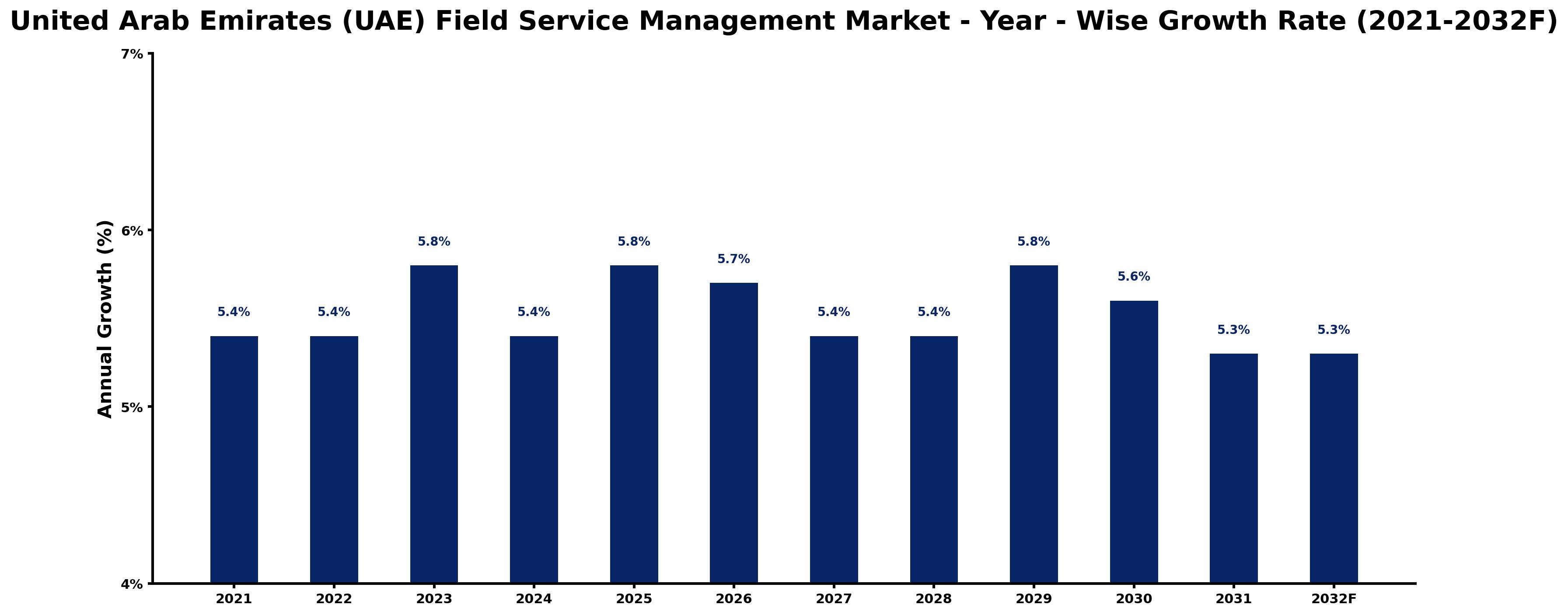
The table below presents the year‑wise growth rates along with the key drivers influencing the market
| Year | Growth Rate | Major Drivers |
| 2021 | 5.4% | Increasing industrial infrastructure investments |
| 2022 | 5.4% | Expansion of transportation and logistics networks |
| 2023 | 5.8% | Increasing industrial infrastructure investments |
| 2024 | 5.4% | Rapid growth in telecom and data center sectors |
| 2025 | 5.8% | Increasing adoption of advanced technologies |
| 2026 | 5.7% | Government infrastructure modernization initiatives |
| 2027 | 5.4% | Growing renewable energy integration projects |
| 2028 | 5.4% | Rapid growth in telecom and data center sectors |
| 2029 | 5.8% | Expansion of commercial construction activities |
| 2030 | 5.6% | Growing renewable energy integration projects |
| 2031 | 5.3% | Increasing adoption of advanced technologies |
| 2032 | 5.3% | Rapid growth in telecom and data center sectors |
Note - Market size estimations and growth projections presented in this report are based on 6Wresearch’s advanced forecasting approach, validated with industry datasets as of June 2026.
United Arab Emirates (UAE) Field Service Management Market Synopsis
In the UAE, field service management is gaining momentum as organizations strive to optimize their field operations to meet customer expectations. The integration of mobile applications for technician management allows for a streamlined workflow that ultimately leads to improved service delivery and customer satisfaction.
As companies in the UAE increasingly adopt technology-driven solutions, FSM systems are becoming essential for managing complex field tasks. The ability to provide first-time-fix resolutions and proactive maintenance has become a competitive differentiator, propelling the market's expansion.
United Arab Emirates (UAE) Field Service Management Market Key Takeaways
- The FSM market in the UAE is rapidly evolving due to the integration of advanced technologies and customer-centric service models.
- Real-time visibility into field operations is increasingly crucial for organizations aiming to enhance service efficiency.
- The demand for predictive maintenance and IoT capabilities is pushing FSM solutions to the forefront of operational strategies.
- Challenges remain in integrating FSM solutions with existing enterprise systems, particularly in urbanized areas.
- Organizations are leveraging mobile FSM applications to adapt to changes driven by recent global events, including the Covid-19 pandemic.
Evaluation of Restraints in United Arab Emirates (UAE) Field Service Management Market
Despite the robust growth prospects, the UAE field service management market faces notable limitations. One of the primary constraints is the complex integration process required for seamless connectivity between FSM solutions and existing enterprise systems. This can lead to delays in implementation and disrupt operations, particularly for companies already entrenched in traditional workflows. Furthermore, managing a mobile workforce in densely populated urban areas poses challenges related to technician routing and service delivery efficiency, limiting the full potential of FSM solutions.
United Arab Emirates (UAE) Field Service Management Market Trends
Emerging trends within the UAE field service management market include a growing preference for cloud-based FSM solutions, enabling scalability and flexibility. Companies are increasingly adopting mobile and remote-access tools, which facilitate real-time data exchange and improve technician communication. Additionally, there is a notable shift towards utilizing artificial intelligence and machine learning to analyze service trends and enhance decision-making processes.
United Arab Emirates (UAE) Field Service Management Market Opportunities
The UAE field service management market presents substantial growth and investment opportunities, particularly in the integration of IoT and AI technologies. Businesses that invest in predictive analytics and automation can significantly reduce operational costs and enhance service efficiency. Moreover, the trend towards smart cities offers FSM providers a unique platform to tailor solutions that meet the evolving needs of urban services and infrastructure maintenance.
Government Initiatives in the United Arab Emirates (UAE) Field Service Management Market
The UAE government has been actively promoting initiatives aimed at enhancing digital transformation across various sectors, including field services. Public spending on smart technologies and infrastructure development aligns with the national agenda of fostering innovation and improving service quality. Programs focused on digital governance and the promotion of smart city frameworks also encourage investment in FSM solutions, thereby driving market growth.
Future Insights of the United Arab Emirates (UAE) Field Service Management Market
Looking ahead to the period between 2026 and 2032, the UAE field service management market is poised for further expansion, fueled by advancements in technology and increasing consumer expectations. Companies will likely prioritize the integration of AI-driven analytics to enhance operational effectiveness and customer engagement. As urbanization intensifies, the demand for FSM solutions that offer real-time data and efficient resource management will become critical in achieving operational excellence.
United Arab Emirates (UAE) Field Service Management Market Latest Developments (May 2025 - June 2026)
Recent developments in the UAE field service management market indicate a strong shift towards mobile-first solutions and enhanced collaboration tools. As organizations adapt to evolving customer demands, the integration of real-time feedback mechanisms and advanced analytics is becoming commonplace. This adaptation has led to increased operational resilience, allowing businesses to respond more effectively to challenges and capitalize on opportunities.
United Arab Emirates (UAE) Field Service Management Market - Key Attractiveness of the Report
- 10 Years of Market Numbers
- Historical Data Starting from 2022 to 2025
- Base Year: 2025
- Forecast Data until 2032
- Key Performance Indicators Impacting the Market
- Major Upcoming Developments and Projects
Key Highlights of the Report:
- United Arab Emirates (UAE) Field Service Management Market Outlook
- Market Size of United Arab Emirates (UAE) Field Service Management Market, 2025
- Forecast of United Arab Emirates (UAE) Field Service Management Market, 2032
- Historical Data and Forecast of United Arab Emirates (UAE) Field Service Management Revenues & Volume for the Period 2022-2032F
- United Arab Emirates (UAE) Field Service Management Market Trend Evolution
- United Arab Emirates (UAE) Field Service Management Market Drivers and Challenges
- United Arab Emirates (UAE) Field Service Management Price Trends
- United Arab Emirates (UAE) Field Service Management Porter's Five Forces
- United Arab Emirates (UAE) Field Service Management Industry Life Cycle
- Historical Data and Forecast of United Arab Emirates (UAE) Field Service Management Market Revenues & Volume By Component for the Period 2022-2032F
- Historical Data and Forecast of United Arab Emirates (UAE) Field Service Management Market Revenues & Volume By Solutions for the Period 2022-2032F
- Historical Data and Forecast of United Arab Emirates (UAE) Field Service Management Market Revenues & Volume By Services for the Period 2022-2032F
- Historical Data and Forecast of United Arab Emirates (UAE) Field Service Management Market Revenues & Volume By Verticals for the Period 2022-2032F
- Historical Data and Forecast of United Arab Emirates (UAE) Field Service Management Market Revenues & Volume By Telecom for the Period 2022-2032F
- Historical Data and Forecast of United Arab Emirates (UAE) Field Service Management Market Revenues & Volume By Manufacturing & Construction for the Period 2022-2032F
- Historical Data and Forecast of United Arab Emirates (UAE) Field Service Management Market Revenues & Volume By Healthcare for the Period 2022-2032F
- Historical Data and Forecast of United Arab Emirates (UAE) Field Service Management Market Revenues & Volume By Energy & Utility for the Period 2022-2032F
- Historical Data and Forecast of United Arab Emirates (UAE) Field Service Management Market Revenues & Volume By Others for the Period 2022-2032F
- Historical Data and Forecast of United Arab Emirates (UAE) Field Service Management Market Revenues & Volume By Deployment Mode for the Period 2022-2032F
- Historical Data and Forecast of United Arab Emirates (UAE) Field Service Management Market Revenues & Volume By Cloud for the Period 2022-2032F
- Historical Data and Forecast of United Arab Emirates (UAE) Field Service Management Market Revenues & Volume By On-premise for the Period 2022-2032F
- United Arab Emirates (UAE) Field Service Management Import Export Trade Statistics
- Market Opportunity Assessment By Component
- Market Opportunity Assessment By Verticals
- Market Opportunity Assessment By Deployment Mode
- United Arab Emirates (UAE) Field Service Management Top Companies Market Share
- United Arab Emirates (UAE) Field Service Management Competitive Benchmarking By Technical and Operational Parameters
- United Arab Emirates (UAE) Field Service Management Company Profiles
- United Arab Emirates (UAE) Field Service Management Key Strategic Recommendations






































