United Arab Emirates (UAE) Fish Farming Market Size, Share & Growth Rate
The United Arab Emirates (UAE) Fish Farming Market was estimated at USD 168 Million in 2025 and is projected to reach USD 226 Million by 2032, growing at a CAGR of 4.3% from 2026 to 2032. This robust growth trajectory is propelled by the increasing domestic demand for fish as a protein source, alongside advancements in aquaculture technology aimed at sustainability. The UAE's strategic investments in modern farming techniques are playing a pivotal role in enhancing production capabilities to meet the nation's rising appetite for seafood.
United Arab Emirates (UAE) Fish Farming Market Year-wise Growth Rate and Key Drivers
This graph highlights how the United Arab Emirates (UAE) Fish Farming Market has steadily grown over the years, supported by major growth factors.
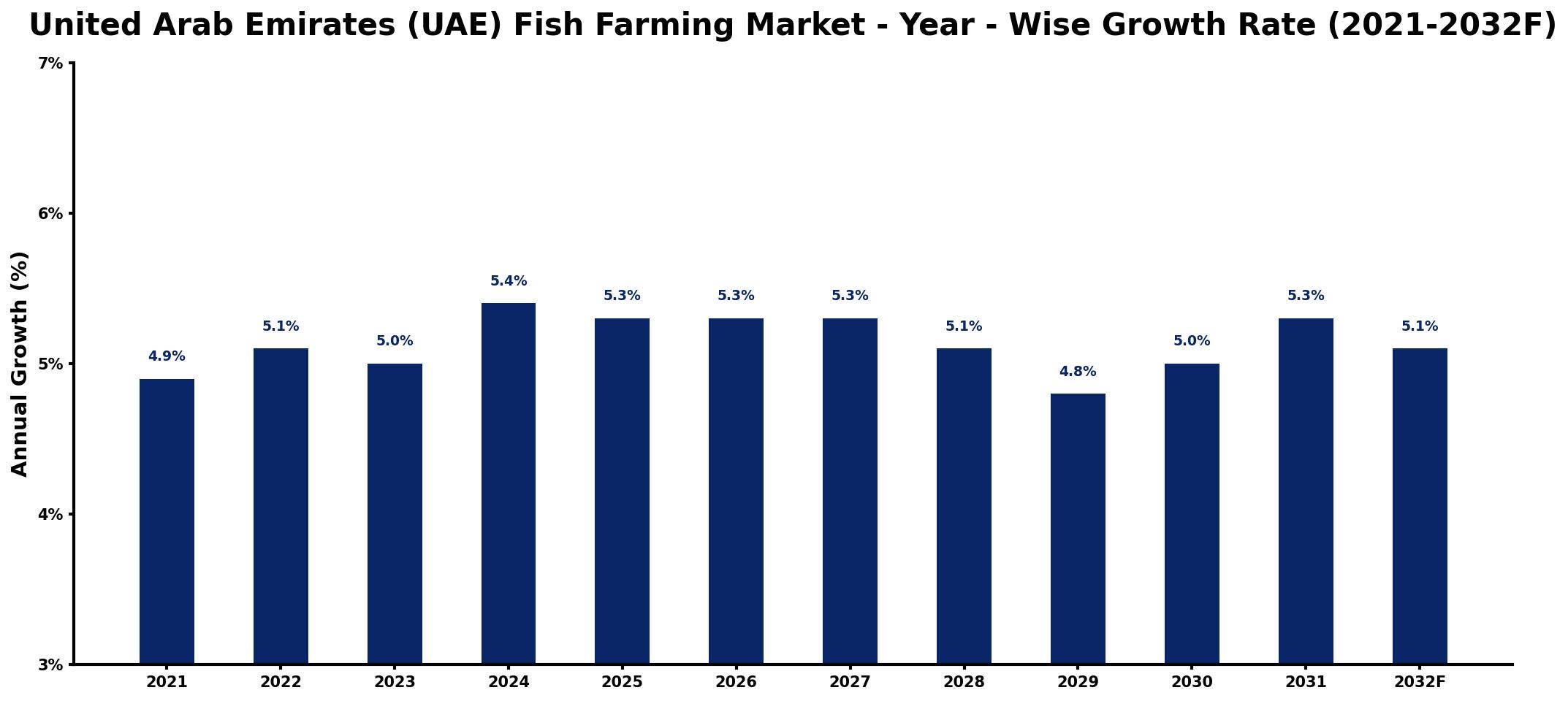
The table below presents the year‑wise growth rates along with the key drivers influencing the market
| Year | Growth Rate | Major Drivers |
| 2021 | 4.9% | Rising consumer health awareness |
| 2022 | 5.1% | Increased investment in aquaculture |
| 2023 | 5.0% | Growing demand for sustainable protein |
| 2024 | 5.4% | Expansion of local supply chains |
| 2025 | 5.3% | Technological advancements in aquaculture |
| 2026 | 5.3% | Government support for local production |
| 2027 | 5.3% | Increased export opportunities abroad |
| 2028 | 5.1% | Development of innovative feed solutions |
| 2029 | 4.8% | Growing interest in alternative proteins |
| 2030 | 5.0% | Strengthening of regulatory frameworks |
| 2031 | 5.3% | Emergence of new market players |
| 2032 | 5.1% | Enhanced consumer education initiatives |
Note: Market size estimations and growth projections presented in this report are based on 6Wresearch's proprietary forecasting methodology, utilizing the latest available industry data, government publications, and primary research inputs.
United Arab Emirates (UAE) Fish Farming Market Synopsis
The fish farming segment in the UAE represents a significant opportunity within the broader seafood industry, characterized by controlled cultivation methods that ensure a consistent and sustainable supply. With a burgeoning population and shifting dietary preferences, the demand for aquaculture products is higher than ever, encouraging investments in state-of-the-art farming practices.
This market is not only crucial for meeting local consumption needs but also plays a vital role in the UAE's strategic efforts to reduce dependency on fish imports. By leveraging cutting-edge technologies, fish farming operations can optimize yield while promoting environmental stewardship, thus aligning with the UAE's vision for sustainable development.
United Arab Emirates (UAE) Fish Farming Market Key Takeaways
- Significant growth expected with a projected market size of USD 226 Million by 2032.
- Rising domestic demand for seafood as a primary protein source is driving market expansion.
- Technological advancements are enhancing aquaculture efficiency and sustainability.
- Government initiatives are supporting the reduction of import dependency through local aquaculture development.
- Challenges related to water scarcity necessitate innovative resource management strategies.
Evaluation of Restraints in United Arab Emirates (UAE) Fish Farming Market
Despite the promising outlook, the UAE fish farming market is not without its constraints. One of the most pressing challenges is the region's water scarcity, which makes sustainable resource management imperative. Efforts to optimize water usage while maintaining fish health are critical. Additionally, the industry faces hurdles related to disease management in aquaculture settings, which can impact productivity. A comprehensive strategy that incorporates technology and best practices will be essential for overcoming these challenges and achieving long-term growth.
United Arab Emirates (UAE) Fish Farming Market Trends
The fish farming landscape in the UAE is shaped by several key trends. There is a noticeable shift towards adopting sustainable aquaculture practices, including recirculating aquaculture systems (RAS) that minimize water use and environmental impact. Furthermore, as consumers become more health-conscious, the demand for locally sourced, chemical-free seafood is on the rise. Innovations in breeding techniques and feed formulations are also enhancing growth rates and the overall health of farmed fish, underscoring the potential for profitability in the sector.
United Arab Emirates (UAE) Fish Farming Market Opportunities
The UAE fish farming market presents numerous opportunities for growth and investment. As the demand for fish continues to increase, there is a significant opportunity to scale production capabilities through state-of-the-art farming technology. Additionally, exploring niche markets such as organic and specialty fish species can attract health-conscious consumers. Collaborative ventures between private players and government entities to promote research and development in aquaculture technologies will further bolster the industry's sustainability and efficiency.
Government Initiatives in the United Arab Emirates (UAE) Fish Farming Market
The UAE government has implemented various initiatives aimed at promoting sustainable aquaculture and reducing reliance on fish imports. Programs focused on research and development encourage innovation in fish farming techniques while public spending supports infrastructure improvements within the industry. Additionally, incentives for environmentally friendly practices are increasingly being emphasized as part of the UAEs broader commitment to sustainability and food security.
Future Insights of the United Arab Emirates (UAE) Fish Farming Market
Looking ahead to the 2026-2032 period, the UAE fish farming market is poised for significant advancements driven by technology and sustainability initiatives. As consumer preferences increasingly favor locally produced seafood, aquaculture will likely play a pivotal role in fulfilling demand. Innovations in farming practices and breeding techniques are expected to become more prominent, enabling producers to enhance efficiency and product quality. Overall, the market is positioned for steady growth, supported by both consumer trends and strategic governmental policies.
United Arab Emirates (UAE) Fish Farming Market Latest Developments (2025 - 2026)
Recent developments in the UAE fish farming sector indicate a focused push towards sustainability and technology adoption. New partnerships are emerging among industry players and research institutions to explore advanced aquaculture technologies. Additionally, the market is witnessing a rise in consumer awareness and demand for sustainably sourced seafood, prompting farmers to enhance their practices to align with market expectations. The industry's adaptability to changes and emphasis on innovation are pivotal as it navigates evolving market dynamics.
United Arab Emirates (UAE) Fish Farming Market - Key Attractiveness of the Report
- 10 Years of Market Numbers
- Historical Data Starting from 2022 to 2025
- Base Year: 2025
- Forecast Data until 2032
- Key Performance Indicators Impacting the Market
- Major Upcoming Developments and Projects
Key Highlights of the Report:
- United Arab Emirates (UAE) Fish Farming Market Outlook
- Market Size of United Arab Emirates (UAE) Fish Farming Market, 2025
- Forecast of United Arab Emirates (UAE) Fish Farming Market, 2032
- Historical Data and Forecast of United Arab Emirates (UAE) Fish Farming Revenues & Volume for the Period 2022-2032F
- United Arab Emirates (UAE) Fish Farming Market Trend Evolution
- United Arab Emirates (UAE) Fish Farming Market Drivers and Challenges
- United Arab Emirates (UAE) Fish Farming Price Trends
- United Arab Emirates (UAE) Fish Farming Porter's Five Forces
- United Arab Emirates (UAE) Fish Farming Industry Life Cycle
- Historical Data and Forecast of United Arab Emirates (UAE) Fish Farming Market Revenues & Volume By Environment for the Period 2022-2032F
- Historical Data and Forecast of United Arab Emirates (UAE) Fish Farming Market Revenues & Volume By Marine Water for the Period 2022-2032F
- Historical Data and Forecast of United Arab Emirates (UAE) Fish Farming Market Revenues & Volume By Fresh Water for the Period 2022-2032F
- Historical Data and Forecast of United Arab Emirates (UAE) Fish Farming Market Revenues & Volume By Brackish Water for the Period 2022-2032F
- Historical Data and Forecast of United Arab Emirates (UAE) Fish Farming Market Revenues & Volume By Fish Type for the Period 2022-2032F
- Historical Data and Forecast of United Arab Emirates (UAE) Fish Farming Market Revenues & Volume By Pompano for the Period 2022-2032F
- Historical Data and Forecast of United Arab Emirates (UAE) Fish Farming Market Revenues & Volume By Snappers for the Period 2022-2032F
- Historical Data and Forecast of United Arab Emirates (UAE) Fish Farming Market Revenues & Volume By Groupers for the Period 2022-2032F
- Historical Data and Forecast of United Arab Emirates (UAE) Fish Farming Market Revenues & Volume By Salmon for the Period 2022-2032F
- Historical Data and Forecast of United Arab Emirates (UAE) Fish Farming Market Revenues & Volume By Milkfish for the Period 2022-2032F
- Historical Data and Forecast of United Arab Emirates (UAE) Fish Farming Market Revenues & Volume By Tuna for the Period 2022-2032F
- Historical Data and Forecast of United Arab Emirates (UAE) Fish Farming Market Revenues & Volume By Tilapia for the Period 2022-2032F
- Historical Data and Forecast of United Arab Emirates (UAE) Fish Farming Market Revenues & Volume By Others for the Period 2022-2032F
- United Arab Emirates (UAE) Fish Farming Import Export Trade Statistics
- Market Opportunity Assessment By Environment
- Market Opportunity Assessment By Fish Type
- United Arab Emirates (UAE) Fish Farming Top Companies Market Share
- United Arab Emirates (UAE) Fish Farming Competitive Benchmarking By Technical and Operational Parameters
- United Arab Emirates (UAE) Fish Farming Company Profiles
- United Arab Emirates (UAE) Fish Farming Key Strategic Recommendations






































