United Arab Emirates (UAE) Food products machinery Market Summary
The united arab emirates (uae) food products machinery market was estimated at USD 410 Million in 2025 and is projected to reach USD 566 Million by 2032, growing at a CAGR of 5.6% from 2026 to 2032.
United Arab Emirates (UAE) Food products machinery Market Year-wise Growth Rate and Key Drivers
This graph highlights how the United Arab Emirates (UAE) Food products machinery Market has steadily grown over the past five years, supported by major growth factors.
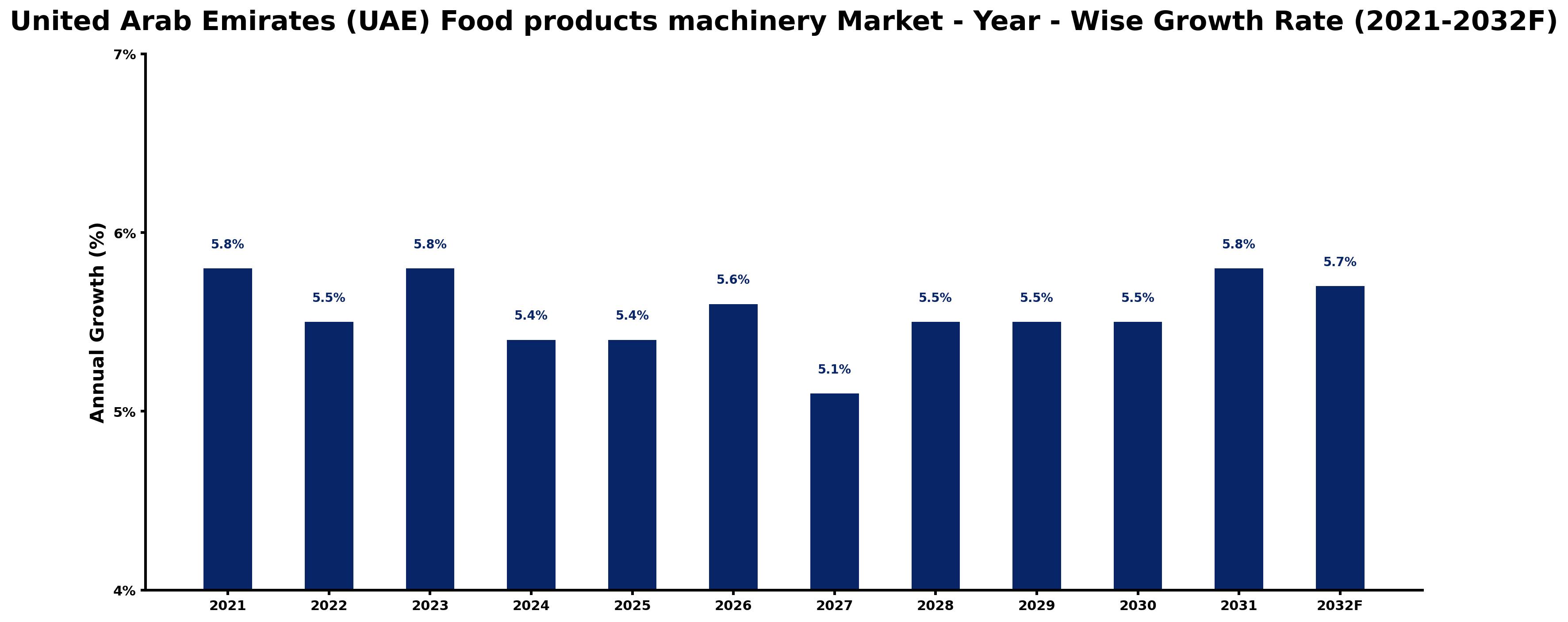
The table below presents the year wise growth rates along with the key drivers influencing the market
| Year | Growth Rate | Major Drivers |
| 2021 | 5.8% | COVID-19 has prompted food safety innovations in machinery across the UAE market. |
| 2022 | 5.5% | Emerging technologies support efficiency, streamlining production processes in food machinery. |
| 2023 | 5.8% | Local manufacturers focus on sustainability, integrating eco-friendly practices into operations. |
| 2024 | 5.4% | The Expo 2020 legacy fosters international collaborations within the food processing sector. |
| 2025 | 5.4% | Consumer trends indicate a shift towards healthier, organic food products and machinery. |
| 2026 | 5.6% | Technological integration enhances supply chain management, improving operational transparency significantly. |
| 2027 | 5.1% | Investment in logistics infrastructure boosts demand for advanced food machinery solutions. |
| 2028 | 5.5% | Food security initiatives lead to greater emphasis on local production technologies. |
| 2029 | 5.5% | Growing tourism influences diverse culinary needs, requiring specialized food production equipment. |
| 2030 | 5.5% | Regional trade agreements promote export opportunities for UAE food machinery manufacturers. |
| 2031 | 5.8% | Automation becomes critical as labor costs escalate, pushing machinery innovation further. |
| 2032 | 5.7% | Consumer preferences shift rapidly, necessitating adaptable machinery solutions for producers. |
Note - Market size estimations and growth projections presented in this report are based on 6Wresearch's advanced forecasting approach, validated with industry datasets as of June 2026.
United Arab Emirates (UAE) Food products machinery Market Synopsis
The United Arab Emirates (UAE) Food products machinery Market is projected to reach 5.6% and witness significant growth during the forecast period (2026-2032). This market segment is critical within the broader industrial framework of the UAE, encompassing a variety of machinery integral to both food processing and packaging sectors. The key machinery includes processing equipment, packaging machines, refrigeration systems, and automation solutions. Numerous factors are spurring growth, including a burgeoning population, rising demand for processed food, and advancements in technology within the sector.
United Arab Emirates (UAE) Food products machinery Market Growth Drivers
Several drivers are underpinning the expansion of the UAE food products machinery market. The first major factor is the continuous influx of expatriates, which has resulted in significant population growth. This demographic change is spurring an increased appetite for food products, particularly processed and packaged foods. The hospitality industry is also flourishing, driven by the UAE's status as a prime tourist destination, thus amplifying the demand for food products machinery to cater to various consumer preferences.
- Population growth is significantly enhancing the need for food processing machinery, as more individuals consume a wider variety of food types.
- Economic prosperity has increased disposable incomes, leading to a preference for convenience foods, which in turn drives the machinery market.
- The push for modernization within production facilities has led to the adoption of advanced automation solutions, streamlining operations and enhancing productivity.
- Technological advancements, particularly in food safety and hygiene, are creating opportunities for new machinery types that meet evolving consumer standards.
- The UAE's strategic location as a logistics hub facilitates the import and export of packaged food products, further driving demand for related machinery.
United Arab Emirates (UAE) Food products machinery Market Challenges and Restraints
Despite the promising growth trajectory, the UAE food products machinery market faces several challenges that could impede its development. A notable concern is the acute water scarcity affecting the agricultural sector, which is vital for food production and processing. This scarcity limits the availability of raw materials and can increase operational risks for processing businesses. Additionally, the UAE relies heavily on food imports due to limited arable land and an unfavorable climate, which can lead to rising operational costs.
- The reliance on food imports makes the market susceptible to global supply chain disruptions, affecting businesses' ability to maintain consistent operations.
- Water scarcity not only impacts agriculture but also restricts investment in more extensive food processing facilities that require significant water resources.
- The cost of advanced machinery can be a barrier for smaller players looking to modernize their operations amidst rising global competition.
- Changing consumer preferences towards healthier options are pressuring traditional food processors to innovate rapidly, which can be a challenge for less adaptable companies.
- This dynamic market environment necessitates continual investment in research and development to keep up with technological advancements and consumer trends.
United Arab Emirates (UAE) Food products machinery Market Government Investment and Initiatives
The UAE government plays a significant role in fostering the growth of the food products machinery market through various initiatives and policies aimed at enhancing food security and industrial capabilities. Notably, the UAE Vision 2021 and the National Food Security Strategy are key frameworks guiding public investments towards sustainable food production practices. These initiatives focus on promoting technological advancements in agriculture and food processing sectors, aiming to reduce dependency on food imports.
- Investment in research and innovation in food processing technologies is a priority, encouraging collaborations between public and private sectors.
- The government provides grants and funding support for companies seeking to develop or adopt new machinery that aligns with food safety regulations.
- Infrastructure development projects in the logistics sector, including cold chain investments, support the distribution of food products and related machinery.
- Regulatory frameworks are being streamlined to facilitate more accessible market entry for advanced food processing technologies.
- Initiatives aimed at enhancing food waste management encourage the development of machinery focused on recycling and sustainable practices.
United Arab Emirates (UAE) Food products machinery Market Latest Developments (May 2025 - June 2026)
Recent developments in the UAE food products machinery market from May 2025 to June 2026 indicate a robust shift towards automation and digital solutions. The focus has been on enhancing food safety standards and improving processing efficiency across the sector. Additionally, trade exhibitions and industry conferences have highlighted innovative machinery designed to meet growing consumer demands for healthier and sustainably produced food products. The emphasis on supply chain resilience has prompted many companies to invest in new technologies that streamline operations and reduce waste.
United Arab Emirates (UAE) Food products machinery Market - Key Attractiveness of the Report
- 10 Years of Market Numbers
- Historical Data Starting from 2022 to 2025
- Base Year: 2025
- Forecast Data until 2032
- Key Performance Indicators Impacting the Market
- Major Upcoming Developments and Projects
Key Highlights of the Report:
- United Arab Emirates (UAE) Food products machinery Market Outlook
- Market Size of United Arab Emirates (UAE) Food products machinery Market, 2025
- Forecast of United Arab Emirates (UAE) Food products machinery Market, 2032
- Historical Data and Forecast of United Arab Emirates (UAE) Food products machinery Revenues & Volume for the Period 2022-2032F
- United Arab Emirates (UAE) Food products machinery Market Trend Evolution
- United Arab Emirates (UAE) Food products machinery Market Drivers and Challenges
- United Arab Emirates (UAE) Food products machinery Price Trends
- United Arab Emirates (UAE) Food products machinery Porter's Five Forces
- United Arab Emirates (UAE) Food products machinery Industry Life Cycle
- Historical Data and Forecast of United Arab Emirates (UAE) Food products machinery Market Revenues & Volume By Type for the Period 2022-2032F
- Historical Data and Forecast of United Arab Emirates (UAE) Food products machinery Market Revenues & Volume By Dairy Product Plant Machinery and Equipment for the Period 2022-2032F
- Historical Data and Forecast of United Arab Emirates (UAE) Food products machinery Market Revenues & Volume By Bakery Machinery and Equipment for the Period 2022-2032F
- Historical Data and Forecast of United Arab Emirates (UAE) Food products machinery Market Revenues & Volume By Meat and Poultry Processing And Preparation Machinery for the Period 2022-2032F
- Historical Data and Forecast of United Arab Emirates (UAE) Food products machinery Market Revenues & Volume By Other Commercial Food Products Machinery for the Period 2022-2032F
- Historical Data and Forecast of United Arab Emirates (UAE) Food products machinery Market Revenues & Volume By Applications for the Period 2022-2032F
- Historical Data and Forecast of United Arab Emirates (UAE) Food products machinery Market Revenues & Volume By Bakery & Confectionery for the Period 2022-2032F
- Historical Data and Forecast of United Arab Emirates (UAE) Food products machinery Market Revenues & Volume By Meat, Poultry, and Seafood for the Period 2022-2032F
- Historical Data and Forecast of United Arab Emirates (UAE) Food products machinery Market Revenues & Volume By Dairy for the Period 2022-2032F
- Historical Data and Forecast of United Arab Emirates (UAE) Food products machinery Market Revenues & Volume By Beverages for the Period 2022-2032F
- Historical Data and Forecast of United Arab Emirates (UAE) Food products machinery Market Revenues & Volume By Others for the Period 2022-2032F
- United Arab Emirates (UAE) Food products machinery Import Export Trade Statistics
- Market Opportunity Assessment By Type
- Market Opportunity Assessment By Applications
- United Arab Emirates (UAE) Food products machinery Top Companies Market Share
- United Arab Emirates (UAE) Food products machinery Competitive Benchmarking By Technical and Operational Parameters
- United Arab Emirates (UAE) Food products machinery Company Profiles
- United Arab Emirates (UAE) Food products machinery Key Strategic Recommendations






































