United Arab Emirates (UAE) Food Retail Market Summary
The united arab emirates (uae) food retail market was estimated at USD 951 Million in 2025 and is projected to reach USD 1703 Million by 2032, growing at a CAGR of 10.0% from 2026 to 2032.
United Arab Emirates (UAE) Food Retail Market Year-wise Growth Rate and Key Drivers
This graph highlights how the United Arab Emirates (UAE) Food Retail Market has steadily grown over the past five years, supported by major growth factors.
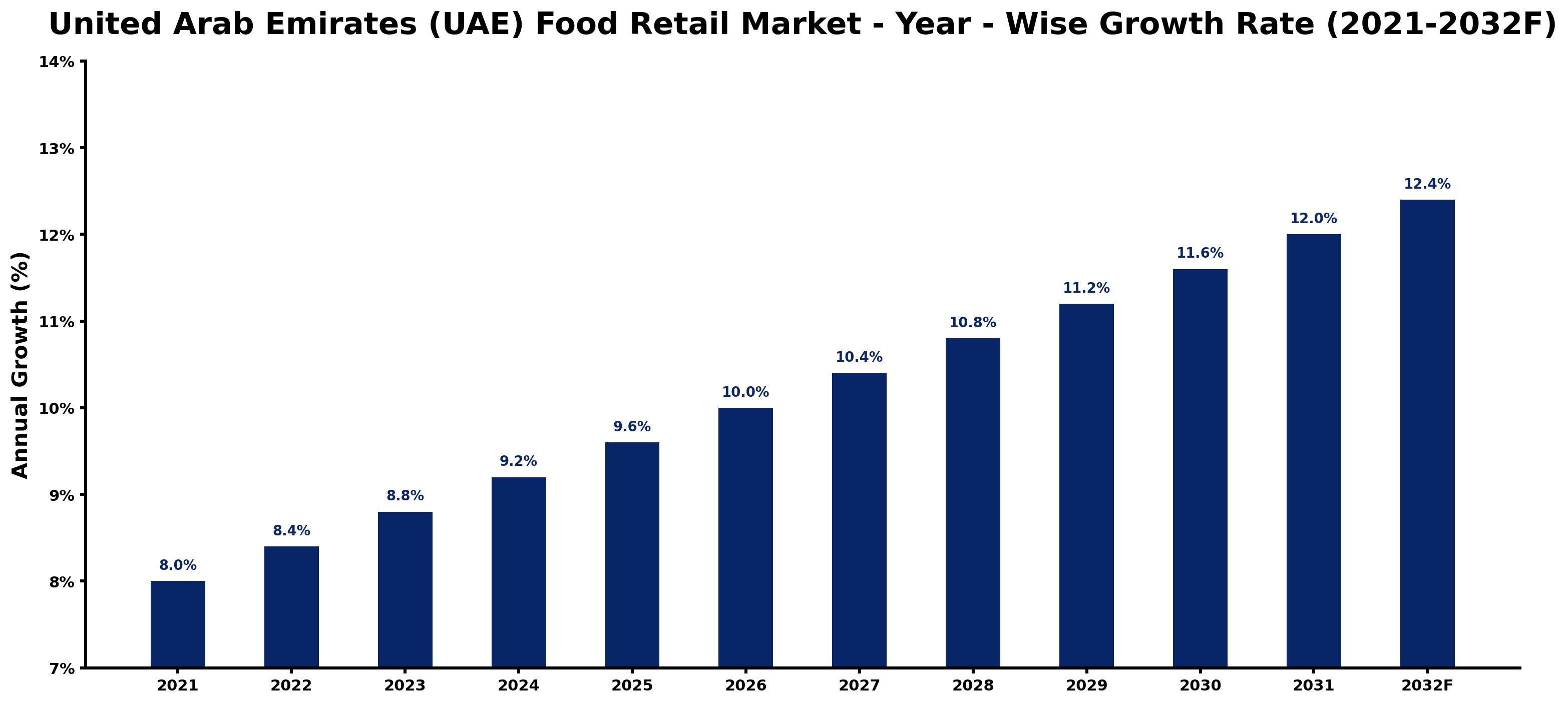
The table below presents the year wise growth rates along with the key drivers influencing the market
| Year | Growth Rate | Major Drivers |
| 2021 | 8.0% | Post-lockdown retail projects fostered significant changes in consumer purchasing behavior across the UAE. |
| 2022 | 8.4% | E-commerce integration in food retail expanded rapidly, reshaping traditional market dynamics nationwide. |
| 2023 | 8.8% | Increased focus on health and wellness prompted supermarkets to prioritize organic product ranges. |
| 2024 | 9.2% | Rising disposable incomes encouraged consumers to explore premium food offerings more frequently. |
| 2025 | 9.6% | Technological innovations, including AI, enhanced inventory management for retailers across the region. |
| 2026 | 10.0% | Local sourcing initiatives gained traction, boosting support for regional agricultural producers and suppliers. |
| 2027 | 10.4% | Changes in expatriate demographics influenced diverse culinary preferences within the food retail sector. |
| 2028 | 10.8% | Expansion of hypermarkets in suburban areas provided consumers with greater accessibility to food options. |
| 2029 | 11.2% | Environmental consciousness prompted retailers to adopt sustainable practices, attracting eco-friendly consumers. |
| 2030 | 11.6% | Corporate social responsibility initiatives became pivotal, aligning businesses with consumer values and expectations. |
| 2031 | 12.0% | Urbanization trends in UAE cities led to increased demand for convenient and quick meal solutions. |
| 2032 | 12.4% | Innovative delivery models, including drone technology, transformed last-mile logistics in food distribution. |
Note - Market size estimations and growth projections presented in this report are based on 6Wresearch's advanced forecasting approach, validated with industry datasets as of June 2026.
United Arab Emirates (UAE) Food Retail Market Synopsis
The United Arab Emirates (UAE) Food Retail Market is projected to reach 10.0% and witness significant growth during the forecast period (2026-2032). This market has undergone considerable transformation, influenced by various socio-economic factors, including a growing population, increased disposable income, and urbanization. The market consists of diverse segments such as supermarkets, hypermarkets, convenience stores, and online grocery retail channels, catering to the needs of a multicultural population. With an increasing demand for both traditional local cuisines and international food products, the UAE food retail sector is poised for dynamic expansion.
United Arab Emirates (UAE) Food Retail Market Growth Drivers
Several key drivers underpin the growth of the UAE food retail market. Firstly, the rapid urbanization in the UAE has led to an influx of residents into cities, which, in turn, has heightened the demand for various food and beverage options. Secondly, the country's robust economy has translated into rising disposable incomes for consumers, encouraging greater spending on both everyday and premium food products. Thirdly, the UAE's appeal as a global tourist destination, attracting millions annually, further fuels demand, especially in urban hotspots and hospitality sectors. Additionally, the evolving consumer preferences have led to a notable shift towards online grocery shopping, emphasizing convenience and accessibility.
United Arab Emirates (UAE) Food Retail Market Challenges and Restraints
Despite its growth potential, the UAE food retail market faces notable challenges. A significant aspect is the country's heavy reliance on food imports, which exposes the market to global supply chain disruptions and price volatility. Such a dependency can impact the availability and affordability of certain food items, creating barriers for consumers and retailers alike. Moreover, the competition within the food retail sector is intensifying, as both local and international brands strive to capture market share. Regulatory hurdles and compliance with health and safety standards also pose obstacles for new entrants and existing players, necessitating ongoing investment in operational capabilities.
United Arab Emirates (UAE) Food Retail Market Covid-19 Impact
The Covid-19 pandemic has markedly influenced the dynamics of the UAE food retail market. Initially, the crisis triggered panic buying, which resulted in a temporary surge in demand for essential food products, thereby straining supply chains. However, as the pandemic progressed, consumer behavior shifted significantly, with an increased focus on at-home consumption due to the closure of restaurants and social distancing measures. This shift has encouraged a greater reliance on online grocery shopping and delivery services, fostering innovation and adaptation within the food retail sector. The pandemic has ultimately paved the way for redefining customer engagement and reshaping the retail landscape.
United Arab Emirates (UAE) Food Retail Market Government Investment and Initiatives
The UAE government has actively promoted initiatives to bolster the food retail market, recognizing its strategic importance to the economy. Policies aimed at enhancing food security and sustainability have been introduced, such as investments in local agriculture and food production. Furthermore, public spending on infrastructure development, including logistics and distribution networks, has improved supply chain efficiency and accessibility. The government encourages innovation within the food retail sector through various incentives, fostering a competitive environment that supports technological advancements and modernization of retail operations. Such initiatives are expected to drive supply chain resilience and market growth in the coming years.
United Arab Emirates (UAE) Food Retail Market Latest Developments (May 2025 - June 2026)
Recent developments within the UAE food retail market highlight a trend towards digital transformation and consumer-centric innovations. Throughout this period, numerous retailers have ramped up their online platforms, enhancing user experience and expanding delivery options to meet changing consumer preferences. Additionally, there has been a notable increase in collaborations between technology firms and food retailers aimed at implementing smart technology solutions for inventory management and customer engagement. Sustainability initiatives have also gained traction as more retailers adopt eco-friendly packaging and promote locally sourced products. These developments are indicative of a market that is adapting to both consumer demands and global trends, positioning itself for future growth.
United Arab Emirates (UAE) Food Retail Market - Key Attractiveness of the Report
- 10 Years of Market Numbers
- Historical Data Starting from 2022 to 2025
- Base Year: 2025
- Forecast Data until 2032
- Key Performance Indicators Impacting the Market
- Major Upcoming Developments and Projects
Key Highlights of the Report:
- United Arab Emirates (UAE) Food Retail Market Outlook
- Market Size of United Arab Emirates (UAE) Food Retail Market, 2025
- Forecast of United Arab Emirates (UAE) Food Retail Market, 2032
- Historical Data and Forecast of United Arab Emirates (UAE) Food Retail Revenues & Volume for the Period 2022-2032F
- United Arab Emirates (UAE) Food Retail Market Trend Evolution
- United Arab Emirates (UAE) Food Retail Market Drivers and Challenges
- United Arab Emirates (UAE) Food Retail Price Trends
- United Arab Emirates (UAE) Food Retail Porter's Five Forces
- United Arab Emirates (UAE) Food Retail Industry Life Cycle
- Historical Data and Forecast of United Arab Emirates (UAE) Food Retail Market Revenues & Volume By Product Types for the Period 2022-2032F
- Historical Data and Forecast of United Arab Emirates (UAE) Food Retail Market Revenues & Volume By Unpackaged Food for the Period 2022-2032F
- Historical Data and Forecast of United Arab Emirates (UAE) Food Retail Market Revenues & Volume By Packaged Food for the Period 2022-2032F
- Historical Data and Forecast of United Arab Emirates (UAE) Food Retail Market Revenues & Volume By Drinks for the Period 2022-2032F
- Historical Data and Forecast of United Arab Emirates (UAE) Food Retail Market Revenues & Volume By Household Products for the Period 2022-2032F
- Historical Data and Forecast of United Arab Emirates (UAE) Food Retail Market Revenues & Volume By Packaging Types for the Period 2022-2032F
- Historical Data and Forecast of United Arab Emirates (UAE) Food Retail Market Revenues & Volume By Boxes for the Period 2022-2032F
- Historical Data and Forecast of United Arab Emirates (UAE) Food Retail Market Revenues & Volume By Cans for the Period 2022-2032F
- Historical Data and Forecast of United Arab Emirates (UAE) Food Retail Market Revenues & Volume By Cellophane Wrapping for the Period 2022-2032F
- Historical Data and Forecast of United Arab Emirates (UAE) Food Retail Market Revenues & Volume By Cylindrical Cardboard for the Period 2022-2032F
- United Arab Emirates (UAE) Food Retail Import Export Trade Statistics
- Market Opportunity Assessment By Product Types
- Market Opportunity Assessment By Packaging Types
- United Arab Emirates (UAE) Food Retail Top Companies Market Share
- United Arab Emirates (UAE) Food Retail Competitive Benchmarking By Technical and Operational Parameters
- United Arab Emirates (UAE) Food Retail Company Profiles
- United Arab Emirates (UAE) Food Retail Key Strategic Recommendations






































