United Arab Emirates (UAE) Frozen Fish Market Size, Share & Growth Rate
The United Arab Emirates (UAE) Frozen Fish Market was estimated at USD 401 Million in 2025 and is projected to reach USD 535 Million by 2032, growing at a CAGR of 4.2% from 2026 to 2032. This growth trajectory is fueled by the rising demand for convenience foods amid busy lifestyles, as consumers increasingly seek longer shelf-life products. Additionally, the diverse range of frozen fish varieties available from global suppliers continues to attract a broad consumer base, thereby reinforcing the market's expansion.
United Arab Emirates (UAE) Frozen Fish Market Year-wise Growth Rate and Key Drivers
This graph highlights how the United Arab Emirates (UAE) Frozen Fish Market has steadily grown over the years, supported by major growth factors.
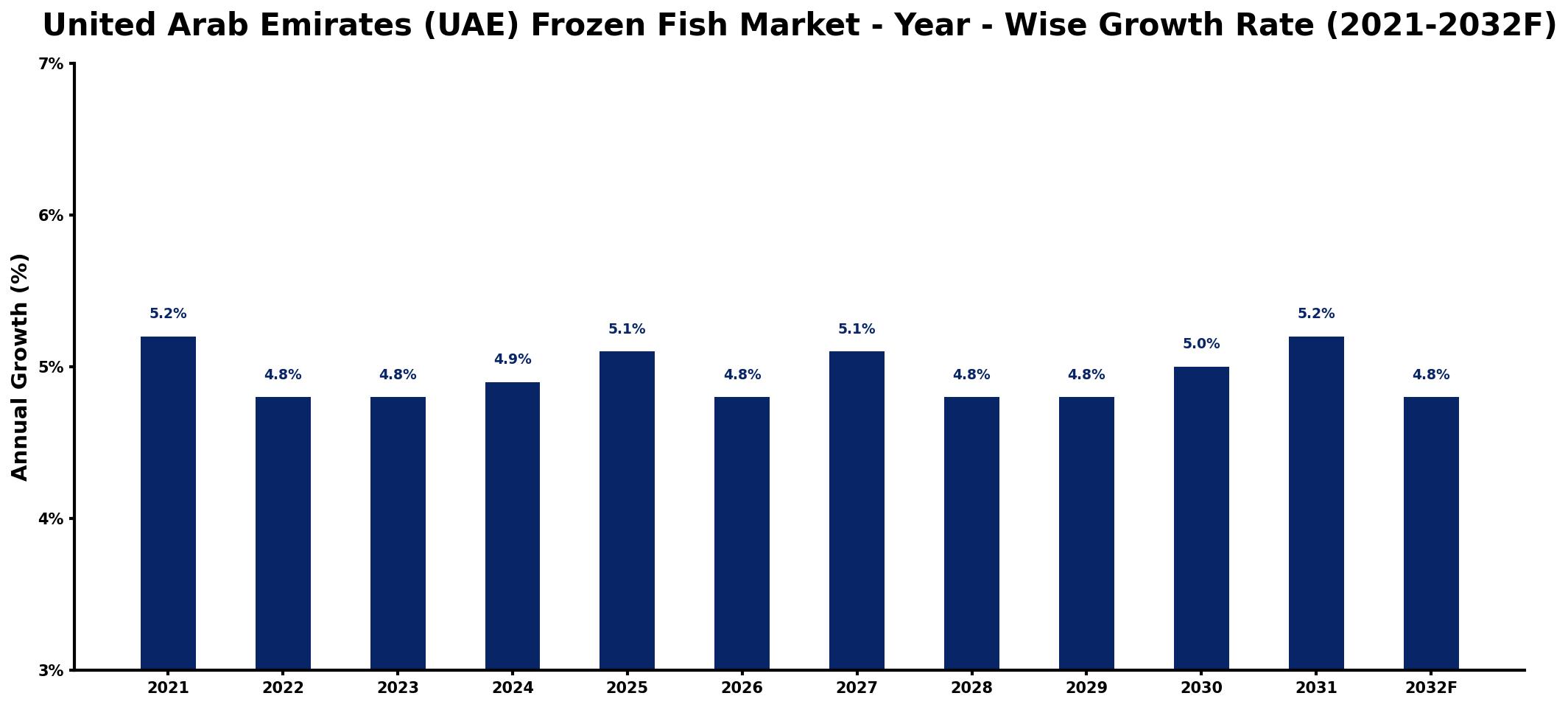
The table below presents the year‑wise growth rates along with the key drivers influencing the market
| Year | Growth Rate | Major Drivers |
| 2021 | 5.2% | Rising seafood consumption trends |
| 2022 | 4.8% | Increased health consciousness among consumers |
| 2023 | 4.8% | Growth in online food delivery |
| 2024 | 4.9% | Expansion of retail distribution channels |
| 2025 | 5.1% | Innovations in cold chain logistics |
| 2026 | 4.8% | Rising popularity of ready meals |
| 2027 | 5.1% | Increase in restaurant dining options |
| 2028 | 4.8% | Strengthening of export markets |
| 2029 | 4.8% | Growing demand for convenience foods |
| 2030 | 5.0% | rising demand from electronics |
| 2031 | 5.2% | Increased investments in aquaculture |
| 2032 | 4.8% | Rise in culinary tourism experiences |
Note: Market size estimations and growth projections presented in this report are based on 6Wresearch's proprietary forecasting methodology, utilizing the latest available industry data, government publications, and primary research inputs.
United Arab Emirates (UAE) Frozen Fish Market Synopsis
The UAE's frozen fish market is a vital segment of the larger seafood industry, catering to a growing consumer preference for easy meal solutions that maintain nutritional value. This market offers a myriad of options, ranging from popular species like salmon and tuna to local varieties, ensuring consumers can easily incorporate fish into their diets.
Recent trends indicate an increased reliance on frozen fish due to its versatility, longer shelf life, and convenience in meal preparation. The market's appeal is further enhanced by the availability of established logistics systems that ensure quality and freshness, vital in the UAE's hot climate.
United Arab Emirates (UAE) Frozen Fish Market Key Takeaways
- Consumer demand for frozen fish is driven by the need for convenience and longer shelf life.
- The market is experiencing robust growth with a projected CAGR of 4.2% from 2026 to 2032.
- Diverse species available in the frozen segment cater to a wide range of consumer tastes and preferences.
- Quality control during storage and transportation is critical due to the UAE's high temperatures.
- E-commerce and home delivery services have gained traction, especially post-pandemic.
Evaluation of Restraints in United Arab Emirates (UAE) Frozen Fish Market
Despite the growth potential, the UAE frozen fish market faces significant challenges that can restrain its development. A primary concern is the maintenance of quality and freshness during transportation and storage, particularly given the extreme temperatures prevalent in the region. Any breakdown in the cold chain can lead to spoilage, affecting product availability and consumer trust. Moreover, fluctuating import regulations and environmental concerns regarding fishing practices may pose additional hurdles, necessitating ongoing adaptation by market players.
United Arab Emirates (UAE) Frozen Fish Market Trends
Several trends are currently shaping the UAE frozen fish market. Firstly, the demand for sustainable seafood options is gaining momentum, with consumers increasingly interested in sourcing ethically produced fish. Secondly, the integration of advanced preservation technologies is improving product quality, thereby attracting health-conscious consumers. Lastly, the rise of plant-based alternatives is starting to influence consumer choices, though traditional frozen fish remains a staple for many households.
United Arab Emirates (UAE) Frozen Fish Market Opportunities
The UAE frozen fish market presents several opportunities for growth and investment. Expanding e-commerce platforms and home delivery services can capitalize on changing consumer shopping behaviors. Additionally, investing in quality assurance technologies can enhance product offerings, attracting a more discerning clientele. Another avenue for growth lies in the potential partnerships with local restaurants and food services that seek reliable frozen fish supplies to meet their menu demands.
Government Initiatives in the United Arab Emirates (UAE) Frozen Fish Market
The UAE government has been proactive in promoting the seafood industry through various initiatives aimed at enhancing sustainability and supply chain efficiency. Investments in cold storage facilities and transportation infrastructure are being made to support the frozen fish market. Furthermore, regulatory frameworks are being developed to ensure the quality and safety of seafood products, which will benefit both consumers and suppliers in the long run.
Future Insights of the United Arab Emirates (UAE) Frozen Fish Market
Looking ahead to 2026-2032, the UAE frozen fish market is poised for continued growth, driven by evolving consumer preferences and increased emphasis on health and convenience. Enhanced distribution networks and technological advancements in food preservation will likely improve product availability and quality. As awareness of sustainable practices grows, the market may see a shift towards responsibly sourced fish, aligning with global trends while maintaining local culinary traditions.
United Arab Emirates (UAE) Frozen Fish Market Latest Developments (2025 - 2026)
In recent months, the UAE frozen fish market has witnessed shifts towards enhanced digitalization, with several suppliers adopting online sales platforms to reach consumers effectively. Moreover, collaborations between local fishermen and retailers have strengthened the supply chain, ensuring fresher products are available for consumers. The focus on sustainability has also increased, with initiatives aimed at promoting responsibly sourced fish gaining momentum in the marketplace.
United Arab Emirates (UAE) Frozen Fish Market - Key Attractiveness of the Report
- 10 Years of Market Numbers
- Historical Data Starting from 2022 to 2025
- Base Year: 2025
- Forecast Data until 2032
- Key Performance Indicators Impacting the Market
- Major Upcoming Developments and Projects
Key Highlights of the Report:
- United Arab Emirates (UAE) Frozen Fish Market Outlook
- Market Size of United Arab Emirates (UAE) Frozen Fish Market, 2025
- Forecast of United Arab Emirates (UAE) Frozen Fish Market, 2032
- Historical Data and Forecast of United Arab Emirates (UAE) Frozen Fish Revenues & Volume for the Period 2022-2032F
- United Arab Emirates (UAE) Frozen Fish Market Trend Evolution
- United Arab Emirates (UAE) Frozen Fish Market Drivers and Challenges
- United Arab Emirates (UAE) Frozen Fish Price Trends
- United Arab Emirates (UAE) Frozen Fish Porter's Five Forces
- United Arab Emirates (UAE) Frozen Fish Industry Life Cycle
- Historical Data and Forecast of United Arab Emirates (UAE) Frozen Fish Market Revenues & Volume By Type for the Period 2022-2032F
- Historical Data and Forecast of United Arab Emirates (UAE) Frozen Fish Market Revenues & Volume By Fish Fingers for the Period 2022-2032F
- Historical Data and Forecast of United Arab Emirates (UAE) Frozen Fish Market Revenues & Volume By Fish Cakes for the Period 2022-2032F
- Historical Data and Forecast of United Arab Emirates (UAE) Frozen Fish Market Revenues & Volume By Breaded/Battered Fish for the Period 2022-2032F
- Historical Data and Forecast of United Arab Emirates (UAE) Frozen Fish Market Revenues & Volume By Whole Fish & Drawn Fish for the Period 2022-2032F
- Historical Data and Forecast of United Arab Emirates (UAE) Frozen Fish Market Revenues & Volume By Single Fillet & Butterfly Fillet for the Period 2022-2032F
- Historical Data and Forecast of United Arab Emirates (UAE) Frozen Fish Market Revenues & Volume By Dressed Fish for the Period 2022-2032F
- Historical Data and Forecast of United Arab Emirates (UAE) Frozen Fish Market Revenues & Volume By Steaks Fish for the Period 2022-2032F
- Historical Data and Forecast of United Arab Emirates (UAE) Fish Fingers Frozen Fish Market Revenues & Volume By Others for the Period 2022-2032F
- Historical Data and Forecast of United Arab Emirates (UAE) Frozen Fish Market Revenues & Volume By Application for the Period 2022-2032F
- Historical Data and Forecast of United Arab Emirates (UAE) Frozen Fish Market Revenues & Volume By Direct Consumption for the Period 2022-2032F
- Historical Data and Forecast of United Arab Emirates (UAE) Frozen Fish Market Revenues & Volume By Restaurants for the Period 2022-2032F
- Historical Data and Forecast of United Arab Emirates (UAE) Frozen Fish Market Revenues & Volume By Food Processing Factories for the Period 2022-2032F
- Historical Data and Forecast of United Arab Emirates (UAE) Frozen Fish Market Revenues & Volume By Others for the Period 2022-2032F
- Historical Data and Forecast of United Arab Emirates (UAE) Frozen Fish Market Revenues & Volume By Distribution Channel for the Period 2022-2032F
- Historical Data and Forecast of United Arab Emirates (UAE) Frozen Fish Market Revenues & Volume By Supermarkets & Hypermarkets for the Period 2022-2032F
- Historical Data and Forecast of United Arab Emirates (UAE) Frozen Fish Market Revenues & Volume By Convenience Stores for the Period 2022-2032F
- Historical Data and Forecast of United Arab Emirates (UAE) Frozen Fish Market Revenues & Volume By Speciality Retailers for the Period 2022-2032F
- Historical Data and Forecast of United Arab Emirates (UAE) Frozen Fish Market Revenues & Volume By Online for the Period 2022-2032F
- Historical Data and Forecast of United Arab Emirates (UAE) Frozen Fish Market Revenues & Volume By Others for the Period 2022-2032F
- United Arab Emirates (UAE) Frozen Fish Import Export Trade Statistics
- Market Opportunity Assessment By Type
- Market Opportunity Assessment By Application
- Market Opportunity Assessment By Distribution Channel
- United Arab Emirates (UAE) Frozen Fish Top Companies Market Share
- United Arab Emirates (UAE) Frozen Fish Competitive Benchmarking By Technical and Operational Parameters
- United Arab Emirates (UAE) Frozen Fish Company Profiles
- United Arab Emirates (UAE) Frozen Fish Key Strategic Recommendations






































