United Arab Emirates (UAE) Full Grain Leather Market Size, Share & Growth Rate
The United Arab Emirates (UAE) Full Grain Leather Market was estimated at USD 1255 Million in 2025 and is projected to reach USD 2151 Million by 2032, growing at a CAGR of 8.0% from 2026 to 2032. This robust growth is primarily driven by the increasing consumer inclination towards luxury and high-quality leather goods, particularly in fashion and furniture. The region's affluence, coupled with a rising demand for bespoke leather products, is shaping an optimistic outlook for the market.
United Arab Emirates (UAE) Full Grain Leather Market Year-wise Growth Rate and Key Drivers
This graph highlights how the United Arab Emirates (UAE) Full Grain Leather Market has steadily grown over the years, supported by major growth factors.
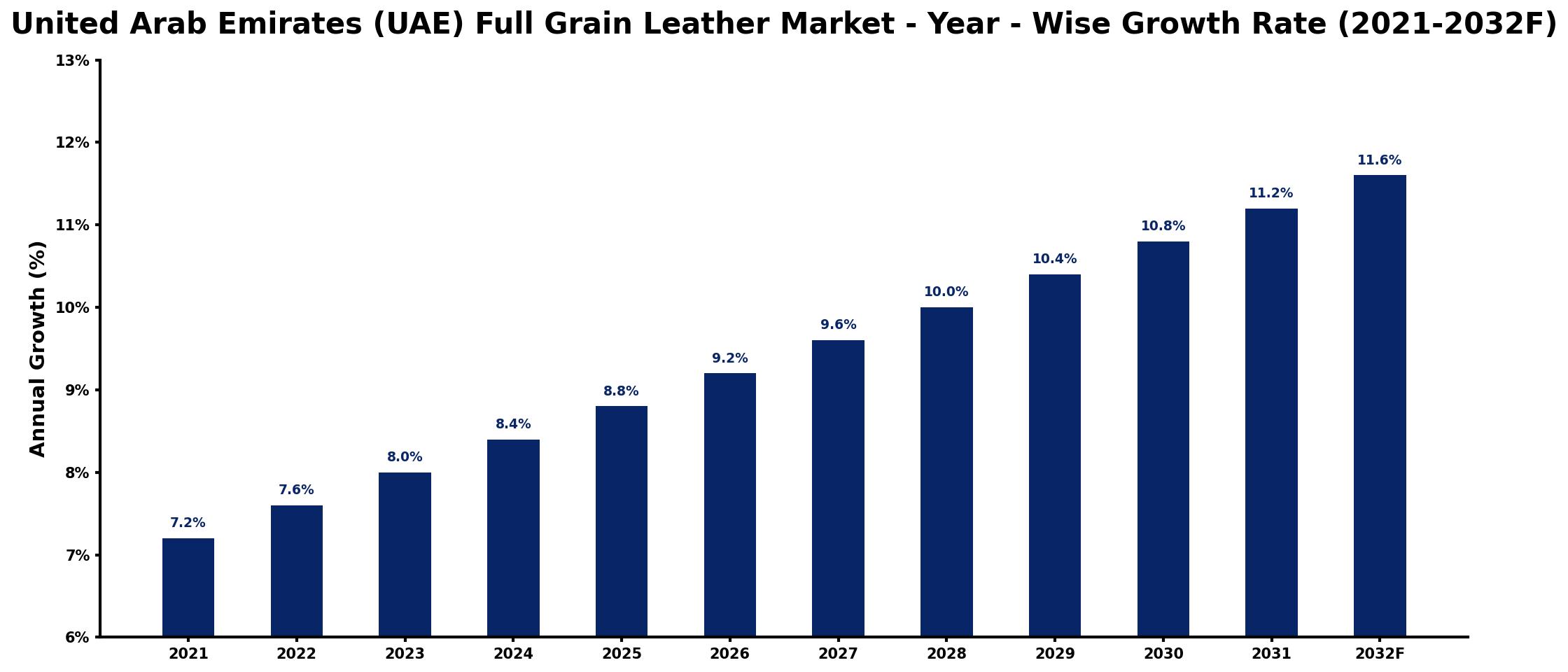
The table below presents the year‑wise growth rates along with the key drivers influencing the market
| Year | Growth Rate | Major Drivers |
| 2021 | 7.2% | Rising demand for luxury goods |
| 2022 | 7.6% | Increased consumer spending habits |
| 2023 | 8.0% | Expansion of retail distribution channels |
| 2024 | 8.4% | Growth in fashion industry trends |
| 2025 | 8.8% | Surge in online shopping platforms |
| 2026 | 9.2% | Investment in sustainable materials production |
| 2027 | 9.6% | Growing popularity of premium accessories |
| 2028 | 10.0% | Increase in regional trade partnerships |
| 2029 | 10.4% | Emergence of high-end artisan brands |
| 2030 | 10.8% | Development of innovative design techniques |
| 2031 | 11.2% | Strengthening global supply chains |
| 2032 | 11.6% | Rising interest in eco-friendly products |
Note: Market size estimations and growth projections presented in this report are based on 6Wresearch's proprietary forecasting methodology, utilizing the latest available industry data, government publications, and primary research inputs.
United Arab Emirates (UAE) Full Grain Leather Market Synopsis
The UAE full grain leather market thrives on the demand for premium products that exemplify durability and an artisanal touch. Full grain leather, revered for its natural texture and resilience, is increasingly sought after for luxury items, from bespoke furniture to fashionable accessories.
As the region continues to establish itself as a hub for luxury consumption, the full grain leather market benefits from the deep-rooted appreciation for craftsmanship among consumers. This is particularly evident in urban centers like Dubai and Abu Dhabi, where the demand for high-end leather goods is substantial and growing.
United Arab Emirates (UAE) Full Grain Leather Market Key Takeaways
- The market is expanding significantly, underpinned by an affluent consumer base that values luxury and quality.
- Full grain leather's reputation for durability and natural aesthetics continues to drive its popularity across various sectors.
- Brand differentiation and innovative design are critical for success in a competitive market landscape.
- Consumer demand for sustainable practices is shaping the market dynamics, urging companies to innovate.
- Key players in the market are known for their commitment to quality and craftsmanship, elevating the standards of luxury goods.
Evaluation of Restraints in United Arab Emirates (UAE) Full Grain Leather Market
Despite the market's promising trajectory, several restraints hinder its full potential. A significant challenge is the shifting consumer preferences towards eco-friendly and sustainable products. As customers become increasingly aware of environmental issues, there is pressure on manufacturers to adopt sustainable sourcing and production methods without compromising quality. Balancing these demands while maintaining affordability presents a formidable barrier for many companies operating in this space.
United Arab Emirates (UAE) Full Grain Leather Market Trends
A notable trend shaping the UAE full grain leather market is the growing emphasis on customization. Consumers are increasingly seeking personalized leather goods, which has prompted manufacturers to offer bespoke options that cater to individual tastes. Additionally, advancements in technology are facilitating new designs and manufacturing techniques, making high-quality leather goods more accessible.
Moreover, the trend towards sustainable practices is gaining momentum, leading many companies to explore eco-friendly leather alternatives. This shift not only aligns with global trends but also resonates well with the environmentally-conscious consumer segment in the UAE.
United Arab Emirates (UAE) Full Grain Leather Market Opportunities
Opportunities abound in the UAE full grain leather market as the demand for luxury items continues to rise. The increasing tourism sector presents a unique chance for brands to attract international consumers seeking high-end products. Additionally, leveraging e-commerce platforms can expand market reach and accessibility, particularly among younger consumers who prefer online shopping. Investment in innovative sustainable practices could also open new avenues for growth and appeal to the eco-conscious demographic.
Government Initiatives in the United Arab Emirates (UAE) Full Grain Leather Market
The UAE government has been proactive in fostering the luxury and craftsmanship sectors, encouraging investments in high-quality manufacturing processes. Initiatives aimed at supporting local artisans and promoting the 'Made in UAE' brand further bolster the full grain leather market. Various programs focusing on sustainability and innovation are also being implemented to ensure that the industry meets both local and international standards.
Future Insights of the United Arab Emirates (UAE) Full Grain Leather Market
Looking ahead to the 2026-2032 period, the UAE full grain leather market is poised for substantial growth. The anticipated rise in disposable incomes and an expanding luxury sector will likely enhance consumer spending on high-end leather goods. As brands increasingly adopt sustainable practices, they will be well-positioned to capture a larger market share. Overall, the combination of evolving consumer preferences, technological advancements, and supportive government initiatives bodes well for the future of this vibrant market.
United Arab Emirates (UAE) Full Grain Leather Market Latest Developments (2025 - 2026)
In the recent months, the UAE full grain leather market has witnessed a surge in collaborative efforts among local artisans and luxury brands to enhance product offerings. Many companies are focusing on integrating sustainable practices into their production processes. This shift not only meets consumer demand for eco-friendly products but also elevates the overall quality of leather goods available in the market. Additionally, several exhibitions and trade shows have emerged, focusing on promoting local craftsmanship and innovation in leather design.
United Arab Emirates (UAE) Full Grain Leather Market - Key Attractiveness of the Report
- 10 Years of Market Numbers
- Historical Data Starting from 2022 to 2025
- Base Year: 2025
- Forecast Data until 2032
- Key Performance Indicators Impacting the Market
- Major Upcoming Developments and Projects
Key Highlights of the Report:
- United Arab Emirates (UAE) Full Grain Leather Market Outlook
- Market Size of United Arab Emirates (UAE) Full Grain Leather Market, 2025
- Forecast of United Arab Emirates (UAE) Full Grain Leather Market, 2032
- Historical Data and Forecast of United Arab Emirates (UAE) Full Grain Leather Revenues & Volume for the Period 2022-2032F
- United Arab Emirates (UAE) Full Grain Leather Market Trend Evolution
- United Arab Emirates (UAE) Full Grain Leather Market Drivers and Challenges
- United Arab Emirates (UAE) Full Grain Leather Price Trends
- United Arab Emirates (UAE) Full Grain Leather Porter's Five Forces
- United Arab Emirates (UAE) Full Grain Leather Industry Life Cycle
- Historical Data and Forecast of United Arab Emirates (UAE) Full Grain Leather Market Revenues & Volume By Type for the Period 2022-2032F
- Historical Data and Forecast of United Arab Emirates (UAE) Full Grain Leather Market Revenues & Volume By Coated for the Period 2022-2032F
- Historical Data and Forecast of United Arab Emirates (UAE) Full Grain Leather Market Revenues & Volume By Non-Coated for the Period 2022-2032F
- Historical Data and Forecast of United Arab Emirates (UAE) Full Grain Leather Market Revenues & Volume By Application for the Period 2022-2032F
- Historical Data and Forecast of United Arab Emirates (UAE) Full Grain Leather Market Revenues & Volume By Automobile for the Period 2022-2032F
- Historical Data and Forecast of United Arab Emirates (UAE) Full Grain Leather Market Revenues & Volume By Consumer Goods for the Period 2022-2032F
- Historical Data and Forecast of United Arab Emirates (UAE) Full Grain Leather Market Revenues & Volume By Furniture for the Period 2022-2032F
- United Arab Emirates (UAE) Full Grain Leather Import Export Trade Statistics
- Market Opportunity Assessment By Type
- Market Opportunity Assessment By Application
- United Arab Emirates (UAE) Full Grain Leather Top Companies Market Share
- United Arab Emirates (UAE) Full Grain Leather Competitive Benchmarking By Technical and Operational Parameters
- United Arab Emirates (UAE) Full Grain Leather Company Profiles
- United Arab Emirates (UAE) Full Grain Leather Key Strategic Recommendations






































