United Arab Emirates (UAE) Glass Tiles Market Size, Share & Growth Rate
The United Arab Emirates (UAE) Glass Tiles Market was estimated at USD 159 Million in 2025 and is projected to reach USD 223 Million by 2032, growing at a CAGR of 5.0% from 2026 to 2032. This growth trajectory can be attributed to the rising demand for luxurious and modern design aesthetics, particularly in urban areas where contemporary architecture flourishes. The increasing adoption of glass tiles in both residential and commercial projects is reshaping interiors, further driving market expansion.
United Arab Emirates (UAE) Glass Tiles Market Year-wise Growth Rate and Key Drivers
This graph highlights how the United Arab Emirates (UAE) Glass Tiles Market has steadily grown over the years, supported by major growth factors.
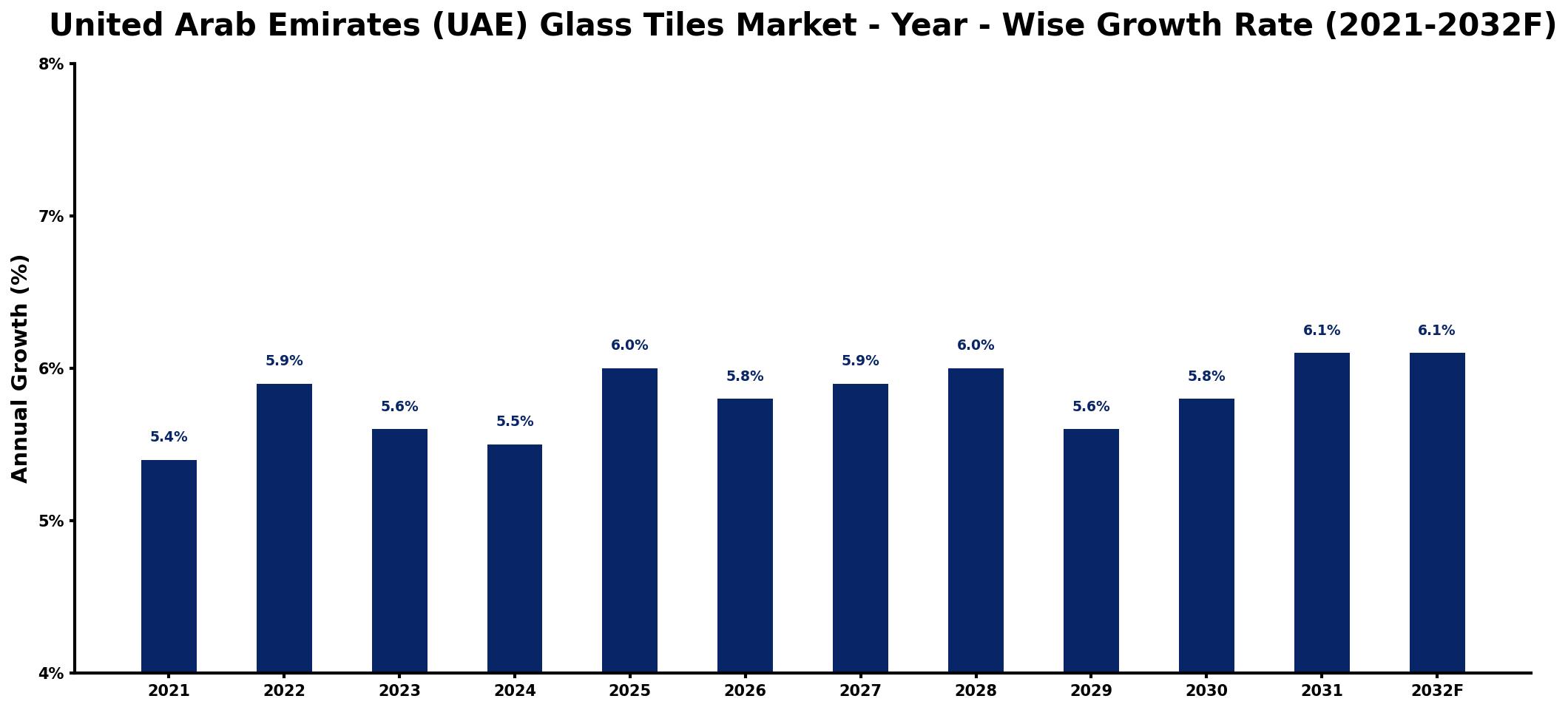
The table below presents the year‑wise growth rates along with the key drivers influencing the market
| Year | Growth Rate | Major Drivers |
| 2021 | 5.4% | Rising construction sector investments |
| 2022 | 5.9% | Increasing residential renovation projects |
| 2023 | 5.6% | Growing demand for sustainable materials |
| 2024 | 5.5% | Expansion of luxury interior designs |
| 2025 | 6.0% | Surge in hospitality industry growth |
| 2026 | 5.8% | Advancements in manufacturing technologies |
| 2027 | 5.9% | Increased focus on aesthetic appeal |
| 2028 | 6.0% | Rising popularity of DIY projects |
| 2029 | 5.6% | Growth in urban development initiatives |
| 2030 | 5.8% | Enhanced marketing strategies effectiveness |
| 2031 | 6.1% | Booming tourism and leisure sector |
| 2032 | 6.1% | Strengthened export market opportunities |
Note: Market size estimations and growth projections presented in this report are based on 6Wresearch's proprietary forecasting methodology, utilizing the latest available industry data, government publications, and primary research inputs.
United Arab Emirates (UAE) Glass Tiles Market Synopsis
The UAE Glass Tiles market is gaining momentum as consumers increasingly favor design solutions that offer both beauty and functionality. With their inherent versatility, glass tiles have found applications in various settings, from lavish hotels to cozy homes, transforming spaces with their reflective surfaces and vibrant colors.
In recent years, the market has benefitted from innovations in manufacturing processes, which have widened the array of design options available. These advancements, coupled with the growing trend towards eco-friendly materials, are further enhancing the appeal of glass tiles in the UAE.
United Arab Emirates (UAE) Glass Tiles Market Key Takeaways
- The market is seeing a consistent rise in demand, largely driven by modern aesthetic preferences.
- Glass tiles are favored for their durability and easy maintenance, making them suitable for a variety of environments.
- Innovations in production methods are expanding design choices, catering to evolving consumer tastes.
- Competition with traditional tile materials presents challenges, but also drives innovation and market adaptation.
- Economic factors influencing the construction sector can directly impact glass tile demand.
Evaluation of Restraints in United Arab Emirates (UAE) Glass Tiles Market
Despite its promising growth, the UAE Glass Tiles market faces certain restraints that could hinder its potential. The dependency on the construction and interior design sectors exposes the market to fluctuations in economic stability, particularly during downturns. Additionally, while glass tiles are sought after for their aesthetic qualities, the perception of ceramic and porcelain tiles as more cost-effective alternatives poses significant competition. Other concerns include installation complexities and the ongoing need for design innovation to meet changing consumer preferences, along with growing environmental considerations surrounding production practices.
United Arab Emirates (UAE) Glass Tiles Market Trends
Current trends indicate a shift towards sustainable and eco-friendly materials in interior design, significantly impacting the demand for glass tiles. Consumers are increasingly gravitating towards products that reflect environmental consciousness, alongside the traditional allure of glass's aesthetic appeal. Furthermore, the rise of smart homes is driving interest in technologically advanced glass tiles that can offer unique functionalities, such as temperature regulation and energy efficiency.
United Arab Emirates (UAE) Glass Tiles Market Opportunities
The UAE Glass Tiles market presents genuine opportunities for growth, particularly in tapping into the luxury residential segment. The burgeoning tourism industry also opens doors for glass tile applications in hotels and resorts, enhancing guest experiences through sophisticated interior designs. Furthermore, leveraging e-commerce platforms for sales could expand market reach, catering to a younger demographic seeking unique home decor solutions. Innovations in production aimed at lowering environmental impact could also position key players favorably in an increasingly eco-conscious market.
Government Initiatives in the United Arab Emirates (UAE) Glass Tiles Market
The UAE government has initiated several programs that indirectly support the Glass Tiles market through policies focused on sustainable construction and renovation projects. Public spending on infrastructure and urban development is aimed at modernizing the landscape and improving aesthetics, which includes the use of glass tiles. Additionally, there is a strong emphasis on enhancing the construction sector's compliance with environmental regulations, encouraging the use of eco-friendly materials.
Future Insights of the United Arab Emirates (UAE) Glass Tiles Market
Looking ahead to the years 2026-2032, the UAE Glass Tiles market is expected to continue its upward trajectory, buoyed by ongoing advancements in manufacturing and design. The growing urban population and rising disposable incomes will likely amplify the demand for stylish home and commercial interiors. As the market adapts to evolving consumer needs, the integration of technology into product offerings will likely play a pivotal role, helping to differentiate glass tiles amidst competitive pressures from alternative materials.
United Arab Emirates (UAE) Glass Tiles Market Latest Developments (2025 - 2026)
Recent developments within the UAE Glass Tiles market reflect a dynamic response to shifting consumer trends. Innovative product launches highlighting advanced design features and sustainability have been noted, while collaborations between manufacturers and designers are becoming more prevalent. These initiatives aim to enhance aesthetic value while meeting the rising consumer demand for environmentally responsible products. As the market gradually recovers from the impacts of the pandemic, heightened activity in both residential and commercial construction is anticipated.
United Arab Emirates (UAE) Glass Tiles Market - Key Attractiveness of the Report
- 10 Years of Market Numbers
- Historical Data Starting from 2022 to 2025
- Base Year: 2025
- Forecast Data until 2032
- Key Performance Indicators Impacting the Market
- Major Upcoming Developments and Projects
Key Highlights of the Report:
- United Arab Emirates (UAE) Glass Tiles Market Outlook
- Market Size of United Arab Emirates (UAE) Glass Tiles Market, 2025
- Forecast of United Arab Emirates (UAE) Glass Tiles Market, 2032
- Historical Data and Forecast of United Arab Emirates (UAE) Glass Tiles Revenues & Volume for the Period 2022-2032F
- United Arab Emirates (UAE) Glass Tiles Market Trend Evolution
- United Arab Emirates (UAE) Glass Tiles Market Drivers and Challenges
- United Arab Emirates (UAE) Glass Tiles Price Trends
- United Arab Emirates (UAE) Glass Tiles Porter's Five Forces
- United Arab Emirates (UAE) Glass Tiles Industry Life Cycle
- Historical Data and Forecast of United Arab Emirates (UAE) Glass Tiles Market Revenues & Volume By Manufacturing Process for the Period 2022-2032F
- Historical Data and Forecast of United Arab Emirates (UAE) Glass Tiles Market Revenues & Volume By Smalti Tiles for the Period 2022-2032F
- Historical Data and Forecast of United Arab Emirates (UAE) Glass Tiles Market Revenues & Volume By Fused Tiles for the Period 2022-2032F
- Historical Data and Forecast of United Arab Emirates (UAE) Glass Tiles Market Revenues & Volume By Sintered Tiles for the Period 2022-2032F
- Historical Data and Forecast of United Arab Emirates (UAE) Glass Tiles Market Revenues & Volume By Cast Tiles for the Period 2022-2032F
- Historical Data and Forecast of United Arab Emirates (UAE) Glass Tiles Market Revenues & Volume By Other for the Period 2022-2032F
- Historical Data and Forecast of United Arab Emirates (UAE) Glass Tiles Market Revenues & Volume By Product Type for the Period 2022-2032F
- Historical Data and Forecast of United Arab Emirates (UAE) Glass Tiles Market Revenues & Volume By Matte-finished Glass Tile for the Period 2022-2032F
- Historical Data and Forecast of United Arab Emirates (UAE) Glass Tiles Market Revenues & Volume By Smooth Glass Tile for the Period 2022-2032F
- Historical Data and Forecast of United Arab Emirates (UAE) Glass Tiles Market Revenues & Volume By End-User Industry for the Period 2022-2032F
- Historical Data and Forecast of United Arab Emirates (UAE) Glass Tiles Market Revenues & Volume By Residential for the Period 2022-2032F
- Historical Data and Forecast of United Arab Emirates (UAE) Glass Tiles Market Revenues & Volume By Commercial for the Period 2022-2032F
- Historical Data and Forecast of United Arab Emirates (UAE) Glass Tiles Market Revenues & Volume By Infrastructure for the Period 2022-2032F
- United Arab Emirates (UAE) Glass Tiles Import Export Trade Statistics
- Market Opportunity Assessment By Manufacturing Process
- Market Opportunity Assessment By Product Type
- Market Opportunity Assessment By End-User Industry
- United Arab Emirates (UAE) Glass Tiles Top Companies Market Share
- United Arab Emirates (UAE) Glass Tiles Competitive Benchmarking By Technical and Operational Parameters
- United Arab Emirates (UAE) Glass Tiles Company Profiles
- United Arab Emirates (UAE) Glass Tiles Key Strategic Recommendations






































