United Arab Emirates (UAE) Government Cloud Market Size & Growth Rate (2026-2032)
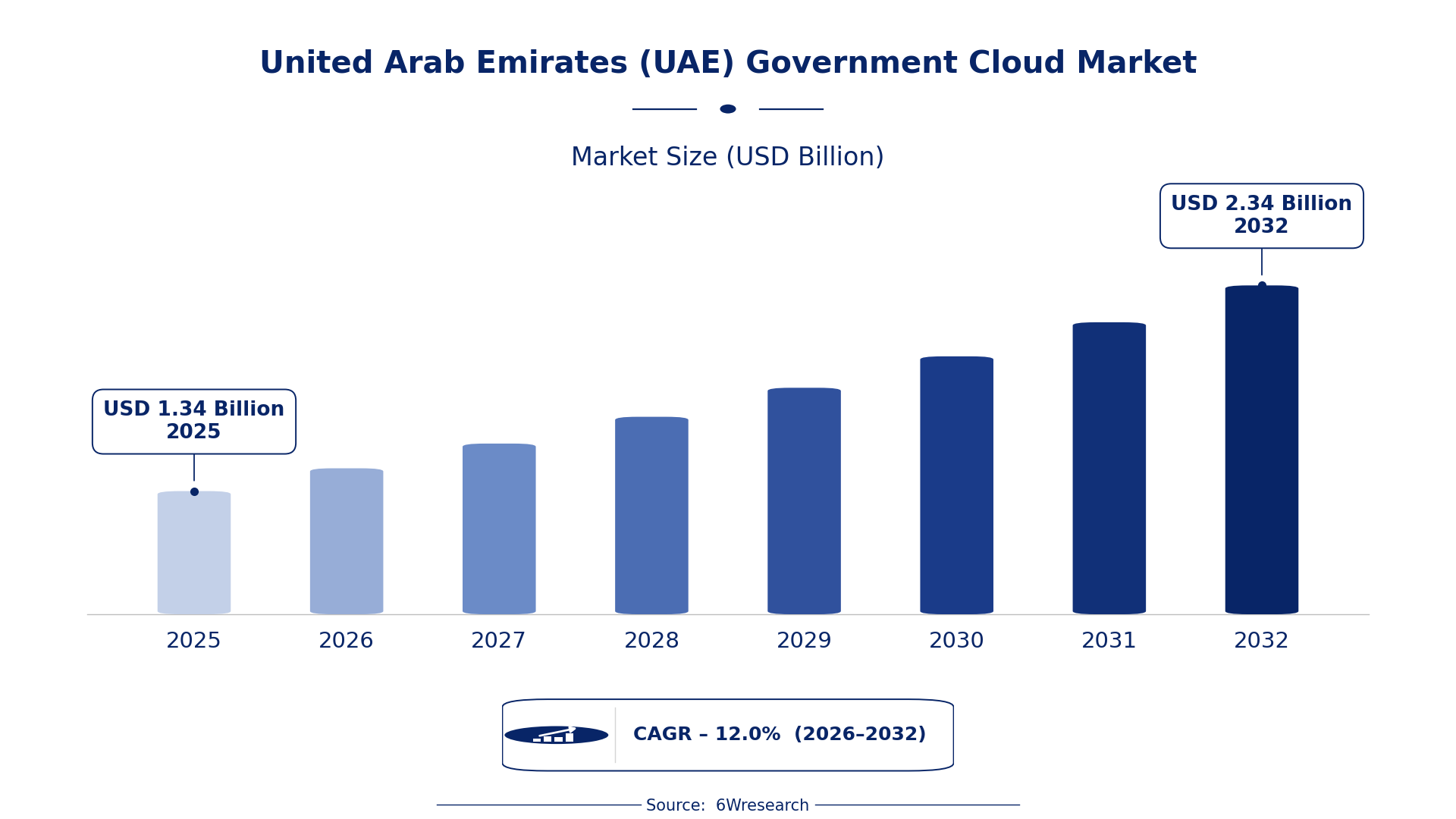
The United Arab Emirates (UAE) Government Cloud Market was estimated at USD 1337 Million in 2025 and is projected to reach USD 2342 Million by 2032, growing at a CAGR of 12.0% from 2026 to 2032.
United Arab Emirates (UAE) Government Cloud Market Synopsis
The demand for government cloud services in the UAE is driven by a strong governmental push towards digital transformation. Cloud technologies are becoming essential for enhancing the efficiency of public service delivery, allowing government agencies to securely manage and store vast amounts of data.
As the UAE pursues its vision of becoming a smart nation, government entities are increasingly adopting cloud solutions. This shift not only supports operational efficiency but also facilitates improved citizen engagement through accessible online services.
United Arab Emirates (UAE) Government Cloud Market Year-wise Growth Rate and Key Drivers
This graph illustrates the annual growth rates of the United Arab Emirates (UAE) Government Cloud Market from 2021 to 2032, highlighting a steady upward trajectory and projected expansion over the forecast period.
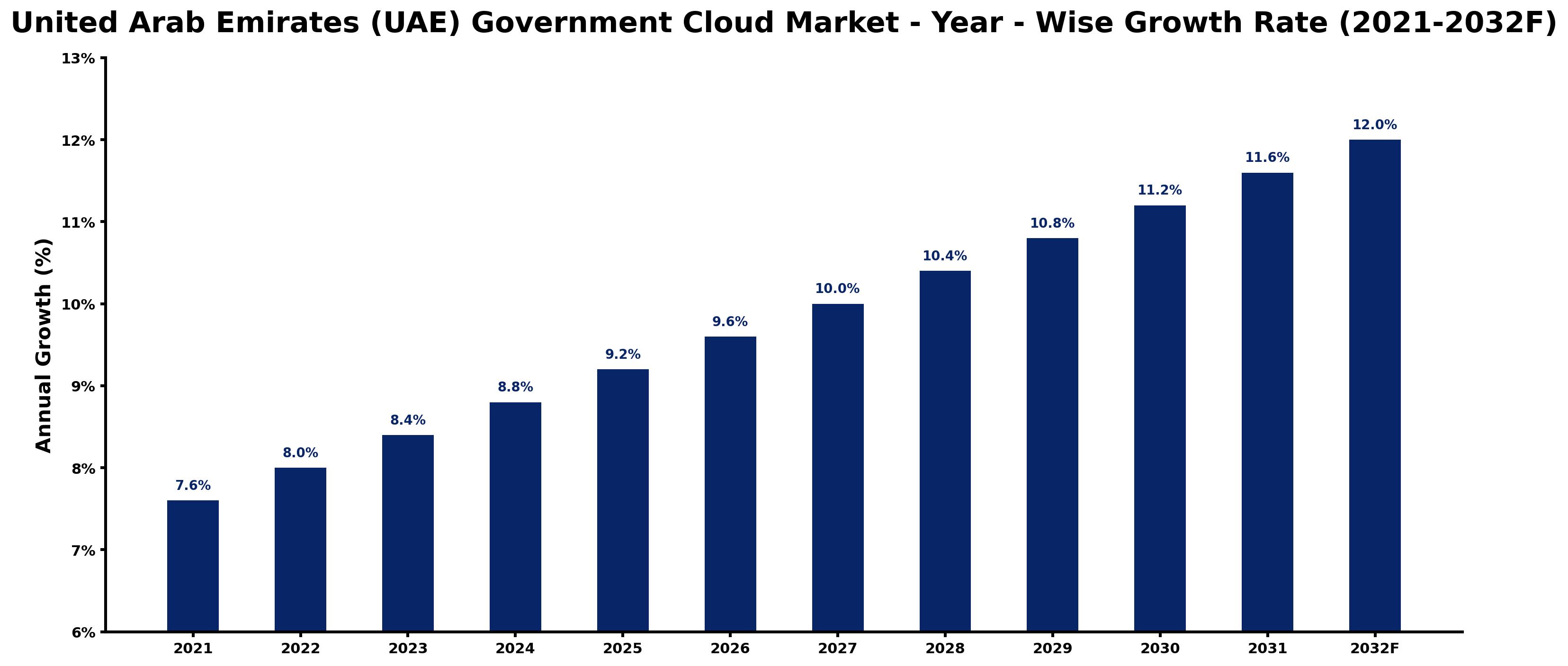
The table below presents the year‑wise growth rates along with the key drivers influencing the market
| Year | Growth Rate | Major Drivers |
| 2021 | 7.6% | UAE's Smart Government strategy boosts cloud adoption. |
| 2022 | 8.0% | Data Protection Law enhances public sector cybersecurity measures. |
| 2023 | 8.4% | Increased investment in digital public services by UAE government. |
| 2024 | 8.8% | Emirates Digital Economy Strategy supports cloud innovation. |
| 2025 | 9.2% | UAE AI strategy drives integration with cloud technologies. |
| 2026 | 9.6% | Government cloud security standards facilitate wider usage. |
| 2027 | 10.0% | National digital transformation initiatives support cloud growth. |
| 2028 | 10.4% | UAE's focus on smart city solutions promotes cloud services. |
| 2029 | 10.8% | Enhanced cross-agency collaboration fosters cloud service demands. |
| 2030 | 11.2% | Investment in 5G technology stimulates cloud-based applications. |
| 2031 | 11.6% | Public sector migration to cloud enhances operational efficiency. |
| 2032 | 12.0% | Commitment to green energy drives eco-friendly cloud solutions. |
Note: Market size estimations and growth projections presented in this report are based on 6Wresearch's proprietary forecasting methodology, utilizing the latest available industry data, government publications, and primary research inputs.
United Arab Emirates (UAE) Government Cloud Market Key Takeaways
Below are some of the specific key takeaways from the market, including:
- The UAE government is aggressively investing in cloud infrastructure to modernize public services.
- Data security and compliance are top priorities, influencing cloud adoption strategies.
- Legacy systems pose integration challenges for government agencies transitioning to cloud solutions.
- The COVID-19 pandemic has accelerated the adoption of cloud services among government entities.
- Major cloud service providers are tailoring solutions specifically for the public sector's unique needs.
Evaluation of Restraints in United Arab Emirates (UAE) Government Cloud Market
The UAE Government Cloud Market faces notable restraints, particularly around stringent security and compliance regulations. Public sector entities are tasked with ensuring data confidentiality and integrity, which can complicate the adoption of cloud technologies. on top of that, many government agencies are still dependent on outdated legacy systems, which complicate interoperability and hinder smooth transitions to modern cloud solutions.
United Arab Emirates (UAE) Government Cloud Market Trends
A shift towards hybrid cloud solutions is becoming prevalent as government agencies seek to balance flexibility with security. There's a growing emphasis on data analytics and artificial intelligence, enabling government bodies to better understand citizen needs and improve service delivery. Additionally, partnerships with global cloud providers are increasing, providing local agencies with access to advanced technologies and expertise.
United Arab Emirates (UAE) Government Cloud Market Opportunities
Investment opportunities abound as the UAE government continues to enhance its digital infrastructure. Initiatives aimed at improving cybersecurity and data governance create pathways for specialized service providers. Additionally, with the rise of smart city projects, there's an increasing demand for integrated cloud solutions that can support various urban services.
Government Initiatives in the United Arab Emirates (UAE) Government Cloud Market
The UAE government is actively shaping the cloud market through various initiatives focused on digital transformation and regulatory compliance. With an emphasis on enhancing public service delivery, these initiatives set a framework for cloud adoption while prioritizing security and efficiency.
- A recently completed initiative involved the launch of a national cloud service platform designed to unify government data management across agencies.
- Currently underway is a comprehensive cybersecurity strategy aimed at strengthening data protection measures for cloud services utilized by public sector entities.
- A planned public-private partnership is expected to enhance cloud infrastructure accessibility in remote areas by 2027.
- The introduction of a regulatory framework in early 2026 will mandate transparency in cloud service contracts for government agencies.
- A pilot program focusing on AI integration within cloud services for public administration is anticipated to begin in late 2025.
Future Insights of the United Arab Emirates (UAE) Government Cloud Market
Looking ahead to 2026-2032, the UAE Government Cloud Market is set to grow as digital initiatives gain momentum. Enhanced government services, driven by data analytics and AI capabilities, will further elevate citizen engagement. As the regulatory environment continues to evolve, compliance and security will remain central to cloud adoption strategies, presenting ongoing challenges and opportunities for service providers.
United Arab Emirates (UAE) Government Cloud Market Latest Developments
In the past year, the UAE Government Cloud Market has seen a flurry of activity as agencies accelerate their digital transformation efforts. New collaborations with cloud service providers have emerged, focusing on delivering tailored solutions for public sector challenges.
- A leading regional cloud provider launched an enhanced platform for public sector clients in Q1 2025, aimed at improving service delivery efficiency.
- Ongoing efforts to migrate legacy systems to cloud-based solutions have been reported across multiple government agencies, with timelines set for completion by mid-2026.
- An upcoming initiative in late 2025 is expected to introduce cloud-based training programs for public sector employees to enhance digital skills.
- A recent partnership between a major technology vendor and a government agency focuses on integrating AI tools within existing cloud frameworks, currently in the pilot phase.
- A new policy aimed at standardizing cloud service procurement processes for government entities was introduced in early 2025, streamlining decision-making.
United Arab Emirates (UAE) Government Cloud Market - Key Attractiveness of the Report
- 10 Years of Market Numbers
- Historical Data Starting from 2022 to 2025
- Base Year: 2025
- Forecast Data until 2032
- Key Performance Indicators Impacting the Market
- Major Upcoming Developments and Projects
Key Highlights of the Report:
- United Arab Emirates (UAE) Government Cloud Market Outlook
- Market Size of United Arab Emirates (UAE) Government Cloud Market, 2025
- Forecast of United Arab Emirates (UAE) Government Cloud Market, 2032
- Historical Data and Forecast of United Arab Emirates (UAE) Government Cloud Revenues & Volume for the Period 2022-2032F
- United Arab Emirates (UAE) Government Cloud Market Trend Evolution
- United Arab Emirates (UAE) Government Cloud Market Drivers and Challenges
- United Arab Emirates (UAE) Government Cloud Price Trends
- United Arab Emirates (UAE) Government Cloud Porter's Five Forces
- United Arab Emirates (UAE) Government Cloud Industry Life Cycle
- Historical Data and Forecast of United Arab Emirates (UAE) Government Cloud Market Revenues & Volume By Solutions for the Period 2022-2032F
- Historical Data and Forecast of United Arab Emirates (UAE) Government Cloud Market Revenues & Volume By Cloud Storage for the Period 2022-2032F
- Historical Data and Forecast of United Arab Emirates (UAE) Government Cloud Market Revenues & Volume By Disaster Recovery for the Period 2022-2032F
- Historical Data and Forecast of United Arab Emirates (UAE) Government Cloud Market Revenues & Volume By Identity and Access Management (IAM) for the Period 2022-2032F
- Historical Data and Forecast of United Arab Emirates (UAE) Government Cloud Market Revenues & Volume By Risk and compliance management for the Period 2022-2032F
- Historical Data and Forecast of United Arab Emirates (UAE) Government Cloud Market Revenues & Volume By Others (reporting and analytics, and security and vulnerability) for the Period 2022-2032F
- Historical Data and Forecast of United Arab Emirates (UAE) Government Cloud Market Revenues & Volume By Services for the Period 2022-2032F
- Historical Data and Forecast of United Arab Emirates (UAE) Government Cloud Market Revenues & Volume By Training, consulting, and education for the Period 2022-2032F
- Historical Data and Forecast of United Arab Emirates (UAE) Government Cloud Market Revenues & Volume By Support and Maintenance for the Period 2022-2032F
- Historical Data and Forecast of United Arab Emirates (UAE) Government Cloud Market Revenues & Volume By Integration and Migration for the Period 2022-2032F
- Historical Data and Forecast of United Arab Emirates (UAE) Government Cloud Market Revenues & Volume By Service Model for the Period 2022-2032F
- Historical Data and Forecast of United Arab Emirates (UAE) Government Cloud Market Revenues & Volume By Infrastructure as a Service (IaaS) for the Period 2022-2032F
- Historical Data and Forecast of United Arab Emirates (UAE) Government Cloud Market Revenues & Volume By Platform as a Service (PaaS) for the Period 2022-2032F
- Historical Data and Forecast of United Arab Emirates (UAE) Government Cloud Market Revenues & Volume By Software as a Service (SaaS) for the Period 2022-2032F
- Historical Data and Forecast of United Arab Emirates (UAE) Government Cloud Market Revenues & Volume By Deployment Model for the Period 2022-2032F
- Historical Data and Forecast of United Arab Emirates (UAE) Government Cloud Market Revenues & Volume By Public Cloud for the Period 2022-2032F
- Historical Data and Forecast of United Arab Emirates (UAE) Government Cloud Market Revenues & Volume By Private Cloud for the Period 2022-2032F
- Historical Data and Forecast of United Arab Emirates (UAE) Government Cloud Market Revenues & Volume By Hybrid Cloud for the Period 2022-2032F
- United Arab Emirates (UAE) Government Cloud Import Export Trade Statistics
- Market Opportunity Assessment By Solutions
- Market Opportunity Assessment By Services
- Market Opportunity Assessment By Service Model
- Market Opportunity Assessment By Deployment Model
- United Arab Emirates (UAE) Government Cloud Top Companies Market Share
- United Arab Emirates (UAE) Government Cloud Competitive Benchmarking By Technical and Operational Parameters
- United Arab Emirates (UAE) Government Cloud Company Profiles
- United Arab Emirates (UAE) Government Cloud Key Strategic Recommendations






































