United Arab Emirates (UAE) Holster Market Size, Share & Growth Rate
The United Arab Emirates (UAE) Holster Market was estimated at USD 237 Million in 2025 and is projected to reach USD 329 Million by 2032, growing at a CAGR of 4.8% from 2026 to 2032. This growth trajectory is largely driven by the enduring tradition of firearm ownership in the UAE, which is entrenched in both recreational activities and personal security needs. Additionally, the expanding defense and law enforcement sectors are creating a steady demand for innovative and high-quality holsters, further bolstering the market.
United Arab Emirates (UAE) Holster Market Year-wise Growth Rate and Key Drivers
This graph highlights how the United Arab Emirates (UAE) Holster Market has steadily grown over the years, supported by major growth factors.
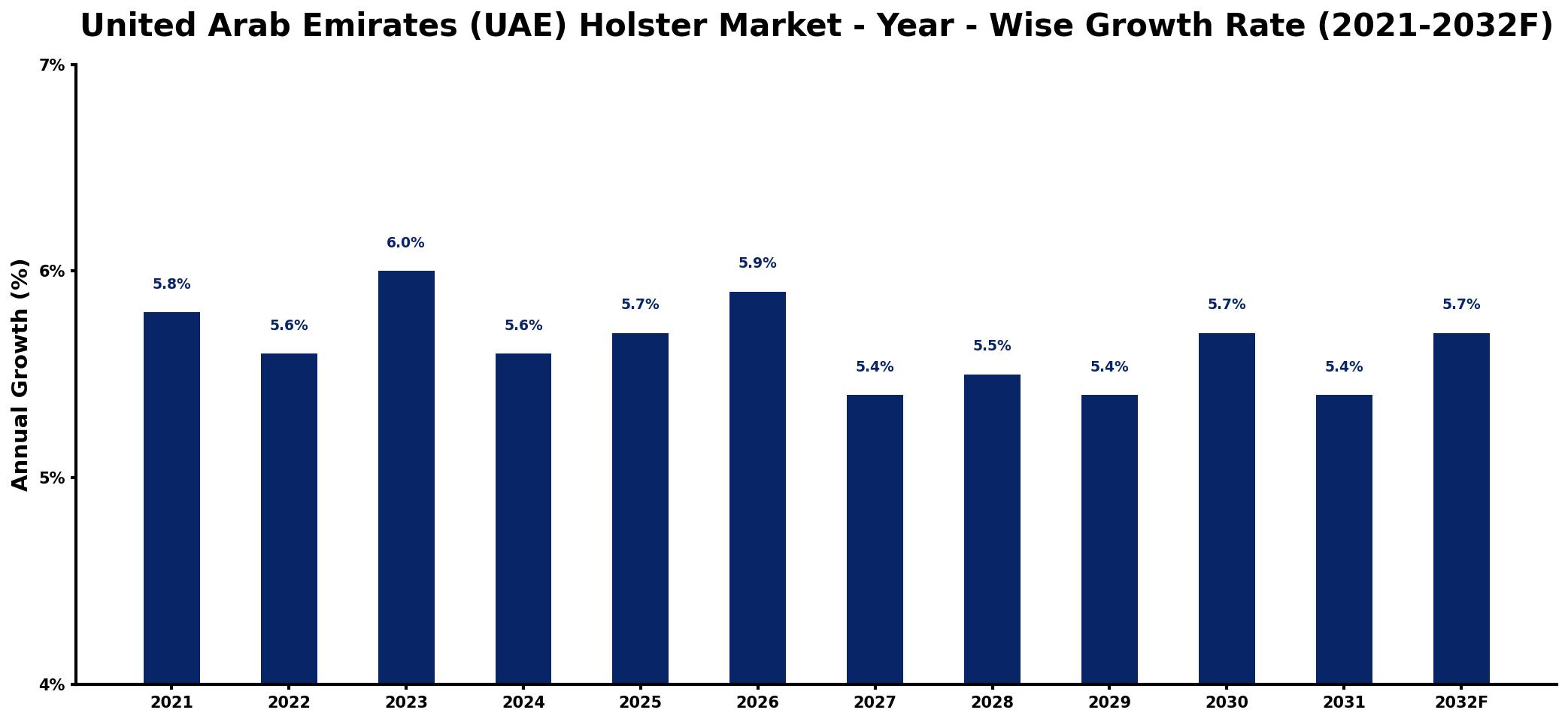
The table below presents the year‑wise growth rates along with the key drivers influencing the market
| Year | Growth Rate | Major Drivers |
| 2021 | 5.8% | Rise in personal safety awareness |
| 2022 | 5.6% | Growth in outdoor recreational activities |
| 2023 | 6.0% | increased overall sector activity |
| 2024 | 5.6% | Expansion of e-commerce platforms |
| 2025 | 5.7% | Surge in self-defense training programs |
| 2026 | 5.9% | Growing interest in tactical gear |
| 2027 | 5.4% | Increase in urban crime rates |
| 2028 | 5.5% | Demand for customized gear solutions |
| 2029 | 5.4% | Emergence of innovative manufacturing technologies |
| 2030 | 5.7% | Rising popularity of outdoor sports |
| 2031 | 5.4% | Focus on sustainable production methods |
| 2032 | 5.7% | Development of smart accessory features |
Note: Market size estimations and growth projections presented in this report are based on 6Wresearch's proprietary forecasting methodology, utilizing the latest available industry data, government publications, and primary research inputs.
United Arab Emirates (UAE) Holster Market Synopsis
The UAE Holster Market has experienced a notable rebound following the pandemic, where initial declines in demand due to travel restrictions have given way to a renewed interest in outdoor activities. As restrictions ease, the market is evolving, with an increasing emphasis on custom holster designs tailored to diverse user preferences and firearm types.
Looking ahead, the market is poised for growth as both law enforcement and civilian consumers seek greater functionality and safety in holster design. Innovations in materials and manufacturing processes are reshaping how holsters are designed and utilized, reflecting a broader trend toward personalization in the firearms accessories market.
United Arab Emirates (UAE) Holster Market Key Takeaways
- The market is projected to grow from USD 237 Million in 2025 to USD 329 Million by 2032.
- Strong demand is fueled by cultural traditions and an increase in recreational firearm usage.
- Innovations in holster design are enhancing safety, functionality, and user comfort.
- Compliance with stringent firearm regulations is a key factor influencing market dynamics.
- The resurgence of tourism is creating new opportunities for holster demand, especially in outdoor sectors.
Evaluation of Restraints in United Arab Emirates (UAE) Holster Market
Despite the market's robust outlook, several restraints impede growth. Stringent firearm regulations necessitate compliance and certification processes, leading to increased production costs for manufacturers. Additionally, import restrictions on firearm-related accessories create challenges for international suppliers looking to enter the market. The need for customized holsters designed for specific firearm models can also add to production complexities, requiring skilled craftsmanship that may not always be readily available. Finally, the evolving nature of firearm technology poses a challenge for manufacturers to ensure safety and security standards remain in alignment with consumer expectations.
United Arab Emirates (UAE) Holster Market Trends
Current trends in the UAE Holster Market are heavily influenced by advancements in technology and design. There is a noticeable shift towards lightweight, durable materials that enhance user experience without compromising safety. Customization is increasingly becoming a key selling point, as consumers seek holsters that reflect personal style and fit specific firearm models. Additionally, the integration of smart technologies into holster design, such as RFID tracking and safety features, is gaining traction, driven by consumer demand for enhanced security. Environmental considerations are also shaping product development, with more manufacturers opting for sustainable materials.
United Arab Emirates (UAE) Holster Market Opportunities
Opportunities for growth in the UAE Holster Market lie in several areas. As the interest in outdoor recreational activities continues to rise, manufacturers can tap into this market by developing specialized holsters that cater to hikers, campers, and sport shooters. Furthermore, the expanding defense and security sectors represent a significant avenue for investment, particularly in the realm of tactical holsters designed for military and law enforcement applications. Collaborations with local brands could also facilitate easier access to a niche market while enhancing brand recognition among consumers. Lastly, as ethical considerations regarding firearm usage gain prominence, brands that position themselves as responsible and safety-conscious will likely resonate well with modern consumers.
Government Initiatives in the United Arab Emirates (UAE) Holster Market
The UAE government has been proactive in shaping the firearms landscape through various regulations and initiatives aimed at ensuring public safety. Policies are in place to monitor firearm ownership and usage, impacting the holster market directly by enforcing standards that manufacturers must adhere to. Public spending in law enforcement and defense sectors continues to see an uptick, indicating a commitment to enhancing security and safety for citizens. Additionally, educational programs focused on firearm safety can also play a role in promoting responsible ownership, indirectly boosting the demand for high-quality holsters.
Future Insights of the United Arab Emirates (UAE) Holster Market
Looking forward to the period between 2026 and 2032, the UAE Holster Market is expected to evolve significantly. Innovations in materials science and manufacturing techniques will likely result in even more advanced holster designs, emphasizing safety, comfort, and user adaptability. Furthermore, with the anticipated growth in the tourism sector, there may be increased opportunities for holster manufacturers to cater to tourists interested in outdoor activities. Consumer preferences will continue to drive customization trends, leading brands to invest in personalized products. Overall, the landscape is set for dynamic growth, influenced by both traditional values and modern consumer expectations.
United Arab Emirates (UAE) Holster Market Latest Developments (2025 - 2026)
Recent developments in the UAE Holster Market indicate a shift towards innovative designs and materials, as manufacturers strive to enhance user experience. There has been a growing focus on integrating technology into holsters, with smart safety features capturing consumer interest. Additionally, various manufacturers are exploring partnerships with local firms to improve supply chain efficiencies and address the increasing demand for customized solutions. The trend towards eco-friendly materials is gaining momentum, reflecting a broader societal shift towards sustainability.
United Arab Emirates (UAE) Holster Market - Key Attractiveness of the Report
- 10 Years of Market Numbers
- Historical Data Starting from 2022 to 2025
- Base Year: 2025
- Forecast Data until 2032
- Key Performance Indicators Impacting the Market
- Major Upcoming Developments and Projects
Key Highlights of the Report:
- United Arab Emirates (UAE) Holster Market Outlook
- Market Size of United Arab Emirates (UAE) Holster Market, 2025
- Forecast of United Arab Emirates (UAE) Holster Market, 2032
- Historical Data and Forecast of United Arab Emirates (UAE) Holster Revenues & Volume for the Period 2022-2032F
- United Arab Emirates (UAE) Holster Market Trend Evolution
- United Arab Emirates (UAE) Holster Market Drivers and Challenges
- United Arab Emirates (UAE) Holster Price Trends
- United Arab Emirates (UAE) Holster Porter's Five Forces
- United Arab Emirates (UAE) Holster Industry Life Cycle
- Historical Data and Forecast of United Arab Emirates (UAE) Holster Market Revenues & Volume By Type for the Period 2022-2032F
- Historical Data and Forecast of United Arab Emirates (UAE) Holster Market Revenues & Volume By Leather for the Period 2022-2032F
- Historical Data and Forecast of United Arab Emirates (UAE) Holster Market Revenues & Volume By Nylon for the Period 2022-2032F
- Historical Data and Forecast of United Arab Emirates (UAE) Holster Market Revenues & Volume By Plastic for the Period 2022-2032F
- Historical Data and Forecast of United Arab Emirates (UAE) Holster Market Revenues & Volume By Other for the Period 2022-2032F
- Historical Data and Forecast of United Arab Emirates (UAE) Holster Market Revenues & Volume By Application for the Period 2022-2032F
- Historical Data and Forecast of United Arab Emirates (UAE) Holster Market Revenues & Volume By Civil for the Period 2022-2032F
- Historical Data and Forecast of United Arab Emirates (UAE) Holster Market Revenues & Volume By Armed Forces for the Period 2022-2032F
- Historical Data and Forecast of United Arab Emirates (UAE) Holster Market Revenues & Volume By others for the Period 2022-2032F
- United Arab Emirates (UAE) Holster Import Export Trade Statistics
- Market Opportunity Assessment By Type
- Market Opportunity Assessment By Application
- United Arab Emirates (UAE) Holster Top Companies Market Share
- United Arab Emirates (UAE) Holster Competitive Benchmarking By Technical and Operational Parameters
- United Arab Emirates (UAE) Holster Company Profiles
- United Arab Emirates (UAE) Holster Key Strategic Recommendations






































