United Arab Emirates (UAE) Household Textile Market Summary
The united arab emirates (uae) household textile market was estimated at USD 412 Million in 2025 and is projected to reach USD 557 Million by 2032, growing at a CAGR of 5.0% from 2026 to 2032.
United Arab Emirates (UAE) Household Textile Market Year-wise Growth Rate and Key Drivers
This graph highlights how the United Arab Emirates (UAE) Household Textile Market has steadily grown over the past five years, supported by major growth factors.
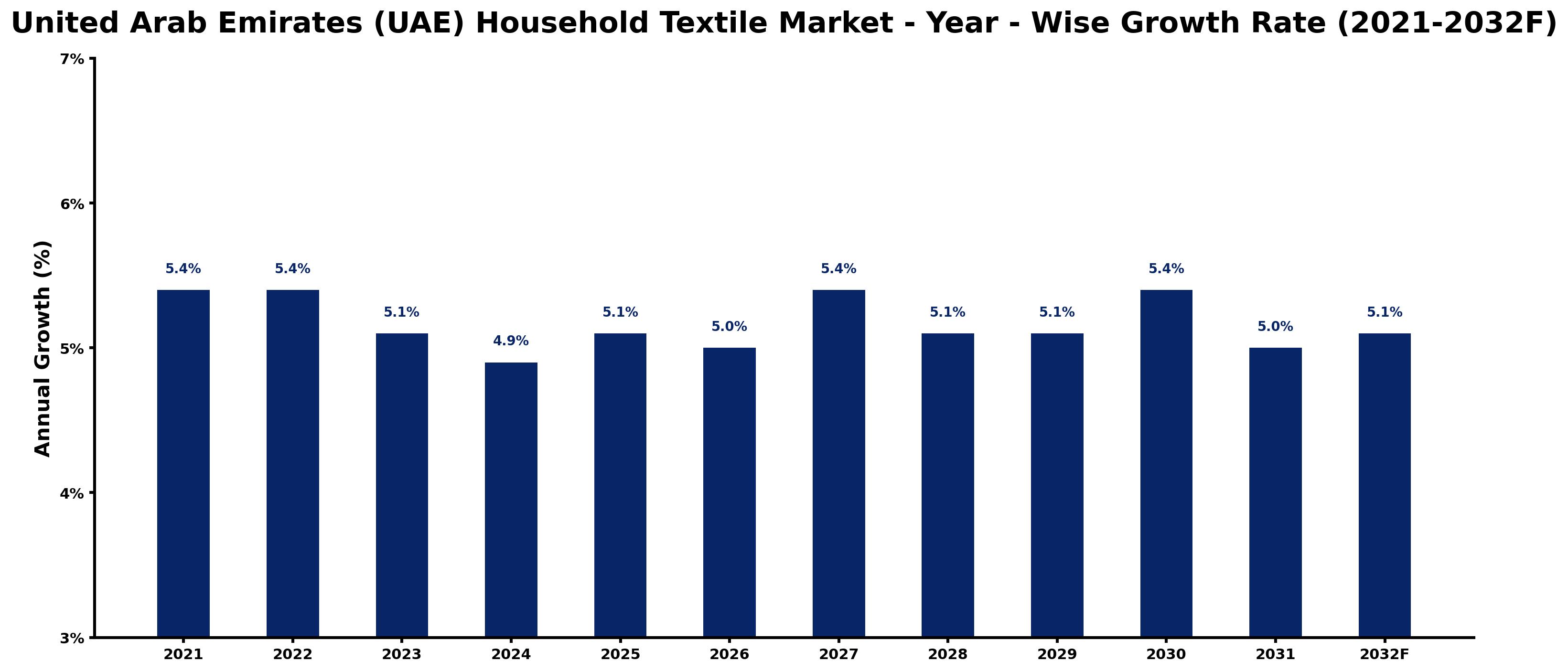
The table below presents the year wise growth rates along with the key drivers influencing the market
| Year | Growth Rate | Major Drivers |
| 2021 | 5.4% | Post-lockdown retail projects catalyzed a renewed interest in home textile purchases. |
| 2022 | 5.4% | Consumer preferences shifted towards sustainable and eco-friendly textile options significantly. |
| 2023 | 5.1% | E-commerce platforms expanded their reach, making household textiles more accessible online. |
| 2024 | 4.9% | Local production initiatives started to reduce dependency on imported textile goods effectively. |
| 2025 | 5.1% | Increased disposable incomes among UAE households elevated spending on luxury textiles. |
| 2026 | 5.0% | Events like Expo 2020 fostered tourism, boosting demand for hospitality textiles dramatically. |
| 2027 | 5.4% | Technological innovations in fabric manufacturing enhanced product quality and design capabilities. |
| 2028 | 5.1% | Urbanization trends led to smaller living spaces, increasing demand for multifunctional textiles. |
| 2029 | 5.1% | Cultural events celebrated local heritage, driving interest in traditional textile patterns and designs. |
| 2030 | 5.4% | Climate awareness campaigns encouraged consumers to prioritize water-saving textile properties. |
| 2031 | 5.0% | Luxury hotel developments spurred demand for high-quality bed linens and curtains specifically. |
| 2032 | 5.1% | Investment in smart home technology began influencing textile design, creating interactive home environments. |
Note - Market size estimations and growth projections presented in this report are based on 6Wresearch's advanced forecasting approach, validated with industry datasets as of June 2026.
United Arab Emirates (UAE) Household Textile Market Synopsis
The United Arab Emirates (UAE) Household Textile Market is projected to reach 5.0% and witness significant growth during the forecast period (2026-2032). This market encompasses the manufacturing, retailing, and distribution of a diverse range of household textile products, such as bed linens, towels, curtains, rugs, and other decorative textiles. The increasing significance of household textiles in enhancing both the aesthetics and comfort of residences plays a crucial role in the expansion of this market, particularly within the UAE's residential and hospitality sectors.
United Arab Emirates (UAE) Household Textile Market Growth Drivers
A combination of factors is driving the growth of the UAE household textile market. The rising population and urbanization trends have significantly influenced the demand for various household textiles, as more individuals establish homes and require essential furnishings. Additionally, consumer preferences for premium and luxurious textiles are on the rise, fueled by increasing disposable incomes.
- Urbanization in the UAE has led to a burgeoning real estate sector, resulting in increased demand for household textiles for both new homes and renovations.
- Consumers in the UAE are increasingly focused on creating aesthetically pleasing environments, prompting them to invest in high-quality textiles that align with modern design trends.
- Rising disposable incomes allow consumers to prioritize luxury and premium textile products, driving demand for higher-end offerings.
- The robust growth in the hospitality sector, particularly in hotels and resorts, further stimulates demand for sophisticated household textiles that enhance guest experiences.
- Awareness of sustainable and eco-friendly products is growing, with consumers showing interest in textiles made from organic and recycled materials, thus expanding market opportunities.
United Arab Emirates (UAE) Household Textile Market Challenges and Restraints
Despite the optimistic growth trajectory, the UAE household textile market contends with certain challenges that could impede its progress. One prominent issue is the competitive landscape influenced by low-cost imports, which can undermine local manufacturers and retailers.
- Imported products often flood the market at lower price points, prompting local businesses to compete on cost, which may affect their profit margins.
- To thrive, local manufacturers must focus on innovation, offering unique designs and superior quality to distinguish themselves from cheaper alternatives.
- The market's vulnerability to fluctuations in raw material costs can influence pricing strategies and profitability for local textile producers.
- Navigating regulatory frameworks and trade tariffs associated with imports can pose additional complexities for businesses operating in this market.
- Consumer preferences may shift towards fast fashion, which can lead to reduced loyalty for traditional household textile brands that focus on quality over price.
United Arab Emirates (UAE) Household Textile Market Government Investment and Initiatives
The UAE government has recognized the significance of the household textile sector within the broader economic landscape and has initiated various policies aimed at fostering growth and investment in this domain. Numerous development plans focus on enhancing the manufacturing capabilities while maximizing local production.
- Government initiatives are directing funding towards innovative textile manufacturing technologies to enhance efficiency and sustainability in production.
- Public spending on urban development projects, such as residential complexes and hospitality ventures, has led to increased demand for household textiles.
- Incentives for businesses investing in eco-friendly production methods are promoted to align with the global sustainability trends affecting consumer preferences.
- Training and educational programs are being established to enhance the skill sets of the local workforce, supporting innovation in textile design and production.
- Collaborations between government and private sectors encourage research and development initiatives aimed at creating advanced household textile solutions.
United Arab Emirates (UAE) Household Textile Market Latest Developments (May 2025 - June 2026)
Recent developments in the UAE household textile market reflect a shift toward more personalized and customized products as consumer preferences evolve. Market players are increasingly investing in technology to offer bespoke solutions, enhancing customer experiences. Additionally, collaborations with local artisans and designers are becoming more common, enriching the variety and uniqueness of textile offerings.
- There has been a rise in online retail channels, leading to increased accessibility and convenience for consumers seeking household textiles.
- Sustainability initiatives are gaining momentum, with companies focusing on the use of organic materials and environmentally friendly manufacturing practices.
- The shift toward home-centric lifestyles has reinforced the importance of household textiles, leading to innovative product launches tailored to improve comfort and aesthetics.
- Market research indicates growing consumer interest in multifunctional textiles that offer both practicality and style in home décor.
- As the economy stabilizes post-pandemic, consumer spending is anticipated to increase, positively impacting the demand for household textiles.
United Arab Emirates (UAE) Household Textile Market - Key Attractiveness of the Report
- 10 Years of Market Numbers
- Historical Data Starting from 2022 to 2025
- Base Year: 2025
- Forecast Data until 2032
- Key Performance Indicators Impacting the Market
- Major Upcoming Developments and Projects
Key Highlights of the Report:
- United Arab Emirates (UAE) Household Textile Market Outlook
- Market Size of United Arab Emirates (UAE) Household Textile Market, 2025
- Forecast of United Arab Emirates (UAE) Household Textile Market, 2032
- Historical Data and Forecast of United Arab Emirates (UAE) Household Textile Revenues & Volume for the Period 2022-2032F
- United Arab Emirates (UAE) Household Textile Market Trend Evolution
- United Arab Emirates (UAE) Household Textile Market Drivers and Challenges
- United Arab Emirates (UAE) Household Textile Price Trends
- United Arab Emirates (UAE) Household Textile Porter's Five Forces
- United Arab Emirates (UAE) Household Textile Industry Life Cycle
- Historical Data and Forecast of United Arab Emirates (UAE) Household Textile Market Revenues & Volume By Type for the Period 2022-2032F
- Historical Data and Forecast of United Arab Emirates (UAE) Household Textile Market Revenues & Volume By Non-woven Textile for the Period 2022-2032F
- Historical Data and Forecast of United Arab Emirates (UAE) Household Textile Market Revenues & Volume By Woven Textile for the Period 2022-2032F
- Historical Data and Forecast of United Arab Emirates (UAE) Household Textile Market Revenues & Volume By Application for the Period 2022-2032F
- Historical Data and Forecast of United Arab Emirates (UAE) Household Textile Market Revenues & Volume By Bed for the Period 2022-2032F
- Historical Data and Forecast of United Arab Emirates (UAE) Household Textile Market Revenues & Volume By Furniture for the Period 2022-2032F
- Historical Data and Forecast of United Arab Emirates (UAE) Household Textile Market Revenues & Volume By Door & Window for the Period 2022-2032F
- Historical Data and Forecast of United Arab Emirates (UAE) Household Textile Market Revenues & Volume By Dining & Wash for the Period 2022-2032F
- Historical Data and Forecast of United Arab Emirates (UAE) Household Textile Market Revenues & Volume By Ground for the Period 2022-2032F
- United Arab Emirates (UAE) Household Textile Import Export Trade Statistics
- Market Opportunity Assessment By Type
- Market Opportunity Assessment By Application
- United Arab Emirates (UAE) Household Textile Top Companies Market Share
- United Arab Emirates (UAE) Household Textile Competitive Benchmarking By Technical and Operational Parameters
- United Arab Emirates (UAE) Household Textile Company Profiles
- United Arab Emirates (UAE) Household Textile Key Strategic Recommendations






































