United Arab Emirates (UAE) Insulated Glass Market Size, Share & Growth Rate
The United Arab Emirates (UAE) Insulated Glass Market was estimated at USD 494 Million in 2025 and is projected to reach USD 660 Million by 2032, growing at a CAGR of 4.2% from 2026 to 2032. This robust growth trajectory is primarily fueled by the regions escalating emphasis on energy-efficient building solutions and sustainable construction practices. The increasing urbanization, combined with ongoing infrastructure projects, is likely to further amplify the demand for insulated glass in both residential and commercial sectors.
United Arab Emirates (UAE) Insulated Glass Market Year-wise Growth Rate and Key Drivers
This graph highlights how the United Arab Emirates (UAE) Insulated Glass Market has steadily grown over the years, supported by major growth factors.
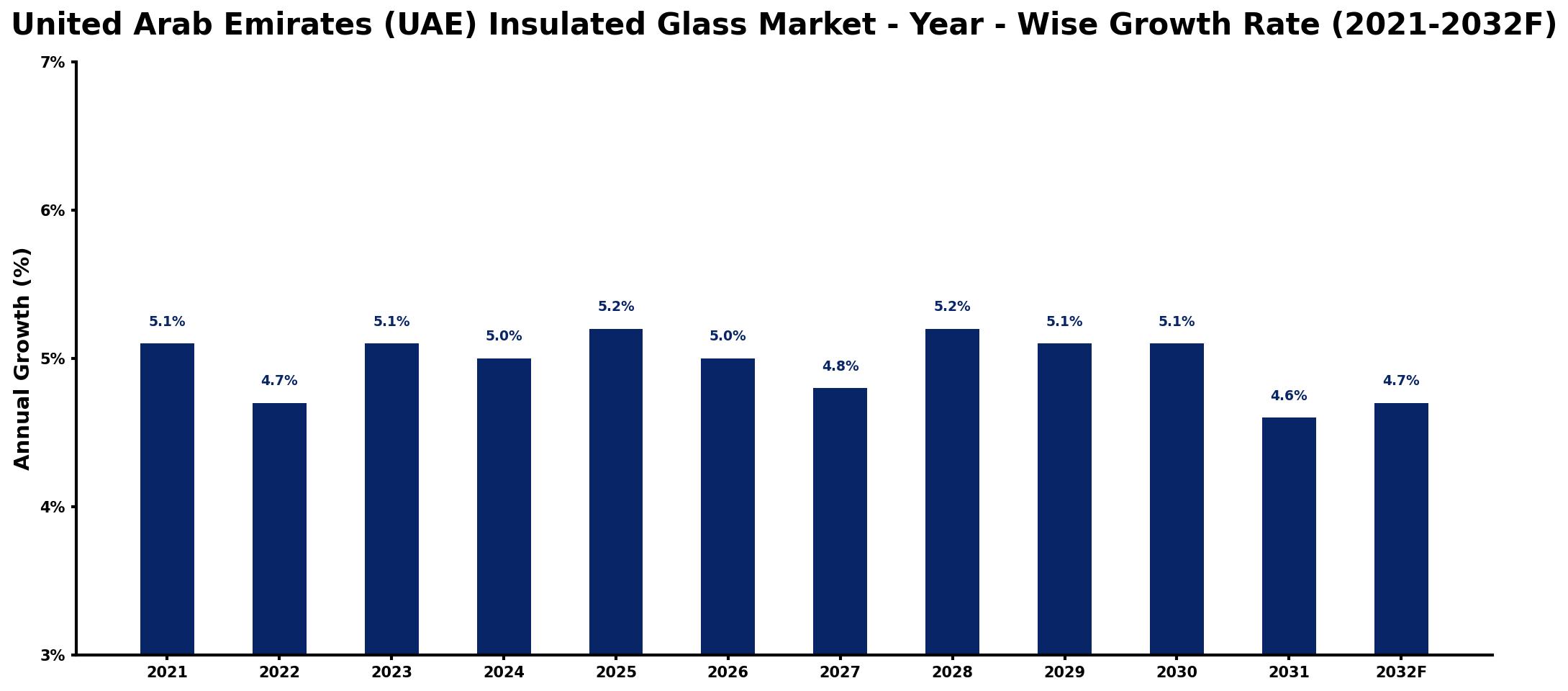
The table below presents the year‑wise growth rates along with the key drivers influencing the market
| Year | Growth Rate | Major Drivers |
| 2021 | 5.1% | increased construction activities nationwide |
| 2022 | 4.7% | growing demand for energy efficiency |
| 2023 | 5.1% | expansion in luxury residential projects |
| 2024 | 5.0% | investment in sustainable building practices |
| 2025 | 5.2% | rise in commercial infrastructure developments |
| 2026 | 5.0% | enhanced focus on green certifications |
| 2027 | 4.8% | growing preference for modern aesthetics |
| 2028 | 5.2% | increased government construction initiatives |
| 2029 | 5.1% | surge in renovation projects nationwide |
| 2030 | 5.1% | growing awareness of thermal performance |
| 2031 | 4.6% | rising interest in smart buildings |
| 2032 | 4.7% | expansion of architectural design trends |
Note: Market size estimations and growth projections presented in this report are based on 6Wresearch's proprietary forecasting methodology, utilizing the latest available industry data, government publications, and primary research inputs.
United Arab Emirates (UAE) Insulated Glass Market Synopsis
In the UAE, the demand for insulated glass products is propelled by the government's commitment to energy conservation and eco-friendly construction. With the implementation of stricter regulations on building materials, developers are increasingly favoring insulated glass to meet compliance standards. This growing trend is further reinforced by heightened consumer awareness regarding energy efficiency and environmental sustainability.
The supply side of the market has adapted to these demands by introducing innovative products that cater specifically to the climatic challenges of the UAE. New advancements, including advanced coatings and specialized gas fillings, enhance the thermal performance of insulated glass, making it a vital component in modern architecture and construction.
United Arab Emirates (UAE) Insulated Glass Market Key Takeaways
- The market is witnessing strong growth driven by increasing demand for energy-efficient construction solutions.
- Innovative product offerings are critical for addressing the unique climatic challenges in the UAE.
- Government regulations are pushing the construction industry toward sustainable building materials.
- Awareness of environmental benefits is leading to increased adoption of insulated glass.
- The market is rebounding post-COVID-19 as construction activities resume with a focus on sustainability.
Evaluation of Restraints in United Arab Emirates (UAE) Insulated Glass Market
Despite its growth prospects, the UAE insulated glass market faces notable constraints. One major challenge is the extreme climate conditions that require manufacturers to balance cost-effectiveness with high-performance insulation. Additionally, fluctuations in raw material prices can impact production costs, potentially leading to higher prices for consumers. The market also contends with the necessity of continuous innovation to meet the evolving demands of builders and architects in an increasingly competitive landscape.
United Arab Emirates (UAE) Insulated Glass Market Trends
Current trends in the UAE insulated glass market are leaning towards smart glass technology, which offers enhanced thermal and sound insulation properties. Moreover, advancements in manufacturing techniques, such as automated production lines and improved sealing methods, are improving product reliability and performance. The emphasis on design aesthetics is also growing, prompting manufacturers to develop insulated glass solutions that not only perform well but also complement contemporary architectural styles.
United Arab Emirates (UAE) Insulated Glass Market Opportunities
There are significant growth and investment opportunities within the UAE insulated glass market, particularly in the context of mega construction projects and urban redevelopment initiatives. The increasing integration of smart home technology presents an opportunity for innovation, as consumers seek products that enhance energy efficiency while improving overall living standards. Additionally, as sustainability takes precedence in urban planning, the demand for high-quality insulated glass is expected to expand, providing manufacturers with a promising landscape for future growth.
Government Initiatives in the United Arab Emirates (UAE) Insulated Glass Market
The UAE government is actively promoting sustainability through various initiatives aimed at enhancing energy efficiency in the construction sector. Policies advocating for green building standards and certification programs encourage the use of insulated glass as a preferred material. Public investment in infrastructure projects and residential development not only aligns with Vision 2021's goals but also fosters demand for innovative building materials that support sustainability targets.
Future Insights of the United Arab Emirates (UAE) Insulated Glass Market
Looking ahead to the 2026-2032 period, the UAE insulated glass market is poised for transformative growth. As sustainability continues to be a focal point for construction practices, the demand for energy-efficient solutions will likely remain strong. Technological advancements in insulated glass, including enhanced thermal properties and aesthetic innovations, are expected to cater to an increasingly discerning clientele. With ongoing government support and the resumption of construction projects, the market stands ready to capitalize on emerging opportunities.
United Arab Emirates (UAE) Insulated Glass Market Latest Developments (2025 - 2026)
Recent developments in the UAE insulated glass market indicate a shift towards more sustainable and technologically advanced solutions. Manufacturers are actively exploring partnerships and collaborations to enhance their product offerings. Innovations are being introduced that not only comply with regulatory standards but also meet the rising expectations of environmentally conscious consumers. The trend of integrating smart technologies into building materials is also gaining traction, reflecting the industry's response to changing market dynamics.
United Arab Emirates (UAE) Insulated Glass Market - Key Attractiveness of the Report
- 10 Years of Market Numbers
- Historical Data Starting from 2022 to 2025
- Base Year: 2025
- Forecast Data until 2032
- Key Performance Indicators Impacting the Market
- Major Upcoming Developments and Projects
Key Highlights of the Report:
- United Arab Emirates (UAE) Insulated Glass Market Outlook
- Market Size of United Arab Emirates (UAE) Insulated Glass Market, 2025
- Forecast of United Arab Emirates (UAE) Insulated Glass Market, 2032
- Historical Data and Forecast of United Arab Emirates (UAE) Insulated Glass Revenues & Volume for the Period 2022-2032F
- United Arab Emirates (UAE) Insulated Glass Market Trend Evolution
- United Arab Emirates (UAE) Insulated Glass Market Drivers and Challenges
- United Arab Emirates (UAE) Insulated Glass Price Trends
- United Arab Emirates (UAE) Insulated Glass Porter's Five Forces
- United Arab Emirates (UAE) Insulated Glass Industry Life Cycle
- Historical Data and Forecast of United Arab Emirates (UAE) Insulated Glass Market Revenues & Volume By Type for the Period 2022-2032F
- Historical Data and Forecast of United Arab Emirates (UAE) Insulated Glass Market Revenues & Volume By Heated Insulating Glass for the Period 2022-2032F
- Historical Data and Forecast of United Arab Emirates (UAE) Insulated Glass Market Revenues & Volume By Tempering Insulating Glass for the Period 2022-2032F
- Historical Data and Forecast of United Arab Emirates (UAE) Insulated Glass Market Revenues & Volume By Custom Insulated Glass for the Period 2022-2032F
- Historical Data and Forecast of United Arab Emirates (UAE) Insulated Glass Market Revenues & Volume By Other Glasses for the Period 2022-2032F
- Historical Data and Forecast of United Arab Emirates (UAE) Insulated Glass Market Revenues & Volume By Application for the Period 2022-2032F
- Historical Data and Forecast of United Arab Emirates (UAE) Insulated Glass Market Revenues & Volume By Doors & Partitions for the Period 2022-2032F
- Historical Data and Forecast of United Arab Emirates (UAE) Insulated Glass Market Revenues & Volume By Kitchen Appliances & Cabinets for the Period 2022-2032F
- Historical Data and Forecast of United Arab Emirates (UAE) Insulated Glass Market Revenues & Volume By Floors & Ceilings for the Period 2022-2032F
- Historical Data and Forecast of United Arab Emirates (UAE) Insulated Glass Market Revenues & Volume By Furniture & Curtain Walls for the Period 2022-2032F
- Historical Data and Forecast of United Arab Emirates (UAE) Insulated Glass Market Revenues & Volume By Railings & Bolted Structures for the Period 2022-2032F
- Historical Data and Forecast of United Arab Emirates (UAE) Insulated Glass Market Revenues & Volume By Automotive Glasses for the Period 2022-2032F
- Historical Data and Forecast of United Arab Emirates (UAE) Insulated Glass Market Revenues & Volume By End User for the Period 2022-2032F
- Historical Data and Forecast of United Arab Emirates (UAE) Insulated Glass Market Revenues & Volume By Residential Buildings for the Period 2022-2032F
- Historical Data and Forecast of United Arab Emirates (UAE) Insulated Glass Market Revenues & Volume By Commercial & Institutional Buildings for the Period 2022-2032F
- Historical Data and Forecast of United Arab Emirates (UAE) Insulated Glass Market Revenues & Volume By Industrial Users for the Period 2022-2032F
- United Arab Emirates (UAE) Insulated Glass Import Export Trade Statistics
- Market Opportunity Assessment By Type
- Market Opportunity Assessment By Application
- Market Opportunity Assessment By End User
- United Arab Emirates (UAE) Insulated Glass Top Companies Market Share
- United Arab Emirates (UAE) Insulated Glass Competitive Benchmarking By Technical and Operational Parameters
- United Arab Emirates (UAE) Insulated Glass Company Profiles
- United Arab Emirates (UAE) Insulated Glass Key Strategic Recommendations






































