United Arab Emirates (UAE) Insurance Telematics Market Size & Growth Rate (2026-2032)
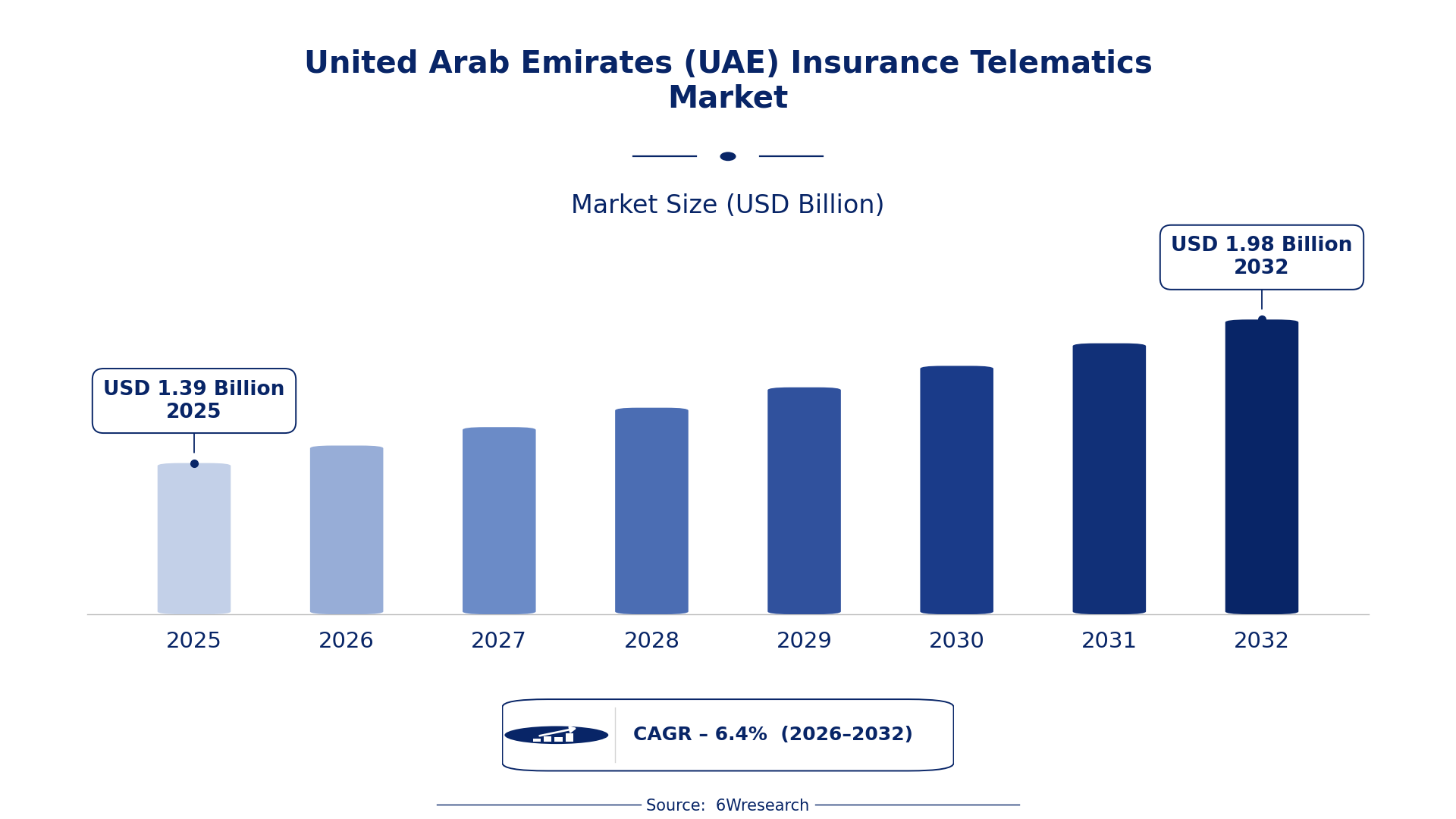
The United Arab Emirates (UAE) Insurance Telematics Market was estimated at USD 1388 Million in 2025 and is projected to reach USD 1981 Million by 2032, growing at a CAGR of 6.4% from 2026 to 2032.
United Arab Emirates (UAE) Insurance Telematics Market Synopsis
The UAE Insurance Telematics Market is at a critical juncture, having gained traction in recent years due to increasing consumer demand for personalized insurance products. As insurers leverage telematics technology to monitor driving behaviors, the market is rapidly evolving toward more data-driven policy offerings, shifting the dynamics in favor of proactive risk management.
Looking ahead, this market is expected to accelerate as regulatory frameworks and technological advancements converge. With a clear emphasis on road safety and fraud prevention, insurance companies are integrating telematics to refine their risk assessment processes, which in turn could reshape customer engagement and retention strategies.
United Arab Emirates (UAE) Insurance Telematics Market Year-wise Growth Rate and Key Drivers
This graph illustrates the annual growth rates of the United Arab Emirates (UAE) Insurance Telematics Market from 2021 to 2032, highlighting a steady upward trajectory and projected expansion over the forecast period.
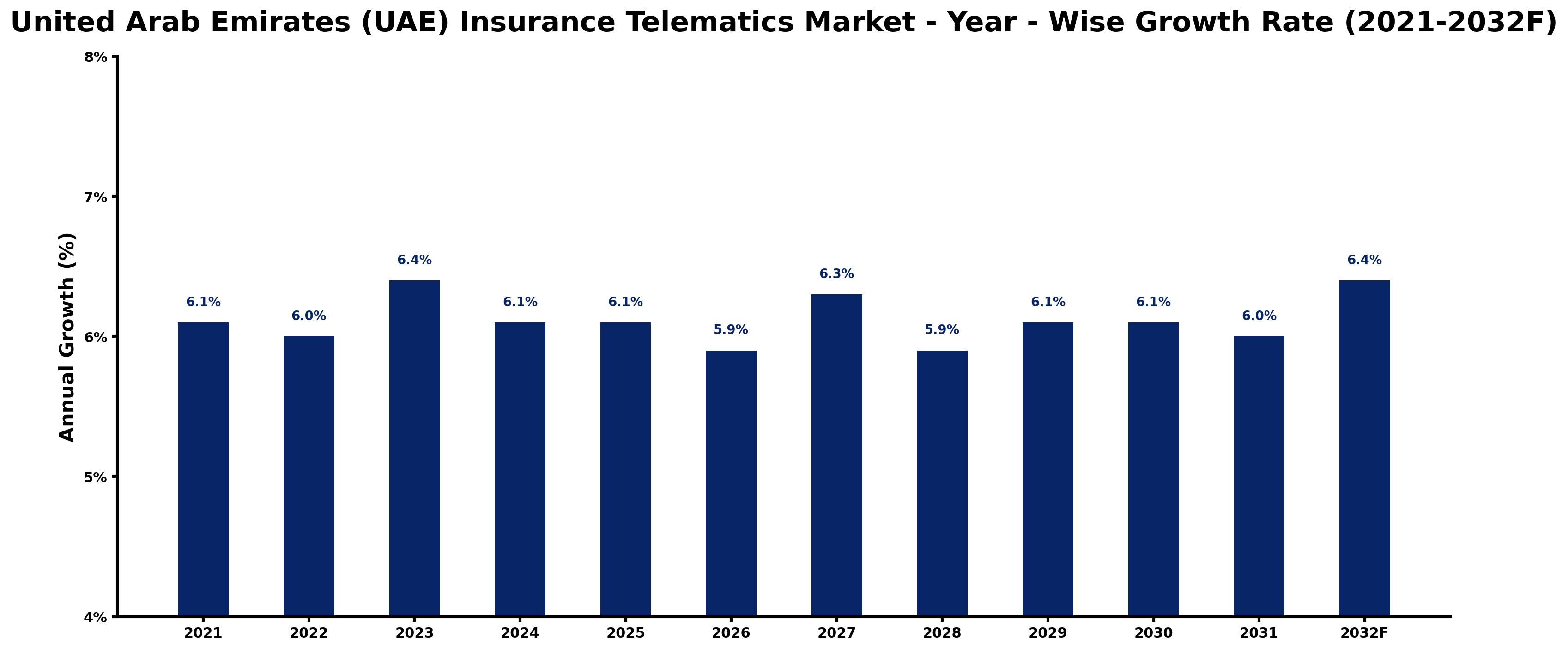
The table below presents the year‑wise growth rates along with the key drivers influencing the market
| Year | Growth Rate | Major Drivers |
| 2021 | 6.1% | Rising smartphone penetration enhancing telematics adoption rates |
| 2022 | 6.0% | Increased consumer awareness about safe driving incentives |
| 2023 | 6.4% | Government push for digital transformation in insurance sector |
| 2024 | 6.1% | Enhanced risk assessment through telematics data analytics |
| 2025 | 6.1% | Partnerships between insurers and telematics service providers |
| 2026 | 5.9% | Growing young population favoring tech-enabled insurance solutions |
| 2027 | 6.3% | Improved road safety initiatives driving telematics interest |
| 2028 | 5.9% | Regulatory mandates promoting usage-based insurance models |
| 2029 | 6.1% | Focus on climate change impacts influencing telematics usage |
| 2030 | 6.1% | Rise in electric vehicles necessitating telematics adaptations |
| 2031 | 6.0% | Increased competition among insurers driving innovation adoption |
| 2032 | 6.4% | UAE Vision 2021 goals aligning with digital insurance growth |
Note: Market size estimations and growth projections presented in this report are based on 6Wresearch's proprietary forecasting methodology, utilizing the latest available industry data, government publications, and primary research inputs.
United Arab Emirates (UAE) Insurance Telematics Market Key Takeaways
Below are some of the specific key takeaways from the market, including:
- Insurance companies are increasingly adopting telematics to offer personalized policies based on real-time driving data.
- Government initiatives promoting road safety and awareness are bolstering the adoption of telematics solutions.
- Insurance fraud is being effectively combated through telematics, thanks to real-time data monitoring capabilities.
- The proliferation of IoT devices and smartphones is facilitating broader access to telematics solutions in the UAE.
- Data security and privacy remain significant concerns, necessitating robust frameworks to protect consumer information.
Evaluation of Restraints in United Arab Emirates (UAE) Insurance Telematics Market
Despite its potential, the UAE Insurance Telematics Market faces several notable constraints. Chief among these is the challenge of data security and privacy. The stringent regulatory environment surrounding data collection and usage means that insurers must navigate complex legal landscapes to ensure compliance while maintaining consumer trust. Many potential customers remain wary of how their driving data is used, which can hinder widespread adoption. on top of that, the need for accurate risk assessments through telematics data requires high-quality data analytics capabilities, which not all insurers possess.
United Arab Emirates (UAE) Insurance Telematics Market Trends
The market is currently witnessing several transformative trends. A significant shift toward behavioral-based insurance policies is evident, as more insurers recognize the value of telematics in assessing individual driving habits. There's also an increasing focus on integrating telematics with artificial intelligence (AI) to enhance predictive analytics, allowing insurers to better forecast risk and tailor offerings. Additionally, as electric and autonomous vehicles become more prevalent, telematics will evolve to encompass new data points, further enriching policy customization.
United Arab Emirates (UAE) Insurance Telematics Market Opportunities
Opportunities for growth in this market lie in expanding telematics services beyond traditional car insurance. Insurers can explore partnerships with automotive manufacturers to embed telematics directly into vehicles, paving the way for innovative usage-based insurance models. on top of that, as consumer awareness grows, insurers have the chance to educate policyholders on the benefits of telematics, fostering a culture of safe driving that can reduce claims and enhance profitability.
Government Initiatives in the United Arab Emirates (UAE) Insurance Telematics Market
Government support is crucial for the advancement of the UAE Insurance Telematics Market. Regulatory bodies are actively working to create frameworks that facilitate telematics adoption while ensuring consumer protection. Public safety initiatives aimed at reducing road accidents directly align with the goals of insurance telematics, promoting a safer driving environment. The emphasis on data privacy and security regulation is also shaping how insurers collect and utilize telematics data.
- A national road safety campaign launched in early 2023 encourages the integration of telematics in insurance policies to improve driver behavior.
- Current initiatives are underway to develop a regulatory framework that ensures data protection while allowing insurers to utilize telematics data effectively.
- Plans are in place for a public-private partnership aimed at improving telematics infrastructure by 2027, enhancing connectivity for data-driven solutions.
- The Ministry of Interior is currently implementing a vehicle tracking system that will leverage telematics to monitor driving patterns and enhance safety.
- By 2025, a proposed policy initiative will mandate all new vehicles sold in the UAE to be telematics-enabled, pushing the market towards universal adoption.
Future Insights of the United Arab Emirates (UAE) Insurance Telematics Market
The outlook for the UAE Insurance Telematics Market through 2032 is optimistic. As technological advancements continue to unfold, insurers will likely leverage increased data analytics capabilities to enhance policy customization. The intertwining of telematics with emerging technologies like AI and machine learning will not only streamline operations but also bolster fraud detection mechanisms. As more drivers become aware of the potential savings and benefits of telematics, consumer adoption will rise, driving market growth.
United Arab Emirates (UAE) Insurance Telematics Market Latest Developments
Recent activity in the UAE Insurance Telematics Market indicates a strong momentum toward technological integration and consumer engagement. Companies are focusing on enhancing their telematics offerings to meet the increasing demand for personalized insurance solutions. This shift is being propelled by both market competition and regulatory encouragement.
- A leading regional insurer launched an advanced telematics platform in early 2023, enabling real-time monitoring of driver behavior and personalized feedback.
- In mid-2023, an ongoing partnership between a major technology vendor and several insurance firms aims to develop a comprehensive analytics tool for telematics data.
- A new product line focused on usage-based insurance policies is expected to debut in late 2024, promising to attract tech-savvy consumers.
- Currently, a pilot program is testing telematics solutions among fleet operators to assess risk and improve safety metrics, with results anticipated by early 2025.
- A rollout of a smartphone app designed for policyholders to track their driving behavior and earn discounts is planned for the second half of 2025.
United Arab Emirates (UAE) Insurance Telematics Market - Key Attractiveness of the Report
- 10 Years of Market Numbers
- Historical Data Starting from 2022 to 2025
- Base Year: 2025
- Forecast Data until 2032
- Key Performance Indicators Impacting the Market
- Major Upcoming Developments and Projects
Key Highlights of the Report:
- United Arab Emirates (UAE) Insurance Telematics Market Outlook
- Market Size of United Arab Emirates (UAE) Insurance Telematics Market, 2025
- Forecast of United Arab Emirates (UAE) Insurance Telematics Market, 2032
- Historical Data and Forecast of United Arab Emirates (UAE) Insurance Telematics Revenues & Volume for the Period 2022-2032F
- United Arab Emirates (UAE) Insurance Telematics Market Trend Evolution
- United Arab Emirates (UAE) Insurance Telematics Market Drivers and Challenges
- United Arab Emirates (UAE) Insurance Telematics Price Trends
- United Arab Emirates (UAE) Insurance Telematics Porter's Five Forces
- United Arab Emirates (UAE) Insurance Telematics Industry Life Cycle
- Historical Data and Forecast of United Arab Emirates (UAE) Insurance Telematics Market Revenues & Volume By End User for the Period 2022-2032F
- Historical Data and Forecast of United Arab Emirates (UAE) Insurance Telematics Market Revenues & Volume By Small for the Period 2022-2032F
- Historical Data and Forecast of United Arab Emirates (UAE) Insurance Telematics Market Revenues & Volume By Medium Enterprises for the Period 2022-2032F
- Historical Data and Forecast of United Arab Emirates (UAE) Insurance Telematics Market Revenues & Volume By Large Enterprises for the Period 2022-2032F
- Historical Data and Forecast of United Arab Emirates (UAE) Insurance Telematics Market Revenues & Volume By Deployment Type for the Period 2022-2032F
- Historical Data and Forecast of United Arab Emirates (UAE) Insurance Telematics Market Revenues & Volume By Cloud for the Period 2022-2032F
- Historical Data and Forecast of United Arab Emirates (UAE) Insurance Telematics Market Revenues & Volume By On-Premises for the Period 2022-2032F
- Historical Data and Forecast of United Arab Emirates (UAE) Insurance Telematics Market Revenues & Volume By Organization Size for the Period 2022-2032F
- Historical Data and Forecast of United Arab Emirates (UAE) Insurance Telematics Market Revenues & Volume By Small and Medium Enterprises (SMEs) for the Period 2022-2032F
- Historical Data and Forecast of United Arab Emirates (UAE) Insurance Telematics Market Revenues & Volume By Large Enterprises for the Period 2022-2032F
- United Arab Emirates (UAE) Insurance Telematics Import Export Trade Statistics
- Market Opportunity Assessment By End User
- Market Opportunity Assessment By Deployment Type
- Market Opportunity Assessment By Organization Size
- United Arab Emirates (UAE) Insurance Telematics Top Companies Market Share
- United Arab Emirates (UAE) Insurance Telematics Competitive Benchmarking By Technical and Operational Parameters
- United Arab Emirates (UAE) Insurance Telematics Company Profiles
- United Arab Emirates (UAE) Insurance Telematics Key Strategic Recommendations






































