United Arab Emirates (UAE) Linen Yarn Market Size, Share & Growth Rate
The United Arab Emirates (UAE) Linen Yarn Market was estimated at USD 1184 Million in 2025 and is projected to reach USD 1697 Million by 2032, growing at a CAGR of 5.3% from 2026 to 2032. This growth trajectory reflects a significant increase in consumer preference for natural textiles, driven by sustainability concerns and a broader shift towards eco-friendly fashion. The ongoing diversification of the UAE textile industry and a rising focus on high-quality linen products are further propelling market expansion.
United Arab Emirates (UAE) Linen Yarn Market Year-wise Growth Rate and Key Drivers
This graph highlights how the United Arab Emirates (UAE) Linen Yarn Market has steadily grown over the years, supported by major growth factors.
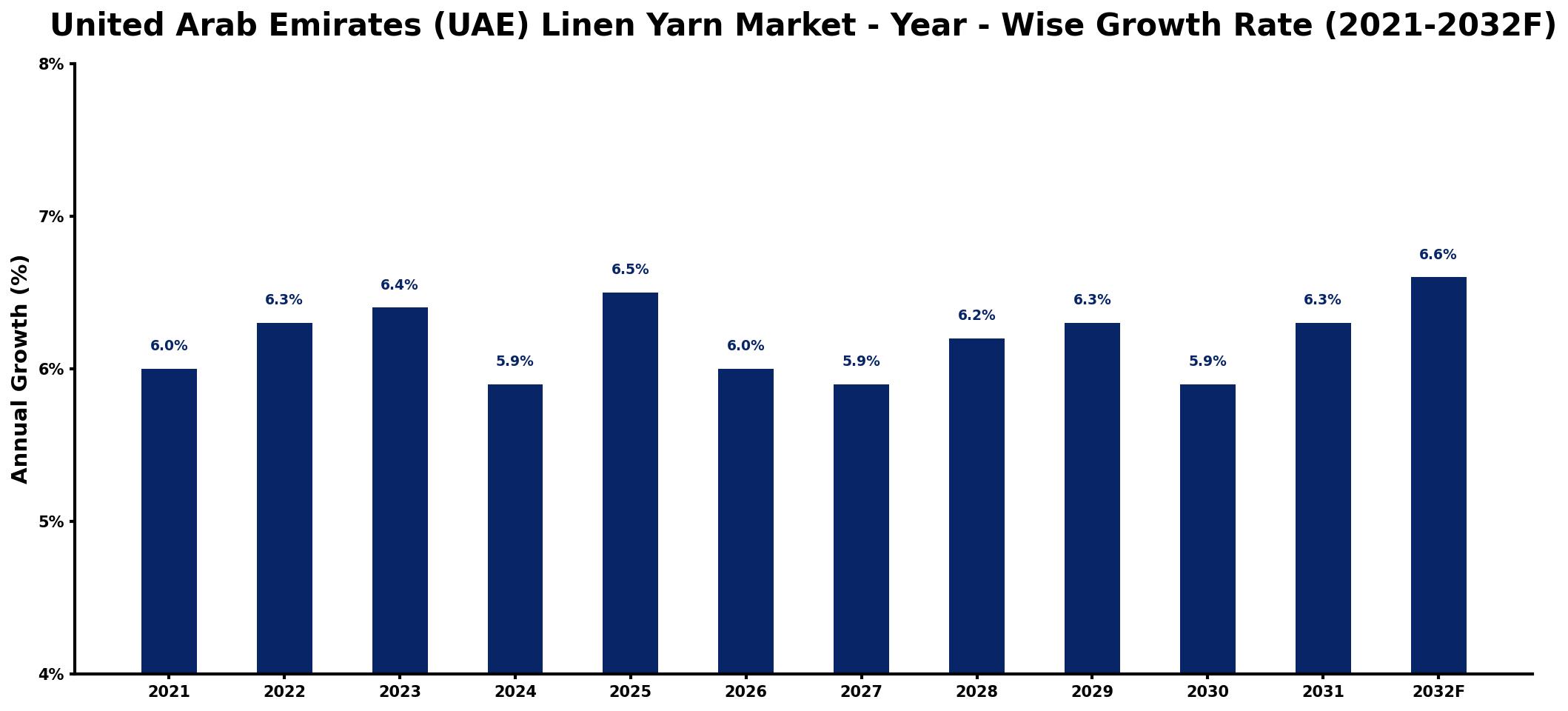
The table below presents the year‑wise growth rates along with the key drivers influencing the market
| Year | Growth Rate | Major Drivers |
| 2021 | 6.0% | Growing demand for sustainable textiles |
| 2022 | 6.3% | Expansion of eco-friendly fashion brands |
| 2023 | 6.4% | Increase in home textile consumption |
| 2024 | 5.9% | Rising popularity of artisanal products |
| 2025 | 6.5% | Investments in renewable fiber production |
| 2026 | 6.0% | Growth of online textile retailing |
| 2027 | 5.9% | Increased focus on textile innovation |
| 2028 | 6.2% | Surge in luxury home décor |
| 2029 | 6.3% | Development of new textile technologies |
| 2030 | 5.9% | Emerging markets boosting textile imports |
| 2031 | 6.3% | Collaboration between designers and manufacturers |
| 2032 | 6.6% | Enhancement of sustainable production methods |
Note: Market size estimations and growth projections presented in this report are based on 6Wresearch's proprietary forecasting methodology, utilizing the latest available industry data, government publications, and primary research inputs.
United Arab Emirates (UAE) Linen Yarn Market Synopsis
The UAE Linen Yarn market is at a fascinating crossroads, witnessing a resurgence in demand as consumers increasingly gravitate towards breathable and sustainable textiles. While the market has faced challenges, particularly regarding supply and reliance on imports, the current trend showcases a robust interest in linen, particularly in fashion and home textiles.
Moving forward, the market is set to capitalize on this renewed interest, with several initiatives focusing on quality and sustainability. As the textile landscape evolves, the UAE Linen Yarn market will likely see innovative approaches that cater to the sophisticated needs of consumers seeking eco-conscious options without compromising on quality.
United Arab Emirates (UAE) Linen Yarn Market Key Takeaways
- The market is projected to grow at a CAGR of 5.3% from 2026 to 2032.
- Increased consumer preference for natural and breathable textiles is a key driver.
- Logistical challenges related to quality maintenance during transport and storage persist.
- Brands are leveraging eco-friendly narratives to appeal to sustainability-conscious consumers.
- Emerging opportunities exist in innovative product development and online retailing.
Evaluation of Restraints in United Arab Emirates (UAE) Linen Yarn Market
Despite the promising growth potential, the UAE Linen Yarn market faces significant restraints that could hinder its progress. A primary concern is the region's dependence on imports, which makes the market vulnerable to fluctuations in global supply chains. Additionally, the preservation of linen yarn quality in the challenging hot and humid climate poses storage and transport dilemmas. Furthermore, the pervasive dominance of synthetic fibers necessitates strategic marketing efforts to educate consumers on the benefits of linen, which can be a substantial hurdle.
United Arab Emirates (UAE) Linen Yarn Market Trends
Several trends are currently shaping the UAE Linen Yarn market. The ongoing shift towards sustainable and eco-friendly textiles is leading to greater consumer demand for linen products. There is also an increasing inclination among manufacturers to adopt innovative technologies to enhance production efficiency and product quality. Digital transformation is playing a crucial role, with many companies moving towards e-commerce platforms to cater to a tech-savvy customer base that values convenience and transparency in sourcing.
United Arab Emirates (UAE) Linen Yarn Market Opportunities
The market presents multiple avenues for growth and investment. Companies can explore niche segments within the linen textile spectrum, such as luxury home furnishings and sustainable fashion collections. Collaborative initiatives aimed at sustainability can attract environmentally conscious consumers, enhancing brand loyalty. Furthermore, leveraging technological advancements in manufacturing processes could reduce production costs and improve product quality, thereby expanding market reach.
Government Initiatives in the United Arab Emirates (UAE) Linen Yarn Market
The UAE government is actively promoting initiatives that align with sustainability goals, aiming to enhance the textile sector's ecological footprint. Public spending on green technologies and support for innovative practices in the manufacturing process are integral to these efforts. Moreover, the government is incentivizing companies that embrace sustainable practices, thereby fostering a more responsible approach within the linen yarn market.
Future Insights of the United Arab Emirates (UAE) Linen Yarn Market
Looking ahead to 2026-2032, the UAE Linen Yarn market is poised for significant advancements, driven by consumer awareness and demand for sustainable options. As the industry adapts to shifts in consumer behavior, the integration of eco-friendly practices will be crucial. Innovations in production methods and enhancements in supply chain logistics are expected to address current challenges, ultimately supporting a more resilient market landscape.
United Arab Emirates (UAE) Linen Yarn Market Latest Developments (2025 - 2026)
Recent developments in the UAE Linen Yarn market indicate a growing trend towards collaborations between textile manufacturers and sustainability-focused organizations. Initiatives aimed at improving product traceability and transparency are gaining traction. Additionally, more brands are exploring direct-to-consumer sales strategies, enhancing their market reach and engagement with eco-conscious consumers. The landscape continues to evolve as industry players respond to emerging market dynamics.
United Arab Emirates (UAE) Linen Yarn Market - Key Attractiveness of the Report
- 10 Years of Market Numbers
- Historical Data Starting from 2022 to 2025
- Base Year: 2025
- Forecast Data until 2032
- Key Performance Indicators Impacting the Market
- Major Upcoming Developments and Projects
Key Highlights of the Report:
- United Arab Emirates (UAE) Linen Yarn Market Outlook
- Market Size of United Arab Emirates (UAE) Linen Yarn Market, 2025
- Forecast of United Arab Emirates (UAE) Linen Yarn Market, 2032
- Historical Data and Forecast of United Arab Emirates (UAE) Linen Yarn Revenues & Volume for the Period 2022-2032F
- United Arab Emirates (UAE) Linen Yarn Market Trend Evolution
- United Arab Emirates (UAE) Linen Yarn Market Drivers and Challenges
- United Arab Emirates (UAE) Linen Yarn Price Trends
- United Arab Emirates (UAE) Linen Yarn Porter's Five Forces
- United Arab Emirates (UAE) Linen Yarn Industry Life Cycle
- Historical Data and Forecast of United Arab Emirates (UAE) Linen Yarn Market Revenues & Volume By Products for the Period 2022-2032F
- Historical Data and Forecast of United Arab Emirates (UAE) Linen Yarn Market Revenues & Volume By Dry spun yarn for the Period 2022-2032F
- Historical Data and Forecast of United Arab Emirates (UAE) Linen Yarn Market Revenues & Volume By Wet spun yarn for the Period 2022-2032F
- Historical Data and Forecast of United Arab Emirates (UAE) Linen Yarn Market Revenues & Volume By Blended yarn for the Period 2022-2032F
- Historical Data and Forecast of United Arab Emirates (UAE) Linen Yarn Market Revenues & Volume By Applications for the Period 2022-2032F
- Historical Data and Forecast of United Arab Emirates (UAE) Linen Yarn Market Revenues & Volume By Clothings for the Period 2022-2032F
- Historical Data and Forecast of United Arab Emirates (UAE) Linen Yarn Market Revenues & Volume By Beddings for the Period 2022-2032F
- Historical Data and Forecast of United Arab Emirates (UAE) Linen Yarn Market Revenues & Volume By Others for the Period 2022-2032F
- United Arab Emirates (UAE) Linen Yarn Import Export Trade Statistics
- Market Opportunity Assessment By Products
- Market Opportunity Assessment By Applications
- United Arab Emirates (UAE) Linen Yarn Top Companies Market Share
- United Arab Emirates (UAE) Linen Yarn Competitive Benchmarking By Technical and Operational Parameters
- United Arab Emirates (UAE) Linen Yarn Company Profiles
- United Arab Emirates (UAE) Linen Yarn Key Strategic Recommendations






































