United Arab Emirates (UAE) Locks and Padlocks Market Summary
The united arab emirates (uae) locks and padlocks market was estimated at USD 384 Million in 2025 and is projected to reach USD 552 Million by 2032, growing at a CAGR of 6.2% from 2026 to 2032.
United Arab Emirates (UAE) Locks and Padlocks Market Year-wise Growth Rate and Key Drivers
This graph highlights how the United Arab Emirates (UAE) Locks and Padlocks Market has steadily grown over the past five years, supported by major growth factors.
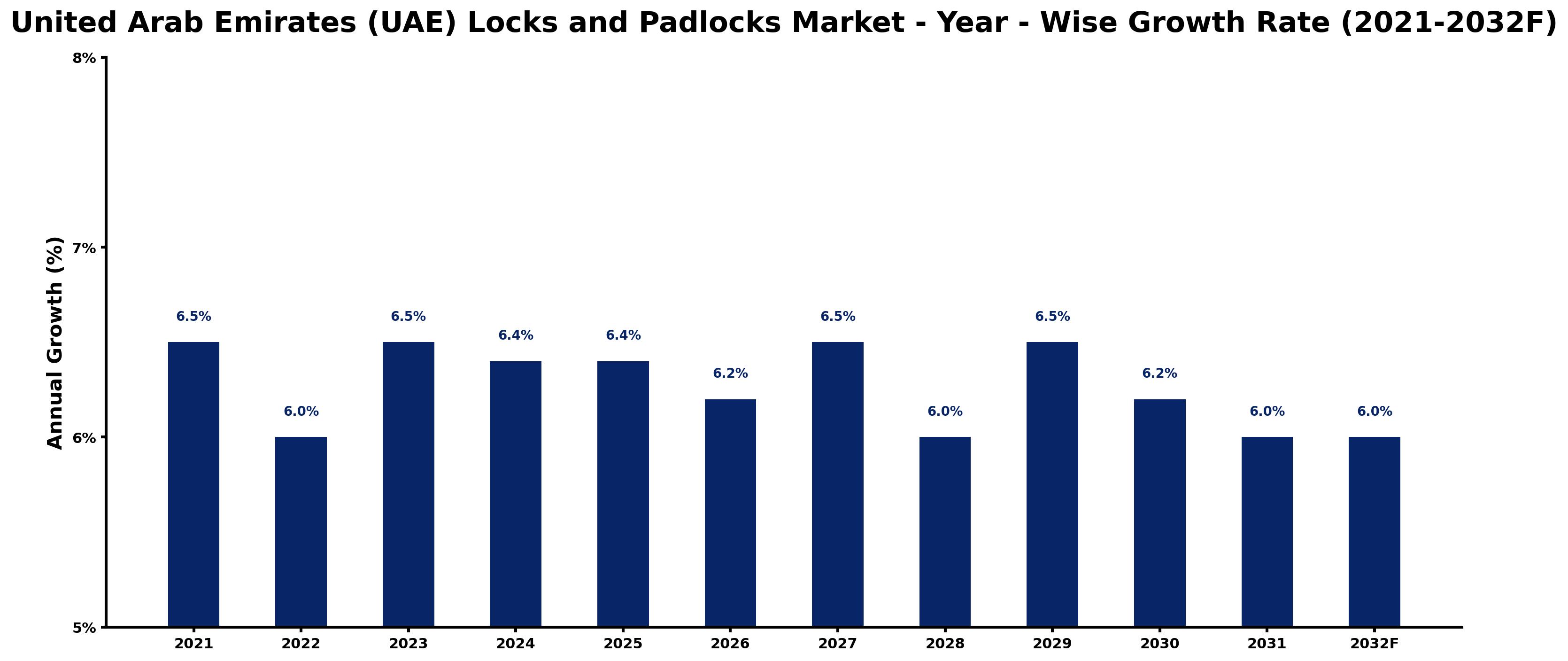
The table below presents the year wise growth rates along with the key drivers influencing the market
| Year | Growth Rate | Major Drivers |
| 2021 | 6.5% | Post-lockdown retail projects prompted renewed interest in security solutions across sectors. |
| 2022 | 6.0% | Increased construction activities fueled demand for durable locks in commercial buildings. |
| 2023 | 6.5% | Corporate budgets shifted towards advanced security devices in response to evolving threats. |
| 2024 | 6.4% | Emerging retail hubs emphasized the need for innovative locking mechanisms and systems. |
| 2025 | 6.4% | Technological integration within security products attracted attention from high-end consumers. |
| 2026 | 6.2% | Expansion of logistics facilities created opportunities for robust locking solutions globally. |
| 2027 | 6.5% | Urban development initiatives highlighted the importance of reliable security in residential areas. |
| 2028 | 6.0% | Cultural shifts towards safety and security prompted significant investment in lock technologies. |
| 2029 | 6.5% | Economic diversification strategies reinforced the importance of security in various sectors. |
| 2030 | 6.2% | Growth in smart home technologies increased interest in automated locking systems. |
| 2031 | 6.0% | Public-private partnerships drove innovation in security products across urban environments. |
| 2032 | 6.0% | Technological advancements in locking mechanisms responded to a more safety-conscious populace. |
Note - Market size estimations and growth projections presented in this report are based on 6Wresearch's advanced forecasting approach, validated with industry datasets as of June 2026.
United Arab Emirates (UAE) Locks and Padlocks Market Synopsis
The United Arab Emirates (UAE) Locks and Padlocks Market is projected to reach 6.2% and witness significant growth during the forecast period (2026-2032). Locks and padlocks serve as essential security devices across residential, commercial, and industrial domains, safeguarding properties and assets from unauthorized access. The market dynamics are increasingly influenced by the burgeoning construction and real estate sectors, alongside heightened security awareness among consumers and enterprises in the UAE.
United Arab Emirates (UAE) Locks and Padlocks Market Growth Drivers
The growth in the UAE locks and padlocks market can be attributed to several key factors:
- The significant surge in construction activities across the UAE has stimulated demand for locks and padlocks in a variety of new buildings, including residential complexes and commercial facilities.
- Urbanization and a consistently growing population have escalated the necessity for advanced security solutions, leading to increased adoption of high-quality locking mechanisms in both urban centers and suburban regions.
- With a rising awareness regarding personal and property security, both consumers and businesses are investing in sophisticated locking solutions, enhancing overall market demand.
- The escalation of security concerns, including theft and burglary, has compelled individuals and organizations to prioritize the installation of robust locking systems to deter unauthorized access.
- Innovations in locking technologies, such as smart locks and biometric systems, are further accelerating the replacement of traditional locks, thereby providing a substantial boost to the market.
United Arab Emirates (UAE) Locks and Padlocks Market Challenges and Restraints
Despite its growth potential, the United Arab Emirates (UAE) locks and padlocks market faces several challenges:
- Intense competition among manufacturers has resulted in price sensitivity, causing some consumers to opt for lower-cost alternatives that may compromise quality.
- The presence of counterfeit locks and padlocks poses a significant threat, as these inferior products can undermine trust in established brands and negatively affect their market reputation.
- Changes in consumer preferences towards technologically advanced locking solutions may create challenges for traditional lock manufacturers unable to adapt quickly.
- The ongoing geopolitical climate may introduce uncertainties affecting supply chains, particularly in the sourcing of materials required for lock manufacturing.
- Fluctuating raw material prices can impact production costs, potentially leading manufacturers to increase prices, which could push consumers towards more affordable options.
United Arab Emirates (UAE) Locks and Padlocks Market Government Investment and Initiatives
The UAE government has implemented various policies and initiatives aimed at enhancing the security landscape, which directly benefits the locks and padlocks market. Significant investments in infrastructure development, particularly within construction and urban planning projects, have increased the demand for reliable security solutions. Public spending on safety and security has been prioritized, leading to enhanced standards for building safety that require the integration of high-quality locks.
Furthermore, government bodies have rolled out initiatives to promote the adoption of smart technology in security systems, aligning with global trends towards innovation. Policies supporting local manufacturing can also drive the growth of domestic players in the locks and padlocks market, ultimately fostering competition and enhancing product quality for consumers.
United Arab Emirates (UAE) Locks and Padlocks Market Latest Developments (May 2025 - June 2026)
The period from May 2025 to June 2026 has been marked by noteworthy developments in the United Arab Emirates (UAE) locks and padlocks market. The post-pandemic recovery has seen a sharp uptick in demand for advanced security solutions, as both businesses and households focus on enhancing safety measures. The introduction of touchless and smart lock technologies has gained traction, reflecting a shift in consumer preference towards convenience and enhanced security features.
Additionally, manufacturers have been increasingly focused on improving their product offerings by integrating technology that aligns with the current trends of connectivity and automated home systems. Efforts towards sustainability in manufacturing processes have also begun to gain attention, with an emphasis on eco-friendly materials and practices. Overall, the landscape of the UAE locks and padlocks market is evolving rapidly, setting the stage for future growth and innovation.
United Arab Emirates (UAE) Locks and Padlocks Market - Key Attractiveness of the Report
- 10 Years of Market Numbers
- Historical Data Starting from 2022 to 2025
- Base Year: 2025
- Forecast Data until 2032
- Key Performance Indicators Impacting the Market
- Major Upcoming Developments and Projects
The demand is primarily driven by significant construction activities, rapid urbanization, and increasing security concerns among consumers and businesses.
Yes, challenges include intense competition leading to price sensitivity, the prevalence of counterfeit products, and changes in consumer preferences.
The pandemic initially disrupted supply chains and reduced demand due to lockdowns; however, the market is now rebounding with a focus on enhanced hygiene and safety measures.
Government policies emphasizing safety and security in construction are driving investments in the locks and padlocks market, promoting standards and local manufacturing.
Key Highlights of the Report:
- United Arab Emirates (UAE) Locks and Padlocks Market Outlook
- Market Size of United Arab Emirates (UAE) Locks and Padlocks Market, 2025
- Forecast of United Arab Emirates (UAE) Locks and Padlocks Market, 2032
- Historical Data and Forecast of United Arab Emirates (UAE) Locks and Padlocks Revenues & Volume for the Period 2022-2032F
- United Arab Emirates (UAE) Locks and Padlocks Market Trend Evolution
- United Arab Emirates (UAE) Locks and Padlocks Market Drivers and Challenges
- United Arab Emirates (UAE) Locks and Padlocks Price Trends
- United Arab Emirates (UAE) Locks and Padlocks Porter's Five Forces
- United Arab Emirates (UAE) Locks and Padlocks Industry Life Cycle
- Historical Data and Forecast of United Arab Emirates (UAE) Locks and Padlocks Market Revenues & Volume By Types for the Period 2022-2032F
- Historical Data and Forecast of United Arab Emirates (UAE) Locks and Padlocks Market Revenues & Volume By Open with Key for the Period 2022-2032F
- Historical Data and Forecast of United Arab Emirates (UAE) Locks and Padlocks Market Revenues & Volume By Open with Password for the Period 2022-2032F
- Historical Data and Forecast of United Arab Emirates (UAE) Locks and Padlocks Market Revenues & Volume By Applications for the Period 2022-2032F
- Historical Data and Forecast of United Arab Emirates (UAE) Locks and Padlocks Market Revenues & Volume By Household for the Period 2022-2032F
- Historical Data and Forecast of United Arab Emirates (UAE) Locks and Padlocks Market Revenues & Volume By Industry for the Period 2022-2032F
- Historical Data and Forecast of United Arab Emirates (UAE) Locks and Padlocks Market Revenues & Volume By Commercial for the Period 2022-2032F
- United Arab Emirates (UAE) Locks and Padlocks Import Export Trade Statistics
- Market Opportunity Assessment By Types
- Market Opportunity Assessment By Applications
- United Arab Emirates (UAE) Locks and Padlocks Top Companies Market Share
- United Arab Emirates (UAE) Locks and Padlocks Competitive Benchmarking By Technical and Operational Parameters
- United Arab Emirates (UAE) Locks and Padlocks Company Profiles
- United Arab Emirates (UAE) Locks and Padlocks Key Strategic Recommendations






































