United Arab Emirates Lumber Market Size Growth Rate
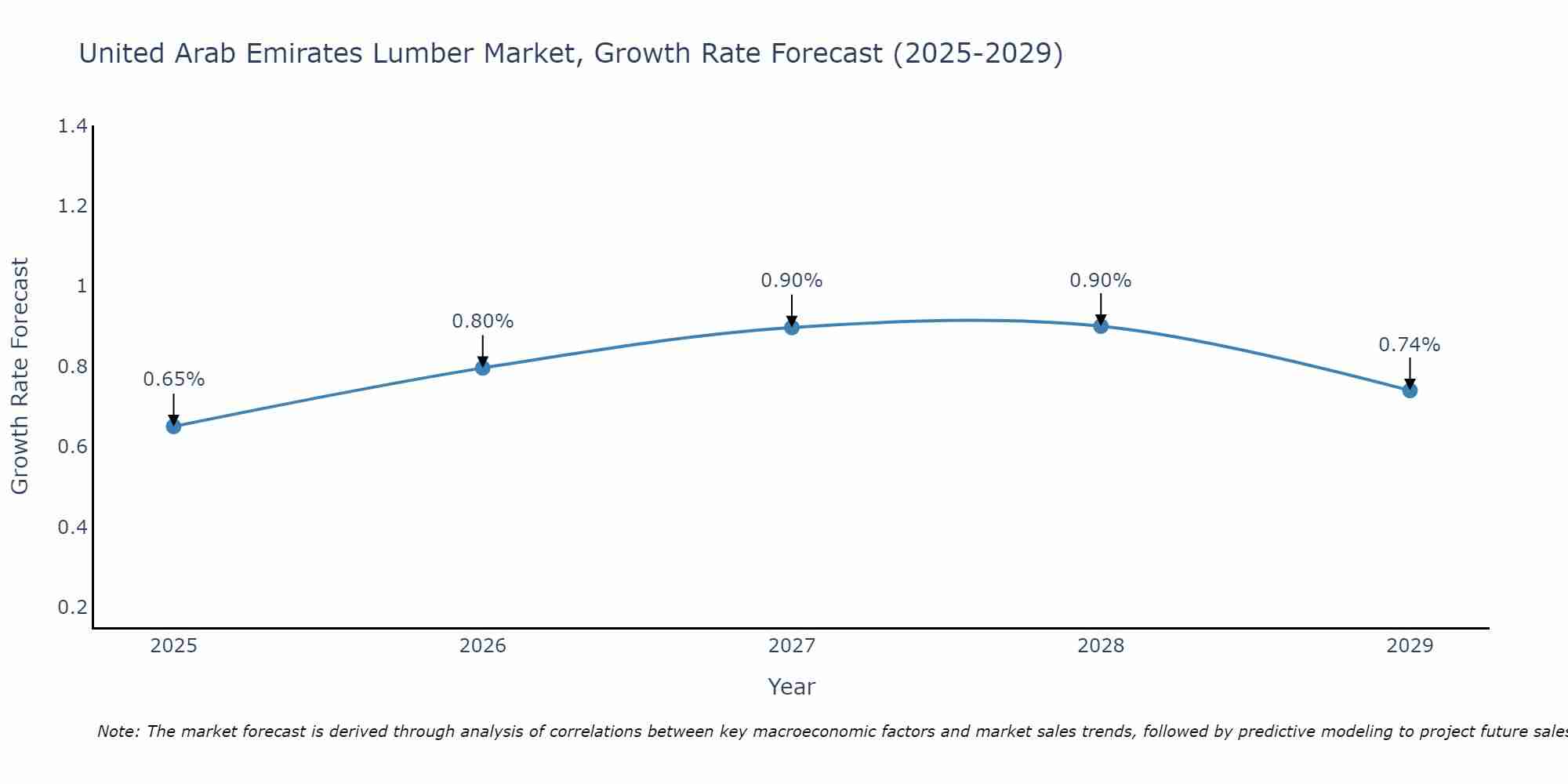
The United Arab Emirates Lumber Market is projected to witness mixed growth rate patterns during 2025 to 2029. Starting at 0.65% in 2025, the market peaks at 0.90% in 2028, and settles at 0.74% by 2029.
United Arab Emirates (UAE) Lumber Market Synopsis
The United Arab Emirates is a significant player in the Middle Eastern construction industry. The demand for lumber in the UAE is primarily driven by the booming construction and real estate sectors. Lumber is widely used in residential and commercial construction projects, as well as in the production of furniture and other wood-based products.
Drivers of the Market
The UAE has been experiencing rapid urbanization and infrastructure development, leading to an increased demand for lumber in the construction sector. Further, a growing population, coupled with a rise in disposable income, has resulted in a higher demand for housing and consumer goods, further driving the lumber market. Moreover, the UAE is a popular tourist destination, and the growth of the tourism and hospitality industry has led to the construction of hotels, resorts, and other related infrastructure, contributing to the demand for lumber.
Challenges of the Market
The UAE is not a major lumber producer, and a large portion of the lumber used in the country is imported. This dependence on imports can lead to supply chain disruptions and price fluctuations. Further, the lumber industry faces scrutiny for its impact on deforestation and environmental degradation. Striking a balance between economic growth and sustainability is a challenge for the industry.
Covid-19 Impact on the Market
The COVID-19 pandemic had significant implications for global markets, including the lumber industry. While I don`t have specific data for the UAE beyond 2025, it`s worth noting that the pandemic led to disruptions in supply chains and fluctuations in demand. Depending on the severity of the outbreak and related restrictions in the UAE, construction activities and related lumber consumption may have been affected.
Key Players of the Market
Arab Building Materials Co. LLC (ABMC), Arabian Gulf Manufacturers Ltd. (AGM), Al Fajer Building Materials LLC, Hardwood Forest Trading LLC, Hassan Abul Co. and Al Tayer Stocks LLC.
Key Highlights of the Report:
- United Arab Emirates (UAE) Lumber Market Outlook
- Market Size of United Arab Emirates (UAE) Lumber Market, 2024
- Forecast of United Arab Emirates (UAE) Lumber Market, 2031
- Historical Data and Forecast of United Arab Emirates (UAE) Lumber Revenues & Volume for the Period 2021-2031
- United Arab Emirates (UAE) Lumber Market Trend Evolution
- United Arab Emirates (UAE) Lumber Market Drivers and Challenges
- United Arab Emirates (UAE) Lumber Price Trends
- United Arab Emirates (UAE) Lumber Porter's Five Forces
- United Arab Emirates (UAE) Lumber Industry Life Cycle
- Historical Data and Forecast of United Arab Emirates (UAE) Lumber Market Revenues & Volume By Types for the Period 2021-2031
- Historical Data and Forecast of United Arab Emirates (UAE) Lumber Market Revenues & Volume By Hardwood Lumber for the Period 2021-2031
- Historical Data and Forecast of United Arab Emirates (UAE) Lumber Market Revenues & Volume By Softwood Lumber for the Period 2021-2031
- Historical Data and Forecast of United Arab Emirates (UAE) Lumber Market Revenues & Volume By Application for the Period 2021-2031
- Historical Data and Forecast of United Arab Emirates (UAE) Lumber Market Revenues & Volume By Construction for the Period 2021-2031
- Historical Data and Forecast of United Arab Emirates (UAE) Lumber Market Revenues & Volume By Furniture for the Period 2021-2031
- Historical Data and Forecast of United Arab Emirates (UAE) Lumber Market Revenues & Volume By Flooring for the Period 2021-2031
- Historical Data and Forecast of United Arab Emirates (UAE) Lumber Market Revenues & Volume By Moldings for the Period 2021-2031
- Historical Data and Forecast of United Arab Emirates (UAE) Lumber Market Revenues & Volume By Others for the Period 2021-2031
- United Arab Emirates (UAE) Lumber Import Export Trade Statistics
- Market Opportunity Assessment By Types
- Market Opportunity Assessment By Application
- United Arab Emirates (UAE) Lumber Top Companies Market Share
- United Arab Emirates (UAE) Lumber Competitive Benchmarking By Technical and Operational Parameters
- United Arab Emirates (UAE) Lumber Company Profiles
- United Arab Emirates (UAE) Lumber Key Strategic Recommendations






































