United Arab Emirates (UAE) Malt Beverages Market Summary
The united arab emirates (uae) malt beverages market was estimated at USD 499 Million in 2025 and is projected to reach USD 933 Million by 2032, growing at a CAGR of 10.8% from 2026 to 2032.
United Arab Emirates (UAE) Malt Beverages Market Year-wise Growth Rate and Key Drivers
This graph highlights how the United Arab Emirates (UAE) Malt Beverages Market has steadily grown over the past five years, supported by major growth factors.
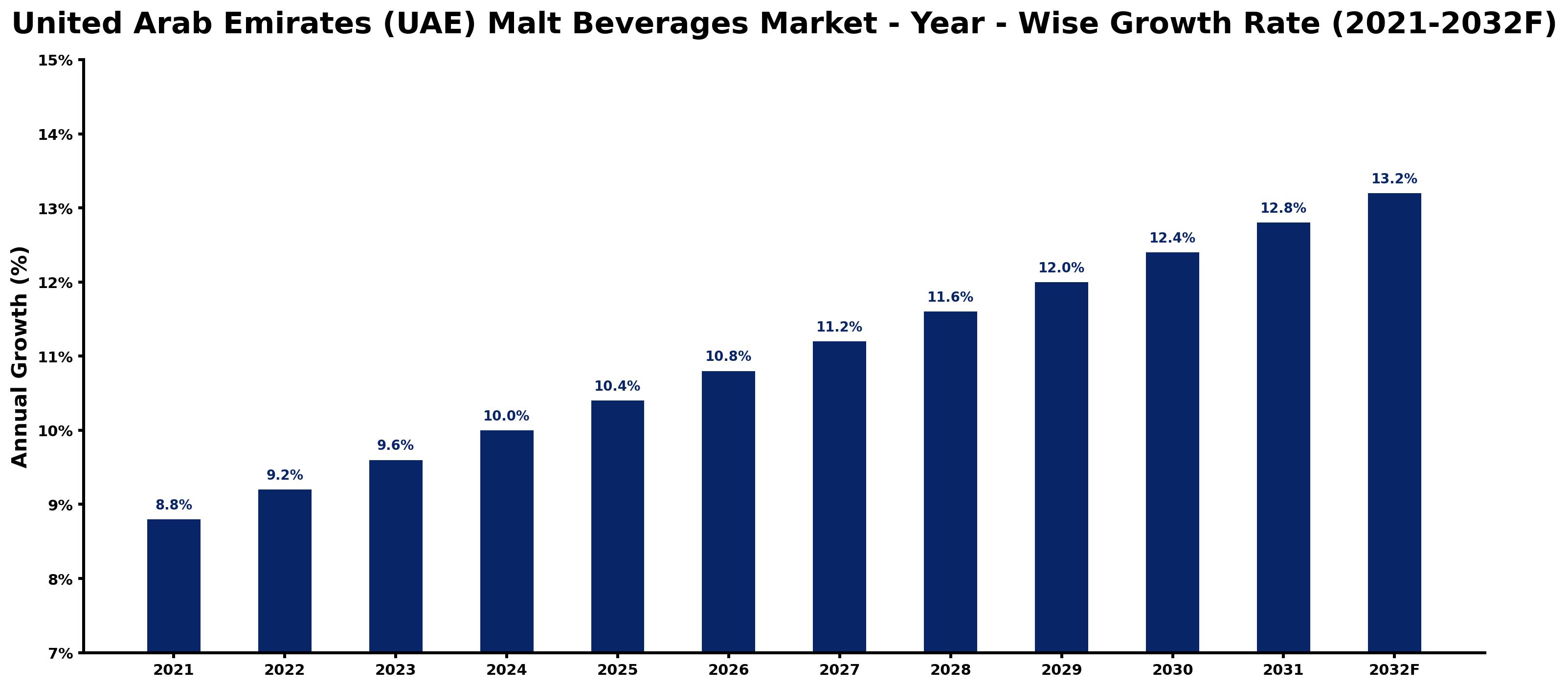
The table below presents the year wise growth rates along with the key drivers influencing the market
| Year | Growth Rate | Major Drivers |
| 2021 | 8.8% | The pandemic emphasized the importance of non-alcoholic beverage options in social settings. |
| 2022 | 9.2% | Increased consumer interest in health and wellness led to malt beverage experimentation. |
| 2023 | 9.6% | Local breweries capitalized on Emirati cultural flavors, boosting regional product appeal. |
| 2024 | 10.0% | International brands entered the market, intensifying competition and consumer choices. |
| 2025 | 10.4% | Online shopping platforms expanded, making malt beverages more accessible to consumers. |
| 2026 | 10.8% | Growing social acceptance of non-alcoholic beverages reshaped traditional consumption patterns. |
| 2027 | 11.2% | Collaborations with restaurants enhanced branding and boosted visibility of malt beverages. |
| 2028 | 11.6% | Innovative marketing campaigns attracted younger consumers seeking trendy beverage options. |
| 2029 | 12.0% | Sustainability trends prompted the introduction of eco-friendly packaging for malt products. |
| 2030 | 12.4% | Increased disposable incomes fostered premium malt beverage offerings in urban centers. |
| 2031 | 12.8% | Cultural events celebrated local flavors, driving interest in unique malt beverage varieties. |
| 2032 | 13.2% | Widespread retail expansion created more opportunities for malt beverage visibility and sales. |
Note - Market size estimations and growth projections presented in this report are based on 6Wresearch's advanced forecasting approach, validated with industry datasets as of June 2026.
United Arab Emirates (UAE) Malt Beverages Market Synopsis
The United Arab Emirates (UAE) Malt Beverages Market is projected to reach 10.8% and witness significant growth during the forecast period (2026-2032). Malt beverages, which derive from grains such as barley, are gaining traction in the UAE due to their refreshing taste and health benefits. This upward trend is driven by evolving consumer preferences, a health-conscious demographic, and increased disposable income among the population.
United Arab Emirates (UAE) Malt Beverages Market Growth Drivers
Several key factors are contributing to the growth of the UAE malt beverages market. First, the rising emphasis on health and wellness has prompted consumers to look for alternatives to sugary sodas. Malt beverages often appeal to this audience thanks to their perception as healthier options.
- With a growing younger population, many consumers are more willing to explore new beverage choices. This demographic shift has set the stage for increased interest in innovative products such as malt beverages.
- The tourism sector in the UAE remains a pivotal driver, as millions flock to the country each year. The consequent expansion in the hospitality industry has fueled demand for non-alcoholic beverages, including malt beverages, catering to a diverse range of tourists.
- Increasing disposable income allows consumers to experiment with premium and diverse beverage options. This trend indicates a receptive market environment for malt beverages in particular.
- Brands are increasingly focusing on marketing efforts that highlight the health benefits and unique flavors of malt beverages, giving them a competitive edge.
- Retail expansion and a surge in e-commerce platforms have made malt beverages more accessible to consumers, further driving up demand.
United Arab Emirates (UAE) Malt Beverages Market Challenges and Restraints
Despite the promising growth outlook, the UAE malt beverages market faces several challenges that could impede its trajectory. The market is experiencing formidable competition from alternative non-alcoholic beverages such as juices, flavored waters, and energy drinks, which can dilute the market share of malt beverages.
- Sustaining consumer interest amidst a plethora of beverage choices can be challenging, requiring ongoing market innovation and effective marketing strategies.
- Distribution and logistics issues may arise as companies strive to ensure their products are readily available across various retail channels.
- Economic fluctuations and changes in consumer spending patterns can significantly impact the performance of the malt beverages market, particularly in a diverse economy such as the UAE.
- Market players must navigate regulatory environments that may affect product formulations and health claims, necessitating agility in compliance.
- Rising production costs due to fluctuations in raw material prices may lead to higher prices for consumers, potentially affecting demand.
United Arab Emirates (UAE) Malt Beverages Market COVID-19 Impact
The COVID-19 pandemic significantly altered the consumption patterns within the UAE malt beverages market. With increased focus on at-home consumption, consumers tended to gravitate towards packaged and non-alcoholic beverages. The implementation of social distancing measures and temporary restrictions on dining led to a substantial shift in beverage consumption, with an inclination towards malt beverages as a preferred non-alcoholic option.
United Arab Emirates (UAE) Malt Beverages Market Government Investment and Initiatives
The UAE government has shown commitment to fostering the growth of various beverage sectors, including malt beverages, through strategic investments and initiatives. Programmes that support local manufacturing and innovation in the food and beverage sector aim to enhance product quality and sustainability practices. Additionally, the government encourages the diversification of the economy, which includes promoting health-centric beverage alternatives. Investment in infrastructure for distribution and retail is also on the agenda, facilitating broader market access for malt beverage producers.
United Arab Emirates (UAE) Malt Beverages Market Latest Developments (May 2025 - June 2026)
Recent developments in the UAE malt beverages market from May 2025 to June 2026 indicate a vibrant industry landscape. Companies are increasingly launching new products that emphasize unique flavors and health benefits, catering to the evolving preferences of consumers. Marketing campaigns are focusing more on the lifestyle aspects associated with malt beverages, promoting them as refreshing and modern alternatives. Sustainable practices are being adopted more widely, with companies exploring eco-friendly packaging solutions to align with consumer expectations. Furthermore, collaborations within the hospitality industry are emerging to promote malt beverages in various dining establishments, enhancing visibility and availability.
United Arab Emirates (UAE) Malt Beverages Market - Key Attractiveness of the Report
- 10 Years of Market Numbers
- Historical Data Starting from 2022 to 2025
- Base Year: 2025
- Forecast Data until 2032
- Key Performance Indicators Impacting the Market
- Major Upcoming Developments and Projects
Key Highlights of the Report:
- United Arab Emirates (UAE) Malt Beverages Market Outlook
- Market Size of United Arab Emirates (UAE) Malt Beverages Market, 2025
- Forecast of United Arab Emirates (UAE) Malt Beverages Market, 2032
- Historical Data and Forecast of United Arab Emirates (UAE) Malt Beverages Revenues & Volume for the Period 2022-2032F
- United Arab Emirates (UAE) Malt Beverages Market Trend Evolution
- United Arab Emirates (UAE) Malt Beverages Market Drivers and Challenges
- United Arab Emirates (UAE) Malt Beverages Price Trends
- United Arab Emirates (UAE) Malt Beverages Porter's Five Forces
- United Arab Emirates (UAE) Malt Beverages Industry Life Cycle
- Historical Data and Forecast of United Arab Emirates (UAE) Malt Beverages Market Revenues & Volume By Product Type for the Period 2022-2032F
- Historical Data and Forecast of United Arab Emirates (UAE) Malt Beverages Market Revenues & Volume By Flavored for the Period 2022-2032F
- Historical Data and Forecast of United Arab Emirates (UAE) Malt Beverages Market Revenues & Volume By Unflavored for the Period 2022-2032F
- Historical Data and Forecast of United Arab Emirates (UAE) Malt Beverages Market Revenues & Volume By Applications for the Period 2022-2032F
- Historical Data and Forecast of United Arab Emirates (UAE) Malt Beverages Market Revenues & Volume By Alcoholic for the Period 2022-2032F
- Historical Data and Forecast of United Arab Emirates (UAE) Malt Beverages Market Revenues & Volume By Non-Alcoholic for the Period 2022-2032F
- United Arab Emirates (UAE) Malt Beverages Import Export Trade Statistics
- Market Opportunity Assessment By Product Type
- Market Opportunity Assessment By Applications
- United Arab Emirates (UAE) Malt Beverages Top Companies Market Share
- United Arab Emirates (UAE) Malt Beverages Competitive Benchmarking By Technical and Operational Parameters
- United Arab Emirates (UAE) Malt Beverages Company Profiles
- United Arab Emirates (UAE) Malt Beverages Key Strategic Recommendations






































