United Arab Emirates (UAE) Meat Packaging Market Summary
The united arab emirates (uae) meat packaging market was estimated at USD 154 Million in 2025 and is projected to reach USD 215 Million by 2032, growing at a CAGR of 5.9% from 2026 to 2032.
United Arab Emirates (UAE) Meat Packaging Market Year-wise Growth Rate and Key Drivers
This graph highlights how the United Arab Emirates (UAE) Meat Packaging Market has steadily grown over the past five years, supported by major growth factors.
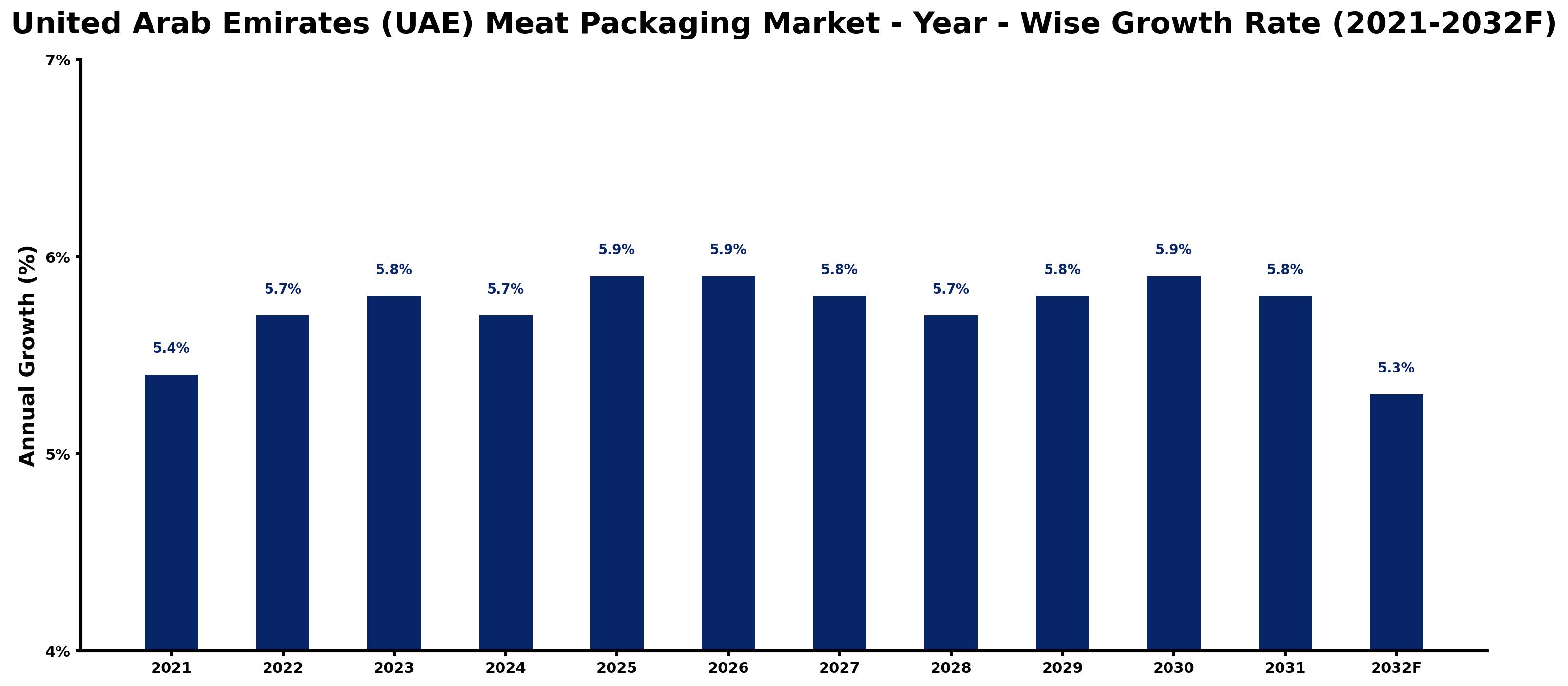
The table below presents the year wise growth rates along with the key drivers influencing the market
| Year | Growth Rate | Major Drivers |
| 2021 | 5.4% | Post-lockdown retail projects saw significant investments in meat packaging facilities. |
| 2022 | 5.7% | Consumer preferences shifted towards convenience, boosting packaged meat sales across retailers. |
| 2023 | 5.8% | Local producers increasingly expanded operations to cater to the growing expatriate population. |
| 2024 | 5.7% | Technological integration enhanced supply chain efficiency in meat packaging processes. |
| 2025 | 5.9% | Demand for halal-certified products created niche markets for localized meat suppliers. |
| 2026 | 5.9% | Increased focus on food safety regulations prompted upgrades in packaging technologies. |
| 2027 | 5.8% | E-commerce platforms emerged as key channels for meat distribution, reshaping market dynamics. |
| 2028 | 5.7% | Health-conscious consumers prioritized organic and sustainably sourced meat products. |
| 2029 | 5.8% | Competitive pricing strategies resulted in an influx of international meat packaging brands. |
| 2030 | 5.9% | Investments in cold chain logistics improved the quality and distribution of packaged meats. |
| 2031 | 5.8% | Urbanization trends led to higher consumption rates in metropolitan areas of the UAE. |
| 2032 | 5.3% | Collaborations between local farms and packagers emphasized traceability and quality assurance. |
Note - Market size estimations and growth projections presented in this report are based on 6Wresearch's advanced forecasting approach, validated with industry datasets as of June 2026.
United Arab Emirates (UAE) Meat Packaging Market Synopsis
The United Arab Emirates (UAE) Meat Packaging Market is projected to reach 5.9% and witness significant growth during the forecast period (2026-2032). This market encompasses the production and supply of specialized packaging solutions tailored for various forms of meat, including fresh, frozen, and processed options. The upward trajectory of the market can be attributed to several key factors, including an expanding population in the UAE, rising meat consumption, and an increasing demand for safe and hygienic packaging alternatives.
United Arab Emirates (UAE) Meat Packaging Market Growth Drivers
Several driving forces contribute to the growth of the UAE meat packaging market. Firstly, the rapid urbanization and population increase in the country create higher demand for packaged and processed meat products. As urban lifestyles become more prevalent, consumers increasingly seek convenient packaging that aligns with their busy routines. Secondly, there is a growing consumer preference for hygienically packaged meat, which has become particularly prominent in reaction to heightened health and safety awareness. Below are additional drivers influencing the market:
- The trend towards convenience foods has led to a surge in demand for ready-to-eat and easy-to-prepare meat products, necessitating innovative packaging solutions.
- Advancements in packaging technologies are improving shelf life, thus meeting consumer expectations for freshness and quality in meat products.
- Regulatory frameworks favoring food safety and hygiene are pushing manufacturers to adopt more sophisticated packaging methods.
- Increased awareness of food waste issues is driving demand for packaging that prolongs the freshness and usability of meat products.
- The expansion of retail and e-commerce channels is significantly impacting the delivery mechanisms for packaged meat, further stimulating the sector.
United Arab Emirates (UAE) Meat Packaging Market Challenges and Restraints
Despite the promising outlook, the UAE meat packaging market faces several challenges. A principal concern is the pressing need for sustainable packaging solutions, as consumers and regulatory bodies increasingly emphasize environmental responsibility. Manufacturers must innovate to provide eco-friendly alternatives while also ensuring compliance with food safety standards. Additional challenges include:
- Volatility in the costs of raw materials used for packaging may hinder profitability and create uncertainties for producers.
- Logistical challenges, particularly in supply chain management, can lead to inefficiencies in distribution and increased operational costs.
- The high rate of competition in the packaging industry necessitates continuous innovation and investment, which could strain smaller firms.
- Adapting to rapidly changing consumer preferences requires flexible production processes that can respond quickly to market trends.
- The ongoing emphasis on health and safety post-pandemic necessitates constant monitoring and adaptation to maintain compliance with evolving regulations.
United Arab Emirates (UAE) Meat Packaging Market COVID-19 Impact
The COVID-19 pandemic has significantly impacted the meat packaging market in the UAE. Disruptions in the food supply chain led to shifts in consumer behavior, with an increased inclination towards packaged and frozen meat products. This trend temporarily bolstered demand within the sector, highlighting the importance of packaging that offers security and contamination resistance. Additionally, the pandemic has underscored the necessity for packaging that assures consumers of product safety and hygiene, further shaping the market dynamics.
United Arab Emirates (UAE) Meat Packaging Market Government Investment and Initiatives
The UAE government is actively fostering the growth of the meat packaging market through various investment initiatives and strategic policies. Recognizing the importance of food security and sustainable practices, the government encourages the development of innovations in packaging technology. Public spending on infrastructure improvement and support for local manufacturing enterprises aims to bolster the meat supply chain. Moreover, initiatives promoting sustainable packaging reflect a commitment to aligning with global environmental standards. These development plans support local businesses in adopting advanced packaging systems that cater to both safety and sustainability.
United Arab Emirates (UAE) Meat Packaging Market Latest Developments (May 2025 - June 2026)
In the period between May 2025 and June 2026, the UAE meat packaging market has seen a series of notable developments. There has been a noticeable shift towards eco-friendly packaging solutions, with more companies investing in biodegradable and recyclable materials to meet consumer demands and regulatory requirements. Additionally, the integration of smart packaging technologies has emerged as a trend, enhancing the traceability and safety of meat products. Industry stakeholders are increasingly collaborating to explore innovative packaging methods that can extend shelf life while minimizing environmental impact, indicating a robust direction towards sustainable practices.
United Arab Emirates (UAE) Meat Packaging Market - Key Attractiveness of the Report
- 10 Years of Market Numbers
- Historical Data Starting from 2022 to 2025
- Base Year: 2025
- Forecast Data until 2032
- Key Performance Indicators Impacting the Market
- Major Upcoming Developments and Projects
Key Highlights of the Report:
- United Arab Emirates (UAE) Meat Packaging Market Outlook
- Market Size of United Arab Emirates (UAE) Meat Packaging Market, 2025
- Forecast of United Arab Emirates (UAE) Meat Packaging Market, 2032
- Historical Data and Forecast of United Arab Emirates (UAE) Meat Packaging Revenues & Volume for the Period 2022-2032F
- United Arab Emirates (UAE) Meat Packaging Market Trend Evolution
- United Arab Emirates (UAE) Meat Packaging Market Drivers and Challenges
- United Arab Emirates (UAE) Meat Packaging Price Trends
- United Arab Emirates (UAE) Meat Packaging Porter's Five Forces
- United Arab Emirates (UAE) Meat Packaging Industry Life Cycle
- Historical Data and Forecast of United Arab Emirates (UAE) Meat Packaging Market Revenues & Volume By Material Type for the Period 2022-2032F
- Historical Data and Forecast of United Arab Emirates (UAE) Meat Packaging Market Revenues & Volume By Plastic for the Period 2022-2032F
- Historical Data and Forecast of United Arab Emirates (UAE) Meat Packaging Market Revenues & Volume By Rigid? for the Period 2022-2032F
- Historical Data and Forecast of United Arab Emirates (UAE) Meat Packaging Market Revenues & Volume By Metal for the Period 2022-2032F
- Historical Data and Forecast of United Arab Emirates (UAE) Meat Packaging Market Revenues & Volume By Meat Type for the Period 2022-2032F
- Historical Data and Forecast of United Arab Emirates (UAE) Meat Packaging Market Revenues & Volume By Fresh and Frozen for the Period 2022-2032F
- Historical Data and Forecast of United Arab Emirates (UAE) Meat Packaging Market Revenues & Volume By Processed for the Period 2022-2032F
- Historical Data and Forecast of United Arab Emirates (UAE) Meat Packaging Market Revenues & Volume By Ready to Eat for the Period 2022-2032F
- United Arab Emirates (UAE) Meat Packaging Import Export Trade Statistics
- Market Opportunity Assessment By Material Type
- Market Opportunity Assessment By Meat Type
- United Arab Emirates (UAE) Meat Packaging Top Companies Market Share
- United Arab Emirates (UAE) Meat Packaging Competitive Benchmarking By Technical and Operational Parameters
- United Arab Emirates (UAE) Meat Packaging Company Profiles
- United Arab Emirates (UAE) Meat Packaging Key Strategic Recommendations






































