United Arab Emirates (UAE) Mechanical Seal Market Size, Share & Growth Rate
The United Arab Emirates (UAE) Mechanical Seal Market was estimated at USD 364 Million in 2025 and is projected to reach USD 495 Million by 2032, growing at a CAGR of 4.5% from 2026 to 2032. This robust growth trajectory is attributed to the escalating demand for mechanical seals across vital sectors such as oil and gas, water treatment, and manufacturing. Increased investments in infrastructure and a regulatory push for safety and environmental sustainability further bolster the market's expansion.
United Arab Emirates (UAE) Mechanical Seal Market Year-wise Growth Rate and Key Drivers
This graph highlights how the United Arab Emirates (UAE) Mechanical Seal Market has steadily grown over the years, supported by major growth factors.
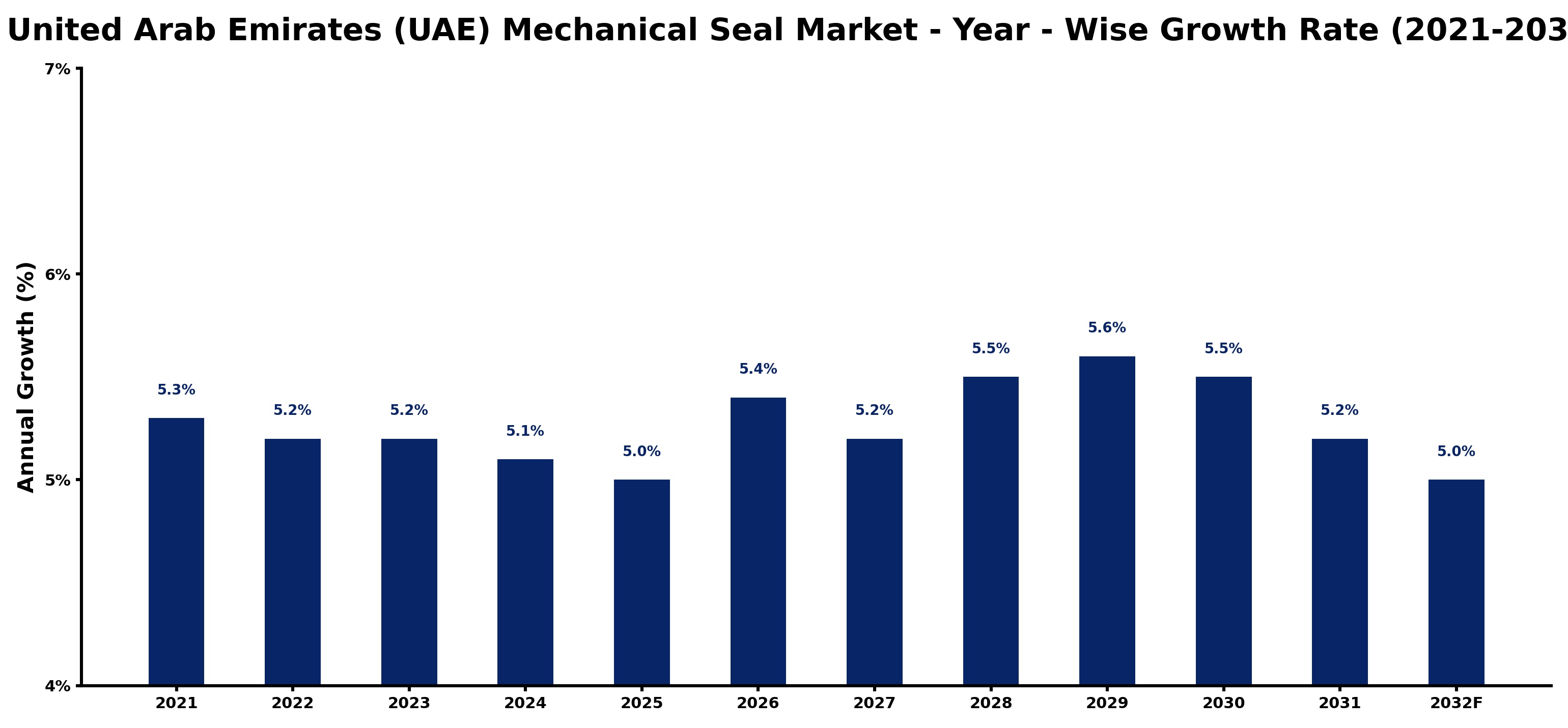
The table below presents the year‑wise growth rates along with the key drivers influencing the market
| Year | Growth Rate | Major Drivers |
| 2021 | 5.3% | Expansion of commercial construction activities |
| 2022 | 5.2% | Expansion of commercial construction activities |
| 2023 | 5.2% | Expansion of manufacturing activities |
| 2024 | 5.1% | Expansion of manufacturing activities |
| 2025 | 5.0% | Rapid growth in telecom and data center sectors |
| 2026 | 5.4% | Expansion of manufacturing activities |
| 2027 | 5.2% | Government infrastructure modernization initiatives |
| 2028 | 5.5% | Government infrastructure modernization initiatives |
| 2029 | 5.6% | Increasing adoption of advanced technologies |
| 2030 | 5.5% | Increasing industrial infrastructure investments |
| 2031 | 5.2% | Growing renewable energy integration projects |
| 2032 | 5.0% | Increasing adoption of advanced technologies |
Note - Market size estimations and growth projections presented in this report are based on 6Wresearch's advanced forecasting approach, validated with industry datasets as of June 2026.
United Arab Emirates (UAE) Mechanical Seal Market Synopsis
In recent years, the UAE mechanical seal market has witnessed remarkable growth, driven by the country's dynamic industrial landscape. Mechanical seals play a critical role in maintaining operational efficiency and preventing fluid leakage in essential machinery, thereby underscoring their importance across various sectors.
With the nation's industrial sector expanding, mechanical seals are increasingly favored over traditional packing seals due to their superior performance. This trend is particularly prominent in industries such as oil and gas, petrochemicals, and water treatment, where reliability and environmental compliance are paramount.
United Arab Emirates (UAE) Mechanical Seal Market Key Takeaways
- The UAE's mechanical seal market is projected to grow at a CAGR of 4.5% from 2026 to 2032.
- Significant demand stems from the oil and gas sector, where advanced sealing solutions are essential.
- Infrastructure projects are driving the need for reliable sealing technology in water and wastewater treatment.
- Environmental regulations are pushing industries towards adopting more eco-friendly sealing solutions.
- Investment in skilled labor is essential for the effective implementation of advanced mechanical seals.
Evaluation of Restraints in United Arab Emirates (UAE) Mechanical Seal Market
Despite promising growth, the UAE mechanical seal market faces notable restraints. A primary concern is the competition from alternative sealing solutions like packing seals and magnetic seals, which may be perceived as less costly options upfront. Furthermore, the associated costs of maintenance and the requirement for skilled technicians to install and manage mechanical seals pose additional hurdles for widespread adoption in some sectors. This combination of factors has the potential to limit market expansion, especially in industries sensitive to operational costs.
United Arab Emirates (UAE) Mechanical Seal Market Trends
Current trends shaping the UAE mechanical seal market highlight an increasing emphasis on technology and sustainability. Manufacturers are focusing on creating seals that not only enhance operational efficiency but also minimize environmental impact. Innovations such as smart seals equipped with sensors to monitor performance and predict maintenance needs are gaining traction. Additionally, the push for energy efficiency in industrial operations is prompting more industries to transition towards high-performance mechanical seals.
United Arab Emirates (UAE) Mechanical Seal Market Opportunities
As the UAE continues to invest in its industrial infrastructure, significant growth opportunities lie ahead for the mechanical seal market. The ongoing development of water treatment facilities and renewable energy projects presents a ripe environment for the adoption of advanced sealing solutions. Furthermore, the rising demand for environmentally friendly products is creating avenues for innovation and new product development, allowing companies to cater to evolving industry standards and customer preferences.
Government Initiatives in the United Arab Emirates (UAE) Mechanical Seal Market
The UAE government has implemented several initiatives aimed at promoting industrial growth and enhancing operational safety, which are beneficial to the mechanical seal market. Programs focused on infrastructure development, particularly in water management and energy sectors, directly impact the demand for mechanical seals. Regulatory frameworks emphasizing environmental sustainability and safety protocols further encourage industries to adopt advanced sealing technologies to comply with new standards.
Future Insights of the United Arab Emirates (UAE) Mechanical Seal Market
Looking ahead to the period between 2026 and 2032, the UAE mechanical seal market is set to evolve significantly. With continued investments in industrial sectors and a consistent push towards modernization, the market will likely see enhanced innovation and increased adoption of advanced sealing technologies. The integration of IoT and smart technology into mechanical seals will further redefine industry standards, making operations more efficient and reliable. As the UAE prioritizes safety and environmental considerations, the mechanical seal market is poised for sustainable growth.
United Arab Emirates (UAE) Mechanical Seal Market Latest Developments (May 2025 - June 2026)
In recent months, the UAE mechanical seal market has seen a shift towards the incorporation of advanced technologies in sealing solutions. Companies are actively exploring the development of smart mechanical seals that provide real-time monitoring capabilities. Additionally, there has been an uptick in collaborative efforts between local suppliers and international firms to enhance product offerings, thereby fostering innovation and improving service delivery within the sector.
United Arab Emirates (UAE) Mechanical Seal Market - Key Attractiveness of the Report
- 10 Years of Market Numbers
- Historical Data Starting from 2022 to 2025
- Base Year: 2025
- Forecast Data until 2032
- Key Performance Indicators Impacting the Market
- Major Upcoming Developments and Projects
Key Highlights of the Report:
- United Arab Emirates (UAE) Mechanical Seal Market Outlook
- Market Size of United Arab Emirates (UAE) Mechanical Seal Market, 2025
- Forecast of United Arab Emirates (UAE) Mechanical Seal Market, 2032
- Historical Data and Forecast of United Arab Emirates (UAE) Mechanical Seal Revenues & Volume for the Period 2022-2032F
- United Arab Emirates (UAE) Mechanical Seal Market Trend Evolution
- United Arab Emirates (UAE) Mechanical Seal Market Drivers and Challenges
- United Arab Emirates (UAE) Mechanical Seal Price Trends
- United Arab Emirates (UAE) Mechanical Seal Porter's Five Forces
- United Arab Emirates (UAE) Mechanical Seal Industry Life Cycle
- Historical Data and Forecast of United Arab Emirates (UAE) Mechanical Seal Market Revenues & Volume By Type for the Period 2022-2032F
- Historical Data and Forecast of United Arab Emirates (UAE) Mechanical Seal Market Revenues & Volume By Cartridge Seals for the Period 2022-2032F
- Historical Data and Forecast of United Arab Emirates (UAE) Mechanical Seal Market Revenues & Volume By Balanced and Unbalanced Seals for the Period 2022-2032F
- Historical Data and Forecast of United Arab Emirates (UAE) Mechanical Seal Market Revenues & Volume By Pusher and Non-Pusher for the Period 2022-2032F
- Historical Data and Forecast of United Arab Emirates (UAE) Mechanical Seal Market Revenues & Volume By Conventional Seals for the Period 2022-2032F
- Historical Data and Forecast of United Arab Emirates (UAE) Mechanical Seal Market Revenues & Volume By Others for the Period 2022-2032F
- Historical Data and Forecast of United Arab Emirates (UAE) Mechanical Seal Market Revenues & Volume By Industry for the Period 2022-2032F
- Historical Data and Forecast of United Arab Emirates (UAE) Mechanical Seal Market Revenues & Volume By Metal & Mining for the Period 2022-2032F
- Historical Data and Forecast of United Arab Emirates (UAE) Mechanical Seal Market Revenues & Volume By Food& Beverage for the Period 2022-2032F
- Historical Data and Forecast of United Arab Emirates (UAE) Mechanical Seal Market Revenues & Volume By Oil & Gas for the Period 2022-2032F
- Historical Data and Forecast of United Arab Emirates (UAE) Mechanical Seal Market Revenues & Volume By Energy & Power for the Period 2022-2032F
- Historical Data and Forecast of United Arab Emirates (UAE) Mechanical Seal Market Revenues & Volume By Aerospace for the Period 2022-2032F
- Historical Data and Forecast of United Arab Emirates (UAE) Mechanical Seal Market Revenues & Volume By Marine for the Period 2022-2032F
- Historical Data and Forecast of United Arab Emirates (UAE) Mechanical Seal Market Revenues & Volume By Construction & Manufacturer for the Period 2022-2032F
- Historical Data and Forecast of United Arab Emirates (UAE) Mechanical Seal Market Revenues & Volume By Others for the Period 2022-2032F
- United Arab Emirates (UAE) Mechanical Seal Import Export Trade Statistics
- Market Opportunity Assessment By Type
- Market Opportunity Assessment By Industry
- United Arab Emirates (UAE) Mechanical Seal Top Companies Market Share
- United Arab Emirates (UAE) Mechanical Seal Competitive Benchmarking By Technical and Operational Parameters
- United Arab Emirates (UAE) Mechanical Seal Company Profiles
- United Arab Emirates (UAE) Mechanical Seal Key Strategic Recommendations






































