United Arab Emirates (UAE) Microbial Products Market Size, Share & Growth Rate
The United Arab Emirates (UAE) Microbial Products Market was estimated at USD 395 Million in 2025 and is projected to reach USD 534 Million by 2032, growing at a CAGR of 4.4% from 2026 to 2032. This positive growth trajectory is being fueled by a significant shift towards sustainable agricultural practices and a burgeoning interest in eco-friendly solutions among local farmers. Additionally, the UAE government's initiatives aimed at fostering innovation and sustainability in agriculture have further reinforced this market's potential.
United Arab Emirates (UAE) Microbial Products Market Year-wise Growth Rate and Key Drivers
This graph highlights how the United Arab Emirates (UAE) Microbial Products Market has steadily grown over the years, supported by major growth factors.
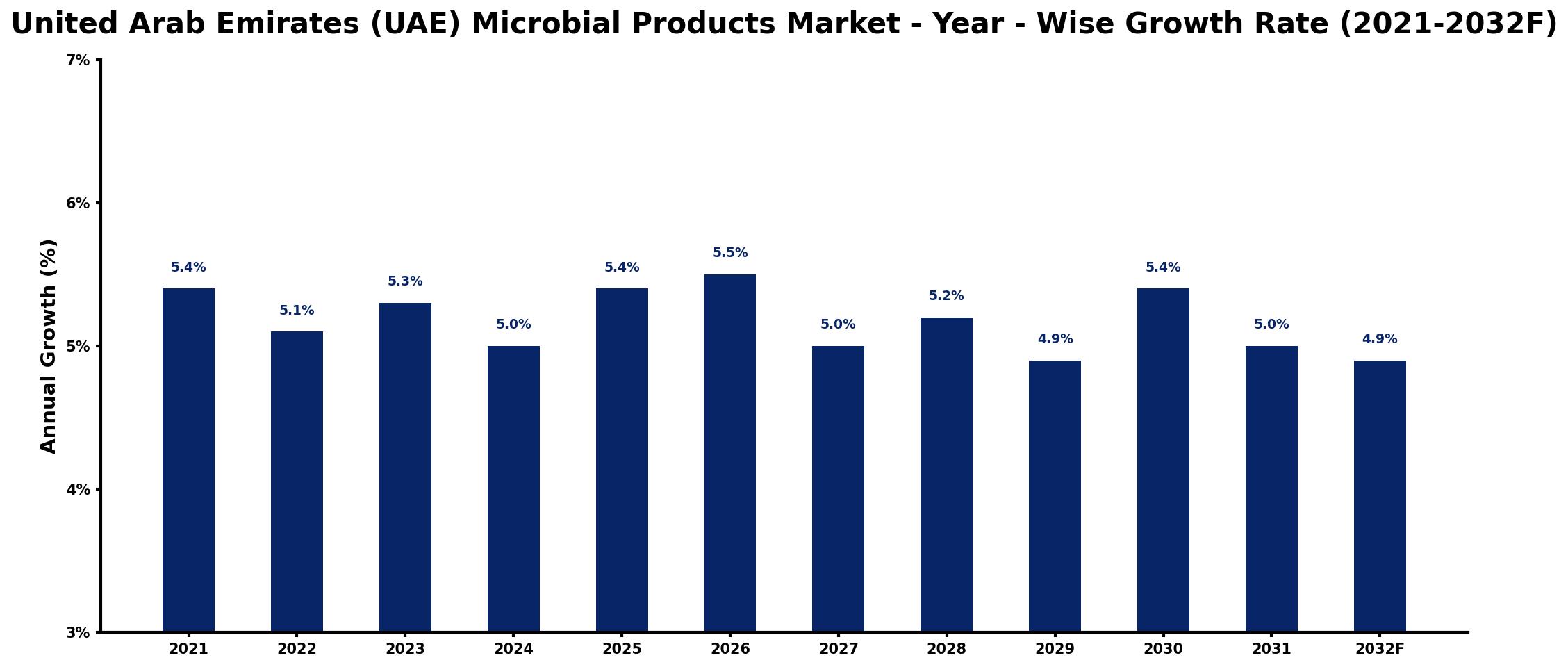
The table below presents the year‑wise growth rates along with the key drivers influencing the market
| Year | Growth Rate | Major Drivers |
| 2021 | 5.4% | Rising demand for sustainable solutions |
| 2022 | 5.1% | growing automotive sector requirements |
| 2023 | 5.3% | Increased investment in biotechnology |
| 2024 | 5.0% | Growing awareness of environmental benefits |
| 2025 | 5.4% | Technological advancements in production |
| 2026 | 5.5% | Surge in agricultural applications |
| 2027 | 5.0% | Enhancements in regulatory frameworks |
| 2028 | 5.2% | Focus on food safety standards |
| 2029 | 4.9% | Diversification of industrial applications |
| 2030 | 5.4% | Increase in research and development |
| 2031 | 5.0% | Strengthening of supply chain partnerships |
| 2032 | 4.9% | Emergence of new market players |
Note: Market size estimations and growth projections presented in this report are based on 6Wresearch's proprietary forecasting methodology, utilizing the latest available industry data, government publications, and primary research inputs.
United Arab Emirates (UAE) Microbial Products Market Synopsis
The most potent force currently shaping the UAE Microbial Products Market is the escalating demand for sustainable agricultural methods. As farmers increasingly prioritize environmental conservation, microbial products are emerging as a preferable alternative to conventional chemical solutions, aiding in soil health and crop productivity.
Moreover, the growing concerns regarding the environmental impact of traditional farming techniques have led to a concerted effort among cultivators to adopt practices that not only enhance yield but also preserve ecological balance. The integration of microbial solutions has become a cornerstone in this pursuit, marking a pivotal shift in agricultural methodologies across the region.
United Arab Emirates (UAE) Microbial Products Market Key Takeaways
- The market is projected to grow significantly as awareness of sustainable agriculture rises.
- Government initiatives are playing a crucial role in promoting the adoption of microbial products.
- There is a marked shift among farmers towards eco-friendly solutions to improve productivity.
- Despite potential, skepticism about microbial products remains a challenge.
- Post-pandemic recovery is expected to stabilize market dynamics and demand.
Evaluation of Restraints in United Arab Emirates (UAE) Microbial Products Market
Despite the promising growth prospects for the UAE Microbial Products Market, several restraints inhibit its full potential. A primary concern lies in the skepticism surrounding the effectiveness and safety of microbial solutions, stemming from a long-standing reliance on traditional chemical alternatives. Overcoming this entrenched mindset necessitates extensive education and demonstrable results to build trust in these new offerings. Furthermore, the lack of local expertise in microbial technology limits in-house development and innovation. This reliance on international partnerships for knowledge transfer presents logistical and strategic challenges that must be navigated carefully.
United Arab Emirates (UAE) Microbial Products Market Trends
The current landscape of the UAE Microbial Products Market is characterized by several key trends. The rise of bioplastics and biofuels, underpinned by a global drive towards sustainability, is reshaping product offerings. Additionally, as the agriculture sector becomes increasingly tech-oriented, there is a growing inclination towards integrating microbial products with modern agricultural technologies, such as precision farming. Probiotics and biofertilizers are also gaining traction, driven by both health trends and an increased focus on organic farming practices.
United Arab Emirates (UAE) Microbial Products Market Opportunities
Genuine growth opportunities in the UAE Microbial Products Market lie in the continuous innovation of products tailored to local agricultural needs. The increasing demand for organic produce offers substantial room for biofertilizers and biostimulants to penetrate the market. Furthermore, the expansion of the food and beverage industry provides an avenue for bioplastics, which can be integrated into packaging solutions, thus aligning with sustainable practices and consumer preferences. These avenues not only promise market growth but also facilitate alignment with national sustainability goals.
Government Initiatives in the United Arab Emirates (UAE) Microbial Products Market
The UAE government is actively implementing policies and programs to support the growth of the microbial products sector. Initiatives aimed at promoting sustainable agricultural practices include funding for research and development in microbial technologies and providing incentives for farmers adopting eco-friendly practices. Additionally, regulatory frameworks are being established to ensure the safe use of microbial products, thereby enhancing consumer confidence and stimulating market growth.
Future Insights of the United Arab Emirates (UAE) Microbial Products Market
Looking ahead to 2026-2032, the UAE Microbial Products Market is poised for significant evolution. The ongoing emphasis on sustainability, coupled with enhanced consumer awareness regarding the environmental impact of farming practices, is likely to propel demand for microbial solutions. As technology advances, innovations in microbial products will further enhance their efficacy and appeal, paving the way for wider adoption in agricultural sectors. This growth trajectory will be supported by continued government backing and evolving regulatory landscapes that favor sustainable practices.
United Arab Emirates (UAE) Microbial Products Market Latest Developments (2025 - 2026)
Recent industry developments in the UAE Microbial Products Market reflect an intensified focus on research collaborations and the introduction of new microbial products. Companies are investing in innovative technologies to enhance product formulations, aiming to address specific local agricultural challenges. Furthermore, sustainability initiatives continue to gain traction, leading to greater participation in environmental awareness campaigns and educational programs to promote microbial product usage among farmers.
United Arab Emirates (UAE) Microbial Products Market - Key Attractiveness of the Report
- 10 Years of Market Numbers
- Historical Data Starting from 2022 to 2025
- Base Year: 2025
- Forecast Data until 2032
- Key Performance Indicators Impacting the Market
- Major Upcoming Developments and Projects
Key Highlights of the Report:
- United Arab Emirates (UAE) Microbial Products Market Outlook
- Market Size of United Arab Emirates (UAE) Microbial Products Market, 2025
- Forecast of United Arab Emirates (UAE) Microbial Products Market, 2032
- Historical Data and Forecast of United Arab Emirates (UAE) Microbial Products Revenues & Volume for the Period 2022-2032F
- United Arab Emirates (UAE) Microbial Products Market Trend Evolution
- United Arab Emirates (UAE) Microbial Products Market Drivers and Challenges
- United Arab Emirates (UAE) Microbial Products Price Trends
- United Arab Emirates (UAE) Microbial Products Porter's Five Forces
- United Arab Emirates (UAE) Microbial Products Industry Life Cycle
- Historical Data and Forecast of United Arab Emirates (UAE) Microbial Products Market Revenues & Volume By Types for the Period 2022-2032F
- Historical Data and Forecast of United Arab Emirates (UAE) Microbial Products Market Revenues & Volume By Enzymes for the Period 2022-2032F
- Historical Data and Forecast of United Arab Emirates (UAE) Microbial Products Market Revenues & Volume By Polysaccharides for the Period 2022-2032F
- Historical Data and Forecast of United Arab Emirates (UAE) Microbial Products Market Revenues & Volume By Nutrients for the Period 2022-2032F
- Historical Data and Forecast of United Arab Emirates (UAE) Microbial Products Market Revenues & Volume By Chemotherapeutic Agents for the Period 2022-2032F
- Historical Data and Forecast of United Arab Emirates (UAE) Microbial Products Market Revenues & Volume By Antibiotics for the Period 2022-2032F
- Historical Data and Forecast of United Arab Emirates (UAE) Microbial Products Market Revenues & Volume By Vaccines for the Period 2022-2032F
- Historical Data and Forecast of United Arab Emirates (UAE) Microbial Products Market Revenues & Volume By Source for the Period 2022-2032F
- Historical Data and Forecast of United Arab Emirates (UAE) Microbial Products Market Revenues & Volume By Bacterial for the Period 2022-2032F
- Historical Data and Forecast of United Arab Emirates (UAE) Microbial Products Market Revenues & Volume By Viral for the Period 2022-2032F
- Historical Data and Forecast of United Arab Emirates (UAE) Microbial Products Market Revenues & Volume By Fungi for the Period 2022-2032F
- Historical Data and Forecast of United Arab Emirates (UAE) Microbial Products Market Revenues & Volume By Applications for the Period 2022-2032F
- Historical Data and Forecast of United Arab Emirates (UAE) Microbial Products Market Revenues & Volume By Pharmaceutical for the Period 2022-2032F
- Historical Data and Forecast of United Arab Emirates (UAE) Microbial Products Market Revenues & Volume By Diagnostic for the Period 2022-2032F
- Historical Data and Forecast of United Arab Emirates (UAE) Microbial Products Market Revenues & Volume By Biotechnology for the Period 2022-2032F
- Historical Data and Forecast of United Arab Emirates (UAE) Microbial Products Market Revenues & Volume By End Users for the Period 2022-2032F
- Historical Data and Forecast of United Arab Emirates (UAE) Microbial Products Market Revenues & Volume By Pharmaceutical And Biotechnological Industries for the Period 2022-2032F
- Historical Data and Forecast of United Arab Emirates (UAE) Microbial Products Market Revenues & Volume By Hospitals And Clinics for the Period 2022-2032F
- Historical Data and Forecast of United Arab Emirates (UAE) Microbial Products Market Revenues & Volume By Diagnostic Labs for the Period 2022-2032F
- Historical Data and Forecast of United Arab Emirates (UAE) Microbial Products Market Revenues & Volume By Research And Academics for the Period 2022-2032F
- United Arab Emirates (UAE) Microbial Products Import Export Trade Statistics
- Market Opportunity Assessment By Types
- Market Opportunity Assessment By Source
- Market Opportunity Assessment By Applications
- Market Opportunity Assessment By End Users
- United Arab Emirates (UAE) Microbial Products Top Companies Market Share
- United Arab Emirates (UAE) Microbial Products Competitive Benchmarking By Technical and Operational Parameters
- United Arab Emirates (UAE) Microbial Products Company Profiles
- United Arab Emirates (UAE) Microbial Products Key Strategic Recommendations






































